
Printable worksheet
Accidentals and Key Signature Worksheet
Free accidentals worksheet: read a melody under a key signature and name each note as it sounds, including sharps, flats and naturals in the bar.
Accidentals and Key Signature Worksheet
Sheet #
Name Date Score /
Answer key
Accidentals and Key Signature Worksheet · Sheet #
About the Accidentals and Key Signature Worksheet
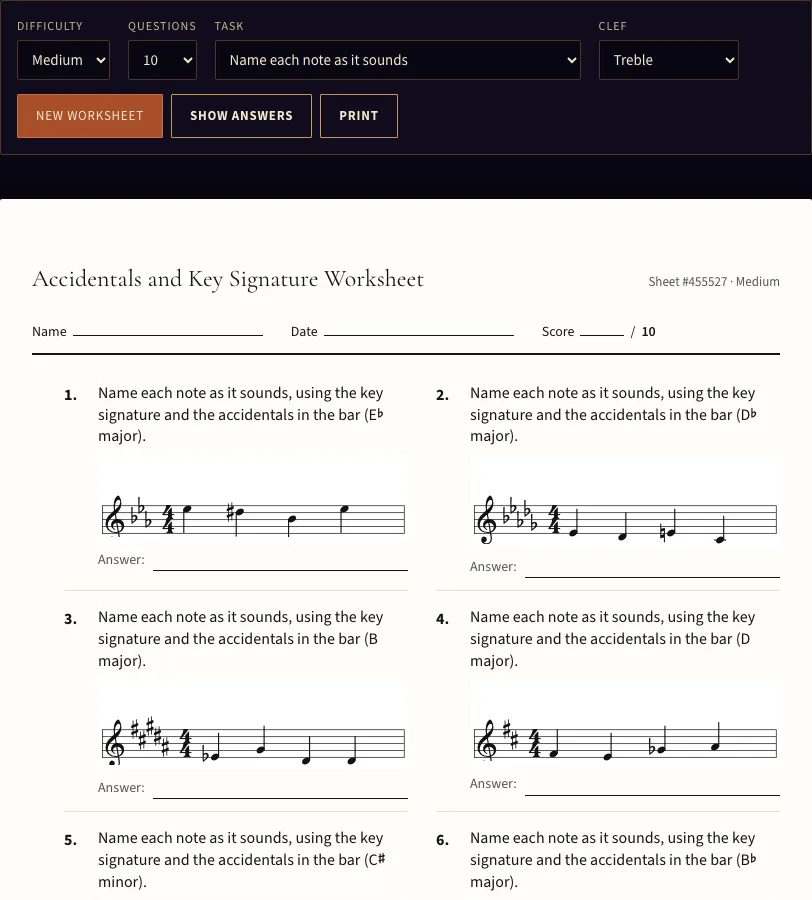
This free accidentals worksheet makes printable practice on sharps, flats and naturals in short melodies. Each question shows a one-bar melody with a key signature at the start, and you either name every note as it actually sounds or find the notes that the key signature changes. Choose easy, medium or hard difficulty, pick treble, bass, alto or tenor clef, and show the answers on screen or print them on A4 or US Letter paper. It runs in your web browser with no sign-up, and nothing you enter is uploaded. Use it for homework, a theory class or a quick review before an exam, and print as many sheets as you need.
How to use it
- Choose a Difficulty: easy, medium or hard. Easy uses one to three sharps or flats and no accidentals drawn in the bar.
- Choose the Task and the Clef: a task such as Name each note as it sounds, Find the notes changed by the key signature, or Mixed (easy level only), and a clef such as treble, bass, alto, tenor, treble and bass, or all four clefs.
- Set Questions to the number of melodies you want on the sheet, so a short warm-up or a full lesson both fit.
- Press New worksheet to generate a fresh set of melodies with the same settings. Each new sheet has its own answers.
- Look at the key signature first and list the sharps or flats it contains.
- Go through the melody note by note, applying the key signature first and then any accidental drawn earlier in the bar, and write the note name beside each note.
- Press Show answers and compare each note name with your own. If a note differs, look again at the key signature and the bar.
- Press Print when you are ready to print the sheet or its answer page.
- If a note is wrong, go back to the bar: an accidental drawn earlier in the same bar still applies to later notes on that line or space until the bar line, then the key signature takes over again.
This worksheet practises reading a short melody under a key signature. Each question gives a one-bar melody with a key signature at the start, and you say how each note actually sounds.
What is an accidental in music?#
An accidental is a sign written beside a note that changes its pitch. A sharp raises the note by one semitone, a flat lowers it by one semitone, and a natural cancels an earlier sharp or flat. A letter name alone does not give the full pitch, so the sign shows exactly where the note sits.
How does a key signature differ from an accidental?#
A key signature is written once at the start of the staff and applies to every note with that letter name, in every octave, for the whole piece. An accidental is written beside a single note and affects only the bar in which it appears. In G major, the key signature has one sharp on F, so every F is played as F-sharp.
How long does an accidental last?#
A drawn accidental lasts until the end of the bar. It applies only to notes on the same line or space, in the same octave. An F-sharp on the top line does not change an F in the bottom space. The barline cancels it, except when a tied note crosses into the next bar.
What are double sharps and double flats?#
A double sharp raises a note by two semitones, which is a whole tone, and a double flat lowers it by two semitones. They are used when a note that is already sharped or flatted has to move again, for example in some chord spellings.
How do the difficulty levels differ?#
- Easy: one to three sharps or flats, four quarter notes, no accidentals drawn in the bar.
- Medium: one to five sharps or flats, four quarter notes, and one accidental drawn in the bar (a natural, sharp or flat that is not already in the key signature).
- Hard: one to seven sharps or flats, six notes in 4/4, two drawn accidentals, with the same pitch repeated later in the bar so you have to carry the accidental forward and, where it fits, the same letter in another octave to test you.
Pick any of the four clefs, or treble plus bass. The notes stay close to the staff, with at most one ledger line.
Frequently asked questions
What does a key signature do to the notes?
How long does an accidental last?
What does a natural sign do?
What if the accidental matches the key signature?
What is the difference between a sharp, a flat and a natural?
What is a double sharp or a double flat?
Is the worksheet free, and does it need an account?
Can I print the answers separately?
Updated