
Altered Scale
| Degrees | |
|---|---|
| Steps | |
| Semitones |
Chords built on each degree
| Degree | Triad | Numeral | Seventh chord | Numeral |
|---|
The first note you type is treated as the likely tonic when two scales fit equally well.
Altered scale (super Locrian) in every key: notes, step pattern, staff and keyboard, with sound. Pick any tonic to see it. Free, no sign-up.
About the Altered Scale
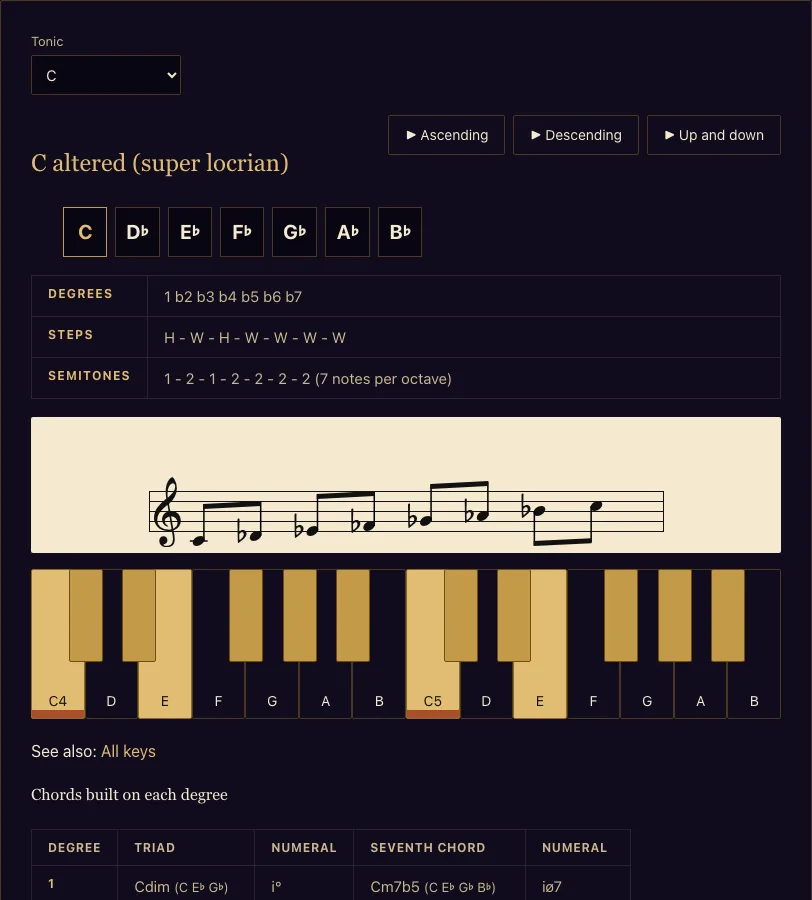
The altered scale tool on this page plays, displays and explains the altered scale, also called the super Locrian scale or the diminished whole tone scale, from any of 17 tonic spellings. It runs in your web browser, is free, and needs no sign-up. The page opens on C altered, and the Tonic menu lets you change the starting note.
The altered scale is a seven-note scale that jazz players use mainly over altered dominant chords. The buttons play it, the note chips show each note as it sounds, and the staff and piano keyboard show where the notes sit. Sound is synthesised live in your browser, so no samples are downloaded, nothing is uploaded and no cookies are set.
How to use the altered scale
- Open the page. The scale is already set to Altered (super Locrian), and the Tonic menu shows C.
- To change the key, open the Tonic menu and choose one of the 17 spellings, such as E♭ or F♯.
- Click ▶ Ascending, ▶ Descending or ▶ Up and down to hear the scale one octave from the tonic in the middle C octave. Browsers keep sound off until you interact with the page, so the first click or key press may start the audio.
- Watch the note chips. Each one lights up as its note sounds, so you can match the sound to the name.
- Read the table under the scale name. The Degrees row shows the scale numbers, the Steps row shows W and H, and the Semitones row shows the size of each step.
- Look at the treble staff below the table. It shows the notes with the correct key signature where one applies.
- Use the two-octave piano keyboard to check the notes. The tonic is highlighted, and clicking any key plays it.
- If a spelling would need triple accidentals, no staff is drawn and a note suggests an enharmonic tonic, such as B♭ instead of A♯.
- Scroll to the Chords built on each degree table to see the triad and seventh chord on every degree, with Roman numerals.
The address bar keeps your chosen tonic and scale type, for example ?tonic=Eb&type=altered. Copy the link to open the same scale again later.
What is the altered scale#
The altered scale is a seven-note scale in which every note above the root is lowered or altered from a plain major or minor sound. Its other names are the super Locrian scale and the diminished whole tone scale, and all three names refer to the same notes. Players use it because its notes give a dissonant, unsettled sound that suits certain dominant chords.
What is the formula of the altered scale#
The formula is 1 ♭2 ♭3 ♭4 ♭5 ♭6 ♭7. The steps from the root are H-W-H-W-W-W-W, which in semitones is 1-2-1-2-2-2-2, adding up to the twelve semitones of an octave. Each interval is counted from the root, so the scale has a half step at the start and then whole steps for most of the rest.
What are the notes of the C altered scale#
The notes of C altered are C D♭ E♭ F♭ G♭ A♭ B♭. The scale uses one letter name for each degree, so the fourth note is written F♭, which sounds the same as E. Because of that spelling, the scale has one note of each letter name, and the tool shows this on the staff.
When do you use the altered scale#
You use the altered scale over altered dominant chords, such as C7alt, C7♭9♯9 or C7♯5♯9. It contains every altered tension that these chords use: ♭9, ♯9 (written as ♭3), ♭5 (♯11) and ♭13 (♯5), together with the root and the ♭7. The third of the chord is the ♭4, which is E in C and written F♭. In other keys, G altered is G A♭ B♭ C♭ D♭ E♭ F, and E♭ altered needs double flats, as in E♭ F♭ G♭ A♭♭ B♭♭ C♭ D♭.
What mode of melodic minor is the altered scale#
The altered scale is the seventh mode of the melodic minor scale. C altered has the same notes as D♭ melodic minor (D♭ E♭ F♭ G♭ A♭ B♭ C), but it starts on the seventh degree, C. It can also be described as a Locrian scale with the fourth degree lowered, which is why it is called super Locrian.
Altered scale in every key#
Notes of each scale from twelve common tonics, written with one letter per degree where the scale has seven notes (the explorer above gives the other spellings and the staff).
| Altered from | Notes |
|---|---|
| C | C D♭ E♭ F♭ G♭ A♭ B♭ |
| D♭ | D♭ E𝄫 F♭ G𝄫 A𝄫 B𝄫 C♭ |
| D | D E♭ F G♭ A♭ B♭ C |
| E♭ | E♭ F♭ G♭ A𝄫 B𝄫 C♭ D♭ |
| E | E F G A♭ B♭ C D |
| F | F G♭ A♭ B𝄫 C♭ D♭ E♭ |
| F♯ | F♯ G A B♭ C D E |
| G | G A♭ B♭ C♭ D♭ E♭ F |
| A♭ | A♭ B𝄫 C♭ D𝄫 E𝄫 F♭ G♭ |
| A | A B♭ C D♭ E♭ F G |
| B♭ | B♭ C♭ D♭ E𝄫 F♭ G♭ A♭ |
| B | B C D E♭ F G A |
Frequently asked questions
Is the altered scale the same as super Locrian?
Why is the fourth note of C altered written as F♭?
Does the tool play the scale without a click?
Does the tool save my settings?
How is the altered scale different from the Locrian scale?
Does the page show chords for the altered scale?
Updated

