
Printable worksheet
Alto Clef Notes Worksheet (Printable, with Answers)
Free printable alto clef notes worksheet for viola players and theory students: name notes on lines, spaces and ledger lines. Answer key included.
Alto Clef Notes Worksheet (Printable, with Answers)
Sheet #
Name Date Score /
Answer key
Alto Clef Notes Worksheet (Printable, with Answers) · Sheet #
About the Alto Clef Notes Worksheet
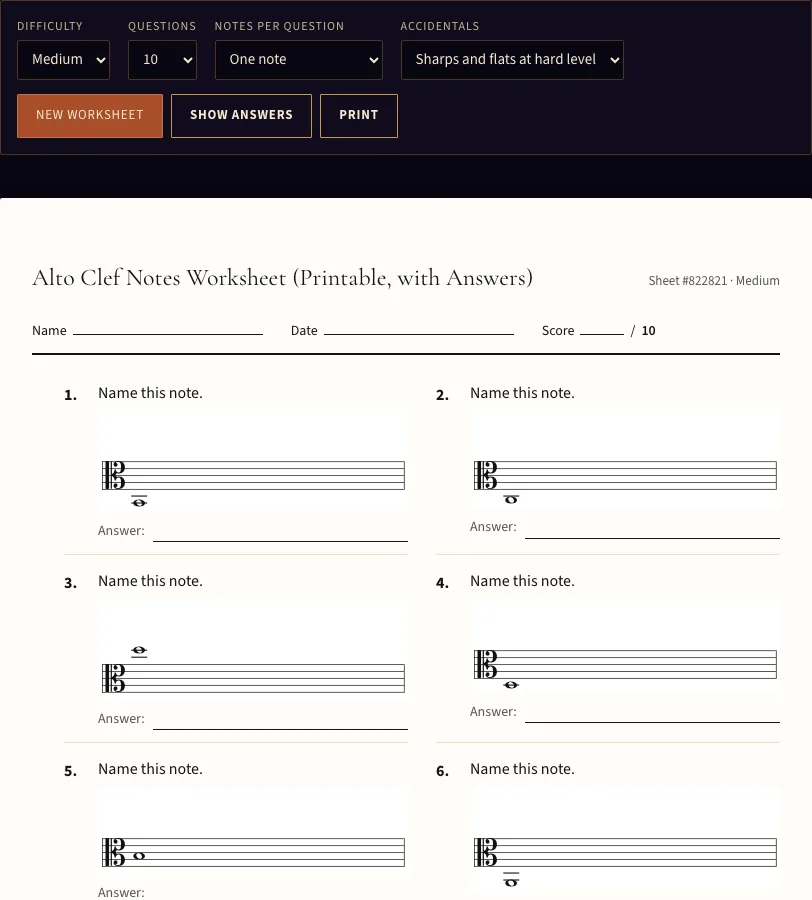
This free alto clef notes worksheet gives you printable practice naming notes on the alto staff, the C clef used mainly by viola players. Each sheet shows a single note or a row of notes, and you write its name, then check your answers against the answer key. Choose easy, medium or hard difficulty, pick one note or a row of 4 to 6 notes per question, and decide whether sharps and flats appear. Show the answers on screen or print the sheet on A4 or US Letter paper. It runs in your web browser with no sign-up, and nothing you enter is uploaded. Use it to learn the middle-C staff before a theory exam or a viola lesson.
How to use it
- Choose a Difficulty: easy stays within the five lines, medium adds up to two ledger lines, and hard adds three ledger lines plus accidentals. Start with easy if you are new to the alto clef.
- Choose Notes per question: One note for a single note per question, or A row of 4 to 6 notes for quick timed practice. Then set Accidentals to Sharps and flats at hard level or Natural notes only.
- Set Questions to the number of notes or rows you want on the sheet, so a short drill or a full lesson both fit.
- Press New worksheet to generate a fresh set with the same settings.
- Remember that the middle line is middle C. Name the middle line first, then name each note by counting up or down from it, one line or space at a time.
- Write your answer for each note on your copy before you check it, so you test yourself rather than read the answer first.
- Press Show answers to compare each name with the answer key.
- Press Print to print the sheet on A4 or US Letter paper. The answers are on a separate page, so students can check their work afterwards.
- Check the answer key against your own names, then recount from the middle line for any miss.
- Note the Sheet # on the paper: the page address keeps your settings and that number, so you can reopen or share exactly the same sheet later.
What is the alto clef?#
The alto clef is a C clef: it is drawn so that its centre sits on the line that is middle C. Because that line is the middle one, the alto clef covers a range centred on middle C, which suits the viola. From the bottom, the five lines read F, A, C, E and G, and the four spaces read G, B, D and F. This worksheet shows a note on an alto staff and asks you to name it.
Where is middle C in the alto clef?#
Middle C sits on the middle, third line of the alto staff. Once you know that one line, you can name every other note by counting up or down, because each line and space is one letter name away from its neighbour. Start there whenever you are unsure of a note.
Which instruments read alto clef?#
Viola music is written mainly in alto clef, so it is the clef most viola players read every day. Alto trombone parts also use it. Alto clef appears in many theory exams that cover movable C clefs, so practice with it can help before a test.
How do the levels differ?#
- Easy stays within the five lines and the spaces directly above and below, from E3 to A4.
- Medium adds notes on up to two ledger lines.
- Hard allows up to three ledger lines and adds sharps and flats.
How do I read notes in the alto clef?#
Start from the middle line, C. The line above is E, the line below is A, and the notes move up in the same way as in other clefs. Practise by naming the middle line first, then counting outward from it. The bottom line is F and the top line is G. For a note on a ledger line, keep the same letter sequence beyond the staff rather than guessing from the shape of the note.
Can I use alto clef with tenor clef too?#
Yes. Tenor clef is also a C clef, and the same method works with C on the fourth line instead of the middle line. Check which C clef sign is at the start of the staff before you name any note, because the two clefs place middle C differently.
Frequently asked questions
Where is middle C in the alto clef?
What are the lines and spaces in the alto clef?
Who uses the alto clef?
What about the tenor clef?
Is the alto clef the same as the tenor clef?
How do I name a note on a ledger line?
Does the worksheet include sharps and flats?
Is the worksheet free, and does it need an account?
Updated