
Arabic Scale
| Degrees | |
|---|---|
| Steps | |
| Semitones |
Chords built on each degree
| Degree | Triad | Numeral | Seventh chord | Numeral |
|---|
The first note you type is treated as the likely tonic when two scales fit equally well.
Arabic scale notes in any key: the double harmonic major scale and Phrygian dominant, with the step pattern, staff, keyboard and sound. Free.
About the Arabic Scale
The arabic scale is a seven-note scale that this free tool plays and displays in your browser. The name is used for more than one scale, so the scale explorer offers the two most common: double harmonic major, also called the Byzantine scale, and Phrygian dominant. Pick a tonic from 17 spellings and a scale type, and the page shows the degrees, steps and semitones, a treble staff and a piano keyboard. Three playback buttons sound the scale one octave from middle C.
The tool runs in the web browser. It is free and needs no sign-up. Nothing is uploaded, and the tool sets no cookies. Sound is synthesised live, so no audio files are downloaded. Both scales are equal-tempered Western scales, which makes them an approximation of Arabic music rather than an exact copy.
How to use the arabic scale
- Open the page. It opens in C with Double harmonic major selected.
- Open the Tonic menu and choose one of the 17 spellings, such as E♭ or F♯.
- Open the Scale type menu and choose Double harmonic major or Phrygian dominant.
- Click ▶ Ascending, ▶ Descending or ▶ Up and down to hear the scale one octave from middle C. Browsers keep sound off until you first click, touch or press a key on the page, so the first press may start the audio.
- Watch the note chips under the scale name. Each one lights up as its note sounds.
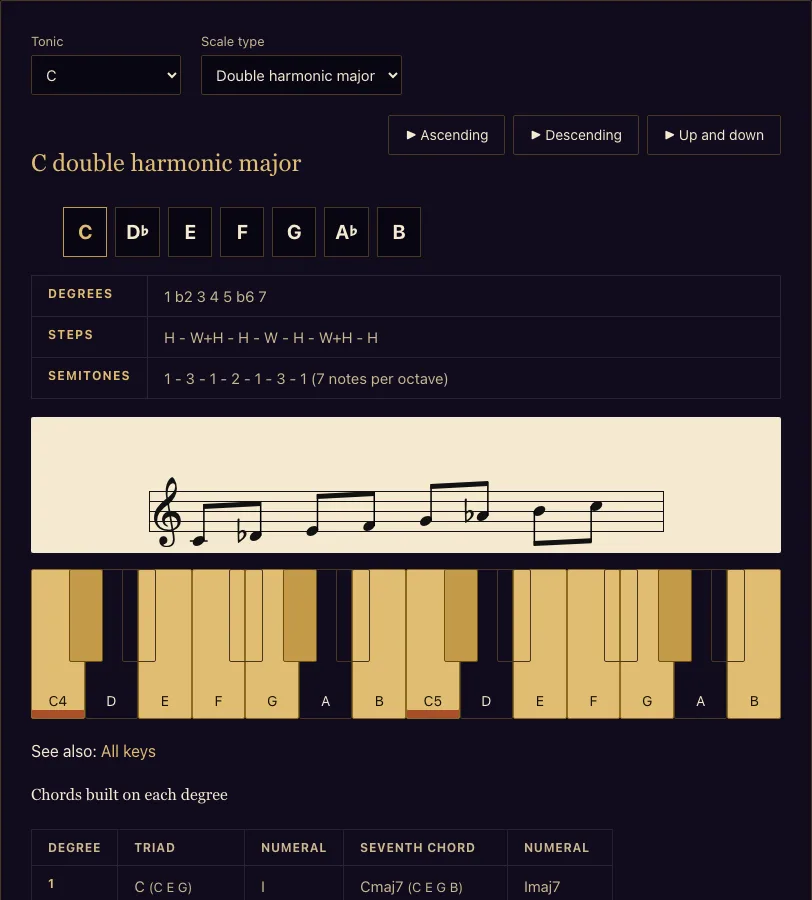
- Read the small table. Degrees shows the scale numbers, Steps shows W, H or W+H, and Semitones shows the size of each step and the number of notes per octave.
- Check the treble staff and the two-octave piano keyboard, where the tonic is highlighted. Click any key to hear it.
- Scroll to the Chords built on each degree table. It appears because both scales have seven notes.
The address bar keeps the chosen tonic and scale type, so copying the link lets you or someone else reopen the same scale. If a spelling would need triple accidentals, no staff is drawn, and a note suggests the enharmonic tonic, such as B♭ instead of A♯.
What is the arabic scale#
The arabic scale has no single fixed set of notes. The name is used for more than one seven-note scale. The most common meaning is the double harmonic major scale, also called the Byzantine scale. It is the default type in the scale explorer.
Its pattern of steps is half, augmented second, half, whole, half, augmented second, half. In semitones that is 1-3-1-2-1-3-1, which adds up to 12, the full octave. The tool uses equal temperament with A4 = 440 Hz, so each semitone is the same fixed size on the keyboard.
What is the difference between the double harmonic scale and Phrygian dominant#
The two scales are easy to confuse. Both are called the Arabic scale in some sources (Phrygian dominant is also known as the Hijaz scale), and when started on C they share the notes D♭, E, F, G and A♭. The difference is the seventh note. Double harmonic major ends on B, a half step below the octave, while Phrygian dominant ends on B♭, a whole step below it.
That change alters the pattern. Double harmonic major has two augmented seconds, between D♭ and E and between A♭ and B. Phrygian dominant has only one, between D♭ and E. Phrygian dominant is also the fifth mode of harmonic minor. The notes of F harmonic minor, started on C, give the same scale.
Arabic scale in every key#
Notes of each scale from twelve common tonics, written with one letter per degree where the scale has seven notes (the explorer above gives the other spellings and the staff).
| Double harmonic major (Arabic) from | Notes |
|---|---|
| C | C D♭ E F G A♭ B |
| D♭ | D♭ E𝄫 F G♭ A♭ B𝄫 C |
| D | D E♭ F♯ G A B♭ C♯ |
| E♭ | E♭ F♭ G A♭ B♭ C♭ D |
| E | E F G♯ A B C D♯ |
| F | F G♭ A B♭ C D♭ E |
| F♯ | F♯ G A♯ B C♯ D E♯ |
| G | G A♭ B C D E♭ F♯ |
| A♭ | A♭ B𝄫 C D♭ E♭ F♭ G |
| A | A B♭ C♯ D E F G♯ |
| B♭ | B♭ C♭ D E♭ F G♭ A |
| B | B C D♯ E F♯ G A♯ |
| Phrygian dominant from | Notes |
|---|---|
| C | C D♭ E F G A♭ B♭ |
| D♭ | D♭ E𝄫 F G♭ A♭ B𝄫 C♭ |
| D | D E♭ F♯ G A B♭ C |
| E♭ | E♭ F♭ G A♭ B♭ C♭ D♭ |
| E | E F G♯ A B C D |
| F | F G♭ A B♭ C D♭ E♭ |
| F♯ | F♯ G A♯ B C♯ D E |
| G | G A♭ B C D E♭ F |
| A♭ | A♭ B𝄫 C D♭ E♭ F♭ G♭ |
| A | A B♭ C♯ D E F G |
| B♭ | B♭ C♭ D E♭ F G♭ A♭ |
| B | B C D♯ E F♯ G A |
Frequently asked questions
What are the notes of the arabic scale in C?
What is the formula of the double harmonic scale?
Why does the arabic scale sound arabic?
Is the arabic scale the same as the maqam?
What keys do these scales work in?
Why is there no staff for some tonics?
Updated

