
Banjo Chords
Banjo chords for 5-string open G tuning: pick a root and chord type, see up to four fingerings on diagrams and hear each one strummed. Free.
About the Banjo Chords
This is a free banjo chord finder for the 5-string banjo in standard open G tuning. Pick a root note and a chord type, and the page shows the notes in that chord along with up to four fingerings you can play and strum. It runs in your web browser with no sign-up, so it works as a banjo chord chart you can open whenever you need one. Each fingering is built for open G, so the diagrams match the tuning the page uses. The page covers 14 root spellings and 12 chord types, including major, minor, seventh, suspended and diminished chords. It is also a useful starting point for banjo chords for beginners, because the first card for every chord is labelled ‘Easiest’.
How to use the banjo chords
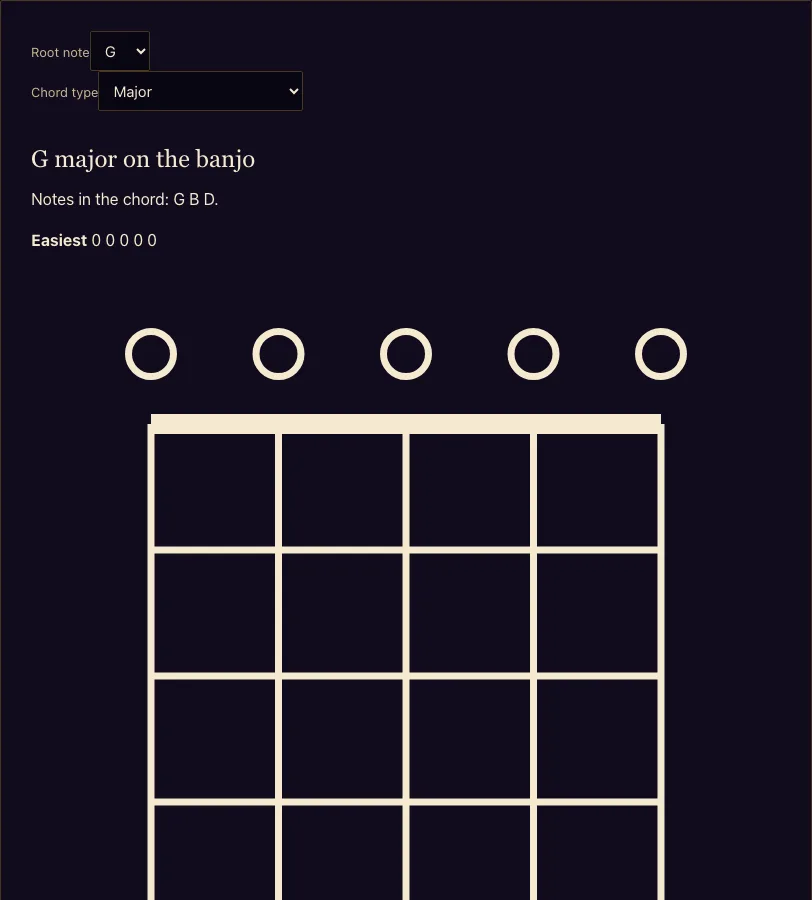
- Open the page. It starts on G major, with the chord name, its notes and its fingering cards.
- Open the ‘Root note’ menu and choose one of the 14 spellings, such as C♯ or B♭.
- Open the ‘Chord type’ menu and choose one of the 12 types, such as Minor, Dominant 7th (7) or Diminished (dim).
- Read the notes listed under the chord name. Every fingering contains these notes.
- Look at the first card, labelled ‘Easiest’. Read its diagram, and check the fret numbers, which are written as text in the order 4th, 3rd, 2nd, 1st, 5th.
- Press ‘▶ Strum’ on a card to hear that fingering. Browsers keep sound off until you click, touch or press a key on the page, so the first press may start the audio.
- Try ‘Option 2’ to ‘Option 4’ to see other places on the neck where the same chord can be played.
- Read the line Notes in the chord under the name, then look at the note names printed under each card. They show which note every string plays.
- Look at the fret numbers above each diagram. A 0 means an open string and an x means the string is not played.
The address bar keeps your chosen root and chord type, such as ?root=D&type=7. Save or share that link to open the same chord again.
What are the basic banjo chords?#
The three basic open G shapes are G, C and D major. G major is played with all five strings open, written ‘0 0 0 0 0’, and sounds D G B D G. C major is ‘2 0 1 2 0’ and sounds E G C E G. D major is ‘0 2 3 4 x’, which sounds D A D F♯ and leaves the fifth string out. Each card shows the note every string plays, so you can check the sound against the chord name.
How do you read a banjo chord diagram?#
Vertical lines are the strings, and horizontal lines are the frets. A filled dot shows where a finger goes. An open circle above a string means play it open, and an x means do not play that string. A label such as ‘5fr’ means the diagram starts at the fifth fret, not the nut. The fret numbers under the diagram follow the same order as the strings: 4th, 3rd, 2nd, 1st, then the short 5th. For C major, ‘2 0 1 2 0’ means fret 2 on the 4th string, open 3rd string, fret 1 on the 2nd, fret 2 on the 1st, and open 5th.
What is open G tuning on a banjo?#
Open G tuning sets the four long strings to D G B D and the short fifth string to a high g. In notes, the 4th string is D3, the 3rd is G3, the 2nd is B3, the 1st is D4, and the fifth is g4. Played open, the five strings sound a G major chord, which is why open G is easy to strum. The tool uses this tuning for every fingering, so the open-string G major shape is always the starting point.
Why is the fifth string on the right of the diagram?#
The tool draws the four long strings from left to right as 4th, 3rd, 2nd and 1st, then places the short 5th string on the right. The fifth string is shorter and starts at the fifth fret. Because it cannot be fretted at the low positions, the tool only plays it open or leaves it out with an x. Every fingering must still sound at least four of the five strings.
Can I use these chords in other tunings?#
No. These fingerings are for open G tuning only. Other tunings, such as double C, open D or G modal, put different notes on the strings, so the same fret numbers would sound different chords. The page also does not show banjo tab, rolls or capo conversions. If you tune differently, you will need fingerings made for that tuning.
Frequently asked questions
Is the chord finder free?
Why is there no sound when I press Strum?
Can I use this for ukulele or guitar?
Why are sixth, add 9, 7sus4 and ninth chords missing?
How many fingerings does each chord show?
Why does a fingering skip a string?
What pitch does the tool use?
Updated

