
Printable chart
Bass clef notes
Bass clef notes on the staff: tap any line, space or ledger line to see and hear its name, practise with a timed quiz, and print a quiz sheet or the chart.
Prints on one page. Choose “Background graphics” off to save ink.
Download the PDF
Free to print and share. No sign-up, no e-mail, no watermark. A4 for most of the world, Letter for the US and Canada; both are black and white, with the fonts embedded.
The five lines
GBDFA
Bottom to top. Common mnemonic: Good Boys Do Fine Always
The four spaces
ACEG
Bottom to top. Common mnemonic: All Cows Eat Grass
Every note, with its place on the staff
Octave numbers use scientific pitch notation, where middle C is C4.
| Note | Where it sits |
|---|---|
| E2 | First ledger line below the staff |
| F2 | Space below the bottom line |
| G2 | Bottom line (line 1) |
| A2 | Space 1 |
| B2 | Line 2 |
| C3 | Space 2 |
| D3 | Line 3 (middle line) |
| E3 | Space 3 |
| F3 | Line 4 — the line the two dots of the clef sit either side of |
| G3 | Space 4 |
| A3 | Top line (line 5) |
| B3 | Space above the top line |
| C4 | First ledger line above the staff — middle C |
musictheoryprint.com · free to print and share
The bass clef in real art songs
1449 of 1462 songs (99.1%) use the bass clef (F clef) somewhere in the score: 68 in the voice part and 1432 in the piano part. In 68 songs (4.7%) the singer reads it. The most common lowest note written on it is F1 (123 songs) and the most common highest note is F4 (209 songs); the median song spans G1 to F4.
How often the bass clef appears
| Where | Songs | Share of 1462 songs |
|---|---|---|
| Bass clef used anywhere in the song | 1449 | 99.1% |
| in the voice part | 68 | 4.7% |
| in the piano / keyboard part | 1432 | 97.9% |
| in another instrument part | 2 | 0.1% |
A song is counted once per row; a song with the clef in both the voice and the piano part is counted in both of those rows.
Which bass clef positions appear
| Clef | Songs | Share of 1462 songs |
|---|---|---|
| F4 | 1449 | 99.1% |
| F3 | 1 | 0.1% |
Letter plus staff line: G2 is the standard treble clef, F4 the standard bass clef, C3 the alto clef and C4 the tenor clef; (8vb) means written an octave lower, (8va) an octave higher. A song with several variants is counted under each.
12 songs where the singer reads the bass clef
One song each from the composers with the most such songs, in title order. Dates are the composer's years.
Songs with a bass-clef voice part
68 songs in the corpus
- A Favorite Glee Thomas Arne (1710–1778) voice part on the bass clef: A♯2 to A♯3
- A Little Old Man Walford Davies (1869–1941) from 8 New Nursery Rhymes, Op.23 voice part on the bass clef: A♯2 to C4
- Abendlich schon rauscht der Wald Fanny Hensel (Mendelssohn) (1805–1847) from Gartenlieder, Op.3 voice part on the bass clef: G2 to D4
- As thro’ the land Charles Villiers Stanford (1852–1924) from A Cycle of Songs, Op.68 voice part on the bass clef: G♯2 to C♯4
- Bootgesang, D.835 Franz Schubert (1797–1828) from Op.52 voice part on the bass clef: F2 to A♯3
- Denn es gehet dem Menschen wie dem Vieh Johannes Brahms (1833–1897) from 4 Serious Songs, Op.121 (Vier ernste Gesänge) voice part on the bass clef: A2 to F4
- Far Away Maria Lindsay (1827–1898) voice part on the bass clef: F2 to G3
- For all the wonder of thy regal day Frederick Bridge (1844–1924) from “Choral Songs in honour of Her Majesty Queen Victoria”, 1899 voice part on the bass clef: G2 to D4
- Lady on the Silver Throne Arthur Murray Goodhart (1866–1941) from “Choral Songs in honour of Her Majesty Queen Victoria”, 1899 voice part on the bass clef: D♯2 to D♯4
- Le cor Ange Flégier (1846–1927) voice part on the bass clef: D2 to D4
- There Rolls the Deep Hubert Parry (1848–1918) voice part on the bass clef: G2 to C♯4
- To her beneath whose stedfast star Edward Elgar (1857–1934) from “Choral Songs in honour of Her Majesty Queen Victoria”, 1899 voice part on the bass clef: G2 to D♯4
Method
- Corpus: All 1462 MusicXML files in the corpus were parsed. The clef in force for every notehead is tracked through the score (including mid-measure clef changes) for the voice, piano and any other parts.
- A song counts as using a clef if a <clef> with that sign (F) appears in any part. The voice / piano / other split uses each part's instrument sound (voice.*, keyboard.*) or, where the sound is a placeholder, whether the part carries sung lyrics.
- Lowest and highest notes are the written pitches of noteheads sitting under that clef, over all parts and the whole song (cue-size notes ignored; transposing parts are not re-pitched). Ranges cover the 1449 songs that actually place noteheads under the clef; notes above or below the staff on ledger lines count.
- Note names use scientific pitch notation (middle C = C4). Black keys are listed as sharps, because the ranking works on pitch numbers; a written D♭ is therefore shown as C♯.
- Representative songs: from the songs whose voice part uses this clef, composers are ordered by how many such songs they have (ties by name), and each composer's alphabetically first song is taken until 12; shown in title order.
Data: computed from the OpenScore Lieder Corpus (CC0), 1,462 scores. Snapshot: commit 6b2dc542ce (2026-04-07).
Background
Excerpts from open reference works, reproduced as published (references, images and tables removed). Every excerpt names its source, licence and original article.
In brief
A clef is a sign at the beginning of a staff of music which makes it possible for the player to work out what the notes are. The word “clef” is a French word meaning “key”. The original Latin word is “clavis”. It is the “key” to understanding which notes should be played.
The staff (or “stave”) consists of five lines across the page. The notes are placed on these lines and in these spaces. The staff is only large enough to cover one and a half octaves of music (a bit more with ledger lines). Therefore, different clefs are used for high music and for low music.
Source: Simple English Wikipedia, “Clef” — CC BY-SA 4.0 — text excerpted; see the article for the full text and authors. Revision of 2025-10-30.
Simple English Wikipedia: the bass clef
Bass clef
The bass clef is normally used for the left hand in piano music. Low instruments like the cello, double bass, and bassoon mostly read from the bass clef. It is an F clef because the two dots are on either side of the fourth line up which is an F below Middle C.
Source: Simple English Wikipedia, “Clef” — CC BY-SA 4.0 — text excerpted; see the article for the full text and authors. Revision of 2025-10-30.
Clef: the F-clef family
Bass clef
The only F-clef still in use is the bass clef, with the clef placed on the fourth line. Since it is the only F-clef commonly encountered, the terms "F-clef" and "bass clef" are often regarded as synonymous.
Bass clef is used for the cello, double bass and bass guitar, bassoon and contrabassoon, bass recorder, trombone, tuba, and timpani. It is used for baritone horn or euphonium when their parts are written at concert pitch, and sometimes for the lowest notes of the horn. Baritone and bass voices also use bass clef, and the tenor voice is notated in bass clef if the tenor and bass are written on the same staff. Bass clef is the bottom clef in the grand staff for harp and keyboard instruments. Double bass, bass guitar, and contrabassoon sound an octave lower than the written pitch; some scores show an "8" beneath the clef for these instruments to differentiate from instruments that sound at the actual written pitch.
The lowest note is C2, is one ledger line below staff and has the frequency of 65.41Hz.
Baritone clef
When the F-clef is placed on the third line, it is called the baritone clef. Baritone clef was used for the left hand of keyboard music (particularly in France; see Bauyn manuscript) and for baritone parts in vocal music. A C-clef on the fifth line creates a staff with identical notes to the baritone clef, but this variant is rare.
Sub-bass clef
When the F-clef is placed on the fifth line, it is called the sub-bass clef. It was used by Johannes Ockeghem and Heinrich Schütz to write low bass parts, by Monsieur de Sainte-Colombe for low notes on the bass viol, and by J. S. Bach in his Musical Offering.
It is the same as the treble clef, but two octaves lower, making the top line F3 (174.614Hz) and the bottom line E2 (82.41Hz).
Placement on the staff
Theoretically, any clef may be placed on any line. With five lines on the staff and three clefs, there are fifteen possibilities for clef placement. Six of these are redundant because they result in an identical assignment of the notes—for example, a G-clef on the third line yields the same note placement as a C-clef on the bottom line. Thus there are nine possible distinct clefs when limiting their placement to the lines. All have been used historically: the G-clef on the two bottom lines, the F-clef on the three top lines, and the C-clef on the four bottom lines. The C-clef on the topmost line has also been used, but is equivalent to the F-clef on the third line, giving a total of ten historically attested clefs placed on the lines. In addition, the C-clef has been used on the third space, i.e. not on a line at all. This is equivalent to the more common suboctave treble clef.
In modern music, only four clefs are used regularly: treble clef, bass clef, alto clef, and tenor clef. Of these, the treble and bass clefs are by far the most common. The tenor clef is used for the upper register of several instruments that usually use bass clef (including cello, bassoon, and trombone), while the alto is most prominently used by the viola. Music for instruments and voices that transpose at the octave is generally written at the transposed pitch, but is sometimes seen written at concert pitch using an octave clef.
Source: Wikipedia, “Clef” — CC BY-SA 4.0 — text excerpted; see the article for the full text and authors. Revision of 2026-07-02.
Ledger line
A ledger line or leger line is used in Western musical notation to notate pitches above or below the lines and spaces of the regular musical staff. A line slightly longer than the note head is drawn parallel to the staff, above or below, spaced at the same distance as the lines within the staff.
The origin of the word is uncertain, but may have been borrowed attributively from the term for a horizontal timber in a scaffolding, lying parallel to the face of the building and supporting the putlogs. There is no basis to support the often-found claim that the word originates from the French léger, meaning "light" or "slight". The Oxford online dictionary describes the origin of the "leger" spelling as a "variant of ledger" that first appeared in the 19th century.
Although ledger lines are found occasionally in manuscripts of plainchant and early polyphony, it was only in the early 16th century in keyboard music that their use became at all extensive. Even then, printers had an aversion to ledger lines which caused difficulties in setting type, wasting space on the page and causing a messy appearance. Vocal music employed a variety of different clefs to keep the range of the part on the staff as much as possible; in keyboard notation a common way of avoiding ledger lines was the use of open score on four staves with different clefs.
Except for woodwind players, who prefer ledger lines to 8va notation because they associate fingerings with staff positions, notes that use at least four ledger lines make music more difficult to read. For easier readability, the composer would usually switch clefs or use the 8va notation. Some transposing instruments, such as the piccolo, double bass, guitar, and the tenor voice, transpose at the octave to avoid ledger lines.
Notation of tuba, trombone, and euphonium parts always uses ledger lines below the bass staff, and never the 8va bassa notation.
Music for bass clef instruments, such as the cello, bassoon or trombone, use tenor clef for the high notes rather than the treble clef. Alto clef is used for the viola, the alto trombone, and for the tenor trombone parts in Russian repertoire. Bass trombone and tuba use the bass clef only.
A ledger line is also used to support a half rest or whole rest where there are multiple voices on one staff and such a rest is forced above or below the staff. (The rare double whole rest is suspended between two ledger lines in this situation.)
Source: Wikipedia, “Ledger line” — CC BY-SA 4.0 — text excerpted; see the article for the full text and authors. Revision of 2026-05-26.
Scientific pitch notation
Overview
Scientific pitch notation (SPN), also known as American standard pitch notation (ASPN) and international pitch notation (IPN), is a method of specifying musical pitch by combining a musical note name (with accidental if needed) and a number identifying the pitch's octave.
Although scientific pitch notation was originally designed as a companion to scientific pitch, the two are not synonymous. Scientific pitch is a pitch standard—a system that defines the specific frequencies of particular pitches. Scientific pitch notation concerns only how pitch names are notated, that is, how they are designated in printed and written text, and does not inherently specify actual frequencies. Thus, the use of scientific pitch notation to distinguish octaves does not depend on the pitch standard used.
Nomenclature
The notation makes use of the traditional tone names (A to G) which are followed by numbers showing which octave they are part of.
For standard A440 pitch equal temperament, the system begins at a frequency of 16.35160 Hz, which is assigned the value C0.
The octave 0 of the scientific pitch notation is traditionally called the sub-contra octave, and the tone marked C0 in SPN is written as ,C or C, or CCC in traditional systems, such as Helmholtz notation. Octave 0 of SPN marks the low end of what humans can actually perceive, with the average person being able to hear frequencies no lower than 20 Hz as pitches.
The octave number increases by 1 upon an ascension from B to C. Thus, A0 refers to the first A above C0 and middle C (the one-line octave's C or simply c′) is denoted as C4 in SPN. For example, C4 is one note above B3, and A5 is one note above G5.
The octave number is tied to the alphabetic character used to describe the pitch, with the division between note letters 'B' and 'C', thus:
- "B3" and all of its possible variants (B𝄫, B♭, B, B♯, B𝄪) would properly be designated as being in octave "3".
- "C4" and all of its possible variants (C𝄫, C♭, C, C♯, C𝄪) would properly be designated as being in octave "4".
- In equal temperament "C♭4" is the same frequency as "B3".
Source: Wikipedia, “Scientific pitch notation” — CC BY-SA 4.0 — text excerpted; see the article for the full text and authors. Revision of 2026-05-22.
Sources and licences for the text, scores and recordings on this page are on the credits page.
Sources: Wikipedia: Clef, Wikipedia: Ledger line, Wikipedia: Scientific pitch notation.
About the bass clef note finder
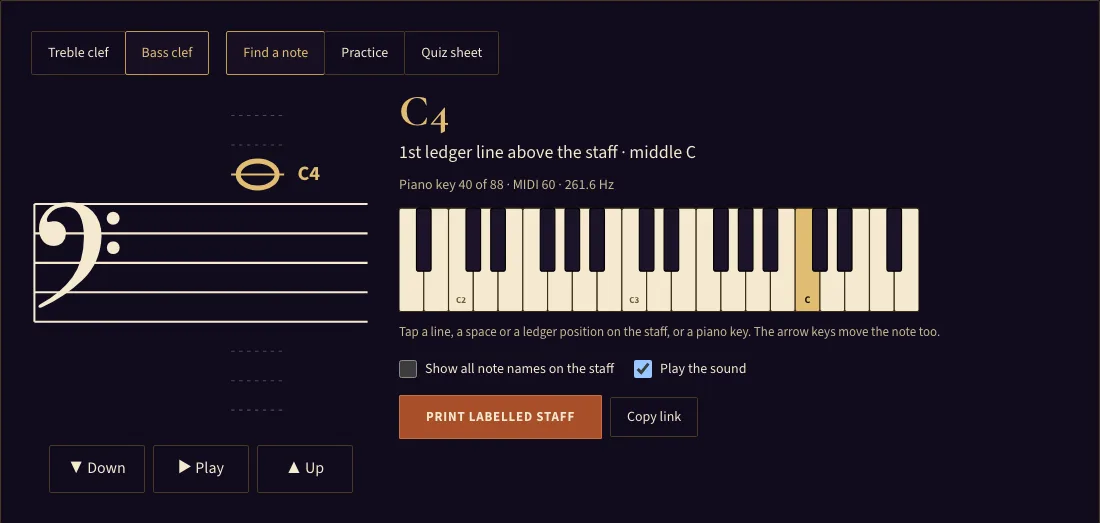
Bass clef notes run from G2 on the bottom line to A3 on the top line, with the spaces and ledger lines filling in the rest; this free tool helps you learn to name every one of them on the staff. It runs in your web browser with no sign-up. Practise by finding notes on the staff, by naming them with letter buttons, or with a quiz sheet you can print. Tap a line or space to hear the note and see its name, octave and piano key, from A1 three ledger lines below the staff to G4 three ledger lines above. A Treble clef button switches to the other staff when you want to compare. Nothing you enter is uploaded.
How to use the bass clef notes tool
- Choose the clef. Press Bass clef in the toggle buttons. If the selected note exists on the other staff, it stays selected. Otherwise, middle C is selected.
- Pick a mode: Find a note, Practice or Quiz sheet.
- In Find a note, click or tap any line, space or ledger position on the staff. The result card shows the note name with its octave, where it sits, and its piano key number. Press Down or Up to move one step, and Play to hear the note.
- Tick “Show all note names on the staff” to see all 21 positions in order, with each letter and octave, below the tool.
- In Practice, set Which notes? and How many?, then press Start. Tap a letter from A to G for each note, or press the same letter key. After a wrong answer, press Next note or Enter. Stop returns you to the setup. At the end, check your score, time and missed notes, then press Practise again or Change settings.
- In Quiz sheet, set the range and count, and keep “Answer key on a second page” ticked to print the key. Press New sheet for a different set, then Print sheet.
Press Print labelled staff to print the staff with a caption, in black ink on white paper. Press Copy link to copy the current address, which keeps your settings.
What are the notes of the bass clef?#
The bass clef staff has five lines and four spaces. Notes go up in letter order, from G2 on the bottom line to A3 on the top line. The nine notes on the staff are G2, A2, B2, C3, D3, E3, F3, G3 and A3. The two dots of the clef sit either side of the F3 line, which gives you a fixed point to count from.
What are the bass clef lines and spaces?#
Counting from the bottom, the lines are G2, B2, D3, F3 and A3. Learn them as “Good Boys Do Fine Always”. The spaces are A2, C3, E3 and G3, learned as “All Cows Eat Grass”. Say each phrase while you look at the staff, then check yourself by counting up from the bottom line. The mnemonics are the quickest way to recall the lines, but counting by letter is the way to confirm a note you are unsure of.
Where is middle C on the bass clef?#
Middle C (C4) sits on the first ledger line above the bass staff, just above the top line. In the treble clef, middle C is on the first ledger line below the staff. Knowing where it sits in both clefs gives you a shared anchor when you read the two staves together.
What are the bass clef ledger line notes?#
Ledger lines extend the staff. Below the staff, the first ledger line is E2, the second is C2 and the third is A1. Above the staff, the first ledger line is C4, the second is E4 and the third is G4. The ledger spaces are F2 below the staff, D2 and B1 below the ledger lines, and B3 above the staff, D4 and F4 above the ledger lines. Each ledger position continues the letter order from the staff, so counting down from G2 gives F2, E2, D2, C2, B1 and A1.
Why is the bass clef called the F clef?#
The bass clef symbol is a stylised letter F. Its two dots surround the fourth line from the bottom, which is F3. Because the clef fixes the position of F on the staff, it is called the F clef. The treble clef is a G clef, and its curl wraps around the G line, which is G4.
How do you read bass clef if you know treble clef?#
The letter order is the same in both clefs. Only the starting point changes: the bottom line of the bass staff is G2, while the bottom line of the treble staff is E4. Lines and spaces in both clefs are read the same way, so the shape of a note on the staff does not change. Only its name changes. Find middle C first, then count by letter from there, using the clef symbol to confirm which line is F.
Frequently asked questions
Is the bass clef notes tool free, and does it need an account?
Can I print the bass clef chart or worksheet?
Can I use the printouts commercially?
Which instruments use the bass clef?
Can I see bass clef notes on a piano keyboard?
Does the tool include ledger line notes?
Updated