
Printable worksheet
Cadences in music worksheet
Cadences in music practice: name perfect (authentic), plagal, imperfect (half) and deceptive cadences from two chords. Free printable sheets, answer key.
Cadences in music worksheet
Sheet #
Name Date Score /
Answer key
Cadences in music worksheet · Sheet #
About the Cadences in Music Worksheet
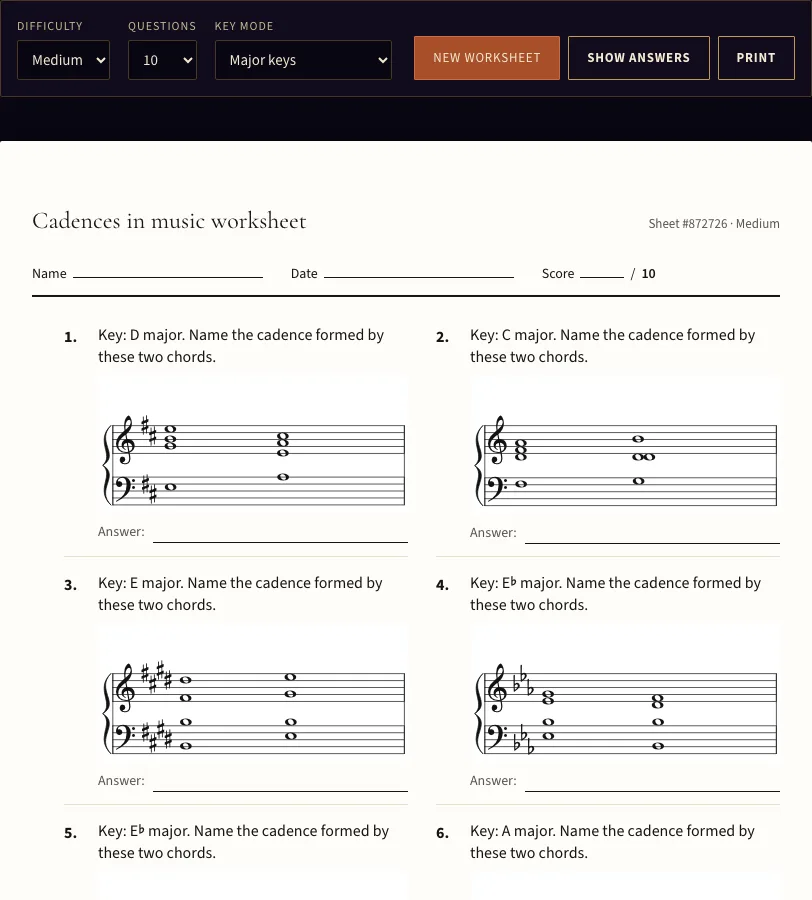
This free Cadence Identification Worksheet helps you learn cadences in music by naming the cadence formed by two chords. Each question shows a grand staff with a key signature and two four-part chords, and you write the cadence name on the answer line. The tool runs in your web browser with no sign-up, and nothing you enter is uploaded.
The sheets cover the four cadence types: perfect (authentic), plagal, imperfect (half) and interrupted (deceptive). You can choose an Easy, Medium or Hard level, set the number of questions, and pick major keys, minor keys or both. Each sheet comes with an answer key, so you can check your work on paper or on screen. It suits cadence identification practice in theory lessons, homework and warm-ups.
How to use the Cadence Identification Worksheet
- Choose a Difficulty: Easy, Medium (the default) or Hard. Easy uses only root-position perfect, plagal and imperfect cadences in keys with up to 3 sharps or flats. Medium adds interrupted cadences and the ii6–V half cadence (up to 4 accidentals), and Hard adds cadences built on V7 and keys with up to 6 sharps or flats (5 in minor).
- Set the number of Questions to 10 (the default) or 20.
- Pick a Key mode: “Major and minor keys”, “Major keys” (the default on this page) or “Minor keys”.
- Click New worksheet. The header shows the sheet number and difficulty, for example “Sheet #123456 · Medium”.
- Read each question, such as “Key: F major. Name the cadence formed by these two chords.” Work out the two chords from the notes on the grand staff, using the key signature. The question shows no Roman numerals or chord symbols, so this step is yours.
- Write the cadence name on the Answer: line. The answer key gives the British name first and the American name in brackets, for example “Perfect cadence (US: authentic cadence)”.
- On a printed sheet, fill in the Name, Date and Score lines.
- Click Show answers to check your work, and Hide answers to hide them again.
Click Print to print the sheet. Questions appear in two columns with their staves, and the answer key starts on a new page. The address bar shows values such as seed, difficulty, count and mode. Copy that address to recreate the same sheet later.
What are the four cadences in music?#
The four cadences in music are the perfect, plagal, imperfect and interrupted cadences. In American usage they are called authentic, plagal, half and deceptive. Each one is a two-chord ending that closes a phrase, and the chord pair decides which type you hear.
A perfect cadence moves from V (or V7) to I. The tool is strict about this: both chords sit in root position, and the tonic note is the top voice of the final chord. A plagal cadence moves from IV to I, often called the “Amen” cadence. An imperfect cadence ends on V, so it sounds unfinished. The tool counts I–V, IV–V and ii–V as imperfect cadences. An interrupted cadence moves from V to vi in major keys, or from V to VI in minor keys.
What is a deceptive (interrupted) cadence?#
A deceptive (interrupted) cadence is a two-chord ending where V moves to vi instead of to the home chord I. In a minor key, V moves to VI instead of to i. It is a “surprise” ending, because the ear expects the tonic and gets a different chord.
In F major, the pair is C major (V) followed by D minor (vi). The tool defines the interrupted cadence as V (or V7) followed by vi, or VI in minor keys. Medium adds the V–vi pattern, and Hard also adds the V7–vi pattern. Because the ear hears the final chord as a pause rather than a full close, the cadence sounds like a phrase that has not finished yet.
How do you identify a cadence from two chords?#
Work out the Roman numeral of each chord in the key shown, then look at the pair. If the second chord is V, the cadence is imperfect (half). If the second chord is I, it is perfect after V and plagal after IV. If the first chord is V and the second is vi (VI in minor), it is interrupted (deceptive).
Two examples from the generator: in F major, the chords G–B♭–D and then C–E–G are ii and V, so the answer is “Imperfect cadence (US: half cadence)”. In F♯ minor, C♯–E♯–G♯ (V, with E♯ as the raised leading tone) followed by D–F♯–A (VI) is “Interrupted cadence (US: deceptive cadence)”. Imperfect cadences come up most often, because more chord pairs end on V than on any other chord.
The sheets you generate are free for commercial use too, so they can go into a classroom pack, a Teachers Pay Teachers resource or an Amazon KDP workbook.
Frequently asked questions
What is the difference between a perfect (authentic) and an imperfect (half) cadence?
How do cadences work in minor keys?
Is it free and does it need an account?
Can I print it with the answers?
Are cadence worksheets from this page free for commercial use?
Updated