
Printable chart
Circle of fifths
C major
- Key signature
- No sharps or flats
- Relative minor
- Next keys
- (IV) · (V)
- Scale
- C D E F G A B
Chords in this key (shown on the circle)
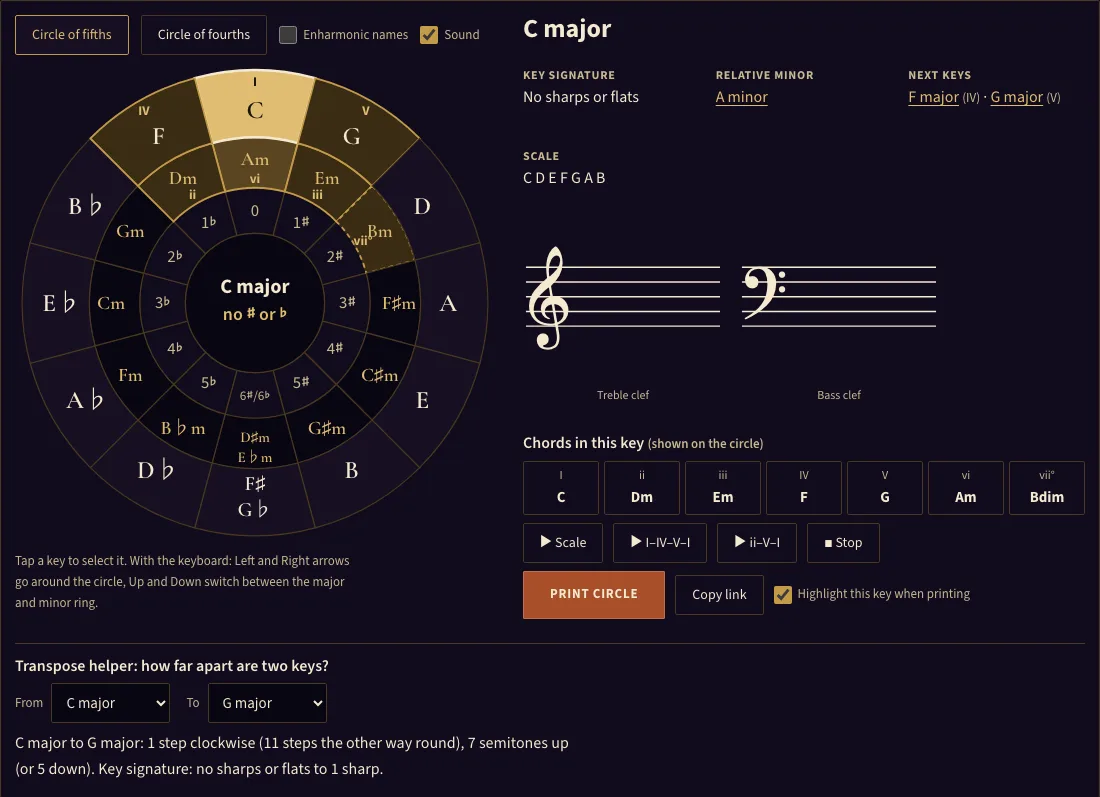
Interactive circle of fifths: tap a key to see its signature, relative minor and chords, hear I-IV-V-I and ii-V-I, switch to fourths, and print the chart.
Fits on one page.
Download the PDF
Free to print and share. No sign-up, no e-mail, no watermark. A4 for most of the world, Letter for the US and Canada; both are black and white, with the fonts embedded.
Clockwise from C
| Major key | Relative minor | Key signature |
|---|---|---|
| C | Am | 0 |
| G | Em | 1♯ |
| D | Bm | 2♯ |
| A | F♯m | 3♯ |
| E | C♯m | 4♯ |
| B | G♯m | 5♯ |
| F♯/G♭ | D♯m/E♭m | 6♯/6♭ |
| D♭ | B♭m | 5♭ |
| A♭ | Fm | 4♭ |
| E♭ | Cm | 3♭ |
| B♭ | Gm | 2♭ |
| F | Dm | 1♭ |
musictheoryprint.com · free to print and share
Which keys do art songs actually use? The circle of fifths in real music
The most common key family is C major / A minor with 184 of 1462 songs (12.6%); the top three positions on the circle (C, F, G) together cover 37.1%. 697 songs (47.7%) open with flats, 581 (39.7%) with sharps and 184 (12.6%) with no signature.
Ranking: the most used key families
| Rank | Major / relative minor | Songs | Share | Est. major | Est. minor |
|---|---|---|---|---|---|
| 1 | C major / A minor | 184 | 12.6% | 95 | 89 |
| 2 | F major / D minor | 182 | 12.4% | 130 | 52 |
| 3 | G major / E minor | 176 | 12.0% | 118 | 58 |
| 4 | E♭ major / C minor | 171 | 11.7% | 127 | 44 |
| 5 | D major / B minor | 136 | 9.3% | 99 | 37 |
| 6 | B♭ major / G minor | 133 | 9.1% | 70 | 63 |
| 7 | A♭ major / F minor | 128 | 8.8% | 86 | 42 |
| 8 | E major / C♯ minor | 106 | 7.3% | 91 | 15 |
| 9 | A major / F♯ minor | 100 | 6.8% | 74 | 26 |
| 10 | D♭ (C♯) major / B♭ (A♯) minor | 59 | 4.0% | 49 | 10 |
| 11 | B major / G♯ minor | 46 | 3.1% | 40 | 6 |
| 12 | F♯ (G♭) major / D♯ (E♭) minor | 41 | 2.8% | 27 | 14 |
Method
- Corpus: All 1462 MusicXML files in the corpus were parsed.
- Each position on the circle counts every song whose opening key signature is that major key's signature (which is also its relative minor's). Enharmonically equivalent signatures share a position: F♯ (G♭) combines 6 sharps and 6 flats; D♭ (C♯) combines 5 flats and 7 sharps; B would also take 7 flats (C♭ major), which does not occur in the corpus. The notated signatures and their counts are shown beside each bar.
- Each score is counted once, by the key signature in force at its opening; songs that change key signature later are still counted under their first key.
- Shares are the position's songs divided by all 1462 songs. The sum of the twelve positions equals 1462.
- The corpus files carry no major/minor flag, so the mode is estimated: for each score the notes written under the opening key signature are compared with the Krumhansl–Schmuckler major and minor profiles, choosing between that signature's major key and its relative minor. Treat the major/minor split as an estimate; the signature counts themselves are read directly from the files.
Data: computed from the OpenScore Lieder Corpus (CC0), 1,462 scores. Snapshot: commit 6b2dc542ce (2026-04-07).
Background
Excerpts from open reference works, reproduced as published (references, images and tables removed). Every excerpt names its source, licence and original article.
In brief
In music theory the Circle of fifths shows how the different keys are related to one another. It is usually shown as a circle with the names of keys around it. If you take any key in the circle, its fifth is the one to its right. It can be easily understood together with a piano keyboard.
Source: Simple English Wikipedia, “Circle of fifths” — CC BY-SA 4.0 — text excerpted; see the article for the full text and authors. Revision of 2023-04-21.
Circle of fifths
Overview
In music theory, the circle of fifths (sometimes also cycle of fifths) organizes the twelve pitch classes of the chromatic scale in a cycle of ascending perfect fifths. Since the cycle ascends in the opposite direction by perfect fourths, it is sometimes also called the circle of fourths.
Starting on a C, the sequence is: C, G, D, A, E, B/C♭, F♯/G♭, C♯/D♭, A♭, E♭, B♭, F, and C. This order places the most closely related key signatures adjacent to one another.
Ascending by twelve justly tuned perfect fifths with a frequency ratio of 3:2 does not return exactly to the starting pitch class, but instead overshoots it by a small interval known as the Pythagorean comma. This leads to tuning issues when transposing or modulating, and tuning systems were developed to address these issues. By changing (tempering) the 3:2 ratio, these systems produce a sequence of perfect fifths that returns to the starting pitch class. Such tuning systems include historical well temperaments, and 12-tone equal temperament, which is the standard tuning system for Western music.
Definition
The circle of fifths organizes pitches in a sequence of perfect fifths, generally shown as a circle with the pitches (and their corresponding keys) in clockwise order. It can be viewed in a counterclockwise direction as a circle of fourths. Harmonic progressions in Western music commonly use adjacent keys in this system, making it a useful reference for musical composition and harmony.
The top of the circle shows the key of C Major, with no sharps or flats. Proceeding clockwise, the pitches ascend by fifths. The key signatures associated with those pitches change accordingly: the key of G has one sharp, the key of D has 2 sharps, and so on. Proceeding counterclockwise from the top of the circle, the notes change by descending fifths and the key signatures change accordingly: the key of F has one flat, the key of B♭ has 2 flats, and so on. Some keys (at the bottom of the circle) can be reasonably notated either in sharps or in flats.
Starting at any pitch and ascending by a fifth generates all tones before returning to the beginning pitch class (a pitch class consists of all of the notes indicated by a given letter regardless of octave—all "C"s, for example, belong to the same pitch class). Moving counterclockwise, the pitches descend by a fifth, but ascending by a perfect fourth will lead to the same note an octave higher (therefore in the same pitch class). Moving counter-clockwise from C could be thought of as descending by a fifth to F, or ascending by a fourth to F.
When notating a circle of fifths, an enharmonic substitution is made for one of the notes. In the clockwise example above, a perfect fifth above A♯ would be E♯, but is notated as F, which is enharmonically equivalent. This technically creates a diminished sixth between A♯ and F. In the counterclockwise example, a perfect fifth below G♭ should be C♭, but is replaced with the enharmonic note of B, also creating a diminished sixth.
Diatonic key signatures
Each pitch can serve as the tonic of a major or minor key, and each of these keys will have a diatonic scale associated with it. The circle diagram shows the number of sharps or flats in each key signature, with the major key indicated by a capital letter and the minor key indicated by a lower-case letter. Major and minor keys that have the same key signature are referred to as the relative major and relative minor of one another.
Modulation and chord progression
Tonal music often modulates to a new tonal center whose key signature differs from the original by only one flat or sharp. These closely-related keys are a fifth apart from each other and are therefore adjacent in the circle of fifths. Chord progressions also often move between chords whose roots are related by perfect fifth, making the circle of fifths useful in illustrating the "harmonic distance" between chords.
The circle of fifths is used to organize and describe the harmonic or tonal function of chords. Chords can progress in a pattern of ascending perfect fourths (alternately viewed as descending perfect fifths) in "functional succession". This can be shown "...by the circle of fifths (in which, therefore, scale degree II is closer to the dominant than scale degree IV)". In this view the tonic or tonal center is considered the end point of a chord progression derived from the circle of fifths.
According to Richard Franko Goldman's Harmony in Western Music, "the IV chord is, in the simplest mechanisms of diatonic relationships, at the greatest distance from I. In terms of the [descending] circle of fifths, it leads away from I, rather than toward it." He states that the progression I–ii–V–I (an authentic cadence) would feel more final or resolved than I–IV–I (a plagal cadence). Goldman concurs with Nattiez, who argues that "the chord on the fourth degree appears long before the chord on II, and the subsequent final I, in the progression I–IV–viio–iii–vi–ii–V–I", and is farther from the tonic there as well. (In this and related articles, upper-case Roman numerals indicate major triads while lower-case Roman numerals indicate minor triads.)
History
The circle of fifths developed in the late 1600s and early 1700s to theorize the modulation of the Baroque era.
The first circle of fifths diagram appears in the Grammatika (1677) of the composer and theorist Mykola Pavlovych Dyletsky, who intended to present music theory as a tool for composition. It was "the first of its kind, aimed at teaching a Russian audience how to write Western-style polyphonic compositions."
A circle of fifths diagram was independently created by German composer and theorist Johann David Heinichen in his Neu erfundene und gründliche Anweisung (1711), which he called the "Musical Circle" (German: Musicalischer Circul). This was also published in his Der General-Bass in der Composition (1728).
Heinichen placed the relative minor key next to the major key, which did not reflect the actual proximity of keys. Johann Mattheson (1735) and others attempted to improve this—David Kellner (1737) proposed having the major keys on one circle, and the relative minor keys on a second, inner circle. This was later developed into chordal space, incorporating the parallel minor as well.
Some sources imply that the circle of fifths was known in antiquity, by Pythagoras. This is a misunderstanding and an anachronism. Tuning by fifths (so-called Pythagorean tuning) dates to Ancient Mesopotamia, though they did not extend this to a twelve-note scale, stopping at seven. The Pythagorean comma was calculated by Euclid and by Chinese mathematicians (in the Huainanzi). Thus, it was known in antiquity that a cycle of twelve fifths was almost exactly seven octaves (more practically, alternating ascending fifths and descending fourths was almost exactly an octave). However, this was theoretical knowledge, and was not used to construct a repeating twelve-tone scale, nor to modulate. This was done later in meantone temperament and twelve-tone equal temperament, which allowed modulation while still being in tune, but did not develop in Europe until about 1500.
Source: Wikipedia, “Circle of fifths” — CC BY-SA 4.0 — text excerpted; see the article for the full text and authors. Revision of 2026-06-05.
Sources and licences for the text, scores and recordings on this page are on the credits page.
Sources: Wikipedia: Circle of fifths.
About the interactive circle of fifths
The circle of fifths (also called the circle of 5ths, the wheel of fifths or the circle of keys) is a diagram that arranges the 12 major keys in a ring, with each key one fifth above the one before it. This page lets you explore it in your browser. The tool is free, needs no sign-up, and uploads nothing.
Click or tap any key to see its key signature, relative minor, scale, and the seven chords that belong to it, then hear those chords played. The circle also shows the minor keys and their signatures in the same view, and you can switch to the circle of fourths. A printable chart sits below the tool for worksheets, notes, or classroom use.
How to use the circle of fifths
- Read the three rings. The outer ring holds the 12 major keys, the middle ring holds their 12 relative minor keys, and the inner ring shows the key signature. The centre names the selected key and its signature. The page opens on C major.
- Click or tap a segment on the outer or middle ring. The side panel updates with the key title, key signature, relative key, next keys, and scale, and the key’s tonic chord plays.
- Use the keyboard to move around the circle. Left and Right move one step, Up and Down switch between the major and minor rings, and Home returns to C major (or A minor).
- Press a button in the Chords in this key row to hear one chord. The chord turns copper on the circle.
- Press ▶ Scale, ▶ I–IV–V–I, or ▶ ii–V–I to hear a sequence. Each beat lights up on the circle. Press ■ Stop to end it.
- If a key has two spellings, such as F♯ and G♭ major, press Spell as G♭ major to switch between them.
Other options sit in the top bar. The Circle of fifths / Circle of fourths toggle reverses the direction. The Enharmonic names checkbox adds alternative spellings. The Sound checkbox turns all audio off. The Transpose helper shows how far apart two keys are. Copy link saves the selected key in the address bar, and Print circle prints the chart.
The circle of fifths (circle of 5ths) explained#
The circle of fifths places the 12 major keys in a loop so that each step clockwise moves up by a perfect fifth, which is seven semitones. Starting at C major with C at the top, G is one step clockwise, D is two steps, and so on. After 12 steps the circle returns to C. It works the same on guitar and piano: guitarists read the wheel of fifths as a map of chords that sit well together, and pianists often practise scales by going clockwise one 5th at a time.
Each clockwise step adds one sharp to the key signature. G major has one sharp (F♯), D major has two (F♯ and C♯), and A major has three. The key names change, but the pattern of steps stays the same in every key.
How do you read the circle of fifths#
Find the key in the outer ring, then read its signature from the inner ring. The key signature ring starts with no sharps or flats at the top, adds sharps going clockwise, and adds flats going counter-clockwise. The three keys at the bottom have two spellings each (B/C♭, F♯/G♭, D♭/C♯); tick Enharmonic names to see both.
Neighbouring keys are easy to find. One step clockwise is the key a fifth up, and one step counter-clockwise is the key a fourth up, which is the same as a fifth down.
How does the circle of fifths show minor keys#
The middle ring shows the 12 relative minor keys. Each minor key sits in the same position as its relative major, so the two keys share one key signature. A minor sits in the same place as C major, and E minor sits in the same place as G major.
A minor key uses the same notes as its relative major, starting three semitones lower. In a minor key, the chord on the fifth step is a major V when the raised seventh is used, which is the form found in harmonic minor. The highlighted v on the circle is the natural-minor chord, which uses lower-case letters.
What is the circle of fourths#
The circle of fourths is the same circle run in the opposite direction, with C at the top and F one step clockwise. Each clockwise step moves down a fifth, which is the same as moving up a fourth. This is why clockwise steps add flats instead of sharps.
The keys and their signatures do not change. Only the direction of the steps is reversed, so the circle of fourths is useful when you think about flat keys first.
How do you use the circle of fifths to find chords in a key#
The seven chords of a major key are built on each note of its scale and are written I, ii, iii, IV, V, vi, and vii°. On the circle, I is the selected key. IV sits one step counter-clockwise and V one step clockwise, so the three main chords are next to each other. The ii, iii, and vi chords sit on the minor ring, with vi in the same position as the relative minor.
A diminished triad has no place of its own, so vii° sits at the minor key with the same root. The tool outlines all seven chords with their Roman numerals, so you can check a key by looking at the circle.
How do you use the circle of fifths for chord progressions#
Many common progressions use chords that sit close together on the circle. In G major, I–IV–V–I is G, C, D, G. The C and D chords are one step away from G on either side, which is why the progression stays close to home.
The ii–V–I progression uses the same idea. In G major it is Am, D, G, where the Am sits on the minor ring. In a minor key the sequence is ii°–V–i, and the tool highlights each chord on the circle as it plays.
Frequently asked questions
Is it free and does it need an account?
Can I print it?
Can I use the printouts commercially (KDP, Etsy, classroom packs)?
What does the Enharmonic names checkbox do?
Does the tool play sound?
How do I share the key I have selected?
Does it work on a phone?
Updated