
Printable worksheet
Compound Intervals Worksheet
Free compound intervals worksheet: name 9ths, 10ths, 11ths, 12ths and 13ths on the staff and reduce them to simple intervals. Printable, with answer key.
Compound Intervals Worksheet
Sheet #
Name Date Score /
Answer key
Compound Intervals Worksheet · Sheet #
About the Compound Intervals Worksheet
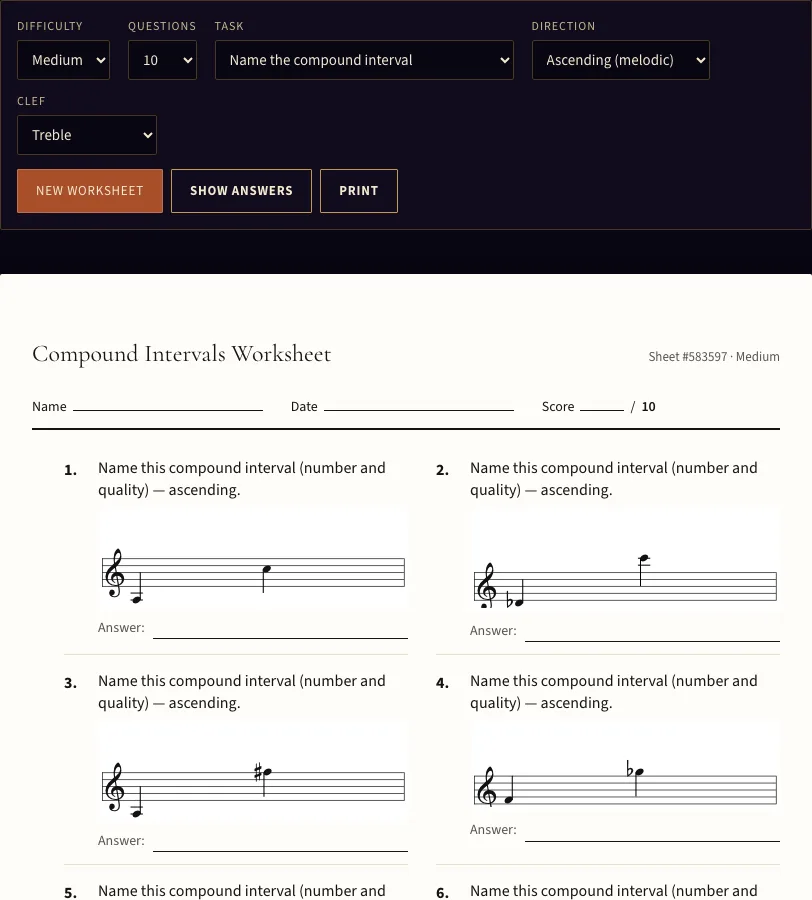
This free worksheet gives you printable practice on compound intervals, with answers. A compound interval is any interval wider than an octave, and each question asks you to name one from a two-note staff. It runs in your web browser with no sign-up, and nothing you enter is uploaded.
Each sheet has its own sheet number, so you can rebuild the same set later or share it with a class. You can choose Easy, Medium or Hard, and pick a task that either names the interval or reduces it to a simple one. Answers stay hidden until you reveal them, and a separate answer key prints on its own page.
The worksheet suits theory homework, lesson starters and quick practice. Students work out each answer by counting letter names and semitones, then check it against the key.
How to use the Compound Intervals Worksheet
- Set Difficulty to Easy, Medium or Hard. Medium is the default.
- Set Questions to 10 or 20.
- Choose a Task: name the compound interval, name it and reduce it to a simple interval, write a compound interval above a note, or Mixed.
- For the two naming tasks, pick a Direction: Ascending (melodic), Descending (melodic), Harmonic (together), or Mixed. The Write task ignores this control.
- Choose a Clef: Treble, Bass, or Treble and bass.
- Click New worksheet for a fresh random sheet.
- Write your answers on the Answer lines, and fill in your Name and Date in the header.
- Click Show answers to reveal each answer, its explanation and its staff. Click Hide answers to hide them again.
- Click Print, or press Ctrl+P, to print the sheet.
The address bar keeps your settings, including the sheet number, so the same link rebuilds the identical sheet. Share the link with students, or note the sheet number to reuse the sheet later. Invalid values in the address bar fall back to the defaults.
Start on Easy with “Name it and reduce it to a simple interval”: the answer key shows the link, such as 6 + 7 = 13 for a major 13th. Then try the Write task, where you also have to place the note in the right octave. The sheets you generate are free for commercial use too, so they can go into a classroom pack, a Teachers Pay Teachers resource or an Amazon KDP workbook.
What is a compound interval?#
A compound interval is an interval larger than an octave. It is made of an octave plus a simple interval, so a 10th is a 3rd plus an octave.
The octave itself is a simple interval (8), so it is not compound. This worksheet uses intervals up to the perfect 15th, which is two octaves, and keeps all notes within two ledger lines of the staff.
How do you name a compound interval?#
Count the letter names from the lower note to the upper note, including both ends. That count gives the number. Then take the quality from the simple interval underneath.
For example, C up to the E an octave and a third higher covers C, D, E, F, G, A, B, C, D, E, which is ten letter names. The distance is a major third plus an octave, so it is a major 10th. The quality does not change when you add an octave.
Counting both ends matters. An octave plus a 2nd is a 9th, not a 10th. Melodic and harmonic intervals are named the same way. A descending 10th is still called a 10th.
How do you find the simple interval of a compound interval?#
Subtract 7 from the compound number. A 9th becomes a 2nd, a 10th becomes a 3rd, a 13th becomes a 6th, a 14th becomes a 7th and a 15th becomes an octave. Keep the same quality.
For example, C up to the A an octave and a sixth higher is a major 13th. It reduces to a major 6th, because 6 + 7 = 13. The real distance is 21 semitones, which is a major 6th (9 semitones) plus one octave (12). Semitones show the distance, but the letter count gives the name.
What is a 9th, 10th or 11th?#
A 9th is an octave plus a 2nd, a 10th is an octave plus a 3rd, and an 11th is an octave plus a 4th. Each one is the simple interval plus an octave, so you can find its size by adding 7 to the simple number.
The quality follows the simple interval. A 9th and a 10th take major or minor, as in a major 9th (a major 2nd plus an octave, 14 semitones from G4 up to A5). An 11th takes perfect, as in a perfect 11th (a perfect 4th plus an octave). Augmented and diminished versions appear only on Hard.
Frequently asked questions
Is it free and does it need an account?
Can I print it with the answers?
Can I put compound interval worksheets in a KDP workbook?
What do the Easy, Medium and Hard levels change?
Does the Write task need the right octave?
Updated