
Printable worksheet
Consonance and Dissonance Worksheet
Free consonance and dissonance worksheet: classify intervals as perfect consonance, imperfect consonance or dissonance. Choose how the 4th is treated.
Consonance and Dissonance Worksheet
Sheet #
Name Date Score /
Answer key
Consonance and Dissonance Worksheet · Sheet #
About the Consonance and Dissonance Worksheet
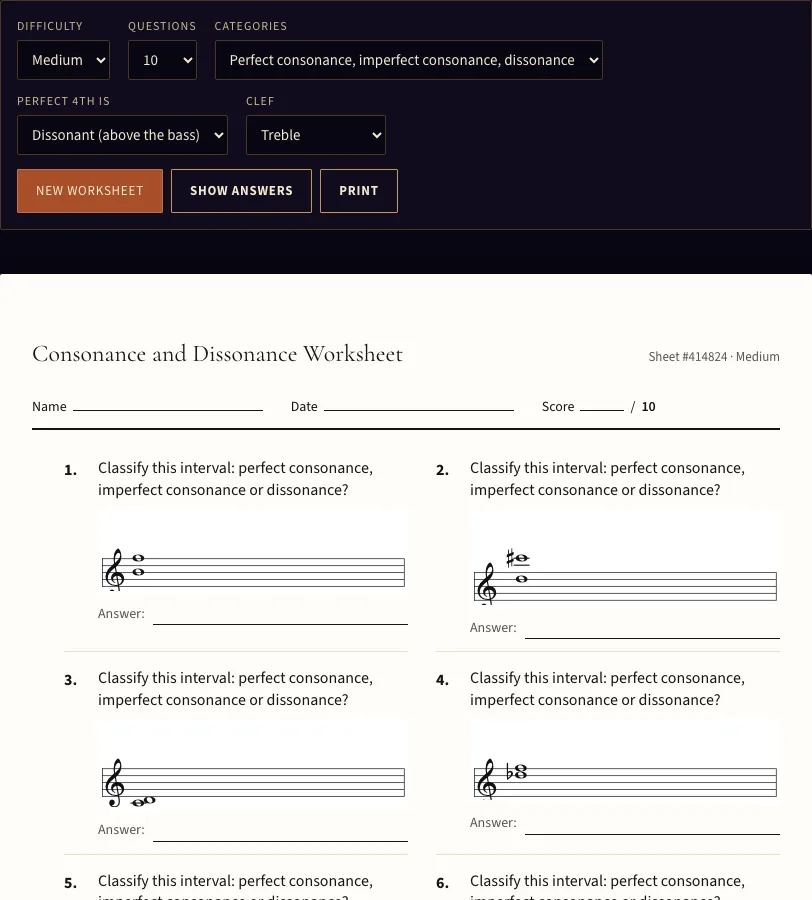
The Consonance and Dissonance Worksheet generates a printable music theory sheet. Each question shows two notes, one above the other, on a staff, and you classify the interval as a perfect consonance, an imperfect consonance or a dissonance. It is free, runs in your web browser, and needs no sign-up. Nothing you enter is uploaded.
You can switch to a simpler two-way question, consonant or dissonant, and choose from three difficulty levels. The easiest level uses natural notes only, and the hardest adds augmented, diminished and compound intervals. Each sheet comes with an answer key. Every answer gives a reason that names the interval, such as “G up to A is a Major 2nd,” so you can see how the class was reached.
How to use the Consonance and Dissonance Worksheet
- Choose Difficulty: Easy, Medium (the default) or Hard. Easy uses natural notes only. Medium adds the perfect 4th, the tritone and one sharp or flat per note. Hard adds other augmented and diminished intervals, compound intervals up to two octaves, and double sharps and flats.
- Set Questions to 10 (the default) or 20.
- Pick Categories. “Perfect consonance, imperfect consonance, dissonance” is the default. “Consonant or dissonant” asks a two-way question.
- Set Perfect 4th is to “Dissonant (above the bass)” (the default), “A perfect consonance”, or “Left out”.
- Choose Clef: Treble (the default), Bass, or Treble and bass. With Treble and bass, each question picks one clef at random.
- Click New worksheet to generate a sheet. Fill in the Name, Date and Score lines.
- For each question, identify the interval first, then write its class on the Answer: line. The sheet does not ask for the interval name, but naming it first makes the class easier to find.
- Click Show answers to check your work. Click Hide answers to hide the key again.
There is no sound playback and no keyboard on this worksheet. The header shows the sheet number and difficulty. The address bar holds the seed, difficulty, count, categories, fourth and clef settings, so opening that address recreates the same sheet. Click Print to print the questions in two columns with their staves. The answer key prints on a new page.
What is consonance and dissonance in music?#
Consonance is a sound that feels stable and settled when two notes play together. Dissonance is a sound that feels tense or rough and tends to move toward a consonance. Music theory uses these two terms to sort every interval, the distance between two notes, into one of these groups.
Consonance has two kinds. Perfect consonances are the unison, the perfect fifth and the octave, along with their compounds. Imperfect consonances are the major and minor thirds and sixths. Dissonances are the major and minor 2nds and 7ths, plus every augmented or diminished interval. Dissonance is not a fault in music. It creates movement and a sense of direction.
Which intervals are consonant, and which are dissonant?#
Perfect fifths, octaves, and major or minor thirds and sixths are consonant. Major and minor 2nds and 7ths, and every augmented or diminished interval, are dissonant. The perfect 4th is the exception, and its class depends on the rule you follow.
To classify any interval, work through these steps in order:
- Check the spelling first. Any augmented or diminished interval is a dissonance, including the tritone (an augmented 4th or diminished 5th). The check uses spelling, so a diminished 4th is a dissonance even though it sounds like a major 3rd.
- Find the simple number. Reduce the interval to a number from 1 to 7. An octave counts as 1, so 8 and 15 are octaves. 12 is a fifth plus an octave, so it counts as a 5th. 9, 10 and 11 become a 2nd, 3rd and 4th.
- Read the simple number. A perfect octave or perfect fifth is a perfect consonance. A major or minor 3rd or 6th is an imperfect consonance. A major or minor 2nd or 7th is a dissonance.
The generator never asks a unison, so the smallest perfect interval you will see is the octave.
The perfect 4th has no single rule. In common-practice counterpoint, a perfect 4th against the lowest voice is a dissonance, while between upper voices it can be consonant. Many beginners’ books list it as a perfect consonance. The worksheet follows your setting. “Dissonant (above the bass)” treats the lower note as the bass. “A perfect consonance” counts it as consonant. “Left out” never asks it, although augmented and diminished 4ths still appear. In the two-way mode, “Consonant” covers both perfect and imperfect consonances.
The sheets you generate are free for commercial use too, so they can go into a classroom pack, a Teachers Pay Teachers resource or an Amazon KDP workbook.
Frequently asked questions
Is a perfect fourth consonant or dissonant?
Is it free and does it need an account?
Can I print it with the answers?
Can I include consonance and dissonance worksheets in a paid course or a printable bundle?
Does the worksheet play the intervals aloud?
Updated