
Diminished Scale
| Degrees | |
|---|---|
| Steps | |
| Semitones |
Chords built on each degree
| Degree | Triad | Numeral | Seventh chord | Numeral |
|---|
The first note you type is treated as the likely tonic when two scales fit equally well.
Diminished scale in every key: whole-half and half-whole notes, step pattern, staff and keyboard, with sound. Pick a tonic to see it. Free.
About the Diminished Scale
This page is a free diminished scale explorer that runs in your web browser. It shows the notes of a diminished scale for any tonic you choose, plays the scale aloud, and draws it on a staff and a piano keyboard. There is no sign-up, and nothing you choose is uploaded.
The diminished scale is an eight-note scale built from alternating whole steps and half steps. This page covers both versions: the whole-half diminished scale and the half-whole diminished scale. The tool opens in C, so you can hear a working example straight away. Change the tonic or the scale type, and the notes below update to match.
How to use the diminished scale
- Open the Tonic menu and choose a note. It offers 17 spellings, from C to B, including sharps and flats such as C♯ and B♭. The page opens in C.
- Open the Scale type menu and pick Diminished (whole-half) or Diminished (half-whole).
- Press ▶ Ascending, ▶ Descending or ▶ Up and down to hear the scale one octave from the tonic, in the middle C octave. The note chips light up as each note sounds.
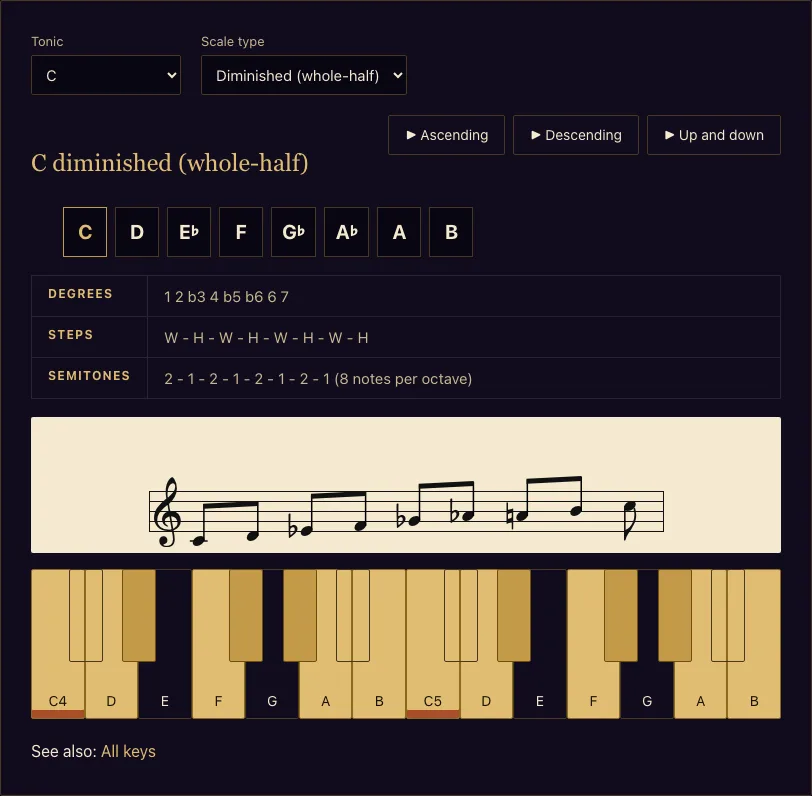
- Read the table under the scale name. The Degrees row gives the scale degrees, Steps shows W, H or W+H, and Semitones gives the size of each step and the number of notes per octave.
- Look at the staff, which shows the notes with the correct key signature where one applies. Below it, the two-octave piano keyboard marks the scale notes, with the tonic highlighted. Click any key to play it.
- If no staff appears, the spelling would need triple accidentals. A note will suggest an enharmonic tonic, such as B♭ instead of A♯. Choose that tonic instead.
- Use the See also line to open the matching key page, the modes chart, or the major or minor scales chart.
The address bar keeps your chosen tonic and scale type, in the form ?tonic=Eb&type=.... Copy that address to share a link that opens the same scale.
What is a diminished scale#
A diminished scale is an eight-note scale that alternates whole steps and half steps. The whole-half diminished scale starts with a whole step, and the half-whole diminished scale starts with a half step. Both versions have eight notes per octave.
The whole-half diminished scale from C is C D E♭ F G♭ A♭ A B. Its steps follow W-H-W-H-W-H-W-H, which is 2-1-2-1-2-1-2-1 semitones. Its scale degrees are 1 2 ♭3 4 ♭5 ♭6 6 7. The four whole steps add up to 8 semitones and the four half steps add up to 4, so the octave totals 12 semitones.
What is the difference between whole-half and half-whole#
The difference is the first step. The whole-half version begins with a whole step, and the half-whole version begins with a half step, so the same alternating pattern produces a different set of notes. Each version has its own degree names, so the two are not interchangeable.
The half-whole diminished scale from C is C D♭ E♭ E F♯ G A B♭. Its steps are H-W-H-W-H-W-H-W, which is 1-2-1-2-1-2-1-2 semitones. Its degrees are 1 ♭2 ♭3 3 ♯4 5 6 ♭7. Compare the two lists: the whole-half version contains a ♭5 and ♭6, while the half-whole version contains a ♭2 and a 5. When you need a particular sound, check the notes rather than assuming they match.
Diminished scale in every key#
Notes of each scale from twelve common tonics, written with one letter per degree where the scale has seven notes (the explorer above gives the other spellings and the staff).
| Whole-half diminished from | Notes |
|---|---|
| C | C D E♭ F G♭ A♭ A B |
| D♭ | D♭ E♭ F♭ G♭ A𝄫 B𝄫 B♭ C |
| D | D E F G A♭ B♭ B C♯ |
| E♭ | E♭ F G♭ A♭ B𝄫 C♭ C D |
| E | E F♯ G A B♭ C C♯ D♯ |
| F | F G A♭ B♭ C♭ D♭ D E |
| F♯ | F♯ G♯ A B C D D♯ E♯ |
| G | G A B♭ C D♭ E♭ E F♯ |
| A♭ | A♭ B♭ C♭ D♭ E𝄫 F♭ F G |
| A | A B C D E♭ F F♯ G♯ |
| B♭ | B♭ C D♭ E♭ F♭ G♭ G A |
| B | B C♯ D E F G G♯ A♯ |
| Half-whole diminished from | Notes |
|---|---|
| C | C D♭ E♭ E F♯ G A B♭ |
| D♭ | D♭ E𝄫 F♭ F G A♭ B♭ C♭ |
| D | D E♭ F F♯ G♯ A B C |
| E♭ | E♭ F♭ G♭ G A B♭ C D♭ |
| E | E F G G♯ A♯ B C♯ D |
| F | F G♭ A♭ A B C D E♭ |
| F♯ | F♯ G A A♯ B♯ C♯ D♯ E |
| G | G A♭ B♭ B C♯ D E F |
| A♭ | A♭ B𝄫 C♭ C D E♭ F G♭ |
| A | A B♭ C C♯ D♯ E F♯ G |
| B♭ | B♭ C♭ D♭ D E F G A♭ |
| B | B C D D♯ E♯ F♯ G♯ A |
Frequently asked questions
How many different diminished scales are there?
When do you use the diminished scale?
What are the notes of the C diminished scale?
What is the octatonic scale?
Are the notes tuned to standard pitch?
Updated

