
Printable worksheet
Enharmonic equivalent worksheet
Enharmonic equivalent practice: rename sharps and flats, then E sharp, C flat and double accidentals, with octave numbers. Free printable sheets, answer key.
Enharmonic equivalent worksheet
Sheet #
Name Date Score /
Answer key
Enharmonic equivalent worksheet · Sheet #
About the Enharmonic Equivalent Worksheet
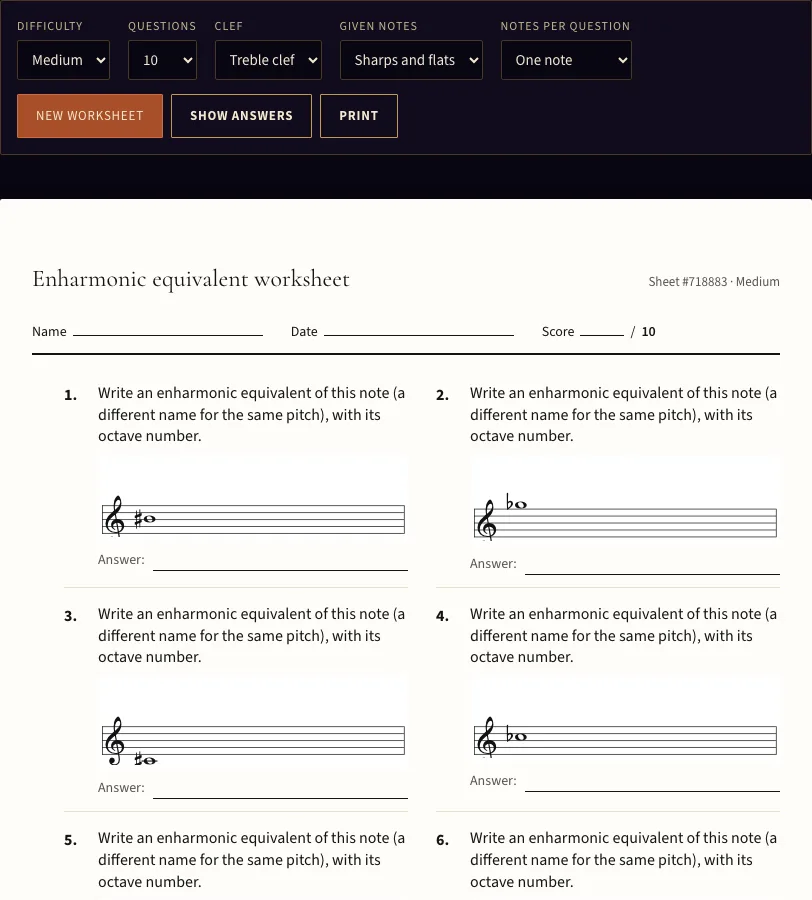
An enharmonic equivalent is a different letter name for the same pitch. For example, C♯ and D♭ are the same key on the piano, so they sound identical but are written differently. This Enharmonic Notes Worksheet creates printable practice sheets where each question asks you to write a different name for a given note, with its octave number. It runs in your web browser, is free, and needs no sign-up. Choose a difficulty, print the sheet, and check your answers against the answer key. The sheets cover enharmonic notes on treble or bass staves, from black-key names up to double sharps and double flats. Sheets made here are yours to use however you like, including in printables you sell, with no attribution required.
How to use the Enharmonic Notes Worksheet
- Set Difficulty to Easy, Medium or Hard. Medium is the default. Easy uses only black-key names, Medium adds E♯, B♯, F♭ and C♭, and Hard adds double sharps and double flats.
- Set Questions to 10 or 20.
- Choose a Clef: Treble (default) or Bass.
- Choose Given notes: Sharps and flats (default), Sharps only, or Flats only. This sets the kind of note shown in each question, the one you must rename.
- Choose Notes per question: One note (default) or A row of notes. A row has 3, 4 or 5 notes depending on difficulty.
- Click New worksheet to make a new random sheet.
- Write each answer as a different letter name, an accidental if needed, and an octave number. For example, C♯5 becomes D♭5.
- Click Show answers to check your work. The button changes to Hide answers.
- Click Print or press Ctrl+P.
The address bar keeps your sheet. It stores the sheet number, difficulty, question count and each control setting. Sharing that link rebuilds the identical sheet, so a teacher can send one link or reuse a sheet number. Invalid values in the address fall back to the defaults.
When you print, only the sheet is printed, with no menus or on-screen answers. The answer key starts on a new page, titled “Answer key” with the sheet number. The number of pages depends on the question count and the staff heights.
What is an enharmonic equivalent?#
An enharmonic equivalent is a note name that sounds at the same pitch as another note name but uses a different letter. C♯ and D♭ are enharmonic equivalents because they are the same key on the piano.
To find one, move to a neighbouring letter and adjust the accidental until the semitone count matches. D sits a whole tone (two semitones) above C. Lowering D by a flat takes it down one semitone, so D♭ is one semitone above C, the same as C♯. The same method gives F♭ = E, E♯ = F, B♯ = C and C♭ = B.
The octave number follows the letter, not the sound. The number changes at C. B♯3 sounds as C4, because the sharp raises B to the next C, which belongs to octave 4. C♭4 sounds as B3. E♯ and F share an octave, so E♯4 = F4. The answer’s octave number can therefore differ from the given note’s.
The worksheet works in equal temperament, the tuning used on a standard piano. In other tuning systems, C♯ and D♭ are not exactly the same pitch. The worksheet does not cover this.
Why spell a note one way and not the other?#
Both spellings are correct, but musicians pick one based on the key and the harmony around the note. A passage in a sharp key usually uses F♯ rather than G♭, and the spelling helps the reader see the scale and chord shapes clearly. A worksheet question has no musical context, so any correct spelling counts as right.
The worksheet lists a best spelling first. It prefers a natural letter name over one with an accidental, and one accidental over two. When two spellings tie, it prefers the opposite kind of accidental to the given note. For a sharp, that means a flat name comes first. In single-note mode, any other correct spelling appears in brackets after the best one.
Double sharps and double flats are also enharmonic names. Every natural note has them: C = B♯ = D𝄫, and G = F𝄪 = A𝄫. These appear only on Hard.
Frequently asked questions
What are some examples of enharmonic notes?
Are E sharp, B sharp, C flat and F flat real notes?
Is it free and does it need an account?
Can I print it with the answers?
Do I have to credit this site if I sell enharmonic notes worksheets I made here?
Updated