
Printable worksheet
Inverting intervals worksheet
Free inverting intervals worksheet: invert intervals on the staff or by name and find the new interval with the rule of nine. Answer key included.
Inverting intervals worksheet
Sheet #
Name Date Score /
Answer key
Inverting intervals worksheet · Sheet #
About the Inverting Intervals Worksheet
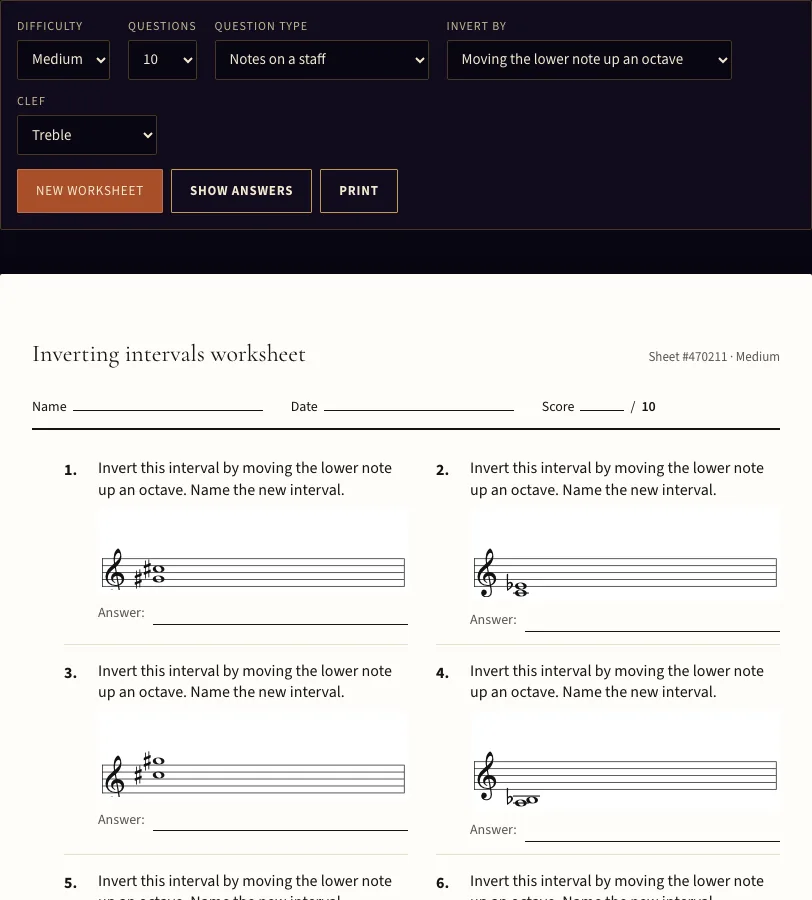
The Interval Inversion Worksheet is a free, printable practice sheet for inverting intervals. You take a two-note interval, move one note by an octave, and name the new interval. It runs in your web browser with no sign-up, and nothing you enter is uploaded. Each sheet has numbered questions and an answer key. You can choose the difficulty, the number of questions and the question style, from notes on a staff to interval names alone. Use it for theory homework, revision before a lesson, or a classroom exercise. Every answer in the key shows the rule of nine at work, so you can see how the new name was found. Sheets made here are yours to use however you like, including in printables you sell, with no attribution required.
How to use the Interval Inversion Worksheet
- Choose a Difficulty: Easy, Medium or Hard. Medium is the default.
- Set Questions to 10 or 20.
- Pick a Question type: Notes on a staff, Notes given as letter names, Interval names only, or Mixed.
- Pick Invert by: Moving the lower note up an octave, Moving the upper note down an octave, or Either. This setting does not apply to interval-name-only questions, because they have no notes to move.
- Pick a Clef for staff questions: Treble, Bass, or Treble and bass.
- Click New worksheet to generate a random sheet with its own sheet number.
- Click Show answers to reveal each answer and a one-line explanation. Click Hide answers to remove them.
- Click Print, or press Ctrl+P, to print the sheet.
The address bar keeps your settings in the form ?seed=… . Anyone who opens the same link gets the identical sheet, so you can share a link or reuse a sheet number. Invalid values in the address fall back to the defaults.
When you print, only the sheet appears, with no menus and no on-screen answers. The answer key starts on a new page. The page needs JavaScript to draw the staves. Paper size follows your browser’s setting, so A4 and US Letter both work.
How do you invert an interval?#
To invert an interval, move the lower note up an octave, or move the upper note down an octave. Both methods give the same result, because the two notes swap places. For example, C up to E becomes E up to C.
What is the rule of nine for interval inversion?#
Add the original interval number to the inverted number and the total is always 9. A 2nd inverts to a 7th, a 3rd to a 6th, and a 4th to a 5th. A unison and an octave also pair up, since 1 + 8 = 9. In the example B3 and C4, a minor 2nd, the inverted interval is a major 7th, because 2 + 7 = 9.
What happens to the quality when you invert an interval?#
Major becomes minor and minor becomes major. Augmented becomes diminished and diminished becomes augmented. Perfect intervals stay perfect. The number and the quality change in opposite ways, so a major 6th inverts to a minor 3rd, and a perfect 5th inverts to a perfect 4th.
Inverting intervals: worked examples#
These come from the generator’s answer key. B3 and C4 are a minor 2nd; move B up an octave and C up to B is a major 7th (2 + 7 = 9, minor becomes major). C5 and A5 are a major 6th; move C up an octave and A up to C is a minor 3rd. With letter names only, D♭ up to B♭ (a major 6th) inverts to B♭ up to D♭, a minor 3rd. A perfect octave inverts to a perfect unison, because the two notes end up on the same pitch.
Easy uses natural notes, Medium adds sharps and flats, and Hard adds double sharps and flats and the augmented and diminished intervals. There an augmented 4th inverts to a diminished 5th: both are the tritone, six semitones, seen from opposite ends. On Easy, letter-name questions also tell you the original interval; on Medium and Hard you name it yourself first.
Why do musicians invert intervals?#
Inversion lets you recognise an interval you already know, because it is the same pair of notes seen from the other side. Thirds and sixths behave alike in harmony because they are inversions of each other, and fourths and fifths do too. If you can hear or name a third, you can also work out the sixth it inverts to. Knowing inversions makes interval recognition faster.
Frequently asked questions
Is it free and does it need an account?
Can I print it with the answers?
Can I use these interval inversion worksheets in a product I sell?
Does the worksheet include compound intervals?
Which intervals appear at each level?
What does an augmented 4th invert to?
Updated