
Printable chart
Key signatures chart
G major · E minor
1 sharp: F♯
C major
No sharps or flats
Key signatures finder and chart: pick sharps or flats to name the major and minor key, see any key in treble, bass or alto clef, and take a quiz.
Fits on one page.
Download the PDF
Free to print and share. No sign-up, no e-mail, no watermark. A4 for most of the world, Letter for the US and Canada; both are black and white, with the fonts embedded.
C major · A minor
No sharps or flats
G major · E minor
1 sharp: F♯
D major · B minor
2 sharps: F♯, C♯
A major · F♯ minor
3 sharps: F♯, C♯, G♯
E major · C♯ minor
4 sharps: F♯, C♯, G♯, D♯
B major · G♯ minor
5 sharps: F♯, C♯, G♯, D♯, A♯
F♯ major · D♯ minor
6 sharps: F♯, C♯, G♯, D♯, A♯, E♯
C♯ major · A♯ minor
7 sharps: F♯, C♯, G♯, D♯, A♯, E♯, B♯
F major · D minor
1 flat: B♭
B♭ major · G minor
2 flats: B♭, E♭
E♭ major · C minor
3 flats: B♭, E♭, A♭
A♭ major · F minor
4 flats: B♭, E♭, A♭, D♭
D♭ major · B♭ minor
5 flats: B♭, E♭, A♭, D♭, G♭
G♭ major · E♭ minor
6 flats: B♭, E♭, A♭, D♭, G♭, C♭
C♭ major · A♭ minor
7 flats: B♭, E♭, A♭, D♭, G♭, C♭, F♭
The same chart as a table
| Major key | Relative minor | Sharps / flats | Which notes |
|---|---|---|---|
| C | Am | 0 | — |
| G | Em | 1♯ | F♯ |
| D | Bm | 2♯ | F♯, C♯ |
| A | F♯m | 3♯ | F♯, C♯, G♯ |
| E | C♯m | 4♯ | F♯, C♯, G♯, D♯ |
| B | G♯m | 5♯ | F♯, C♯, G♯, D♯, A♯ |
| F♯ | D♯m | 6♯ | F♯, C♯, G♯, D♯, A♯, E♯ |
| C♯ | A♯m | 7♯ | F♯, C♯, G♯, D♯, A♯, E♯, B♯ |
| F | Dm | 1♭ | B♭ |
| B♭ | Gm | 2♭ | B♭, E♭ |
| E♭ | Cm | 3♭ | B♭, E♭, A♭ |
| A♭ | Fm | 4♭ | B♭, E♭, A♭, D♭ |
| D♭ | B♭m | 5♭ | B♭, E♭, A♭, D♭, G♭ |
| G♭ | E♭m | 6♭ | B♭, E♭, A♭, D♭, G♭, C♭ |
| C♭ | A♭m | 7♭ | B♭, E♭, A♭, D♭, G♭, C♭, F♭ |
musictheoryprint.com · free to print and share
Which key signatures do real art songs use?
In 1462 art songs from the OpenScore Lieder Corpus, the most common opening key signature is no sharps or flats (184 songs, 12.6%), followed by 1 flat (182) and 1 sharp (176); 14 of the 15 possible signatures from 7 flats to 7 sharps appear.
Songs in each key signature
Up to eight songs per signature. Dates are the composer's years; the corpus gives no per-song year. The key shown is the estimated tonic of the opening key.
6 flats: G♭ major / E♭ minor
27 songs in the corpus; showing 8
- Dans les bois Augusta Mary Anne Holmès (1847–1903) from Mélodies pour Piano et Chant (Chansons populaires) G♭ major
- Für Musik Robert Franz (1815–1892) from 6 Gesänge, Op.10 G♭ major
- Green Claude Debussy (1862–1918) from Ariettes Oubliées E♭ minor
- Green Gabriel Fauré (1845–1924) from Cinq Mélodies, Op.58 G♭ major
- Je demande à l'oiseau / For My Love Amy Beach (1867–1944) from 4 Songs, Op. 51 G♭ major
- Lament Frank Bridge (1879–1941) from H.40 E♭ minor
- Liebestreu Johannes Brahms (1833–1897) from 6 Songs, Op.3 E♭ minor
- Oraison Ernest Chausson (1855–1899) from Serres chaudes, Op.24 E♭ minor
5 flats: D♭ major / B♭ minor
56 songs in the corpus; showing 8
- Abschied Josephine Lang (1815–1880) from 6 Lieder, Op.10 D♭ major
- Botschaft Johannes Brahms (1833–1897) from 5 Lieder, Op.47 D♭ major
- Dans l'immense tristesse Lili Boulanger (1893–1918) B♭ minor
- Der Fichtenbaum Robert Franz (1815–1892) from 6 Gesänge, Op.16 D♭ major
- Der Mond kommt still gegangen Clara Schumann (1819–1896) from 6 Lieder, Op.13 D♭ major
- Die Forelle (4th version, 1820) Franz Schubert (1797–1828) from "Die Forelle" D♭ major
- Geistliches Lied Louise Reichardt (1779–1826) from Sechs Lieder von Novalis, Op.4 D♭ major
- The Year's at the Spring Amy Beach (1867–1944) from 3 Browning Songs, Op. 44 D♭ major
4 flats: A♭ major / F minor
128 songs in the corpus; showing 8
- Ach, wende diesen Blick Johannes Brahms (1833–1897) from 8 Lieder und Gesänge, Op.57 F minor
- Altdeutsches Lied Clara Mathilda Faisst (1872–1948) from 4 Lieder, Op.1 F minor
- Auf dem Wasser zu singen, D.774 Franz Schubert (1797–1828) A♭ major
- Aus Tiecks Genoveva Louise Reichardt (1779–1826) from Zwölf Deutsche und Italiänische Romantische Gesänge F minor
- Chanson Lointaine Augusta Mary Anne Holmès (1847–1903) from 20 Mélodies A♭ major
- Der vielschönen Fraue Robert Franz (1815–1892) from 6 Gesänge, Op.10 A♭ major
- Die stille Lotosblume Clara Schumann (1819–1896) from 6 Lieder, Op.13 A♭ major
- Du bist wie ein Blume Robert Schumann (1810–1856) from Myrthen, Op.25 A♭ major
3 flats: E♭ major / C minor
171 songs in the corpus; showing 8
- Abschied Franz Schubert (1797–1828) from Schwanengesang.D.957 E♭ major
- Absence Georges Bizet (1838–1875) from 20 Mélodies, Op.21 E♭ major
- Am Bache, Op.20 Josephine Lang (1815–1880) E♭ major
- Amoroso Cécile Chaminade (1857–1944) E♭ major
- An Maria (aus Novalis geistlichen Liedern) Louise Reichardt (1779–1826) from Zwölf Gesänge E♭ major
- Aus den östlichen Rosen Robert Schumann (1810–1856) from Myrthen, Op.25 E♭ major
- Das Lied vom Herrn von Falkenstein Johannes Brahms (1833–1897) from 4 Songs, Op.43 C minor
- Hymne au soleil Augusta Mary Anne Holmès (1847–1903) from 20 Melodies E♭ major
2 flats: B♭ major / G minor
133 songs in the corpus; showing 8
- Abreise Johanna Kinkel (1810–1858) from 6 Gedichte, Op.8 B♭ major
- Agnes Johannes Brahms (1833–1897) from 8 Lieder und Gesänge, Op.59 G minor
- Am leuchtenden Sommermorgen Robert Schumann (1810–1856) from Dichterliebe, Op.48 B♭ major
- Auf dem Meere Robert Franz (1815–1892) from 6 Gesänge, Op.6 B♭ major
- Chanson catalane Augusta Mary Anne Holmès (1847–1903) from Mélodies pour Piano et Chant (Chansons populaires) B♭ major
- Clasp mine closer, little dear white hand Liza Lehmann (1862–1918) from 5 Little Love Songs B♭ major
- Das Wandern Franz Schubert (1797–1828) from Die schöne Müllerin (D.795) B♭ major
- Erwin Fanny Hensel (Mendelssohn) (1805–1847) from 6 Lieder, Op.7 G minor
1 flat: F major / D minor
182 songs in the corpus; showing 8
- Abschied Johanna Kinkel (1810–1858) from 6 Lieder, Op.19 F major
- Amor im Tanz Corona Schröter (1751–1802) from 25 Lieder F major
- Assynt of the Shadows Charles Villiers Stanford (1852–1924) from Songs of a Roving Celt, Op.157 D minor
- Aus Ariels Offenbarungen Louise Reichardt (1779–1826) from Zwölf Deutsche und Italiänische Romantische Gesänge F major
- Bitteres zu sagen denkst du Johannes Brahms (1833–1897) from 9 Lieder und Gesänge, Op.32 F major
- Das Wirtshaus Franz Schubert (1797–1828) from Winterreise, D.911 F major
- Douce mer Georges Bizet (1838–1875) from 20 Mélodies, Op.21 F major
- En chemin Augusta Mary Anne Holmès (1847–1903) from 20 Mélodies F major
No sharps or flats: C major / A minor
184 songs in the corpus; showing 8
- Abendfeier Johanna Kinkel (1810–1858) from 6 Gedichte, Op.8 A minor
- Alleluia Cécile Chaminade (1857–1944) C major
- Als Neuling trat ich ein in dein Gehege Arnold Schoenberg (1874–1951) from Das Buch der hängenden Gärten, Op.15 C major
- Am Feierabend Franz Schubert (1797–1828) from Die schöne Müllerin (D.795) A minor
- An Bachesranft Anton Webern (1883–1945) from 5 Lieder aus “Der siebente Ring”, Op.3 A minor
- An die Tauben Johannes Brahms (1833–1897) from 9 Lieder und Gesänge, Op.63 C major
- Aubade-Habanera Augusta Mary Anne Holmès (1847–1903) from 20 Mélodies C major
- Auf einer Burg Robert Schumann (1810–1856) from Liederkreis, Op.39 C major
1 sharp: G major / E minor
176 songs in the corpus; showing 8
- Am Sonntag Morgen Johannes Brahms (1833–1897) from 5 Lieder, Op.49 E minor
- An den Mond Johanna Kinkel (1810–1858) from 6 Lieder, Op.7 G major
- Auf dem Flusse Franz Schubert (1797–1828) from Winterreise, D.911 E minor
- Aus den hebräischen Gesängen (Mein Herz ist schwer) Robert Schumann (1810–1856) from Myrthen, Op.25 E minor
- Betteley der Vögel Louise Reichardt (1779–1826) from Zwölf Gesänge G major
- Chanson du chamelier Augusta Mary Anne Holmès (1847–1903) from Mélodies pour Piano et Chant (Chansons populaires) G major
- Christbaum Peter Cornelius (1824–1874) from Weihnachtslieder, Op.8 G major
- Hymne Gabriel Fauré (1845–1924) from 3 songs, Op. 7 G major
2 sharps: D major / B minor
136 songs in the corpus; showing 8
- Abschied Josephine Lang (1815–1880) from 6 Deutsche Lieder, Op.11 D major
- An den Traum Peter Cornelius (1824–1874) from Trauer und Trost, Op.3 B minor
- An die Musik Franz Schubert (1797–1828) D major
- An meinem Herzen, an meiner Brust Robert Schumann (1810–1856) from Frauenliebe und Leben D major
- Au bois dormant Augusta Mary Anne Holmès (1847–1903) from Paysages d'amour D major
- Gestillte Sehnsucht Johannes Brahms (1833–1897) from 2 Gesänge, Op.91 D major
- Go down, Moses (Let my people go!) Harry Thacker Burleigh (1866–1949) B minor
- Lamento - La chanson du pêcheur Pauline Viardot (1821–1910) B minor
3 sharps: A major / F♯ minor
100 songs in the corpus; showing 8
- Aus meinen Tränen spriessen Robert Schumann (1810–1856) from Dichterliebe, Op.48 A major
- Bergeslust Fanny Hensel (Mendelssohn) (1805–1847) from 5 Lieder, Op.10 A major
- Der Serjungfern Gesang Johanna Kinkel (1810–1858) from 3 Duetten, Op.11 A major
- Der Überläufer Johannes Brahms (1833–1897) from 7 Lieder, Op.48 F♯ minor
- Des Müllers Blumen Franz Schubert (1797–1828) from Die schöne Müllerin (D.795) A major
- Gib dich dahin in Gottes Sinn Josephine Lang (1815–1880) from Lieder des Leids, Op.29 A major
- Hast nicht ein einzig Mal zurückgeschaut Clara Mathilda Faisst (1872–1948) from 5 Lieder, Op. 6 F♯ minor
- Ich hab’ im Traum geweinet Robert Franz (1815–1892) from 6 Lieder, Op.25 F♯ minor
4 sharps: E major / C♯ minor
106 songs in the corpus; showing 8
- Abenddämmerung Johannes Brahms (1833–1897) from 5 Lieder, Op.49 E major
- Aus alten Märchen Robert Schumann (1810–1856) from Dichterliebe, Op.48 E major
- C'est l'extase langoureuse Claude Debussy (1862–1918) from Ariettes Oubliées E major
- Charme-du-jour Augusta Mary Anne Holmès (1847–1903) E major
- Das Paradies Josephine Lang (1815–1880) from 6 Lieder, Op.25 E major
- Der Freund Hugo Wolf (1860–1903) from Eichendorff-Lieder E major
- Der Rosenkranz Fanny Hensel (Mendelssohn) (1805–1847) from 6 Lieder, Op.9 E major
- Elle est gravement gaie Lili Boulanger (1893–1918) from Clairières dans le ciel E major
5 sharps: B major / G♯ minor
46 songs in the corpus; showing 8
- Abermals am See Josephine Lang (1815–1880) from 6 Lieder, Op.12 B major
- Allnächtlich im Traume Robert Schumann (1810–1856) from Dichterliebe, Op.48 B major
- Chanson des gars d'Irlande Augusta Mary Anne Holmès (1847–1903) from Mélodies pour Piano et Chant (Chansons populaires) G♯ minor
- Der Neugierige Franz Schubert (1797–1828) from Die schöne Müllerin B major
- Die Schnur, die Perl an Perle Johannes Brahms (1833–1897) from 8 Lieder und Gesänge, Op.57 B major
- Du bist die Ruh Fanny Hensel (Mendelssohn) (1805–1847) from 6 Lieder, Op.7 B major
- Du liebes Auge Robert Franz (1815–1892) from 6 Gesänge, Op.16 B major
- Harmonie du Soir Claude Debussy (1862–1918) from Cinq Poëmes de Baudelaire G♯ minor
6 sharps: F♯ major / D♯ minor
14 songs in the corpus; showing 8
- Absence Hector Berlioz (1803–1869) from Les nuits d’été, Op.7 F♯ major
- Der Wanderer an die Quellen Josephine Lang (1815–1880) from 6 Lieder, Op.13 F♯ major
- Flieder Mathilde Kralik (1857–1944) from Blumenlieder D♯ minor
- Frühling Fanny Hensel (Mendelssohn) (1805–1847) from 6 Lieder, Op.7 F♯ major
- Hymne à Éros Augusta Mary Anne Holmès (1847–1903) from Mélodies pour Piano et Chant (Chansons populaires) F♯ major
- Junge Lieder I Johannes Brahms (1833–1897) from 9 Lieder und Gesänge, Op.63 F♯ major
- The lads in their hundreds George Butterworth (1885–1916) from Six Songs from A Shropshire Lad F♯ major
- Wasserfahrt Robert Franz (1815–1892) from 6 Gesänge, Op.6 F♯ major
7 sharps: C♯ major / A♯ minor
3 songs in the corpus; showing all
- Attente Lili Boulanger (1893–1918) C♯ major
- Dein ist mein Herz Fanny Hensel (Mendelssohn) (1805–1847) from 6 Lieder, Op.7 C♯ major
- L'Ombre des Arbres Claude Debussy (1862–1918) from Ariettes Oubliées C♯ major
Method
- Corpus: All 1462 MusicXML files in the corpus were parsed. Total songs counted: 1462.
- Key signature = the first <fifths> value in the song's melody part (the first vocal part, or the first part with notes). Each score is counted once, by the key signature in force at its opening; songs that change key signature later are still counted under their first key.
- The corpus files carry no major/minor flag, so the mode is estimated: for each score the notes written under the opening key signature are compared with the Krumhansl–Schmuckler major and minor profiles, choosing between that signature's major key and its relative minor. Treat the major/minor split as an estimate; the signature counts themselves are read directly from the files.
- Bar length = songs with that signature divided by the largest group; the percentage beside each bar is its share of all 1462 songs. The 15 signatures run from 7 flats to 7 sharps; signatures with no songs are omitted.
- Representative songs: for each signature, composers are ordered by how many songs they have in that signature (ties by name); each composer's alphabetically first song is taken, then each second song, never more than 2 per composer, up to 8; shown in title order. Signatures with 8 or fewer songs list them all.
- Dates beside composers are birth and death years from the corpus's composer table; the corpus records no composition or publication year for individual songs.
Data: computed from the OpenScore Lieder Corpus (CC0), 1,462 scores. Snapshot: commit 6b2dc542ce (2026-04-07).
Background
Excerpts from open reference works, reproduced as published (references, images and tables removed). Every excerpt names its source, licence and original article.
In brief
A key signature is a group of sharps or flats which are printed at the beginning of a line/measure of music. It shows which notes have to be changed into sharps or flats. For example: if there is one sharp in the key signature it will be an F sharp. It means that every time the note F is written one plays (or sings) an F sharp (on a keyboard: the black note just to the right of the F) instead.
Source: Simple English Wikipedia, “Key signature” — CC BY-SA 4.0 — text excerpted; see the article for the full text and authors. Revision of 2025-06-26.
Key signature
Overview
With any note as a starting point, a certain series of intervals produces a major scale: whole step, whole, half, whole, whole, whole, half.
Starting on C, this yields C-D-E-F-G-A-B-C (a C-major scale). There are no sharps or flats in this scale, so the key signature for C has no sharps or flats in it. Starting on any other note requires that at least one of these notes be changed (raised or lowered) to preserve the major scale pattern. These raised or lowered notes form the key signature. Starting the pattern on D, for example, yields D-E-F♯-G-A-B-C♯-D, so the key signature for D major has two sharps—F♯ and C♯.
Key signatures indicate that this applies to the section of music that follows, showing the reader which key the music is in, and making it unnecessary to apply accidentals to individual notes.
In standard music notation, the order in which sharps or flats appear in key signatures is uniform, following the circle of fifths: F♯, C♯, G♯, D♯, A♯, E♯, B♯, and B♭, E♭, A♭, D♭, G♭, C♭, F♭. Musicians can identify the key by the number of sharps or flats shown, since they always appear in the same order. A key signature with one sharp must show F-sharp, which indicates G major or E minor.
There can be exceptions to this, especially in 20th-century music, if a piece uses an unorthodox or synthetic scale and an invented key signature to reflect that. This may consist of sharps or flats that are not in the usual order, or of sharps combined with flats (e.g., F♯ and B♭). Key signatures of this kind can be found in the music of Béla Bartók, for example.
In a score, transposing instruments will show a different key signature to reflect their transposition but their music is in the same concert key as the other instruments. Percussion instruments with indeterminate pitch will not show a key signature, and timpani parts are sometimes written without a key signature (early timpani parts were sometimes notated with the high drum as "C" and the low drum a fourth lower as "G", with actual pitches indicated at the beginning of the music, e.g., "timpani in D–A"). In polytonal music, where different parts are actually in different keys sounding together, instruments may be notated in different keys.
Conventions
The order in which sharps or flats appear in key signatures is illustrated in the diagram of the circle of fifths. Starting the major scale pattern (whole step, whole, half, whole, whole, whole, half) on C requires no sharps or flats. Proceeding clockwise in the diagram starts the scale a fifth higher, on G. Starting on G requires one sharp, F♯, to form a major scale. Starting another fifth higher, on D, requires F♯ and C♯. This pattern continues, raising the seventh scale degree of each successive key. As the scales become notated in flats, this is shown by eliminating one of the flats. This is strictly a function of notation—the seventh scale degree is still being raised by a semitone compared to the previous key in the sequence. Going counter-clockwise from C results in lowering the fourth scale degree with each successive key (starting on F requires a B♭ to form a major scale). Each major key has a relative minor key that shares the same key signature. The relative minor is always a minor third lower than its relative major.
The key signatures with seven flats and seven sharps are usually notated in their enharmonic equivalents. C♯ major (seven sharps) is usually written as D♭ major (five flats) and C♭ major is usually written as B major.
The key signature may be changed at any time in a piece by providing a new signature. If the new signature has no sharps or flats, a signature of naturals, as shown, is used to cancel the preceding signature. If a change in signature occurs at the start of a new line on the page, where a signature would normally appear, the new signature is customarily repeated at the end of the previous line to make the change more conspicuous.
Source: Wikipedia, “Key signature” — CC BY-SA 4.0 — text excerpted; see the article for the full text and authors. Revision of 2026-06-17.
Relative key
In music theory, relative keys are the major and minor scales that have the same key signatures (enharmonically equivalent), meaning that they share all of the same notes but are arranged in a different order of whole steps and half steps. A pair of major and minor scales sharing the same key signature are said to be in a relative relationship. The relative minor of a particular major key, or the relative major of a minor key, is the key which has the same key signature but a different tonic. (This is as opposed to parallel minor or major, which shares the same tonic.)
For example, F major and D minor both have one flat in their key signature: B♭. Therefore, D minor is the relative minor of F major, and conversely F major is the relative major of D minor. The tonic of the relative minor is the sixth scale degree of the major scale, while the tonic of the relative major is the third scale degree of the minor scale. The minor key starts three semitones below its relative major; for example, A minor is three semitones below its relative, C major.
The relative relationship may be visualized through the circle of fifths.
Relative keys are a type of closely related keys, the keys between which most modulations occur, because they differ by no more than one accidental. Relative keys are the most closely related, as they share exactly the same notes.
The major key and the minor key also share the same set of chords. In every major key, the triad built on the first degree of the scale is major, the second and third are minor, the fourth and fifth are major, the sixth is minor, and the seventh is diminished. In the relative minor, the same triads pertain. Because of this, it can occasionally be difficult to determine whether a particular piece of music is in a major key or its relative minor.
Source: Wikipedia, “Relative key” — CC BY-SA 4.0 — text excerpted; see the article for the full text and authors. Revision of 2026-06-11.
Keys at a glance
The fifteen major keys on this chart, each with the opening of its Wikipedia article.
- C majorC major is a major scale based on C, consisting of the pitches C, D, E, F, G, A, and B. C major is one of the most common keys used in music.
- G majorG major is a major scale based on G, with the pitches G, A, B, C, D, E, and F♯. Its key signature has one sharp.
- D majorD major is a major scale based on D, consisting of the pitches D, E, F♯, G, A, B, and C♯. Its key signature has two sharps.
- A majorA major is a major scale based on A, with the pitches A, B, C♯, D, E, F♯, and G♯. Its key signature has three sharps.
- E majorE major is a major scale based on E, consisting of the pitches E, F♯, G♯, A, B, C♯, and D♯. Its key signature has four sharps.
- B majorB major is a major scale based on B. The pitches B, C♯, D♯, E, F♯, G♯, and A♯ are all part of the B major scale.
- F♯ majorF-sharp major is a major scale based on F♯, consisting of the pitches F♯, G♯, A♯, B, C♯, D♯, and E♯. Its key signature has six sharps.
- C♯ majorC-sharp major is a major scale based on C♯, consisting of the pitches C♯, D♯, E♯, F♯, G♯, A♯, and B♯. Its key signature has seven sharps.
- F majorF major is a major scale based on F, with the pitches F, G, A, B♭, C, D, and E. Its key signature has one flat.
- B♭ majorB-flat major is a major scale based on B♭, with pitches B♭, C, D, E♭, F, G, and A. Its key signature has two flats.
- E♭ majorE-flat major is a major scale based on E♭, consisting of the pitches E♭, F, G, A♭, B♭, C, and D. Its key signature has three flats.
- A♭ majorA-flat major is a major scale based on A♭, with the pitches A♭, B♭, C, D♭, E♭, F, and G. Its key signature has four flats.
- D♭ majorD-flat major is a major scale based on D♭, consisting of the pitches D♭, E♭, F, G♭, A♭, B♭ and C. Its key signature has five flats.
- G♭ majorG-flat major is a major scale based on G♭, consisting of the pitches G♭, A♭, B♭, C♭, D♭, E♭, and F. Its key signature has six flats.
- C♭ majorC-flat major is a major scale based on C♭, consisting of the pitches C♭, D♭, E♭, F♭, G♭, A♭, and B♭. Its key signature has seven flats.
Source: Wikipedia, the linked articles — CC BY-SA 4.0 — opening sentences excerpted; follow each link for the full text and authors.
Sources and licences for the text, scores and recordings on this page are on the credits page.
Sources: Wikipedia: Key signature, Wikipedia: Relative key.
About the key signature finder
Key signatures are the groups of sharps or flats written at the start of each staff. It tells you which notes to play sharp or flat for the whole piece, and it points to the key. The key signature finder runs in your web browser, is free, and needs no sign-up. It shows any signature on a staff in treble, bass, or alto clef, names the major and minor keys that use it, and includes a 10-question quiz. Below the tool, the page keeps a printable chart of 15 key cards with a “Print this chart” button and free PDF downloads in A4 and US Letter.
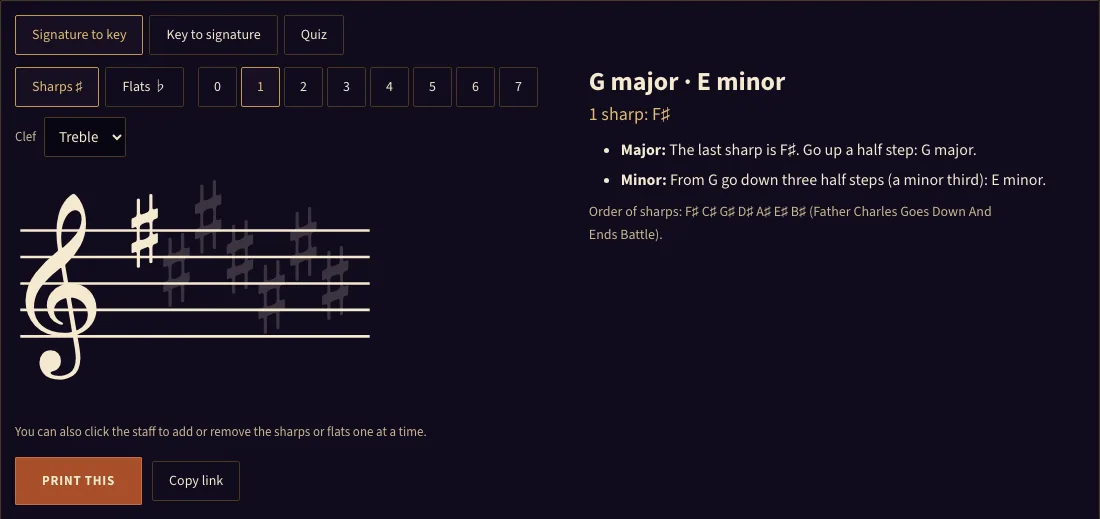
How to use the key signature finder
- Open the Signature to key tab. It is selected by default.
- Choose Sharps ♯ or Flats ♭. Then pick a count from 0 to 7 with the count buttons. Use 0 for no accidentals.
- Choose a clef from the Clef menu: Treble, Bass, or Alto. The staff draws the signature, and unused slots appear as faint ghosts.
- Read the result under the staff. It gives the key names (for example, G major · E minor), the rule that leads to them, and the order line.
- To go the other way, open Key to signature and pick one of the 30 keys from the key select. The page shows the signature on Treble and Bass staves. Click ▶ Play the scale to hear the scale.
- Open Quiz, choose Major keys, Minor keys, or Both, and pick a clef. Click Start the quiz to answer 10 questions. The result shows your score and a review list of your mistakes.
Under the staff, you can also click the staff itself to add or remove accidentals one at a time. Keyboard users can use the count buttons instead. Copy link saves your settings in the address, such as ?s=3f&clef=bass. Print this prints the current result on one page. Print quiz sheet + answers builds a new 10-question sheet from your current settings, with an answer key on page 2.
Identifying key signatures: how do you name the key?#
Count the accidentals and note whether they are sharps or flats. Then apply one rule. With sharps, the last sharp is the leading tone of the key, so go up a half step from it to find the major key. With flats, the second-to-last flat is the name of the major key. The exception is one flat, which always means F major.
What is the order of sharps and flats?#
Sharps always appear in this order: F♯ C♯ G♯ D♯ A♯ E♯ B♯. Flats always appear in this order: B♭ E♭ A♭ D♭ G♭ C♭ F♭. Each new sharp is a fifth above the previous one, and each new flat is a fifth below it. The tool’s memory aid for sharps is “Father Charles Goes Down And Ends Battle,” and for flats it reads the same words backward.
How do you tell if a key signature is major or minor?#
A key signature by itself cannot tell you the mode. Each signature belongs to one major key and one relative minor key. To find the minor key, go down three half steps (a minor third) from the major tonic. For example, 3 sharps is A major and F♯ minor, and 4 flats is A♭ major and F minor. Check the melody and chords of the music to decide which one you are in.
What key has 2 sharps or 3 flats?#
A 2 sharps key is D major or B minor. A 3 flats key is E♭ major or C minor. The same method works for the other signatures:
- A 2 flats key is B♭ major or G minor.
- A 4 sharp key is E major or C♯ minor.
- A 4 flats key is A♭ major or F minor.
- A 5 flats key is D♭ major or B♭ minor.
How are key signatures written in bass clef?#
The sharps and flats keep the same order in bass clef, but they sit on different lines. The clef changes which note each line represents. In bass clef, the first sharp, F♯, sits on the second line from the top, while in treble clef it sits on the top line. Bass staves use the same accidentals as treble, so you can check any bass signature by counting from the same starting point.
How many key signatures are there?#
There are 15 key signatures: no accidentals, 1 to 7 sharps, and 1 to 7 flats. Each signature belongs to a major key and a relative minor key, so there are 30 keys in total. Some signatures have two spellings of the same sound. For example, 6 sharps (F♯ major) and 6 flats (G♭ major) sound the same, and both spellings are correct.
Frequently asked questions
Is the key signature finder free, and does it need an account?
Can I print it?
Can I use the printouts commercially?
What is a key sig?
What is the 4 sharp key?
Does the tool show enharmonic key signatures?
Can I share the exact view I am looking at?
Updated