
Printable chart
Major scales chart: all 15 major scales
Scale degrees
Chords on each degree
| Degree | Chord | Numeral | Notes | Seventh |
|---|
Major scales for all 15 keys: pick a key to see and hear its notes on a staff and keyboard, the W-W-H-W-W-W-H pattern and its chords, then print.
Two pages, A4 or Letter. Fingerings are not included.
Download the PDF
Free to print and share. No sign-up, no e-mail, no watermark. A4 for most of the world, Letter for the US and Canada; both are black and white, with the fonts embedded.
The 15 major scales in one line each
There are 15 major scales in standard notation: C major with no sharps or flats, 7 sharp keys (G, D, A, E, B, F♯, C♯) and 7 flat keys (F, B♭, E♭, A♭, D♭, G♭, C♭). Every one is built the same way, from its first note: W W H W W W H (whole step, whole step, half step, whole step, whole step, whole step, half step). Only the starting note changes; the sharps or flats are whatever the pattern needs.
- 15 scales written
- 12 that sound different
- 3 enharmonic pairs
- 182 automatic checks on the data
On this page: printable chart with staves · every note in a table · how the pattern builds a scale · enharmonic pairs · keys in real music · questions
Major scales chart page 1 of 2
C major and the seven sharp keys
Pattern, going up from the first note (W = whole step, H = half step): W – W – H – W – W – W – H. The small letters between the note names show each step.
musictheoryprint.com/major-scales-chart · Free to print and share. Each scale is written with the key signature of its key.
Major scales chart page 2 of 2
The seven flat keys
Pattern, going up from the first note (W = whole step, H = half step): W – W – H – W – W – W – H. The small letters between the note names show each step.
musictheoryprint.com/major-scales-chart · Free to print and share. Each scale is written with the key signature of its key.
All 15 major scales, note by note
Read across for one scale, or down a column to compare the same scale degree in every key. Notes with a sharp or flat are in bold: they are exactly the notes of the key signature.
| Major scale | Key signature | 1 | 2 | 3 | 4 | 5 | 6 | 7 | Relative minor | Key page |
|---|---|---|---|---|---|---|---|---|---|---|
| C major | none | C | D | E | F | G | A | B | A minor | C major |
| G major | 1♯ | G | A | B | C | D | E | F♯ | E minor | G major |
| D major | 2♯ | D | E | F♯ | G | A | B | C♯ | B minor | D major |
| A major | 3♯ | A | B | C♯ | D | E | F♯ | G♯ | F♯ minor | A major |
| E major | 4♯ | E | F♯ | G♯ | A | B | C♯ | D♯ | C♯ minor | E major |
| B major | 5♯ | B | C♯ | D♯ | E | F♯ | G♯ | A♯ | G♯ minor | B major |
| F♯ major | 6♯ | F♯ | G♯ | A♯ | B | C♯ | D♯ | E♯ | D♯ minor | F♯ major |
| C♯ major | 7♯ | C♯ | D♯ | E♯ | F♯ | G♯ | A♯ | B♯ | A♯ minor | see D♭ major |
| F major | 1♭ | F | G | A | B♭ | C | D | E | D minor | F major |
| B♭ major | 2♭ | B♭ | C | D | E♭ | F | G | A | G minor | B♭ major |
| E♭ major | 3♭ | E♭ | F | G | A♭ | B♭ | C | D | C minor | E♭ major |
| A♭ major | 4♭ | A♭ | B♭ | C | D♭ | E♭ | F | G | F minor | A♭ major |
| D♭ major | 5♭ | D♭ | E♭ | F | G♭ | A♭ | B♭ | C | B♭ minor | D♭ major |
| G♭ major | 6♭ | G♭ | A♭ | B♭ | C♭ | D♭ | E♭ | F | E♭ minor | see F♯ major |
| C♭ major | 7♭ | C♭ | D♭ | E♭ | F♭ | G♭ | A♭ | B♭ | A♭ minor | see B major |
Column numbers are the scale degrees: 1 is the tonic (the key note), 5 the dominant, 7 the leading tone. The octave note repeats the first. The spelling follows one rule: each of the seven letter names is used once, which is why F♯ major has E♯ and C♭ major has F♭.
How W–W–H–W–W–W–H builds a major scale
The same eight steps in four of the scales. Only the notes change; the distance between neighbours never does. On a piano, a half step is the very next key (black or white) and a whole step skips one key.
| Degree | Name | Sol-fa | Step up | Half steps from tonic | C major | G major | F major | E♭ major |
|---|---|---|---|---|---|---|---|---|
| 1 | Tonic | Do | — | 0 | C | G | F | E♭ |
| 2 | Supertonic | Re | W | 2 | D | A | G | F |
| 3 | Mediant | Mi | W | 4 | E | B | A | G |
| 4 | Subdominant | Fa | H | 5 | F | C | B♭ | A♭ |
| 5 | Dominant | Sol | W | 7 | G | D | C | B♭ |
| 6 | Submediant | La | W | 9 | A | E | D | C |
| 7 | Leading tone | Ti | W | 11 | B | F♯ | E | D |
| 8 | Tonic | Do | H | 12 | C | G | F | E♭ |
Worked example: F♯ major
- F♯ → G♯: W (2 half steps)
- G♯ → A♯: W (2 half steps)
- A♯ → B: H (1 half step)
- B → C♯: W (2 half steps)
- C♯ → D♯: W (2 half steps)
- D♯ → E♯: W (2 half steps)
- E♯ → F♯: H (1 half step)
Seven letters, each once: F, G, A, B, C, D, E. The last note below the octave is E♯, because it must be a form of E; it sounds like F.
One new note for each step around the circle of fifths
Going up a fifth (C to G, G to D, …) keeps six of the seven notes and changes one:
- C♭ major → G♭ major: F♭ becomes F
- G♭ major → D♭ major: C♭ becomes C
- D♭ major → A♭ major: G♭ becomes G
- A♭ major → E♭ major: D♭ becomes D
- E♭ major → B♭ major: A♭ becomes A
- B♭ major → F major: E♭ becomes E
- F major → C major: B♭ becomes B
- C major → G major: F becomes F♯
- G major → D major: C becomes C♯
- D major → A major: G becomes G♯
- A major → E major: D becomes D♯
- E major → B major: A becomes A♯
- B major → F♯ major: E becomes E♯
- F♯ major → C♯ major: B becomes B♯
Enharmonic major scales: three pairs that are one scale on the piano
With 15 written scales but only 12 notes in the octave, three pairs share the same keys. Which spelling is used depends on the key signature a piece needs, and in practice composers choose the one with fewer sharps or flats. The counts show how the 1,462 art songs of the OpenScore Lieder corpus are written: the key signature is read exactly from the score, so the number for each spelling is a direct count (that the song is in the major key is the corpus’s estimate).
| Pair | Spelling | Key signature | Notes | Lieder songs written this way |
|---|---|---|---|---|
| B = C♭ | B major | 5♯ | B C♯ D♯ E F♯ G♯ A♯ | 40 |
| C♭ major | 7♭ | C♭ D♭ E♭ F♭ G♭ A♭ B♭ | 0 | |
| F♯ = G♭ | F♯ major | 6♯ | F♯ G♯ A♯ B C♯ D♯ E♯ | 13 |
| G♭ major | 6♭ | G♭ A♭ B♭ C♭ D♭ E♭ F | 14 | |
| C♯ = D♭ | C♯ major | 7♯ | C♯ D♯ E♯ F♯ G♯ A♯ B♯ | 3 |
| D♭ major | 5♭ | D♭ E♭ F G♭ A♭ B♭ C | 46 |
Every spelling in a pair is a different name for the same keys: play B major and C♭ major on a piano and you press the same seven keys. The page for each pair covers both spellings under the name with fewer accidentals (for C♯ major see D♭ major, for G♭ major see F♯ major, for C♭ major see B major).
Which major keys do composers actually use?
There is no single most common key: it depends on what is counted. The leading key is C major in three of the six (Mutopia 18.6%, Open Opus titles 11.6%, AcousticBrainz 8.2%); D major in two of the six (MusicBrainz (key field) 11.4%, MusicBrainz (key in title) 11.0%); F major in one of the six (OpenScore Lieder 8.9%). C major, F major and G major are in the top five of every dataset, and minor keys make up 25.6% to 42.9% of the keyed items (major is always the majority).
| Major key | OpenScore Liedern = 1,462 | Mutopian = 1,974 | MusicBrainz (key field)n = 13,669 | MusicBrainz (key in title)n = 5,340 | Open Opus titlesn = 3,587 | AcousticBrainzn = 63,124 |
|---|---|---|---|---|---|---|
| C major | 6.5% | 18.6% | 10.6% | 8.7% | 11.6% | 8.2% |
| G major | 8.1% | 14.5% | 9.8% | 8.9% | 8.7% | 6.7% |
| D major | 6.8% | 9.9% | 11.4% | 11.0% | 11.0% | 6.0% |
| A major | 5.1% | 6.1% | 6.0% | 6.9% | 5.8% | 5.2% |
| E major | 6.2% | 3.2% | 3.2% | 2.8% | 2.7% | 4.1% |
| B major | 2.7% | 0.4% | 0.7% | 0.5% | 0.4% | 1.7% |
| F♯ major | 1.9% | 0.7% | 0.7% | 0.6% | 0.5% | 1.9% |
| F major | 8.9% | 9.5% | 7.9% | 7.4% | 8.4% | 7.8% |
| B♭ major | 4.8% | 4.8% | 6.1% | 5.2% | 8.3% | 6.4% |
| E♭ major | 8.7% | 4.0% | 5.8% | 5.6% | 7.4% | 3.7% |
| A♭ major | 5.9% | 1.9% | 1.4% | 1.2% | 1.3% | 2.6% |
| D♭ major | 3.4% | 0.8% | 1.1% | 0.7% | 0.3% | 2.7% |
Datasets: 1,462 OpenScore Lieder art songs, 1,974 Mutopia scores with a key, 13,669 MusicBrainz works with an editor-entered key and 5,340 with a key in the title, 3,587 Open Opus titles with a key, and 63,124 recordings with a machine-estimated key. This says which keys are common in these collections, mostly Western classical and art music, not in all music. Enharmonic spellings are merged here: the D♭ major row includes C♯ major, F♯ major includes G♭ major, and B major includes C♭ major.
Sharp keys or flat keys? It depends on the instrument
Of 364 guitar-solo scores in the Mutopia Project, 59.1% have a key signature with sharps and only 11.0% have flats. For 484 piano-solo scores it is the other way round: 43.0% flats against 34.7% sharps. C major is the commonest key for both (24.7% of guitar scores, 15.1% of piano scores), but the guitar then goes G, D, A and E major while the piano goes G major, F major, A minor and B♭ major.
Dataset: the Mutopia Project, 2,129 scores of which 364 guitar-solo and 484 piano-solo scores have a readable key. Solo means the score lists one instrument family. The key is the first key signature of the MIDI file made from the score. This is a collection of free-to-use scores (mostly Baroque to Romantic), not a sample of all guitar or piano music.
musictheoryprint.com · free to print and share
Background
Excerpts from open reference works, reproduced as published (references, images and tables removed). Every excerpt names its source, licence and original article.
In brief
A major scale is a sequence of musical notes containing a major triad on the tonic.
Most commonly, the term "major scale" refers to the natural major scale (or Ionian mode), which is one of the most commonly used musical scales, especially in Western music. It is one of the diatonic scales. Like many musical scales, it is made up of seven notes: the eighth duplicates the first at double its frequency so that it is called a higher octave of the same note (from Latin "octavus", the eighth). The notes C–D–E–F–G–A–B form a prototypical major scale.
Source: Wikipedia, “Major scale” — CC BY-SA 4.0 — text excerpted; see the article for the full text and authors. Revision of 2026-06-17.
Major scale
Natural major scale
The natural major scale is the diatonic Ionian mode.
The major scale has a central importance in Western music, particularly that of the common practice period and in popular music.
In Carnatic music, it is known as Sankarabharanam. In Hindustani classical music, it is known as Bilaval.
A major scale may be seen as two identical tetrachords separated by a whole tone. Each tetrachord consists of two whole tones followed by a semitone (i.e. whole, whole, half).
The major scale is maximally even.
Scale degrees
The scale degrees are named:
- 1st: Tonic
- 2nd: Supertonic
- 3rd: Mediant
- 4th: Subdominant
- 5th: Dominant
- 6th: Submediant
- 7th: Leading tone
- 8th: Tonic
Relationship to major keys
If a piece of music (or part of a piece of music) is in a major key, then the notes in the corresponding major scale are considered diatonic notes, while the notes outside the major scale are considered chromatic notes. Moreover, the key signature of the piece of music (or section) will generally reflect the accidentals in the corresponding major scale.
For instance, if a piece of music is in E♭ major, then the seven pitches in the E♭ major scale (E♭, F, G, A♭, B♭, C and D) are considered diatonic pitches, and the other five pitches (E♮, F♯/G♭, A♮, B♮, and C♯/D♭) are considered chromatic pitches. In this case, the key signature will have three flats (B♭, E♭, and A♭).
Source: Wikipedia, “Major scale” — CC BY-SA 4.0 — text excerpted; see the article for the full text and authors. Revision of 2026-06-17.
Enharmonic equivalence: why B major and C♭ major are one key
Definition
The predominant tuning system in Western music is twelve-tone equal temperament (12 tet), where each octave is divided into twelve equal half-steps, or semitones; each half-step is both a chromatic semitone (a sharp or a flat) and a diatonic semitone (a minor step between two diatonic notes). The notes F and G are a whole step apart, so the note one semitone above F (F♯) and the note one semitone below G (G♭) indicate the same pitch. These written notes are enharmonic, or enharmonically equivalent. The choice of notation for a pitch can depend on its role in harmony; this notation keeps modern music compatible with earlier tuning systems, such as meantone temperaments. The choice can also depend on the note's readability in the context of the surrounding pitches. Multiple sharps or flats can produce other enharmonic equivalents; for example, F 𝄪 (double-sharp) is enharmonically equivalent to G♮.
When other tuning systems were in use, prior to the adoption of 12 tet, the term enharmonic referred to notes that were very close in pitch — closer than the smallest step of a diatonic scale — but not quite identical. In a tuning system without equal half steps, F♯ and G♭ do not indicate the same pitch, although the two pitches would be called enharmonically equivalent.
Sets of notes that involve pitch relationships — scales, key signatures, or intervals, for example — can also be referred to as enharmonic (e.g, in 12 tet the keys of C♯ major and D♭ major contain identical pitches and are therefore enharmonic). Identical intervals notated with different, enharmonically equivalent, written pitches are also referred to as enharmonic. The interval of a tritone above C may be written as a diminished fifth from C to G♭, or as an augmented fourth (C to F♯). In modern 12 tet, notating the C as a B♯ leads to other enharmonically equivalent notations, an option which does not exist in most earlier notation systems.
Enharmonic equivalents can be used to improve the readability of music, as when a sequence of notes is more easily read using sharps or flats. This may also reduce the number of accidentals required.
Examples
At the end of the bridge section of Jerome Kern's "All the Things You Are", a G♯ (the sharp 5th of an augmented C chord) becomes an enharmonically equivalent A♭ (the third of an F minor chord) at the beginning of the returning A section.
Chopin's Prelude No. 15, known as the "Raindrop Prelude", features a pedal point on the note A♭ throughout its opening section.
Enharmonic key
Some key signatures have an enharmonic equivalent that contains the same pitches, albeit spelled differently. In twelve-tone equal temperament, there are three pairs each of major and minor enharmonically equivalent keys: B major/C♭ major, G♯ minor/A♭ minor, F♯ major/G♭ major, D♯ minor/E♭ minor, C♯ major/D♭ major and A♯ minor/B♭ minor.
If a key were to use more than 7 sharps or flats it would require at least one double flat or double sharp. These key signatures are extremely rare since they have enharmonically equivalent keys with simpler, conventional key signatures. For example, G sharp major would require eight sharps (six sharps plus F double-sharp), but would almost always be replaced by the enharmonically equivalent key signature of A flat major, with four flats.
Source: Wikipedia, “Enharmonic equivalence” — CC BY-SA 4.0 — text excerpted; see the article for the full text and authors. Revision of 2026-01-26.
Key signature: major scale structure
Scales with sharp key signatures
There can be up to seven sharps in a key signature, appearing in this order: F♯ C♯ G♯ D♯ A♯ E♯ B♯. The key note or tonic of a piece in a major key is a semitone above the last sharp in the signature. For example, the key of D major has a key signature of F♯ and C♯, and the tonic (D) is a semitone above C♯. Each scale starting on the fifth scale degree of the previous scale has one new sharp, added in the order shown.
Scales with flat key signatures
There can be up to seven flats in a key signature, applied as: B♭ E♭ A♭ D♭ G♭ C♭ F♭ The major scale with one flat is F major. In all major scales with flat key signatures, the tonic in a major key is a perfect fourth below the last flat. When there is more than one flat, the tonic is the note of the second-to-last flat in the signature. In the major key with four flats (B♭ E♭ A♭ D♭), for example, the second to last flat is A♭, indicating a key of A♭ major. Each new scale starts a fifth below (or a fourth above) the previous one.
Source: Wikipedia, “Key signature” — CC BY-SA 4.0 — text excerpted; see the article for the full text and authors. Revision of 2026-06-17.
Sources and licences for the text, scores and recordings on this page are on the credits page.
Sources: Wikipedia: Major scale, Wikipedia: Enharmonic equivalence, Wikipedia: Key signature.
About the major scale builder
A major scale is a seven-note pattern of whole and half steps, and this free tool shows the major scales of all 15 major keys in your web browser. Pick a key and the page draws the scale on a staff, labels it on a two-octave keyboard, lists the key signature, and builds a table of the chords on each degree. You can play the scale or any chord, print the result, or copy a link to your exact setup. It is free with no sign-up, and nothing is uploaded. Whether you are learning piano scales, looking for a scale chart piano reference, or checking the chords in a major key such as D or E for guitar, the chart gives you the notes and chord names in one place.
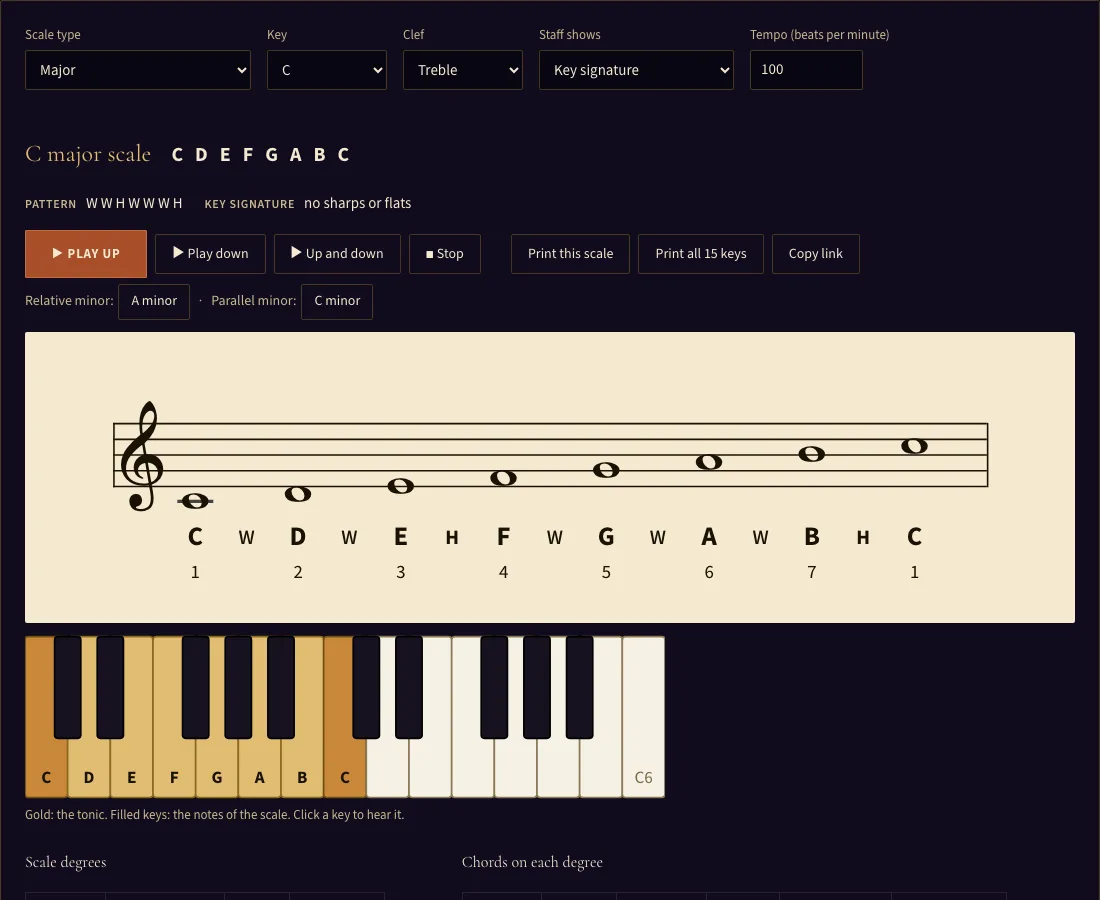
How to use the Major Scale Chart
- Check that Scale type is set to Major.
- Open the Key menu and choose a key. The 15 keys are listed with the sharp keys first (C G D A E B F♯ C♯), then the flat keys.
- Set Clef to Treble or Bass.
- Set Staff shows to Key signature (the default, which marks only notes that differ from the signature) or Accidentals on the notes (which signs every altered note).
- Set Tempo (40 to 240 beats per minute, default 100) for playback.
- Press Play up, Play down or Up and down to hear the scale. Press Stop to end playback.
- In the chord table, press ▶ for a triad or ▶7 for the seventh chord; click any keyboard key to hear its note.
- Use Relative minor/major, Parallel minor/major or Same sounds, other spelling to jump to a related key.
- Press Print this scale for the full result, Print all 15 keys for a sheet of every key, or Copy link to save your setup as a URL.
The page opens on C major in treble clef, with key signature notation and a tempo of 100. To explore another key:
A printed scale usually runs to two A4 pages, with the chord table on page 2.
What is a major scale?#
A major scale is a set of seven different notes, ordered by a fixed pattern of steps, that starts and ends on the same note, called the tonic. It is the reference sound that much Western music is built on, and the major key takes its name from it.
What is the major scale pattern (whole and half steps)?#
The pattern is W W H W W W H: whole, whole, half, whole, whole, whole, half. A whole step is two semitones (two piano keys apart, counting black keys), and a half step is one semitone. Start on any note and follow this pattern to build a major scale. The tool shows this pattern for every key in its Pattern line.
How many major scales are there?#
There are 15 major key spellings but only 12 different starting pitches. Three pairs share the same sounds with different spellings: F♯ and G♭, C♯ and D♭, and B and C♭.
What are the notes of the C major scale?#
C major uses the notes C, D, E, F, G, A and B, then returns to C. It has no sharps or flats, so it is played on the white keys of a piano from C to the next C. Its steps follow the pattern exactly: C to D is a whole step, D to E is whole, E to F is half, and so on through B to C, which is half. In treble clef the tonic sits at C4.
What are the chords in a major scale?#
Build a triad, a stack of three notes each a third apart, on each scale degree using only the notes of the scale. In every major key the chords follow the pattern I, ii, iii, IV, V, vi, vii°: major, minor, minor, major, major, minor and diminished. In C major that gives C, Dm, Em, F, G, Am and Bdim. Adding a fourth note to each triad gives the seventh chords Cmaj7, Dm7, Em7, Fmaj7, G7, Am7 and Bm7♭5. The same pattern works in every key, so D major gives D, Em, F♯m, G, A, Bm and C♯dim, and E major gives E, F♯m, G♯m, A, B, C♯m and D♯dim. B major gives B, C♯m, D♯m, E, F♯, G♯m and A♯dim. The chord table lists these for the key you choose.
Which major scales have sharps and which have flats?#
G, D, A, E, B, F♯ and C♯ major have sharps, with one to seven sharps. F, B♭, E♭, A♭, D♭, G♭ and C♭ major have flats, with one to seven flats. C major has neither. Sharps are added in the order F, C, G, D, A, E, B, and flats in the order B, E, A, D, G, C, F. The key signature list in the tool shows which notes are altered for each key.
Frequently asked questions
Is the Major Scale Chart free, and does it need an account?
Can I print it?
Can I use the printouts commercially?
Can I switch to minor scales or bass clef?
Why do some keys have two names?
Does the tool play the sound?
Can I share my setup?
Updated