
Mandolin Chords
Mandolin chords for every root: pick a chord and see up to four fingerings as diagrams, hear each one strummed, in G D A E tuning. Free.
About the Mandolin Chords
This is a free mandolin chord finder that runs in your web browser. Pick a root note and a chord type, and the page shows the notes in the chord along with fingerings you can play on a mandolin tuned G D A E. No sign-up is needed. The page covers 14 root spellings and 15 chord types, so you can look up a mandolin chord chart entry for almost any common chord, from simple major and minor triads to dominant 7ths and 9ths.
The fingerings are built for beginners and for anyone who wants to check a shape quickly. Each option shows a diagram, the fret numbers, and the note each string plays. You can also hear the chord strummed, which helps you confirm a shape before you practise it.
How to use the mandolin chords
- Open the page. It starts on G major, with the chord name and its notes shown below the tool.
- Open the Root note menu and choose the note the chord is built on, such as D or B♭.
- Open the Chord type menu and choose a type, such as Minor, Dominant 7th (7) or Add 9 (add9).
- Read the Notes in the chord line to see which notes you are working with.
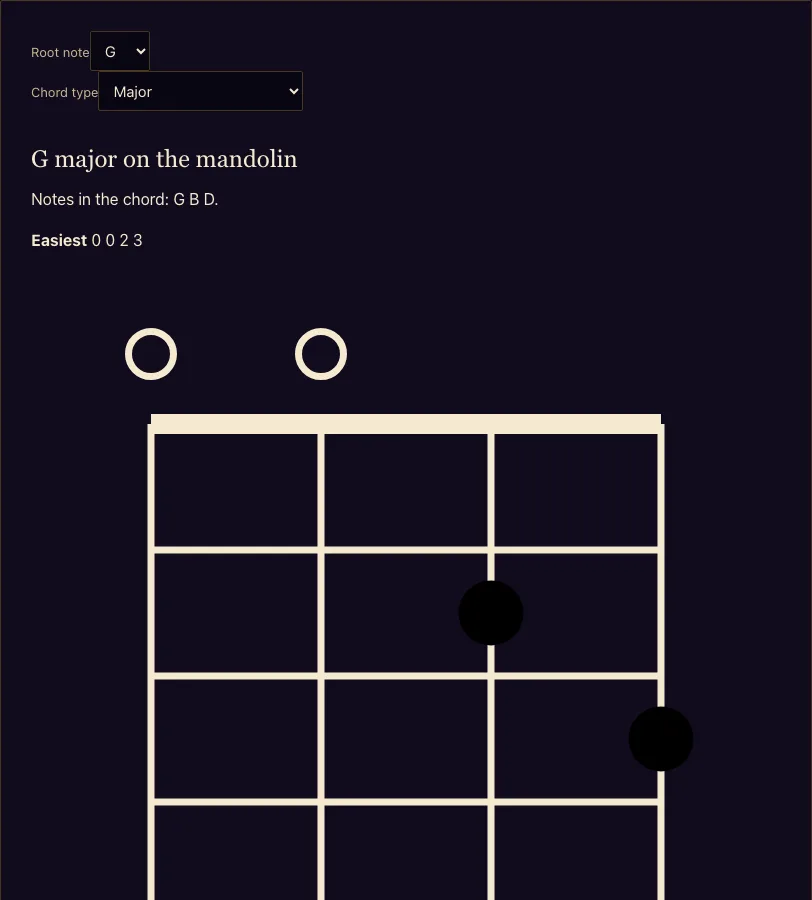
- Look at the first fingering card, labelled Easiest. Place your fingers where the dots are, and play the strings marked with an open circle or a fretted dot.
- Press ▶ Strum on a card to hear the strings played from low to high.
- Check the Option 2 to Option 4 cards if the first shape is awkward for your hand.
- Look at the fret numbers above each diagram. A 0 means an open string and an x means the string is not played.
- If a diagram starts higher up the neck, a label such as 5fr shows the fret where it begins.
- Change the Root note or Chord type at any time. The address bar updates, so you can copy the link to a chord.
Sound stays off until you click, touch or press a key on the page, so the first press may start the audio. The address bar keeps your root and chord type, so a link such as ?root=D&type=minor opens the same chord.
What are the basic mandolin chords (G, C, D, A, E minor)?#
The basic open shapes are G major, C major, D major, A major and E minor. These are the chords most players learn first because they use open strings, which sound without a finger on them. On this tool, G major is 0 0 2 3, C major is 0 2 3 0, D major is 2 0 0 2, and E minor is 0 2 2 0. A major appears among the options as 2 2 4 0.
The chord finder works out these shapes from the notes. For G major, the open G and D strings plus a finger on the 2nd fret of the A string and the 3rd fret of the E string sound G, D, B and G.
How do you read a mandolin chord diagram?#
A diagram shows the four strings as vertical lines, with the lowest string (G) on the left and the highest (E) on the right. Horizontal lines are frets, and a filled dot shows where a finger goes. An open circle above a string means you play it without pressing any fret, and an x means you do not play that string.
When a shape sits higher up the neck, the diagram starts at that fret, and a label such as “5fr” shows the starting fret. The row of numbers under each diagram lists the frets in the same left-to-right order as the strings.
What is the mandolin tuning (G D A E)?#
The mandolin is tuned G D A E, which are the notes G3, D4, A4 and E5. Each interval is a perfect fifth, and these are the same notes as the violin’s open strings. The tool uses this tuning for every fingering.
Can I move a mandolin chord up the neck?#
Yes, a shape with no open strings can slide up or down the neck. Moving it up one fret raises every note by a semitone, so the chord rises by a half step. Moving a shape from the 5th fret to the 7th fret raises the chord by two semitones.
A shape with an open string cannot slide this way, because the open string does not move with your fingers. In the tool, a fingering with no 0 in it is a closed shape that can be moved.
How many strings does a mandolin have?#
A standard mandolin has eight strings in four pairs, called courses. Each pair is tuned in unison, so it sounds as one note played on two strings. The tool treats each pair as a single string, which is why every diagram has four lines.
Is the mandolin chord finder free?#
Yes, the chord finder is free, and it needs no sign-up. It runs in your browser, and nothing you choose is uploaded. Sound is generated live in the browser, so no audio samples are downloaded. The page sets no cookies and records nothing.
The chord finder searches every combination of open and fretted strings up to the 9th fret. It keeps only the fingerings that use notes from the chord, include the root and the other required notes, and sound all four strings within a hand span of four frets. The fifth can be left out of seventh and ninth chords. The fingerings are ranked with open strings and low frets first, then a narrow stretch, then the root as the lowest note.
Frequently asked questions
Why is there no sound when I open the page?
What does the Strum button do?
Why is there no plain diminished chord in the menu?
What happens if a chord has no fingering?
Does the tool show songs, tablature or strumming patterns?
Can I use the tool for other tunings or instruments with more strings?
What pitch standard does the sound use?
Updated

