
Printable chart
Minor scales chart: natural, harmonic and melodic minor
Scale degrees
Chords on each degree
| Degree | Chord | Numeral | Notes | Seventh |
|---|
Minor scales in natural, harmonic and melodic form for all 15 keys: notes on a staff and keyboard, step pattern, chords and relative major. Print free.
A one-page table of note names, plus four pages with the scales on the staff. A4 or Letter.
Download the PDF kit
Free to print and share. No sign-up, no e-mail, no watermark. A4 for most of the world, Letter for the US and Canada; both are black and white, with the fonts embedded.
Natural, harmonic and melodic minor: the short answer
There are 15 minor keys in standard notation, and each has three scales. The natural minor scale uses only the notes of the key signature. The harmonic minor raises the 7th note by a half step. The melodic minor raises the 6th and 7th notes going up and goes back to the natural minor notes coming down. In A minor: natural A B C D E F G; harmonic A B C D E F G♯; melodic up A B C D E F♯ G♯, melodic down A G F E D C B.
- 15 minor keys
- 45 scales (3 forms each)
- 3 enharmonic pairs
- 359 automatic checks on the data
On this page: printable table of all notes · printable staves · the three forms side by side · relative and parallel majors · minor in real songs · questions
Minor scales chart all 15 keys
Natural, harmonic and melodic · note names
Underlined notes are the ones raised from the natural minor (the key signature). Melodic minor going up raises two notes; going down it is the natural minor again. W = whole step, H = half step: natural W H W W H W W; harmonic W H W W H W+H H; melodic up W H W W W W H.
| Minor key | Natural | Harmonic | Melodic |
|---|---|---|---|
| A minorno ♯/♭ · rel. C major | A B C D E F G A | A B C D E F G♯ A | ↑A B C D E F♯ G♯ A ↓A G F E D C B A |
| E minor1♯ · rel. G major | E F♯ G A B C D E | E F♯ G A B C D♯ E | ↑E F♯ G A B C♯ D♯ E ↓E D C B A G F♯ E |
| B minor2♯ · rel. D major | B C♯ D E F♯ G A B | B C♯ D E F♯ G A♯ B | ↑B C♯ D E F♯ G♯ A♯ B ↓B A G F♯ E D C♯ B |
| F♯ minor3♯ · rel. A major | F♯ G♯ A B C♯ D E F♯ | F♯ G♯ A B C♯ D E♯ F♯ | ↑F♯ G♯ A B C♯ D♯ E♯ F♯ ↓F♯ E D C♯ B A G♯ F♯ |
| C♯ minor4♯ · rel. E major | C♯ D♯ E F♯ G♯ A B C♯ | C♯ D♯ E F♯ G♯ A B♯ C♯ | ↑C♯ D♯ E F♯ G♯ A♯ B♯ C♯ ↓C♯ B A G♯ F♯ E D♯ C♯ |
| G♯ minor5♯ · rel. B major= A♭ minor | G♯ A♯ B C♯ D♯ E F♯ G♯ | G♯ A♯ B C♯ D♯ E F𝄪 G♯ | ↑G♯ A♯ B C♯ D♯ E♯ F𝄪 G♯ ↓G♯ F♯ E D♯ C♯ B A♯ G♯ |
| D♯ minor6♯ · rel. F♯ major= E♭ minor | D♯ E♯ F♯ G♯ A♯ B C♯ D♯ | D♯ E♯ F♯ G♯ A♯ B C𝄪 D♯ | ↑D♯ E♯ F♯ G♯ A♯ B♯ C𝄪 D♯ ↓D♯ C♯ B A♯ G♯ F♯ E♯ D♯ |
| A♯ minor7♯ · rel. C♯ major= B♭ minor | A♯ B♯ C♯ D♯ E♯ F♯ G♯ A♯ | A♯ B♯ C♯ D♯ E♯ F♯ G𝄪 A♯ | ↑A♯ B♯ C♯ D♯ E♯ F𝄪 G𝄪 A♯ ↓A♯ G♯ F♯ E♯ D♯ C♯ B♯ A♯ |
| D minor1♭ · rel. F major | D E F G A B♭ C D | D E F G A B♭ C♯ D | ↑D E F G A B C♯ D ↓D C B♭ A G F E D |
| G minor2♭ · rel. B♭ major | G A B♭ C D E♭ F G | G A B♭ C D E♭ F♯ G | ↑G A B♭ C D E F♯ G ↓G F E♭ D C B♭ A G |
| C minor3♭ · rel. E♭ major | C D E♭ F G A♭ B♭ C | C D E♭ F G A♭ B C | ↑C D E♭ F G A B C ↓C B♭ A♭ G F E♭ D C |
| F minor4♭ · rel. A♭ major | F G A♭ B♭ C D♭ E♭ F | F G A♭ B♭ C D♭ E F | ↑F G A♭ B♭ C D E F ↓F E♭ D♭ C B♭ A♭ G F |
| B♭ minor5♭ · rel. D♭ major= A♯ minor | B♭ C D♭ E♭ F G♭ A♭ B♭ | B♭ C D♭ E♭ F G♭ A B♭ | ↑B♭ C D♭ E♭ F G A B♭ ↓B♭ A♭ G♭ F E♭ D♭ C B♭ |
| E♭ minor6♭ · rel. G♭ major= D♯ minor | E♭ F G♭ A♭ B♭ C♭ D♭ E♭ | E♭ F G♭ A♭ B♭ C♭ D E♭ | ↑E♭ F G♭ A♭ B♭ C D E♭ ↓E♭ D♭ C♭ B♭ A♭ G♭ F E♭ |
| A♭ minor7♭ · rel. C♭ major= G♯ minor | A♭ B♭ C♭ D♭ E♭ F♭ G♭ A♭ | A♭ B♭ C♭ D♭ E♭ F♭ G A♭ | ↑A♭ B♭ C♭ D♭ E♭ F G A♭ ↓A♭ G♭ F♭ E♭ D♭ C♭ B♭ A♭ |
musictheoryprint.com/minor-scales-chart · Free to print and share. 𝄪 = double sharp.
Minor scales on the staff page 1 of 4
A, E, B and F♯ minor (0 to 3 sharps)
A minor
No sharps or flats · relative major C major
E minor
1 sharp: F♯ · relative major G major
B minor
2 sharps: F♯ C♯ · relative major D major
F♯ minor
3 sharps: F♯ C♯ G♯ · relative major A major
Minor scales on the staff page 2 of 4
C♯, G♯, D♯ and A♯ minor (4 to 7 sharps)
C♯ minor
4 sharps: F♯ C♯ G♯ D♯ · relative major E major
G♯ minor
5 sharps: F♯ C♯ G♯ D♯ A♯ · relative major B major · same keys as A♭ minor
D♯ minor
6 sharps: F♯ C♯ G♯ D♯ A♯ E♯ · relative major F♯ major · same keys as E♭ minor
A♯ minor
7 sharps: F♯ C♯ G♯ D♯ A♯ E♯ B♯ · relative major C♯ major · same keys as B♭ minor
Minor scales on the staff page 3 of 4
D, G, C and F minor (1 to 4 flats)
D minor
1 flat: B♭ · relative major F major
G minor
2 flats: B♭ E♭ · relative major B♭ major
C minor
3 flats: B♭ E♭ A♭ · relative major E♭ major
F minor
4 flats: B♭ E♭ A♭ D♭ · relative major A♭ major
Minor scales on the staff page 4 of 4
B♭, E♭ and A♭ minor (5 to 7 flats)
B♭ minor
5 flats: B♭ E♭ A♭ D♭ G♭ · relative major D♭ major · same keys as A♯ minor
E♭ minor
6 flats: B♭ E♭ A♭ D♭ G♭ C♭ · relative major G♭ major · same keys as D♯ minor
A♭ minor
7 flats: B♭ E♭ A♭ D♭ G♭ C♭ F♭ · relative major C♭ major · same keys as G♯ minor
The three minor scales side by side, in A minor
Only two notes ever change, the 6th and the 7th. Natural minor is the plain scale of the key signature. Harmonic minor raises the 7th, which gives the key a leading tone, a note a half step below the tonic that pulls up to it, at the price of a gap of three half steps (an augmented second) between the 6th and the 7th. Melodic minor smooths that gap by raising the 6th as well, but only going up; coming down it returns to the natural minor notes.
The notes of the key signature, nothing raised. In A minor these are the white keys, the same notes as C major starting on A.
The 7th is raised: G becomes G♯. The step from F to G♯ is W+H, an augmented second.
The 6th and 7th are raised: F becomes F♯ and G becomes G♯. All steps are whole or half.
Back to the notes of the natural minor, read from the top. This is the traditional rule of classical theory.
| Degree | Natural | Harmonic | Melodic up | Melodic down |
|---|---|---|---|---|
| 1 | A | A | A | A |
| 2 | B | B | B | B |
| 3 | C | C | C | C |
| 4 | D | D | D | D |
| 5 | E | E | E | E |
| 6 | F | F | F♯ | F |
| 7 | G | G♯ | G♯ | G |
| 8 | A | A | A | A |
The key signature is always the natural minor’s. Raised notes are written as accidentals next to the notes, and a natural sign takes them back when the melodic minor comes down. The same rule gives every other key on the printable chart: in G♯ minor the harmonic 7th is F𝄪, a double sharp.
Each minor scale and its relative major
A minor key and its relative major share one key signature and the same seven notes. The relative major starts a minor third (three half steps) above the minor tonic; equivalently, the minor scale starts on the 6th note of its relative major. The parallel major shares the tonic instead: A minor and A major both start on A but have different signatures. A natural minor scale is the parallel major with its 3rd, 6th and 7th lowered.
| Minor key | Key signature | Relative major (same signature) | Parallel major (same tonic) | Key page |
|---|---|---|---|---|
| A minor | none | C major | A major | A minor |
| E minor | 1♯: F♯ | G major | E major | E minor |
| B minor | 2♯: F♯ C♯ | D major | B major | B minor |
| F♯ minor | 3♯: F♯ C♯ G♯ | A major | F♯ major | F♯ minor |
| C♯ minor | 4♯: F♯ C♯ G♯ D♯ | E major | C♯ major | C♯ minor |
| G♯ minor | 5♯: F♯ C♯ G♯ D♯ A♯ | B major | G♯ major (8 sharps: not used in practice) | G♯ minor |
| D♯ minor | 6♯: F♯ C♯ G♯ D♯ A♯ E♯ | F♯ major | D♯ major (9 sharps: not used in practice) | see E♭ minor |
| A♯ minor | 7♯: F♯ C♯ G♯ D♯ A♯ E♯ B♯ | C♯ major | A♯ major (10 sharps: not used in practice) | see B♭ minor |
| D minor | 1♭: B♭ | F major | D major | D minor |
| G minor | 2♭: B♭ E♭ | B♭ major | G major | G minor |
| C minor | 3♭: B♭ E♭ A♭ | E♭ major | C major | C minor |
| F minor | 4♭: B♭ E♭ A♭ D♭ | A♭ major | F major | F minor |
| B♭ minor | 5♭: B♭ E♭ A♭ D♭ G♭ | D♭ major | B♭ major | B♭ minor |
| E♭ minor | 6♭: B♭ E♭ A♭ D♭ G♭ C♭ | G♭ major | E♭ major | E♭ minor |
| A♭ minor | 7♭: B♭ E♭ A♭ D♭ G♭ C♭ F♭ | C♭ major | A♭ major | see G♯ minor |
The relative majors are listed on the major scales chart, with their notes and staves. The key signature chart and the circle of fifths show the same pairs.
Enharmonic minor scales: three pairs that are one scale on the piano
Like the majors, three minor keys have two spellings with the same keys on the piano. Counts are the number of the 1,462 art songs in the OpenScore Lieder corpus whose key signature matches that spelling; the signature is read exactly from the score, while “minor” is the corpus’s estimate.
| Pair | Spelling | Key signature | Natural minor notes | Lieder songs written this way |
|---|---|---|---|---|
| G♯ = A♭ | G♯ minor | 5♯ | G♯ A♯ B C♯ D♯ E F♯ | 6 |
| A♭ minor | 7♭ | A♭ B♭ C♭ D♭ E♭ F♭ G♭ | 0 | |
| D♯ = E♭ | D♯ minor | 6♯ | D♯ E♯ F♯ G♯ A♯ B C♯ | 1 |
| E♭ minor | 6♭ | E♭ F G♭ A♭ B♭ C♭ D♭ | 13 | |
| A♯ = B♭ | A♯ minor | 7♯ | A♯ B♯ C♯ D♯ E♯ F♯ G♯ | 0 |
| B♭ minor | 5♭ | B♭ C D♭ E♭ F G♭ A♭ | 10 |
Minor scales in real music
Which minor keys are common?
In the OpenScore Lieder corpus (1,462 art songs) 456 songs (31.2%) come out as minor, an estimate made from the notes because the corpus does not record major or minor. The table shows each of the twelve sounding minor keys in the six datasets of the site’s key statistics; the keys with many sharps or flats have only a handful of songs.
| Minor key | OpenScore Liedern = 1,462 | Mutopian = 1,974 | MusicBrainz (key field)n = 13,669 | MusicBrainz (key in title)n = 5,340 | Open Opus titlesn = 3,587 | AcousticBrainzn = 63,124 |
|---|---|---|---|---|---|---|
| A minor | 6.1% | 6.1% | 5.7% | 6.3% | 4.6% | 8.0% |
| E minor | 4.0% | 2.7% | 4.2% | 4.8% | 3.3% | 3.9% |
| B minor | 2.5% | 1.5% | 3.1% | 2.4% | 2.6% | 2.2% |
| F♯ minor | 1.8% | 0.5% | 1.1% | 1.4% | 0.8% | 1.9% |
| C♯ minor | 1.0% | 0.3% | 0.9% | 0.7% | 0.7% | 1.8% |
| G♯ minor | 0.4% | 0.2% | 0.4% | 0.3% | 0.0% | 1.6% |
| D minor | 3.6% | 5.7% | 6.3% | 8.2% | 6.5% | 6.4% |
| G minor | 4.3% | 3.3% | 5.5% | 7.1% | 6.6% | 2.9% |
| C minor | 3.0% | 3.1% | 4.5% | 5.7% | 5.3% | 3.8% |
| F minor | 2.9% | 1.7% | 2.4% | 2.5% | 2.5% | 5.7% |
| B♭ minor | 0.7% | 0.1% | 0.9% | 0.7% | 0.3% | 3.2% |
| E♭ minor | 1.0% | 0.3% | 0.5% | 0.4% | 0.3% | 1.7% |
Datasets: 1,462 OpenScore Lieder art songs, 1,974 Mutopia scores with a key, 13,669 MusicBrainz works with an editor-entered key and 5,340 with a key in the title, 3,587 Open Opus titles with a key, and 63,124 recordings with a machine-estimated key. This says which keys are common in these collections, mostly Western classical and art music, not in all music. Enharmonic spellings are merged: the E♭ minor row includes D♯ minor, B♭ minor includes A♯ minor, and G♯ minor includes A♭ minor.
Do composers use the raised 6th and 7th?
Counting every note of the singer’s melody in 352 minor-key songs (48,100 notes), the lowered 6th and 7th of the natural minor are the more common notes, but the raised ones are far from rare: about one note in three on the 6th and 7th degrees is a raised one.
| Degree | Lowered, as in natural minor | Raised, as in harmonic and melodic | Raised notes as a share of that degree |
|---|---|---|---|
| 6th | 8.1% | 3.5% | 30% |
| 7th | 7.6% | 3.8% | 33% |
First vocal line of every song in the corpus whose key signature never changes (352 songs counted as minor, 880 as major). Degrees are measured from the tonic of the key signature plus the estimated mode, so a count tells you which notes are used, not which scale form the composer had in mind: a raised 7th can come from harmonic or melodic minor alike. Melody only; the piano part is not counted.
The chords tell the same story
In the automatic chord analysis of 361 songs that start in a minor key, the dominant chord is written V (a major chord, which needs the raised 7th of harmonic minor), not the v of pure natural minor: V makes up 20.1% of the chord labels, while v is not among the 30 most used chords in minor, each of which has a share of 0.5% or more.
| Chord (Roman numeral) | Share of chord labels | Occurrences | What it is |
|---|---|---|---|
| i | 24.4% | 7,142 | tonic, a minor triad |
| V | 20.1% | 5,889 | major dominant: contains the raised 7th |
| iv | 6.1% | 1,782 | minor subdominant |
| VI | 4.6% | 1,355 | major chord on the lowered 6th |
| vii° | 4.4% | 1,282 | diminished chord on the raised 7th |
| iiø | 3.5% | 1,026 | half-diminished chord on the 2nd degree |
Chords come from the AugmentedNet automatic analysis (version 1.9.1), which has not been corrected by people. Whether a song is in a major or a minor key is the corpus’s estimate, and these are mostly 19th-century art songs, not music in general.
musictheoryprint.com · free to print and share
Background
Excerpts from open reference works, reproduced as published (references, images and tables removed). Every excerpt names its source, licence and original article.
In brief
A minor scale is a sequence of musical notes in which the third scale degree is a minor third above the tonic. The notes A–B–C–D–E–F–G form a prototypical minor scale.
There are three common types of minor scales: the natural minor scale, the melodic minor scale, and the harmonic minor scale. The Aeolian, Phrygian, and Dorian modes are also examples of minor scales.
Source: Wikipedia, “Minor scale” — CC BY-SA 4.0 — text excerpted; see the article for the full text and authors. Revision of 2026-06-17.
Minor scale: natural, harmonic and melodic
Natural minor
The natural minor scale is the diatonic Aeolian mode. It can be played on the white keys of the piano as A–B–C–D–E–F–G. Because this A minor scale shares a key signature with the C major scale, the two are considered relatives. The major scale sits a third above its relative minor.
The major and natural minor scales have the same collection of intervals: two semitones and five whole tones. Beginning in the 17th century, they were the two dominant modes of tonal music.
The resulting harmonies are quite different from the major scale. The tonic chord (A–C–E) is minor, as are the subdominant (D–F–A) and dominant chords (E–G–B). The absence of the leading tone made composing a satisfactory cadence difficult. This problem gave rise to the two common variations of the natural minor scale.
The term "natural minor" was not in common use until the twentieth century.
Harmonic minor
The first solution to the minor scale's missing leading tone was to simply restore it. This modification became known as the harmonic minor scale. The configuration creates an augmented second between the sixth and seventh scale degrees. Because of the melodic awkwardness of this interval, the harmonic minor scale prompted further refinement.
Harmonic minor scales are common in classical music. They can be found in works like Wolfgang Amadeus Mozart's Piano Sonata No. 16. Ludwig van Beethoven often relied on the upper tetrachord of the harmonic minor scale to create tonal ambiguity and maximize chromaticism in later works like the Grosse Fuge. Nikolai Rimsky-Korsakov considered the harmonic minor scale as part of the "basis of harmony". He also introduced the term "harmonic major scale" for a major scale with a lowered sixth.
Worcester Cathedral rings its "Harmonic Minor 10" on solemn occasions like Good Friday and Armistice Day. The church bells are half-muffled and play a pattern based on a descending minor scale.
Spirituals like "Go Down Moses" and "Soon I Will Be Done" employ the harmonic minor scale. In popular music, shredders like Yngwie Malmsteen made liberal use of harmonic minor scales as they expanded the vernacular of the guitar solo beyond the blues scale. Heavy metal guitarists often orient their use of the harmonic minor scale around the dominant, which introduces a Phrygian flavor to their melodies.
The Hungarian minor scale is a harmonic minor scale with a raised 4th degree. The Neapolitan minor scale is a harmonic minor scale with a lowered second scale degree.
Melodic minor
Given the awkwardness of the harmonic minor's augmented second, composers developed another version of the scale known as the melodic minor. When played upwards, both the sixth and seventh scale degrees appear as they do in the major scale. The only lowered scale degree is the third, which ameliorates voice leading. During a descent, the sixth and seventh scale degrees are lowered to their positions in the natural minor scale.
Consistently raising and lowering the sixth and seventh scale degrees requires copious accidentals. The primary minor key signature prevails, and the note alterations are so commonplace that they are viewed as diatonic.
The ascending melodic minor scale is sometimes referred to as a "jazz minor scale".
Elton John uses a melodic minor scale in "Sorry Seems to Be the Hardest Word".
Source: Wikipedia, “Minor scale” — CC BY-SA 4.0 — text excerpted; see the article for the full text and authors. Revision of 2026-06-17.
Harmonic minor scale
The harmonic minor scale (or Aeolian ♮7 scale) is a musical scale derived from the natural minor scale, with the minor seventh degree raised by one semitone to a major seventh, creating an augmented second between the sixth and seventh degrees.
While it evolved primarily as a basis for chords, the harmonic minor with its augmented second is sometimes used melodically. Instances can be found in Mozart, Beethoven (for example, the finale of his String Quartet No. 14), and Schubert (for example, in the first movement of the Death and the Maiden Quartet). In this role, it is used while descending far more often than while ascending. A familiar example of the descending scale is heard in a ring of bells. A ring of twelve is sometimes augmented with a 5♯ and 6♭ to make a 10 note harmonic minor scale from bell 2 to bell 11 (for example, Worcester Cathedral).
In popular music, examples of songs in harmonic minor include Katy B's "Easy Please Me", Bobby Brown's "My Prerogative", and Jazmine Sullivan's "Bust Your Windows". The scale also had a notable influence on heavy metal, spawning a sub-genre known as neoclassical metal, with guitarists such as Chuck Schuldiner, Yngwie Malmsteen, Ritchie Blackmore, and Randy Rhoads employing it in their music.
Source: Wikipedia, “Harmonic minor scale” — CC BY-SA 4.0 — text excerpted; see the article for the full text and authors. Revision of 2026-06-19.
Relative key
In music theory, relative keys are the major and minor scales that have the same key signatures (enharmonically equivalent), meaning that they share all of the same notes but are arranged in a different order of whole steps and half steps. A pair of major and minor scales sharing the same key signature are said to be in a relative relationship. The relative minor of a particular major key, or the relative major of a minor key, is the key which has the same key signature but a different tonic. (This is as opposed to parallel minor or major, which shares the same tonic.)
For example, F major and D minor both have one flat in their key signature: B♭. Therefore, D minor is the relative minor of F major, and conversely F major is the relative major of D minor. The tonic of the relative minor is the sixth scale degree of the major scale, while the tonic of the relative major is the third scale degree of the minor scale. The minor key starts three semitones below its relative major; for example, A minor is three semitones below its relative, C major.
The relative relationship may be visualized through the circle of fifths.
Relative keys are a type of closely related keys, the keys between which most modulations occur, because they differ by no more than one accidental. Relative keys are the most closely related, as they share exactly the same notes.
The major key and the minor key also share the same set of chords. In every major key, the triad built on the first degree of the scale is major, the second and third are minor, the fourth and fifth are major, the sixth is minor, and the seventh is diminished. In the relative minor, the same triads pertain. Because of this, it can occasionally be difficult to determine whether a particular piece of music is in a major key or its relative minor.
Source: Wikipedia, “Relative key” — CC BY-SA 4.0 — text excerpted; see the article for the full text and authors. Revision of 2026-06-11.
Sources and licences for the text, scores and recordings on this page are on the credits page.
Sources: Wikipedia: Minor scale, Wikipedia: Harmonic minor scale, Wikipedia: Relative key.
About the minor scale builder
The minor scale builder shows any minor scale as a staff, a keyboard, a scale degree table and a chord table, so you can see how minor scales and their chords are built. It runs in your web browser, is free, and has no sign-up. Nothing you enter is uploaded.
The page opens on A natural minor in treble clef. You can switch to harmonic or melodic minor, choose any of the 15 minor keys, and play the notes back at your own tempo. Each view lists the note names, the whole and half step pattern, the key signature, the relative and parallel keys, and the triads and seventh chords on every degree. The printable chart of all 15 minor scales and its free PDFs stay below the tool.
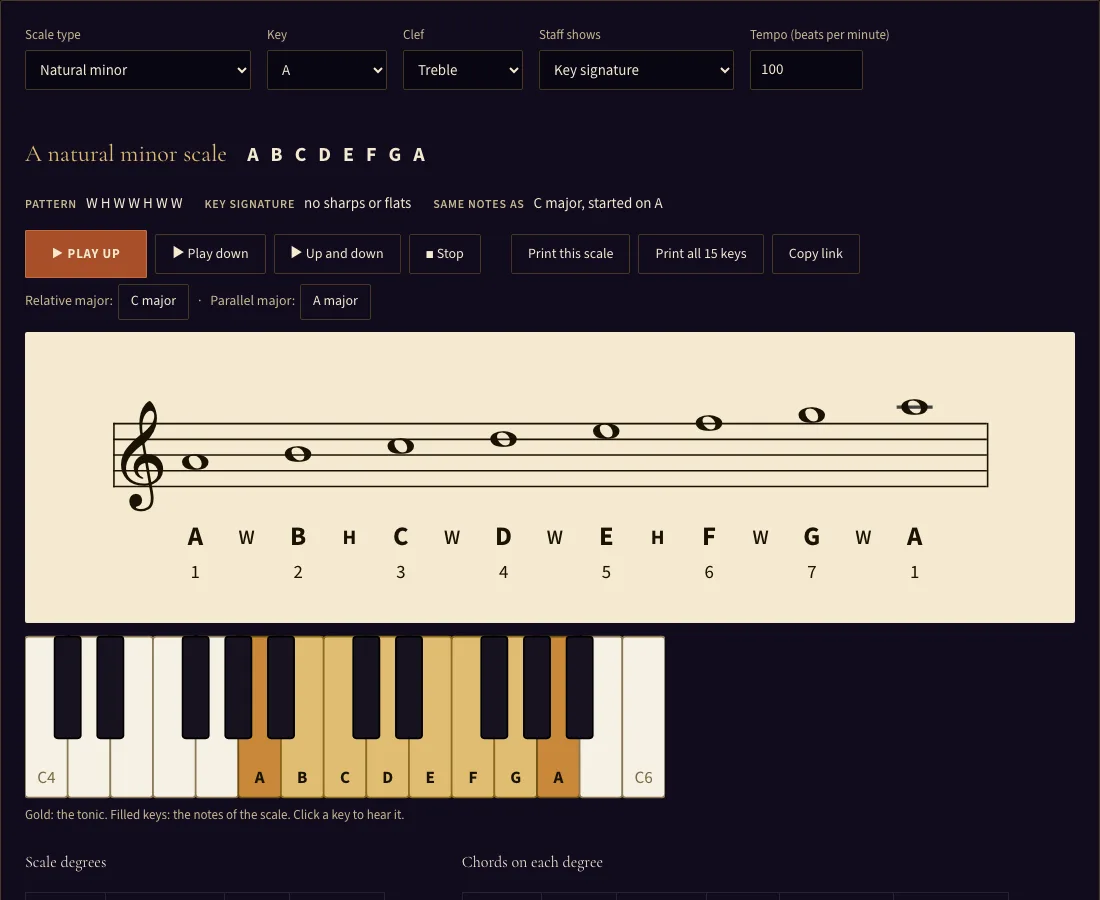
How to use the minor scale builder
- Open the page. It starts on Natural minor, key A, Treble clef, with Key signature notation and tempo 100.
- Open Scale type and choose Harmonic minor or Melodic minor (up and down). Choose Major to compare with a major scale.
- Open Key and pick one of the 15 minor spellings, such as E or G.
- Set Clef to Bass if you want the notes written lower on the staff.
- Set Staff shows to Accidentals on the notes if you want every sharp or flat written beside its note instead of in the key signature.
- Change Tempo (beats per minute) to set how fast the play buttons run.
- Press Play up, Play down or Up and down to hear the scale. Press Stop to end playback.
- In the chord table, press the ▶ button for a triad or the ▶7 button for a seventh chord on any degree.
- Use the Relative minor/major or Parallel minor/major buttons to jump to a related key.
To keep your settings, press Copy link. The link holds your scale type, key, clef, notation and tempo. For a paper copy, press Print this scale, or Print all 15 keys to get a sheet covering every key of the chosen type.
What is a minor scale#
A minor scale is a seven-note scale with a minor sound, meaning its third note sits a minor third (three semitones) above the starting note. Every minor scale is built from a starting note called the tonic, and the other six notes follow a set pattern of whole and half steps. A piece in a minor key uses its minor key scale as the home set of notes.
What is the difference between natural, harmonic and melodic minor#
Natural, harmonic and melodic minor are three versions of the same minor scale, and they differ only in their seventh and sixth notes. Natural minor keeps the notes of the relative major scale and has no raised notes. Harmonic minor raises the seventh note to create a half step leading into the tonic. Melodic minor raises both the sixth and seventh notes going up, then returns to natural minor coming down. The builder shows all three, so you can compare them by changing Scale type.
What is the harmonic minor scale#
The harmonic minor scale is natural minor with the seventh note raised by a half step. In E harmonic minor, D becomes D♯, giving the notes E F♯ G A B C D♯. The raised seventh creates a half step up to the tonic, and it turns the chord on the fifth degree into a major chord (V), the chord that leads most strongly back to the tonic. The step pattern is W H W W H W+H H, where W+H is the augmented second between the sixth and seventh notes.
What is the natural minor scale pattern#
The natural minor scale pattern is W H W W H W W, where W means a whole step and H means a half step. Start on any note, follow this pattern, and you get that key’s natural minor scale. A minor scale built this way has the same notes as its relative major, starting from the sixth degree. The same pattern works from any starting note, so the minor scale patterns for A, E or G differ only in which notes are used. The A minor pentatonic scale (A C D E G) is a five-note scale taken from A natural minor; this tool builds the full seven-note forms.
How do you find the relative minor#
To find the relative minor of a major key, go down three semitones from the major tonic, or count down to the sixth note of the major scale. For example, C major has the relative minor A minor, because A is three semitones below C and both use the same notes. The relative minor has the same key signature as its major, so A minor has no sharps or flats, like C major. The Relative minor/major button on the builder takes you straight to this key.
What are the chords in a minor key#
Each note of a minor scale can carry a triad built from it and the notes two and four steps above. In natural minor, these chords are i, ii°, III, iv, v, VI and VII, where lowercase numerals are minor chords and uppercase are major. For the E natural minor scale, the chords are Em, F♯dim, G, Am, Bm, C and D. The chord table on the builder lists these chords with their Roman numerals and seventh chords, and the ▶ buttons let you hear each one.
Frequently asked questions
Is it free and does it need an account?
Can I print it?
Can I use the printouts commercially?
Why does the staff show a sharp that is not in the key signature?
Why does a button send me to a key with a different name?
What does "Same sounds, other spelling" do?
Can I change how fast the scale plays?
Updated