
Overtone Series
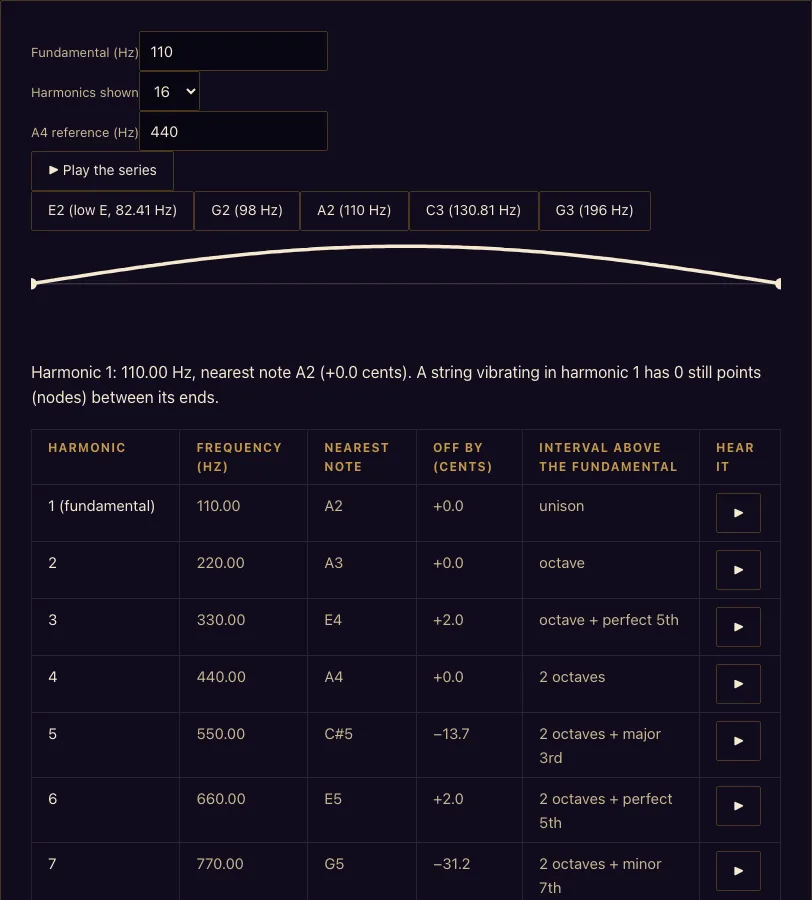
| Harmonic | Frequency (Hz) | Nearest note | Off by (cents) | Interval above the fundamental | Hear it |
|---|
Overtone series calculator: enter a fundamental frequency to get its harmonics with the nearest note, cents off and interval. Hear each one.
About the Overtone Series Calculator
The overtone series, also called the harmonic series, is the set of frequencies you get by multiplying one base pitch, the fundamental, by 1, 2, 3, 4 and so on. This overtone series calculator lists those frequencies for any fundamental from 16 to 2000 Hz, with the nearest equal-tempered note and how many cents each harmonic sits from it.
It runs in your web browser, is free, and needs no sign-up. Use it as a harmonics calculator to build an overtone chart for a string or air column, check where each partial falls against the piano keys, or hear each harmonic as a sine tone. Preset buttons fill in five common low notes, or you can type your own fundamental.
How to use the overtone series calculator
- Click, touch or press a key once on the page. Browsers keep sound off until you do this, so the first press may start the audio.
- Set Fundamental (Hz) to a number from 16 to 2000. The default is 110, which is A2. Or click a preset: E2 (82.41 Hz), G2 (98 Hz), A2 (110 Hz), C3 (130.81 Hz) or G3 (196 Hz).
- Choose Harmonics shown: 8, 16 (the default), 24 or 32.
- If you want a different tuning standard, set A4 reference (Hz) between 400 and 480. The default is 440.
- Read the table. Each row shows the Harmonic, its Frequency (Hz), the Nearest note, the Off by (cents) value and the Interval above the fundamental. A minus sign means flatter than the note. Differences of 5 cents or more are coloured: orange for flat, blue for sharp.
- Click the ▶ button in any row to hear that harmonic as a sine tone. The row is then selected, the string drawing below the input shows its standing wave, and a line of text gives its frequency, nearest note and number of nodes.
- Click ▶ Play the series to hear the first 16 harmonics one after another, about half a second each.
The fundamental is saved in the address bar (for example, ?f=82.41), so a link opens the same series.
What is the overtone series?#
The overtone series is the set of frequencies that are whole-number multiples of a fundamental frequency f: f, 2f, 3f, 4f and so on. A vibrating string or air column sounds many of these partials together, and the mix of their loudness gives an instrument its tone colour. The formula is simply f × n, where n is the number of the harmonic. With a fundamental of 110 Hz, harmonic 3 is 330 Hz and harmonic 5 is 550 Hz.
The intervals between neighbouring harmonics are not equal. The first step is an octave (2f), then an octave plus a perfect fifth (3f), then two octaves (4f), then a major third above that (5f). The gaps between harmonics get smaller as you go up, so the series starts with wide intervals and becomes denser.
Equal temperament is the reason many harmonics sound out of tune with a piano. It divides the octave into 12 equal semitones, while the series uses whole-number ratios. Only the octaves (2, 4, 8 and 16) match equal temperament exactly. Every other harmonic lands somewhere between two piano keys, and the Off by (cents) column shows how far.
What is the difference between a harmonic and an overtone?#
Harmonics and overtones are the same set of frequencies, numbered differently. Harmonics are counted from 1, which is the fundamental itself. Overtones are counted from the first frequency above the fundamental, so the 2nd harmonic is the 1st overtone and the 3rd harmonic is the 2nd overtone.
The fundamental is harmonic 1 but is not an overtone. That is the main source of confusion. The calculator uses harmonic numbers in its Harmonic column, so each row’s number is the multiple of the fundamental. When you count overtones, subtract one from the harmonic number.
Harmonics 4, 5 and 6 are in the ratio 4 : 5 : 6, which spells a major triad. For a fundamental of A2 they are A4, C♯5 and E5, so the upper part of the series contains the chord that the fundamental implies.
Frequently asked questions
What are the first notes of the harmonic series?
Why is the 7th harmonic flat?
How are harmonics related to string length?
How do I find the harmonics of a note?
Why is there no sound when I press play?
Can the tool analyse a real instrument?
Updated

