
Printable worksheet
Parallel Major and Minor Worksheet (Printable, with Answers)
Free printable parallel major and minor worksheet: compare keys with the same tonic, find the changed degrees, write both scales. Answer key included.
Parallel Major and Minor Worksheet (Printable, with Answers)
Sheet #
Name Date Score /
Answer key
Parallel Major and Minor Worksheet (Printable, with Answers) · Sheet #
About the Parallel Major and Minor Worksheet
The Parallel Major and Minor Worksheet is a free tool that makes printable practice sheets on parallel keys, which are a major key and its minor key with the same tonic, such as C major and C minor. It runs in your web browser with no sign-up, and nothing you enter is uploaded.
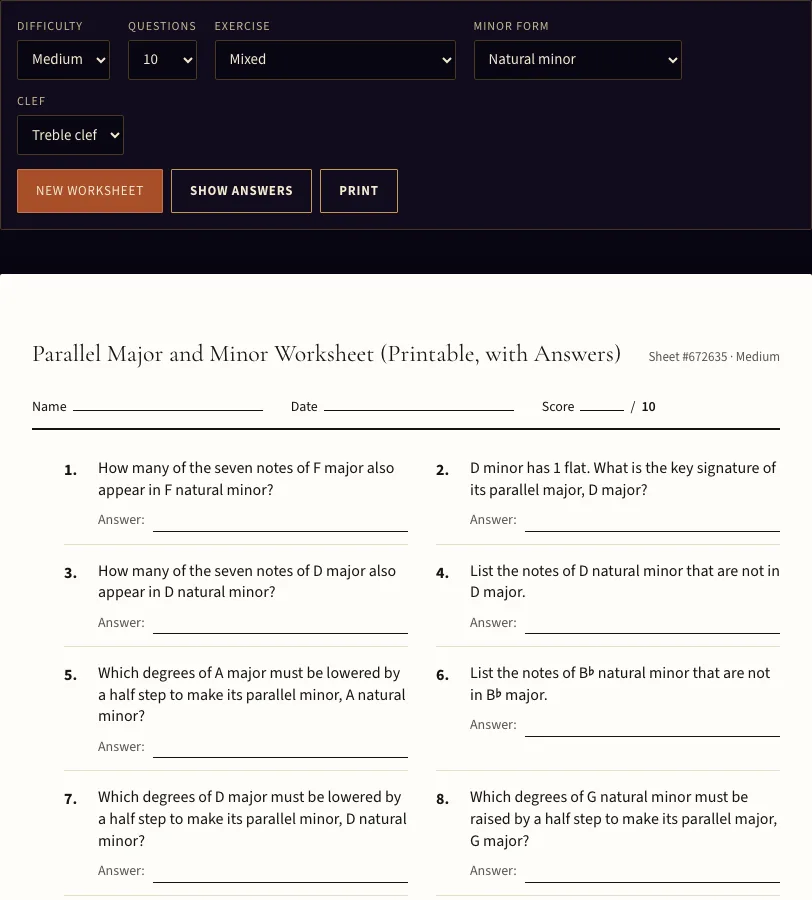
Each sheet can include questions on which scale degrees change between a major key and its parallel minor, questions where you write the parallel scale on a staff, and questions on the key signature of the parallel key. You choose the difficulty, the number of questions, the minor form and the clef, and every sheet comes with an answer key. It suits homework, revision, or a quick scales warm-up in a lesson.
How to use the Parallel Major and Minor Worksheet
- Choose a Difficulty: Easy, Medium (the default) or Hard.
- Set Questions to 10 (the default) or 20.
- Pick an Exercise: “Which degrees change?”, “Write the parallel scale”, “Key signature of the parallel key”, or “Mixed” (the default), which combines all three.
- Set Minor form to Natural minor (the default), Harmonic minor, or Melodic minor (ascending).
- Choose a Clef: Treble (the default) or Bass. The clef affects the staff in the writing questions.
- Click New worksheet to generate a sheet. The header shows the sheet number and difficulty.
- Write your name, the date and your score in the Name, Date and Score lines.
- Click Show answers to display the answer key, and Hide answers to hide it again.
- Click Print to print the sheet.
The address bar holds the settings for the current sheet, in the form ?seed=…&difficulty=…&count=…&task=mixed&minor=natural&clef=treble. Keep those values to recreate the same sheet later, or change the seed number to get a new sheet with the same settings.
Start with Natural minor and “Which degrees change?”, then switch Minor form to Harmonic minor or Melodic minor (ascending) to see that fewer degrees change. The key signature questions always use natural-minor signatures, whatever the Minor form setting. You can use the sheets at home, in class or in products you sell, such as KDP workbooks or Etsy printables, and no credit is needed.
What is a parallel key (parallel major and minor)?#
Parallel keys are a major key and a minor key that share the same tonic, such as C major and C minor. Because the mode differs, the scales and key signatures differ too. The two keys are “parallel” in the sense that they start on the same note and then go their own way.
Relative keys are a different pair. They share a key signature but have different tonics. C major and A minor are relative keys: both have no sharps or flats, but they start on different notes.
The key signature of a parallel minor is found from its relative major. A minor key has the same key signature as the major key whose tonic is a minor third above it. For example, D minor’s relative major is F major, so D minor has one flat, B♭. The same logic works the other way: C major has no sharps or flats, while C minor has three flats.
Which notes change between a major key and its parallel minor?#
In natural minor, the 3rd, 6th and 7th degrees are each lowered by a half step compared with the major scale. For C major, that means E, A and B become E♭, A♭ and B♭. The result is C natural minor: C D E♭ F G A♭ B♭ C.
Harmonic minor changes fewer notes. Only the 3rd and 6th degrees are lowered, so the 7th stays as it is in the major scale. For D major, F♯ becomes F and B becomes B♭, while C♯ stays the same.
Melodic minor (ascending) changes only the 3rd degree. For E major, G♯ becomes G, and the other notes match the major scale.
To compare two keys quickly, go note by note. Take G major, which is G A B C D E F♯, and G natural minor, which is G A B♭ C D E♭ F. The notes in G minor that are not in G major are B♭, E♭ and F. Four notes are shared, so counting shared notes is a good check on your answer.
Frequently asked questions
Is the Parallel Major and Minor Worksheet free, and does it need an account?
Can I print it with the answers?
Is it OK to sell printed parallel major and minor worksheets from this tool?
What is the difference between parallel and relative keys?
How does the key signature change between parallel keys?
Why does an Easy writing sheet include keys like E or F?
Updated