
Chart
Piano chord chart: all chords and inversions on the keyboard
Loading the chord finder…
Piano chord sheet
Piano chord chart for any chord: pick a root, type and inversion to see the keys on a keyboard, the notes and chord symbols, hear it, and print a chord sheet.
Four pages, A4 or Letter: three chord pages and one page of inversions. Black and white, nothing smaller than 7.5 pt.
Download the PDF kit
Free to print and share. No sign-up, no e-mail, no watermark. A4 for most of the world, Letter for the US and Canada; both are black and white, with the fonts embedded.
Quick answer
This is a printable piano chord chart with 108 chords drawn on a keyboard: 9 chord types (major, minor, diminished, augmented, sus2, sus4, dominant 7th, major 7th, minor 7th) on all 12 roots, with the chord tones highlighted and named. A fourth page shows root position and every inversion (30 keyboards) for each chord type. Every chord was built twice, by letter names and by position on the circle of fifths, and the two results had to be the same note for note.
On this page: printable chart · how to read it · chords in each key · progressions · real songs · data and checks · questions
Press ▶ next to a chord to hear it (all notes together, in the octave shown). The sound is made in your browser; it is a simple synthesised tone, not a recording of a piano.
Piano chords: major, minor and diminished
Root position, all 12 roots · page 1 of 4
Major chords (12)
C E G
D♭ F A♭
D F♯ A
E♭ G B♭
E G♯ B
F A C
F♯ A♯ C♯
G B D
A♭ C E♭
A C♯ E
B♭ D F
B D♯ F♯
Minor chords (12)
C E♭ G
C♯ E G♯
D F A
E♭ G♭ B♭
E G B
F A♭ C
F♯ A C♯
G B♭ D
G♯ B D♯
A C E
B♭ D♭ F
B D F♯
Diminished chords (12)
C E♭ G♭
C♯ E G
D F A♭
E♭ G♭ B♭♭
E G B♭
F A♭ C♭
F♯ A C
G B♭ D♭
G♯ B D
A C E♭
B♭ D♭ F♭
B D F
How to read: grey keys are the notes of the chord; the black dot is the root, a ringed dot is any other chord tone. The letters under each keyboard name the notes from low to high. Every chord is in root position, drawn from middle C upwards; the same chord sounds the same in any octave.
Chord tones worked out by letter names and by the line of fifths and compared with chords-db (MIT licence). musictheoryprint.com/charts/piano-chord-chart
Piano chords: augmented and suspended
Root position, all 12 roots · page 2 of 4
Augmented chords (12)
C E G♯
D♭ F A
D F♯ A♯
E♭ G B
E G♯ B♯
F A C♯
F♯ A♯ C♯♯
G B D♯
A♭ C E
A C♯ E♯
B♭ D F♯
B D♯ F♯♯
Suspended 2nd chords (sus2) (12)
C D G
D♭ E♭ A♭
D E A
E♭ F B♭
E F♯ B
F G C
F♯ G♯ C♯
G A D
A♭ B♭ E♭
A B E
B♭ C F
B C♯ F♯
Suspended 4th chords (sus4) (12)
C F G
D♭ G♭ A♭
D G A
E♭ A♭ B♭
E A B
F B♭ C
F♯ B C♯
G C D
A♭ D♭ E♭
A D E
B♭ E♭ F
B E F♯
How to read: grey keys are the notes of the chord; the black dot is the root, a ringed dot is any other chord tone. The letters under each keyboard name the notes from low to high. Every chord is in root position, drawn from middle C upwards; the same chord sounds the same in any octave.
Chord tones worked out by letter names and by the line of fifths and compared with chords-db (MIT licence). musictheoryprint.com/charts/piano-chord-chart
Piano chords: seventh chords
Dominant 7th, major 7th and minor 7th, root position · page 3 of 4
Dominant 7th chords (12)
C E G B♭
D♭ F A♭ C♭
D F♯ A C
E♭ G B♭ D♭
E G♯ B D
F A C E♭
F♯ A♯ C♯ E
G B D F
A♭ C E♭ G♭
A C♯ E G
B♭ D F A♭
B D♯ F♯ A
Major 7th chords (12)
C E G B
D♭ F A♭ C
D F♯ A C♯
E♭ G B♭ D
E G♯ B D♯
F A C E
F♯ A♯ C♯ E♯
G B D F♯
A♭ C E♭ G
A C♯ E G♯
B♭ D F A
B D♯ F♯ A♯
Minor 7th chords (12)
C E♭ G B♭
C♯ E G♯ B
D F A C
E♭ G♭ B♭ D♭
E G B D
F A♭ C E♭
F♯ A C♯ E
G B♭ D F
G♯ B D♯ F♯
A C E G
B♭ D♭ F A♭
B D F♯ A
How to read: grey keys are the notes of the chord; the black dot is the root, a ringed dot is any other chord tone. The letters under each keyboard name the notes from low to high. Every chord is in root position, drawn from middle C upwards; the same chord sounds the same in any octave.
Chord tones worked out by letter names and by the line of fifths and compared with chords-db (MIT licence). musictheoryprint.com/charts/piano-chord-chart
Piano chords: inversions
Root position and every inversion, C chords · page 4 of 4
C major
C E G
E G C
G C E
C minor
C E♭ G
E♭ G C
G C E♭
C diminished
C E♭ G♭
E♭ G♭ C
G♭ C E♭
C augmented
C E G♯
E G♯ C
G♯ C E
C suspended 2nd
C D G
D G C
G C D
C suspended 4th
C F G
F G C
G C F
C dominant 7th
C E G B♭
E G B♭ C
G B♭ C E
B♭ C E G
C major 7th
C E G B
E G B C
G B C E
B C E G
C minor 7th
C E♭ G B♭
E♭ G B♭ C
G B♭ C E♭
B♭ C E♭ G
Major and minor triads in all 12 keys, lowest note first
| Root | Major: root position | 1st inversion | 2nd inversion | Minor: root | 1st inversion | 2nd inversion |
|---|---|---|---|---|---|---|
| C | C E G | E G C | G C E | C E♭ G | E♭ G C | G C E♭ |
| D♭ / C♯m | D♭ F A♭ | F A♭ D♭ | A♭ D♭ F | C♯ E G♯ | E G♯ C♯ | G♯ C♯ E |
| D | D F♯ A | F♯ A D | A D F♯ | D F A | F A D | A D F |
| E♭ | E♭ G B♭ | G B♭ E♭ | B♭ E♭ G | E♭ G♭ B♭ | G♭ B♭ E♭ | B♭ E♭ G♭ |
| E | E G♯ B | G♯ B E | B E G♯ | E G B | G B E | B E G |
| F | F A C | A C F | C F A | F A♭ C | A♭ C F | C F A♭ |
| F♯ | F♯ A♯ C♯ | A♯ C♯ F♯ | C♯ F♯ A♯ | F♯ A C♯ | A C♯ F♯ | C♯ F♯ A |
| G | G B D | B D G | D G B | G B♭ D | B♭ D G | D G B♭ |
| A♭ / G♯m | A♭ C E♭ | C E♭ A♭ | E♭ A♭ C | G♯ B D♯ | B D♯ G♯ | D♯ G♯ B |
| A | A C♯ E | C♯ E A | E A C♯ | A C E | C E A | E A C |
| B♭ | B♭ D F | D F B♭ | F B♭ D | B♭ D♭ F | D♭ F B♭ | F B♭ D♭ |
| B | B D♯ F♯ | D♯ F♯ B | F♯ B D♯ | B D F♯ | D F♯ B | F♯ B D |
An inversion is the same chord with another note at the bottom: in the 1st inversion the third is lowest, in the 2nd inversion the fifth is lowest, in the 3rd inversion (seventh chords) the seventh is lowest. Grey keys are the chord tones, the black dot is the root. Minor triads are spelled from the minor-key root (C♯m, G♯m, E♭m, B♭m).
Inversions built by moving the lowest note up an octave and checked to keep the same pitch classes. musictheoryprint.com/charts/piano-chord-chart
How to read a piano chord chart
- Grey keys are the notes of the chord. Everything else on the keyboard stays silent.
- The black dot is the root, the note that gives the chord its name. A ringed dot marks the other chord tones.
- The letters under the keyboard name the notes from lowest to highest, with sharps or flats spelled the way they are in the chord.
- The keyboard is 8 or more white keys wide and starts at, or just below, the lowest note; the chart is drawn from middle C upwards.
- Inversions: the last page has the same chord with the third or the fifth (or the seventh) at the bottom.
The chords of every key, with how often real songs use each one
Most songs in a major key are built from seven chords, one on each note of the scale: I, ii, iii, IV, V, vi and vii°. Read across for one key, down a column for the same job in every key. The share under each Roman numeral is how much of the chord labels in major-key passages of 1,156 classical art songs it makes up (see the scope note below: this is not pop music). Press a chord to hear it in root position.
| Major key | I29.0% | ii6.8% | iii2.0% | IV6.8% | V24.3% | vi4.5% | vii°1.9% |
|---|---|---|---|---|---|---|---|
| C | C | Dm | Em | F | G | Am | Bdim |
| D♭ | D♭ | E♭m | Fm | G♭ | A♭ | B♭m | Cdim |
| D | D | Em | F♯m | G | A | Bm | C♯dim |
| E♭ | E♭ | Fm | Gm | A♭ | B♭ | Cm | Ddim |
| E | E | F♯m | G♯m | A | B | C♯m | D♯dim |
| F | F | Gm | Am | B♭ | C | Dm | Edim |
| F♯ | F♯ | G♯m | A♯m | B | C♯ | D♯m | E♯dim |
| G | G | Am | Bm | C | D | Em | F♯dim |
| A♭ | A♭ | B♭m | Cm | D♭ | E♭ | Fm | Gdim |
| A | A | Bm | C♯m | D | E | F♯m | G♯dim |
| B♭ | B♭ | Cm | Dm | E♭ | F | Gm | Adim |
| B | B | C♯m | D♯m | E | F♯ | G♯m | A♯dim |
Minor keys
| Minor key | i24.4% | iv6.1% | V20.1% | VI4.6% | vii°4.4% |
|---|---|---|---|---|---|
| Cm | Cm | Fm | G | A♭ | Bdim |
| C♯m | C♯m | F♯m | G♯ | A | B♯dim |
| Dm | Dm | Gm | A | B♭ | C♯dim |
| E♭m | E♭m | A♭m | B♭ | C♭ | Ddim |
| Em | Em | Am | B | C | D♯dim |
| Fm | Fm | B♭m | C | D♭ | Edim |
| F♯m | F♯m | Bm | C♯ | D | E♯dim |
| Gm | Gm | Cm | D | E♭ | F♯dim |
| G♯m | G♯m | C♯m | D♯ | E | F♯♯dim |
| Am | Am | Dm | E | F | G♯dim |
| B♭m | B♭m | E♭m | F | G♭ | Adim |
| Bm | Bm | Em | F♯ | G | A♯dim |
Chord progressions quick reference
A progression is a pattern of Roman numerals, so it works in every key. These are the well-known patterns for which this site has real counts, written out in six keys. Press a row to hear it. The last two columns are not about pop songs: they say in how many of the 1,156 art songs of the OpenScore Lieder corpus the pattern appears, in any major-key passage.
| Pattern | In C | In G | In D | In F | In B♭ | In E♭ | Songs | Share of songs |
|---|---|---|---|---|---|---|---|---|
| I–V–vi–IV | C – G – Am – F | G – D – Em – C | D – A – Bm – G | F – C – Dm – B♭ | B♭ – F – Gm – E♭ | E♭ – B♭ – Cm – A♭ | 18 | 1.6% |
| V–vi–IV–I | G – Am – F – C | D – Em – C – G | A – Bm – G – D | C – Dm – B♭ – F | F – Gm – E♭ – B♭ | B♭ – Cm – A♭ – E♭ | 12 | 1.0% |
| vi–IV–I–V | Am – F – C – G | Em – C – G – D | Bm – G – D – A | Dm – B♭ – F – C | Gm – E♭ – B♭ – F | Cm – A♭ – E♭ – B♭ | 22 | 1.9% |
| IV–I–V–vi | F – C – G – Am | C – G – D – Em | G – D – A – Bm | B♭ – F – C – Dm | E♭ – B♭ – F – Gm | A♭ – E♭ – B♭ – Cm | 16 | 1.4% |
| I–vi–IV–V | C – Am – F – G | G – Em – C – D | D – Bm – G – A | F – Dm – B♭ – C | B♭ – Gm – E♭ – F | E♭ – Cm – A♭ – B♭ | 13 | 1.1% |
| I–IV–V–I | C – F – G – C | G – C – D – G | D – G – A – D | F – B♭ – C – F | B♭ – E♭ – F – B♭ | E♭ – A♭ – B♭ – E♭ | 191 | 16.5% |
| I–vi–ii–V | C – Am – Dm – G | G – Em – Am – D | D – Bm – Em – A | F – Dm – Gm – C | B♭ – Gm – Cm – F | E♭ – Cm – Fm – B♭ | 52 | 4.5% |
| I–IV–V | C – F – G | G – C – D | D – G – A | F – B♭ – C | B♭ – E♭ – F | E♭ – A♭ – B♭ | 241 | 20.8% |
| I–V–I | C – G – C | G – D – G | D – A – D | F – C – F | B♭ – F – B♭ | E♭ – B♭ – E♭ | 829 | 71.7% |
| ii–V–I | Dm – G – C | Am – D – G | Em – A – D | Gm – C – F | Cm – F – B♭ | Fm – B♭ – E♭ | 498 | 43.1% |
| IV–V–I | F – G – C | C – D – G | G – A – D | B♭ – C – F | E♭ – F – B♭ | A♭ – B♭ – E♭ | 339 | 29.3% |
| V–I | G – C | D – G | A – D | C – F | F – B♭ | B♭ – E♭ | 1,006 | 87.0% |
Counted by these rules: sevenths and inversions count as the plain chord, repeated chords are merged, a pattern never crosses a change of key. A rotation such as vi–IV–I–V is the same loop starting on another chord and is counted separately.
What real songs use: the numbers behind the chart
In 1,156 art songs analysed by software, the most common two-chord move in a major key is V→I: 10,374 times in 1,006 songs, 19.2% of all two-chord moves. After a V chord the next chord is I 73.3% of the time. ii–V–I appears 1,256 times in 498 songs (43% of the songs). The loop I–V–vi–IV, which Wikipedia calls extremely common, is found, in any of its four rotations, in only 53 songs (4.6%).
- In major-key passages the tonic I (29.0%) and the dominant V (24.3%) together are 53% of all chord labels. In minor-key passages the tonic i (24.4%) and V (20.1%) are 45%.
- 35.2% of the chord labels carry a seventh (the pattern tables fold sevenths into the plain chord, so V7 counts as V). That is why the chart has a page of seventh chords.
- By the lowest note, 59.8% of the labels are in root position, 21.3% in first inversion and 14.8% in second inversion: this is the reason for the inversions page.
- A diminished chord (vii°) is 1.9% of the labels in major and 4.4% in minor.
Where the chords come from and how they were checked
The chord tones come from the build script itself: every chord is the root plus a fixed list of intervals, and each one is worked out in two independent ways before it is drawn. The list of chords and the note names of each chord were then compared with chords-db, an open database of instrument chords, which also contains piano chords (its piano list is documented as coming from pianoapi.jsdisco.dev). The keyboard pictures are drawn by the script as static SVG, so they print sharply and need no JavaScript.
The rule for the one shape shown
- Which chords: 9 chord types (major, minor, diminished, augmented, sus2, sus4, dominant 7th, major 7th, minor 7th) on all 12 roots, 108 chords, every one in root position.
- Spelling: the root is spelled the usual way for its key (D♭ major, C♯ minor, E♭ minor, B♭ major), and every other note by letter names, so C♯ is never called D♭ inside a chord. Each chord is worked out twice, by letters and semitones and by position on the line of fifths, and the two results must be identical.
- Voicing: the root is the note from middle C (C4) up to the B above it, and the other notes stack upwards from it; the keyboard shows the white keys from the one at or below the lowest note, at least eight keys.
- Inversions: an inversion moves the lowest note up an octave, once for each inversion. The page shows them for the C chords of every type and lists them as note names for all 12 major and minor triads.
The checks
The build stops at the first failed check. This run passed 1,345 checks for this page:
| Check | Count |
|---|---|
| A usable shape was found for the chord by the selection rule | 1 |
| Chords of each key: spelled two ways (letters, and line of fifths) with the same result | 432 |
| Wikipedia excerpts contain only allowed markup, no leftovers, and name source, licence and article | 5 |
| Chord tones spelled by letters and semitones equal the tones spelled by the line of fifths | 108 |
| Pitch classes agree between letters, line of fifths and root + semitone formula; MIDI notes ascend and have the same pitch classes | 432 |
| Pitch classes equal the note names stored in chords-db for the same chord | 108 |
| The drawn keyboard window contains every chord tone | 139 |
| Each inversion keeps the pitch classes of the root position and has the expected bass note | 120 |
The piano data in chords-db has a separate list of MIDI numbers for every chord; for 13 of the 108 chords that list leaves out or repeats a note, so only its note names were used for the comparison.
Licence
The chord data comes from chords-db, MIT licence, Copyright (c) 2016 David Rubert. The licence text is reproduced here as the licence requires:
MIT License

Copyright (c) 2016 David Rubert

Permission is hereby granted, free of charge, to any person obtaining a copy of this software and associated documentation files (the "Software"), to deal in the Software without restriction, including without limitation the rights to use, copy, modify, merge, publish, distribute, sublicense, and/or sell copies of the Software, and to permit persons to whom the Software is furnished to do so, subject to the following conditions:

The above copyright notice and this permission notice shall be included in all copies or substantial portions of the Software.

THE SOFTWARE IS PROVIDED "AS IS", WITHOUT WARRANTY OF ANY KIND, EXPRESS OR IMPLIED, INCLUDING BUT NOT LIMITED TO THE WARRANTIES OF MERCHANTABILITY, FITNESS FOR A PARTICULAR PURPOSE AND NONINFRINGEMENT. IN NO EVENT SHALL THE AUTHORS OR COPYRIGHT HOLDERS BE LIABLE FOR ANY CLAIM, DAMAGES OR OTHER LIABILITY, WHETHER IN AN ACTION OF CONTRACT, TORT OR OTHERWISE, ARISING FROM, OUT OF OR IN CONNECTION WITH THE SOFTWARE OR THE USE OR OTHER DEALINGS IN THE SOFTWARE.
The Wikipedia excerpts further down are under CC BY-SA 4.0 and say where they come from. The statistics come from the site’s own analysis of the CC0 OpenScore Lieder corpus. Sources and licences for everything on the page are listed on the credits page.
Every chord as note names
The same chords as text: the notes from the lowest to the highest in root position. Use it to copy a chord, or when you cannot see the pictures.
Show the table (108 chords)
| Chord | Notes |
|---|---|
| C | C E G |
| D♭ / C♯ | D♭ F A♭ |
| D | D F♯ A |
| E♭ | E♭ G B♭ |
| E | E G♯ B |
| F | F A C |
| F♯ / G♭ | F♯ A♯ C♯ |
| G | G B D |
| A♭ / G♯ | A♭ C E♭ |
| A | A C♯ E |
| B♭ | B♭ D F |
| B | B D♯ F♯ |
| Cm | C E♭ G |
| C♯m / D♭m | C♯ E G♯ |
| Dm | D F A |
| E♭m | E♭ G♭ B♭ |
| Em | E G B |
| Fm | F A♭ C |
| F♯m / G♭m | F♯ A C♯ |
| Gm | G B♭ D |
| G♯m / A♭m | G♯ B D♯ |
| Am | A C E |
| B♭m | B♭ D♭ F |
| Bm | B D F♯ |
| Cdim | C E♭ G♭ |
| C♯dim / D♭dim | C♯ E G |
| Ddim | D F A♭ |
| E♭dim | E♭ G♭ B♭♭ |
| Edim | E G B♭ |
| Fdim | F A♭ C♭ |
| F♯dim / G♭dim | F♯ A C |
| Gdim | G B♭ D♭ |
| G♯dim / A♭dim | G♯ B D |
| Adim | A C E♭ |
| B♭dim | B♭ D♭ F♭ |
| Bdim | B D F |
| Caug | C E G♯ |
| D♭aug / C♯aug | D♭ F A |
| Daug | D F♯ A♯ |
| E♭aug | E♭ G B |
| Eaug | E G♯ B♯ |
| Faug | F A C♯ |
| F♯aug / G♭aug | F♯ A♯ C♯♯ |
| Gaug | G B D♯ |
| A♭aug / G♯aug | A♭ C E |
| Aaug | A C♯ E♯ |
| B♭aug | B♭ D F♯ |
| Baug | B D♯ F♯♯ |
| Csus2 | C D G |
| D♭sus2 / C♯sus2 | D♭ E♭ A♭ |
| Dsus2 | D E A |
| E♭sus2 | E♭ F B♭ |
| Esus2 | E F♯ B |
| Fsus2 | F G C |
| F♯sus2 / G♭sus2 | F♯ G♯ C♯ |
| Gsus2 | G A D |
| A♭sus2 / G♯sus2 | A♭ B♭ E♭ |
| Asus2 | A B E |
| B♭sus2 | B♭ C F |
| Bsus2 | B C♯ F♯ |
| Csus4 | C F G |
| D♭sus4 / C♯sus4 | D♭ G♭ A♭ |
| Dsus4 | D G A |
| E♭sus4 | E♭ A♭ B♭ |
| Esus4 | E A B |
| Fsus4 | F B♭ C |
| F♯sus4 / G♭sus4 | F♯ B C♯ |
| Gsus4 | G C D |
| A♭sus4 / G♯sus4 | A♭ D♭ E♭ |
| Asus4 | A D E |
| B♭sus4 | B♭ E♭ F |
| Bsus4 | B E F♯ |
| C7 | C E G B♭ |
| D♭7 / C♯7 | D♭ F A♭ C♭ |
| D7 | D F♯ A C |
| E♭7 | E♭ G B♭ D♭ |
| E7 | E G♯ B D |
| F7 | F A C E♭ |
| F♯7 / G♭7 | F♯ A♯ C♯ E |
| G7 | G B D F |
| A♭7 / G♯7 | A♭ C E♭ G♭ |
| A7 | A C♯ E G |
| B♭7 | B♭ D F A♭ |
| B7 | B D♯ F♯ A |
| Cmaj7 | C E G B |
| D♭maj7 / C♯maj7 | D♭ F A♭ C |
| Dmaj7 | D F♯ A C♯ |
| E♭maj7 | E♭ G B♭ D |
| Emaj7 | E G♯ B D♯ |
| Fmaj7 | F A C E |
| F♯maj7 / G♭maj7 | F♯ A♯ C♯ E♯ |
| Gmaj7 | G B D F♯ |
| A♭maj7 / G♯maj7 | A♭ C E♭ G |
| Amaj7 | A C♯ E G♯ |
| B♭maj7 | B♭ D F A |
| Bmaj7 | B D♯ F♯ A♯ |
| Cm7 | C E♭ G B♭ |
| C♯m7 / D♭m7 | C♯ E G♯ B |
| Dm7 | D F A C |
| E♭m7 | E♭ G♭ B♭ D♭ |
| Em7 | E G B D |
| Fm7 | F A♭ C E♭ |
| F♯m7 / G♭m7 | F♯ A C♯ E |
| Gm7 | G B♭ D F |
| G♯m7 / A♭m7 | G♯ B D♯ F♯ |
| Am7 | A C E G |
| B♭m7 | B♭ D♭ F A♭ |
| Bm7 | B D F♯ A |
musictheoryprint.com · free to print and share
Background
Excerpts from open reference works, reproduced as published (references, images and tables removed). Every excerpt names its source, licence and original article.
Chord (music)
Definition
A chord is the sound of two or more notes being played at the same time. The term derives from "accord", which became "cord" in Middle English. The original meaning was an agreement or harmonious sound. In the 17th century, the spelling was changed to "chord" to prevent confusion with "cord".
Until the Middle Ages, harmony was any combination of two notes. In the Renaissance, the simultaneous sound of three notes began to be understood as the working definition of harmony. An arpeggio is a broken chord where each note is sounded successively instead of simultaneously. Chords can also be implied by melodies.
A chord progression is a collection of harmonies with a specific destination or purpose, such as reinforcing the tonic or modulation to a new pitch center. Chord progressions are common in Western music. Homophonic textures where the melody and harmony generally move in unison are considered the standard practice in classical music and remain central to music instruction. The study of harmony involves chords and progressions and the principles of connection that govern them.
Structure
Just as scales derive from the harmonic series, the major chord is likewise formed by overtones 4, 5, and 6. The next overtone creates a seventh chord. A common triad has three notes: the root, third, and fifth. The intervals are identified by their distance from the root of the chord. The notes that form a chord are sometimes called members or factors.
Continuing up in thirds yields a seventh, ninth, eleventh, and thirteenth before returning to the root again. Complex sonorities larger than a tetrad are sometimes called polychords because they can be seen as combinations of two different chords. Extended chords are one of the central characteristics of jazz harmony.
Chords are identified by their intervals. The four basic triad qualities are major, minor, diminished, and augmented. Major and minor chords derive from the quality of their thirds. Diminished and augmented chords describe the quality of the fifth. Additional intervals like sevenths are also described by their quality in relation to the root.
Composers began expanding tonality beyond the common practice and often structured chords in fourths and fifths. They were more tonally ambiguous, enabling new patterns for music. Chords also shrunk to tone clusters made of small intervals like seconds. The resulting sound mass was a common feature in the 20th century. Microtonal chords are also used by many contemporary composers.
Theorists began to analyze the structure of chords in the 16th century. Jean-Philippe Rameau developed the nomenclature for chord inversion that is still in use today.
Root position is when the lowest note of a chord is the root, regardless of how the other members are arranged above it. The chord is considered inverted when the root is not the lowest voice. When the third is the lowest sounding pitch, the chord is in first inversion. The second inversion puts the fifth in the bass and was widely seen as dissonant, even as composers put it into frequent practice.
Source: Wikipedia, “Chord (music)” — CC BY-SA 4.0 — text excerpted; see the article for the full text and authors. Revision of 2026-04-05.
Inversion: root position and inverted chords
Root position and inverted chords
A chord is in root position if its root is the lowest note. This is sometimes known as the parent chord of its inversions. For example, the root of a C-major triad is C, so a C-major triad will be in root position if C is the lowest note and its third and fifth (E and G, respectively) are above it – or, on occasion, do not sound at all.
The following C-major triads are both in root position, since the lowest note is the root. The rearrangement of the notes above the bass into different octaves (here, the note E) and the doubling of notes (here, G), is known as voicing – the first voicing is close voicing, while the second is open.
In an inverted chord, the root is not the lowest note. The inversions are numbered in the order their lowest notes appear in a close root-position chord (from bottom to top).
As shown above, a C-major triad (or any chord with three notes) has two inversions:
- In the first inversion, the lowest note is E – the third of the triad – with the fifth and the root stacked above it (the root now shifted an octave higher), forming the intervals of a minor third and a minor sixth above the inverted bass of E, respectively.
- In the second inversion, the lowest note is G – the fifth of the triad – with the root and the third above it (both again shifted an octave higher), forming a fourth and a sixth above the (inverted) bass of G, respectively.
Source: Wikipedia, “Inversion (music)” — CC BY-SA 4.0 — text excerpted; see the article for the full text and authors. Revision of 2026-07-03.
Triads
Overview
In music, a triad is a set of three notes (or "pitch classes") that can be stacked vertically in thirds. Triads are the most common chords in Western music.
When stacked in thirds, notes produce triads. The triad's members, from lowest-pitched tone to highest, are called:
- the root
- Note: Inversion does not change the root. (The third or fifth can be the lowest note.)
- the third – its interval above the root being a minor third (three semitones) or a major third (four semitones)
- the fifth – its interval above the third being a minor third or a major third, hence its interval above the root being a diminished fifth (six semitones), perfect fifth (seven semitones), or augmented fifth (eight semitones). Perfect fifths are the most commonly used interval above the root in Western classical, popular and traditional music.
Some 20th-century theorists, notably Howard Hanson, Carlton Gamer, and Joseph Schillinger expand the term to refer to any combination of three different pitches, regardless of the intervals. Schillinger defined triads as "A structure in harmony of but three parts; conventionally, but not necessarily, the familiar triad of ordinary diatonic harmony." The word used by other theorists for this more general concept is "trichord". Others use the term to refer to combinations apparently stacked by other intervals, as in "quartal triad"; a combination stacked in thirds is then called a "tertian triad".
The root of a triad, together with the degree of the scale to which it corresponds, primarily determine its function. Secondarily, a triad's function is determined by its quality: major, minor, diminished or augmented. Major and minor triads are the most commonly used triad qualities in Western classical, popular and traditional music. In standard tonal music, only major and minor triads can be used as a tonic in a song or some other piece of music. That is, a song or other vocal or instrumental piece can be in the key of C major or A minor, but a song or some other piece cannot be in the key of B diminished or F augmented (although songs or other pieces might include these triads within the triad progression, typically in a temporary, passing role). Three of these four kinds of triads are found in the major (or diatonic) scale. In popular music and 18th-century classical music, major and minor triads are considered consonant and stable, and diminished and augmented triads are considered dissonant and unstable.
When we consider musical works we find that the triad is ever-present and that the interpolated dissonances have no other purpose than to effect the continuous variation of the triad.
Construction
Triads (or any other tertian chords) are built by superimposing every other note of a diatonic scale (e.g, standard major or minor scale). For example, a C major triad uses the notes C–E–G. This spells a triad by skipping over D and F. While the interval from each note to the one above it is a third, the quality of those thirds varies depending on the quality of the triad:
- major triads contain a major third and perfect fifth interval, symbolized: R 3 5 (or 0–4–7 as semitones)
- minor triads contain a minor third, and perfect fifth, symbolized: R ♭3 5 (or 0–3–7)
- diminished triads contain a minor third, and diminished fifth, symbolized: R ♭3 ♭5 (or 0–3–6)
- augmented triads contain a major third, and augmented fifth, symbolized: R 3 ♯5 (or 0–4–8)
The above definitions spell out the interval of each note above the root. Since triads are constructed of stacked thirds, they can be alternatively defined as follows:
- major triads contain a major third with a minor third stacked above it, e.g, in the major triad C–E–G (C major), the interval C–E is major third and E–G is a minor third.
- minor triads contain a minor third with a major third stacked above it, e.g, in the minor triad A–C–E (A minor), A–C is a minor third and C–E is a major third.
- diminished triads contain two minor thirds stacked, e.g., B–D–F (B diminished)
- augmented triads contain two major thirds stacked, e.g., D–F♯–A♯ (D augmented).
Triads appear in close or open positions. "When the three upper voices are as close together as possible, the spacing is described as close position or close harmony. [...] The other arrangements [...] are called open position or open harmony."
Source: Wikipedia, “Triad (music)” — CC BY-SA 4.0 — text excerpted; see the article for the full text and authors. Revision of 2025-09-03.
Seventh chords
A seventh chord is a chord consisting of a triad plus a note forming an interval of a seventh above the chord's root. When not otherwise specified, a "seventh chord" usually means a dominant seventh chord: a major triad together with a minor seventh. However, a variety of sevenths may be added to a variety of triads, resulting in many different types of seventh chords.
Source: Wikipedia, “Seventh chord” — CC BY-SA 4.0 — text excerpted; see the article for the full text and authors. Revision of 2026-04-21.
Sources and licences for the text, scores and recordings on this page are on the credits page.
Sources: chords-db (MIT licence), Wikipedia: Chord (music), Wikipedia: Inversion (music), Wikipedia: Triad (music), Wikipedia: Seventh chord, OpenScore Lieder Corpus.
About the piano chord finder
A piano chord chart shows which keys to press to play a chord, and this tool builds one for any root note and chord type. Pick a root such as C or E♭, choose a chord type such as major, minor, or dominant 7th, and the tool draws a two-octave keyboard with each chord tone marked and named. You can also see the notes in order, the interval formula, and the other names the chord goes by.
The tool runs in your web browser. It is free, and you do not need to sign up. You can play the chord or its arpeggio, build a chord sheet for a whole key, and print the result on paper.
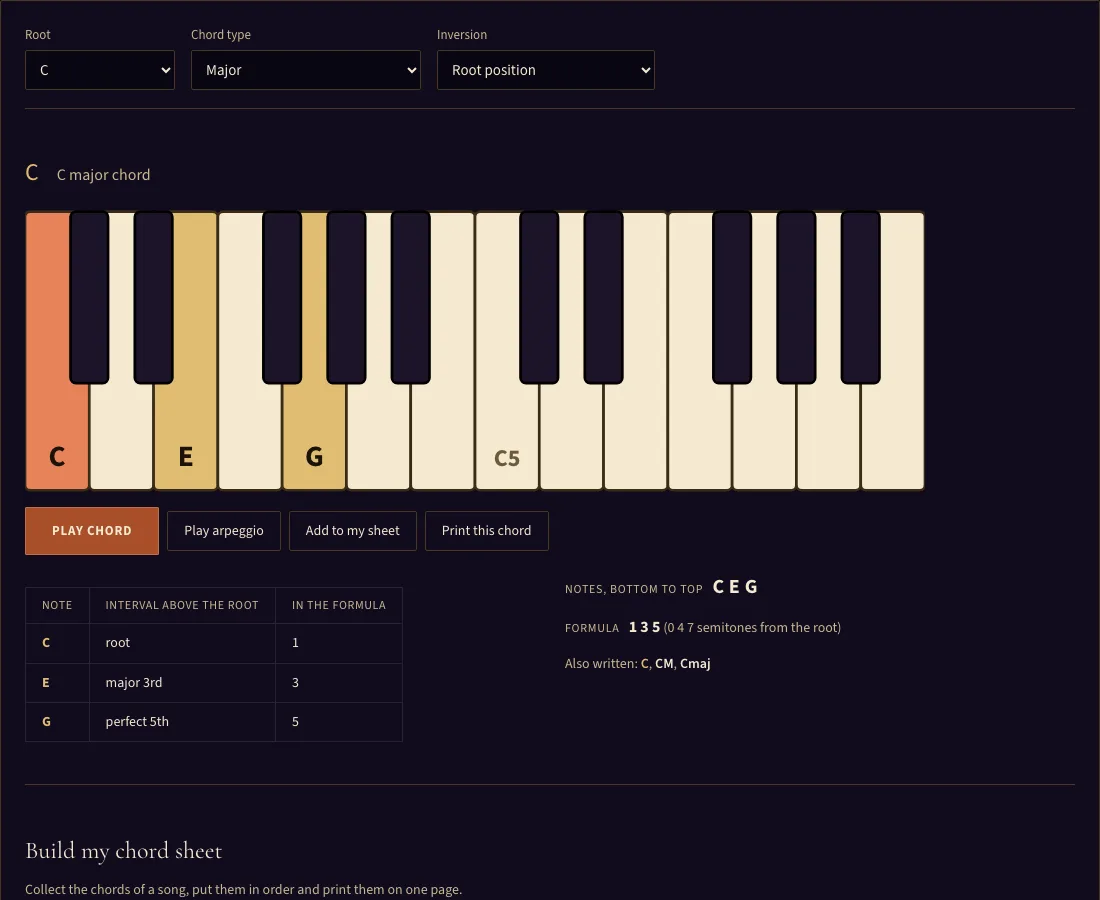
How to use the piano chord finder
- Open the Root menu and choose the note the chord starts on. The default is C.
- Open the Chord type menu and choose a type, such as Major, Minor, Dominant 7th, or Diminished. The default is Major.
- Open the Inversion menu to change which note sits lowest. It resets to Root position when you change the chord type.
- Read the large chord name at the top, such as E♭7/G, and the line below it that describes the chord.
- Look at the keyboard. The root key is orange, the other chord tones are amber, and each pressed key shows its note name.
- Check the table under the keyboard. It lists each note, its interval above the root, and whether it appears in the formula.
- Press Play chord to hear the notes together, or Play arpeggio to hear them one at a time. The keys and table rows light up as they sound.
- To build a sheet, press Add to my sheet, or use the Build my chord sheet section to load all the chords in a key. Use the arrow buttons on each card to reorder them, and the play and remove buttons to change the sheet.
Press Print this chord to print the single chord, or Print the sheet to print your sheet. Turn on Large print to put one big card on each row. Copy link saves your exact chord or sheet as a web address you can share.
How do you build a piano chord#
A piano chord is a set of notes stacked on top of a root note, and each chord type follows a fixed pattern of steps called semitones. A semitone is the distance from one key to the next, including black keys. A major chord uses the root, a note four semitones above it (the major third), and a note seven semitones above it (the perfect fifth). A minor chord lowers the third by one semitone, so it has three semitones from the root to the third.
From any root the pattern is the same: C major is C, E, G. Start on E♭ for E♭ major: E♭, G, B♭. The tool shows the formula as “1 3 5” for major and “1 ♭3 5” for minor.
What are the basic piano chords for beginners#
Most beginner songs use major and minor triads, which are three-note chords. Start with C major (C E G), F major (F A C), and G major (G B D), then learn A minor (A C E), D minor (D F A), and E minor (E G B).
Easy piano chords for beginners are played with the right hand, fingers 1, 3 and 5 (thumb, middle, little finger); check each shape on the keyboard in the tool before you try it.
What is a chord inversion#
An inversion is the same chord with a different note at the bottom. The chord keeps all its notes, but the lowest one changes. In a first inversion the third is in the bass, so C major becomes E, G, C with E lowest. In a second inversion the fifth is in the bass, and in a third inversion the seventh is in the bass.
The slash in a chord name shows the bass note. For example, E♭7/G is a dominant 7th chord with G in the bass, which is the first inversion. Inversions make chord transitions on piano smoother, because the notes can stay close together. In chord sequences built from the main piano chords of a key, such as C, Am, F and G, pianists pick inversions so each change moves as little as possible; progressive chord exercises practise exactly that.
What does a diminished chord look like on piano#
A diminished triad is a minor chord with a lowered fifth. Its pattern is 1 ♭3 ♭5, which means three semitones from the root to the third and three more to the fifth. B diminished is B, D, F: on the piano all three are white keys, each three semitones above the one before, so the shape looks narrower than a major chord.
The diminished chord symbol is written as Bdim, B° or Bm♭5 in different charts. The tool shows all of these names under “Also written” so you can match whatever you find.
What is a 7th chord#
A 7th chord is a four-note chord made by adding a seventh above the root to a triad. The seventh can sit at different distances from the root, and that changes the chord’s sound. A dominant 7th (C7) uses a flat seventh, which is ten semitones above the root. A major 7th (Cmaj7) uses a natural seventh, which is eleven semitones above the root.
Minor 7th chords (Cm7) use a flat third and a flat seventh. Half-diminished chords (Cm7♭5) add a flat fifth to a minor 7th.
How do you read chord names and symbols#
In chord notation the root letter comes first, then a symbol that tells you the chord type; flat roots are often typed with a b, so Ab chords on piano are the same as A♭ chords. No symbol means major, so C alone is C major. A lowercase m or a minus sign means minor, so Cm and C- both mean C minor. A number such as 7 or 9 adds a note, and “maj” or “M” before the number means major 7th.
Sharps (♯) and flats (♭) move the root or any other note up or down by one semitone. A chord name with a slash, such as C/E, means play C major with E in the bass. The tool’s result line shows the name it uses first, and lists the other ways the same chord is written.
Frequently asked questions
Is the Piano Chord Finder free, and does it need an account?
Can I print the chord charts?
Can I use the printouts commercially?
Are all 19 chord types on the printed chart?
How do I find every chord on the piano?
Why does the chord name change when I change the inversion?
Can I save or share a chord sheet?
Updated