
Polyrhythm
A free polyrhythm player: set two beat patterns from 1 to 16, hear them against each other and watch the beats on a wheel. Try 3:2 or 4:3.
About the Polyrhythm Player
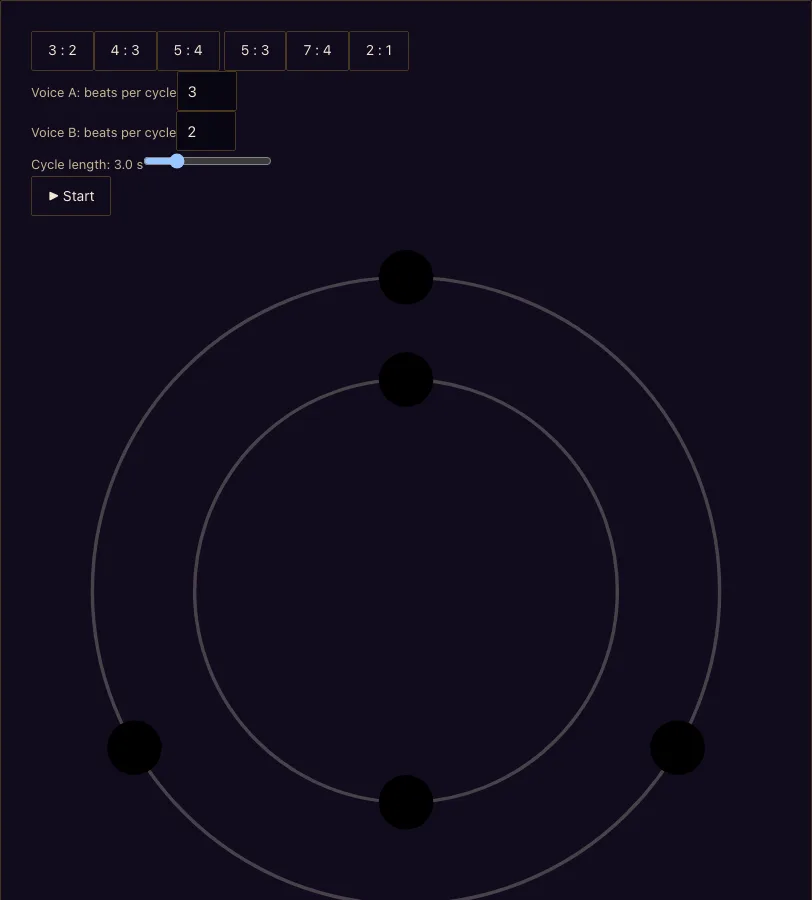
The polyrhythm player is a free tool that runs in your web browser and plays two rhythms at the same time, with each rhythm dividing one cycle into a different number of equal beats, such as 3 beats against 2. No sign-up is needed. You set the beats for each voice, choose how long the cycle lasts, and press Start to hear the patterns together. A wheel shows where each beat falls, and a grid below it puts both voices on a shared count, so you can see why the patterns meet and separate. You can use the presets for common ratios such as 4 : 3 and 7 : 4, or enter your own whole numbers from 1 to 16.
How to use the polyrhythm player
- Type a whole number from 1 to 16 into ‘Voice A: beats per cycle’. The default is 3.
- Type a whole number from 1 to 16 into ‘Voice B: beats per cycle’. The default is 2. Or press one of the six preset buttons (3 : 2, 4 : 3, 5 : 4, 5 : 3, 7 : 4 or 2 : 1) to fill both boxes.
- Drag the ‘Cycle length’ slider to set how long one cycle lasts, from 1.5 to 8 seconds in half-second steps. The default is 3 seconds.
- Press ‘▶ Start’. Browsers keep sound off until you click, touch or press a key on the page, so if you hear nothing, press a key or click once and try again.
- Listen for the clicks. Voice A is a higher click and voice B is a lower click. Where both land on the same instant, you hear both.
- Watch the wheel. The outer ring is voice A (orange) and the inner ring is voice B (blue). The dot that is sounding grows and gets a white outline.
- Read the beat grid under the wheel. The line of text below it names the pattern and says how often the two voices sound together.
- Press ‘■ Stop’ to end the sound. If you change a number or the cycle length while it is playing, the sound restarts with the new values.
The two numbers are kept in the address bar, so 4 against 3 appears as ?a=4&b=3. Copy the page address to share a pattern; anyone who opens that link sees and hears the same settings.
What is a polyrhythm?#
A polyrhythm is two or more rhythms played at the same time that divide the same stretch of time into different numbers of equal beats. In a 3 against 2 polyrhythm, one voice plays 3 evenly spaced beats and the other plays 2 evenly spaced beats within the same cycle. Because the two voices share one start point and one end point, their beats fall at different places between those points. The result sounds like two separate pulses that keep crossing each other.
How do you play 3 against 2?#
To play 3 against 2, divide one cycle into 6 equal steps. Voice A plays on steps 1, 3 and 5, and voice B plays on steps 1 and 4. The first beat of both voices lands together, and the other beats fall between each other. Clap or tap the three beats of voice A with one hand and the two beats of voice B with the other hand, and you will feel the two pulses drift and realign once per cycle. The tool’s grid shows exactly this layout, with the two voices together only on the first step.
How do you play 4 against 3?#
To play 4 against 3, divide one cycle into 12 equal steps. Voice A plays on steps 1, 4, 7 and 10, and voice B plays on steps 1, 5 and 9. The two numbers have no common factor, so the voices sound together only at the start of the cycle. Between those two points the four-beat pattern and the three-beat pattern never line up. Start slowly, with each hand counting its own pattern, before you try to play both at full speed.
What is the difference between a polyrhythm and a polymeter?#
In a polyrhythm, both voices share one cycle length and divide it into different numbers of beats, so the beats are all inside the same time. In a polymeter, the beats move at the same speed but the bars have different lengths, such as 3/4 against 4/4. Polymeters are compared bar by bar, and the patterns drift apart and meet again only after the lowest common multiple of the bar lengths. This tool plays polyrhythms, where the cycle is the shared unit.
What is a hemiola?#
A hemiola is a rhythmic pattern in which three beats are played in the space normally used for two, or two beats in the space normally used for three. In practice, 3 against 2 is the most common example, and the tool names it that way when the pattern matches. The name is used in music of many styles to describe the moment a steady triple pulse seems to shift into a duple feel for a short time. Playing 3 against 2 in this tool gives you a clear way to hear the effect.
How do I count a polyrhythm?#
Count the whole cycle as one fixed set of steps, using the grid length. For 3 against 2, count ‘1 2 3 4 5 6’ out loud, and tap voice A on 1, 3 and 5 and voice B on 1 and 4. A common teaching aid is to say ’not difficult’ while tapping: the word ’not’ falls on 1 and 4 for one hand, and ‘dif-fi-cult’ falls on 1, 3 and 5 for the other. Count slowly and keep the same count going through several cycles, so that each beat has a fixed place in the grid. Then add the second voice only when the counting is steady.
Frequently asked questions
Is the polyrhythm player free?
Why do I hear nothing when I press Start?
What numbers can I enter?
What tempo does each voice play at?
Why does 4 against 2 say it is the same as 2 against 1?
Can I play more than two voices or add dotted and swung rhythms?
Which sounds are used for the two voices?
Updated

