
Printable worksheet
Syncopation worksheet
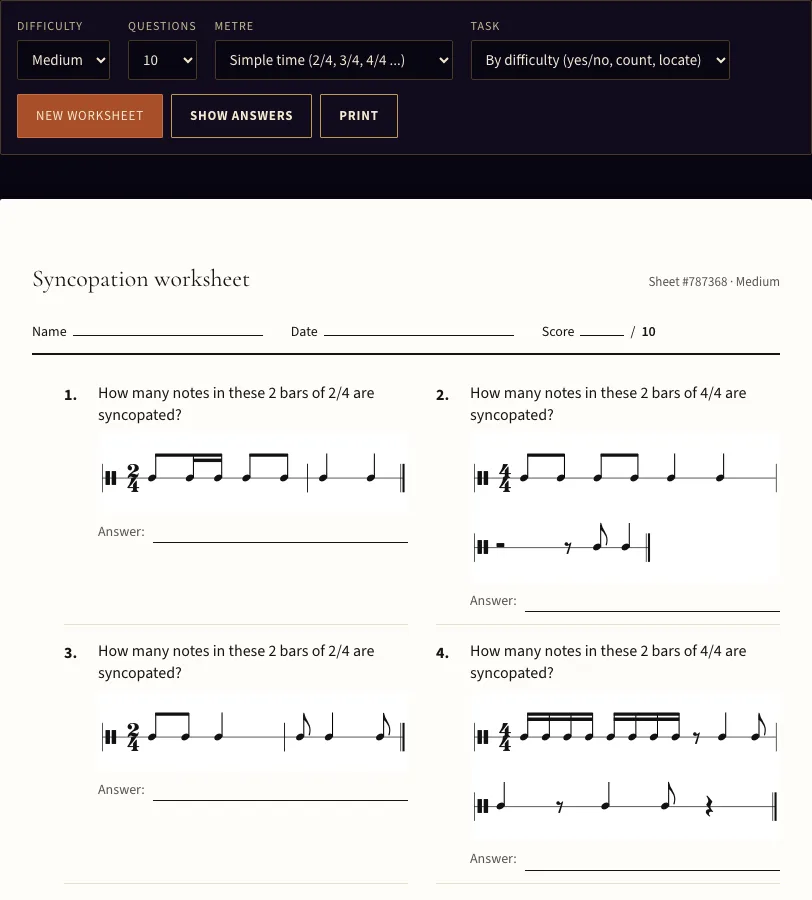
Free printable syncopation worksheet: decide if a bar is syncopated, count the syncopated notes and name where each begins. Simple and compound.
Syncopation worksheet
Sheet #
Name Date Score /
Answer key
Syncopation worksheet · Sheet #
About the Syncopation Worksheet
Syncopation is a rhythm where a note starts on a weaker part of the bar and is held through a stronger beat. This free Syncopation worksheet generator makes printable practice sheets with answer keys, and it runs in your web browser with no sign-up.
Each sheet gives you short bars of simple or compound time, with a one-line rhythm staff for every question. You can ask yes/no questions, counting questions, or questions that ask where each syncopated note begins. The answer key explains each answer and shows the counting under every note, so you can check your work or teach from it. You can use the sheets at home, in class or in products you sell, such as KDP workbooks or Etsy printables, and no credit is needed.
How to use the Syncopation worksheet
- Choose a Difficulty: Easy, Medium or Hard. Medium is selected by default.
- Choose the number of Questions: 10 or 20. The default is 10.
- Choose the Metre: Simple time (2/4, 3/4, 4/4 …), Compound time (6/8, 9/8, 12/8), or Simple and compound mixed.
- Choose the Task. The default, “By difficulty”, sets the task for you. The other options are “Is the bar syncopated?”, “How many syncopated notes?” and “Where does each one begin?”
- Click New worksheet to make a new random sheet. The header shows a six-digit sheet number, such as Sheet #123456.
- Write your answers on the Answer: lines. Fill in the Name, Date and Score lines at the top.
- Click Show answers to display the key. The button then changes to Hide answers.
The address bar also changes to include the sheet number and your settings. If you open that same link later, you get the same sheet again, which is useful if you want to give a class the same questions.
Click Print (or press Ctrl+P) to print. The question pages print first, in two columns, followed by the answer key on a new page. The printed question pages never include answers, so you can hand them out as they are.
Try clapping each bar while you count aloud before you write the answer. The syncopated notes are the ones that feel pushed ahead of the beat.
What is syncopation in music#
Syncopation happens when the rhythm pushes against the expected beat. A note starts on a weak part of the bar and keeps sounding through a stronger beat, so the emphasis seems to shift. Many styles of music use this effect, and it is one of the main ways a rhythm gets its bounce.
On this worksheet, syncopation comes only from one written note value that lasts through a stronger position. There are no ties and no triplets in these sheets. The rule also counts sixteenth-level cases, such as a note on the “e” of a beat held through the “&”, which some textbooks leave out.
What does a syncopated rhythm look like (example)#
A simple example is quarter, half, quarter in 4/4. The half note starts on beat 2 and is held through beat 3, which is stronger, so the half note is syncopated.
Another example is eighth, quarter, eighth in 2/4. The quarter note starts on the “&” of beat 1 and is held through beat 2. In the answer key, the syncopated note is marked, and it is named as “the ‘&’ of beat 1.”
Rests are never syncopated. A bar like eighth, quarter, eighth, quarter rest in 3/4 has one syncopated note, the quarter note on the “&” of beat 1.
How do you count a syncopated rhythm#
In simple time, each beat is divided into four sixteenth positions: “1 e & a”, “2 e & a”, and so on. Count the beats aloud, evenly, while you tap or clap the rhythm.
In compound time, each beat is a dotted quarter divided into three eighths: “1 & a”, “2 & a”. In 6/8 you count six syllables per bar.
When you write counts under a rhythm, put one syllable under each note’s start. A note that begins on a beat is named “beat 2” (or “beat 3” and so on), and a note that begins between beats is named by its syllable.
How do I find where each syncopated note begins#
Follow these steps for each note in the bar:
- Find the position where the note starts.
- Find the strength of that position. The start of the bar is the strongest, then the middle of the bar in four-beat bars, then the other beats. Half-beat positions (the “&” in simple time, or the “&” and “a” in compound time) are weaker. The sixteenth positions in simple time, “e” and “a”, are the weakest.
- Check whether any stronger position falls strictly inside the note, between its start and its end. If it does, the note is syncopated.
A note that ends exactly where a stronger position begins is not syncopated. In 3/4, a half note on beat 2 is not syncopated, because beat 2 and beat 3 are equally strong in 3/4. In 4/4 the middle of the bar is stronger than beat 2, so the same half note is syncopated.
How does syncopation work in compound time (6/8)#
In 6/8 the beats are dotted quarters. Each beat has three eighth positions, “1 & a 2 & a”, and the “&” and “a” are both weak half-beat positions. The first and second beats are equally strong.
A quarter note, then a dotted quarter note starting on the “a” of beat 1 and held through beat 2, is syncopated. The “a” is weaker than beat 2, which falls inside the dotted quarter. A quarter, dotted quarter and eighth on the “a” of beat 1 is therefore marked “the ‘a’ of beat 1” in the answer key.
Frequently asked questions
Is it free and does it need an account?
Can I print it with the answers?
Can I sell syncopation worksheets made with this generator on Etsy or Teachers Pay Teachers?
How many syncopated notes can one bar have?
What is the difference between Easy, Medium and Hard?
Is every bar on the sheet syncopated?
Will the same settings give me the same sheet?
Updated