
Printable worksheet
Ties in music worksheet
Ties in music practice: add up tied notes, find the single note equal to a tie and read ties across the barline. Free printable sheets with an answer key.
Ties in music worksheet
Sheet #
Name Date Score /
Answer key
Ties in music worksheet · Sheet #
About the Ties in Music Worksheet
Ties in music are curved lines that join two notes of the same pitch, so they are held as one longer sound. This Tied notes worksheet creates practice sheets where you add up the length of tied notes and write the total in beats, with an answer key for each sheet. It runs in your web browser, is free, and needs no sign-up. Nothing you enter is uploaded. You can choose easy, medium or hard levels, simple time, compound time or a mix of both, and three kinds of task: finding the single note that equals a tie, counting beats, and working out ties inside two-bar phrases. Each sheet is ready to print. Sheets made here are yours to use however you like, including in printables you sell, with no attribution required.
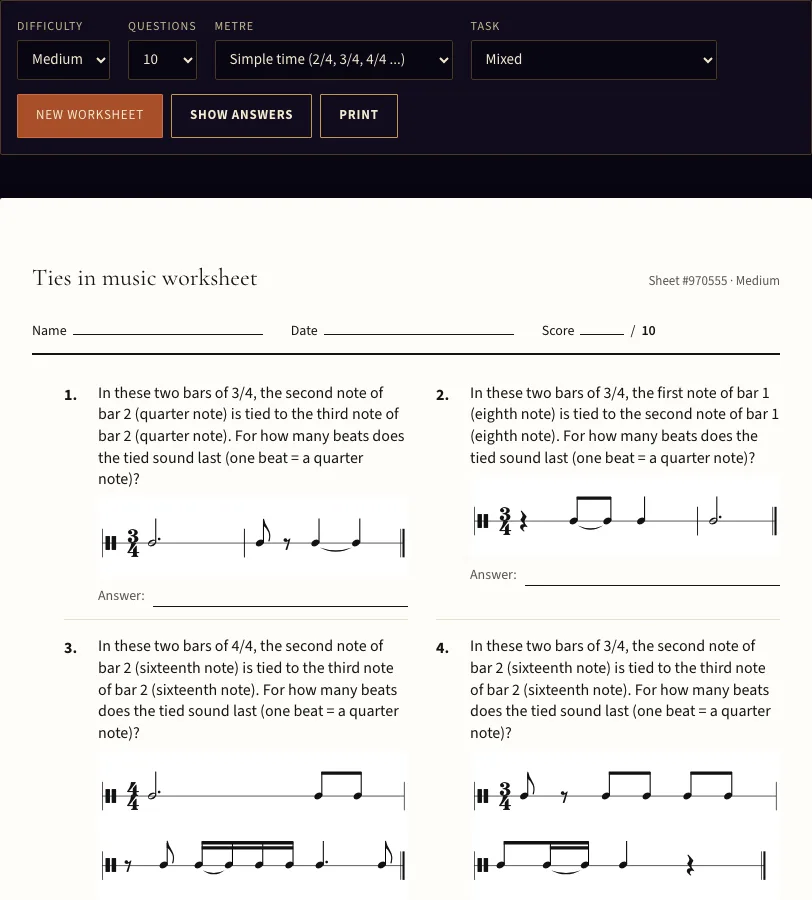
How to use the Tied notes worksheet
- Choose a Difficulty: Easy, Medium (the default) or Hard.
- Set Questions to 10 (the default) or 20.
- Pick a Metre: Simple time (the default), Compound time (6/8, 9/8, 12/8), or Simple and compound mixed.
- Pick a Task: Mixed (the default), Which single note equals the tie?, How many beats?, or Ties in a two-bar phrase.
- Click New worksheet. The header shows the sheet number and difficulty.
- Write your name, the date and your score in the lines at the top. Work out each question and write your answer on the blank Answer: line.
- Click Show answers to open the key, which gives the answer and explanation for each question. Click Hide answers to close it.
- Click Print to print the questions in two columns, with the answer key on a new page.
The address bar stores your settings as seed, difficulty, count, metre and task values. Copy that address to get the same sheet again. With Task set to Mixed, phrase questions appear about twice as often as the other two types.
Before a phrase question, write the beat count under each note, then add only the two tied notes. Move to Compound time once simple time feels easy, because the beat becomes a dotted quarter note and the fractions change.
What is a tie in music?#
A tie is a curved line between two notes of the same pitch. The first note is played, and the second is not struck again. Together they make one sound whose length is the total of both notes. A tie only joins two sounding notes, never a rest. The worksheet does not show pitches, so assume every tie joins the same pitch and focus on the lengths.
How do you count tied notes?#
Tied lengths add. Find each note’s length in beats, add them, then match the total to a single note if one exists.
- Know the beat. In simple time, one beat is a quarter note. A whole note is 4 beats, a half note 2, a quarter note 1, an eighth note 1/2 and a sixteenth note 1/4. A dot adds half of the note’s value, so a dotted half note is 3 beats.
- Use the compound beat. In compound time, one beat is a dotted quarter note. An eighth note is then 1/3 beat and a quarter note is 2/3 beat.
- Add the lengths. A quarter note tied to a quarter note gives 1 + 1 = 2 beats, which is a half note.
- Match or describe the total. If the total matches a note value, name that note. The match can include up to two dots, so a quarter note tied to a dotted whole note in compound time is a double-dotted whole note. If no single note fits, the total is given in beats. An eighth note tied to a dotted half note in simple time gives 3 1/2 beats, a double-dotted half note. A quarter note tied to a whole note gives 5 beats, and no single note has that length.
- Work inside a bar. In a two-bar phrase, add the two tied notes and check that each bar still adds up to its full number of beats. Two sixteenths tied in a bar of 2/4 give 1/4 + 1/4 = 1/2 beat, an eighth note.
Frequently asked questions
What is the difference between a tie and a slur?
Why are notes tied across the bar line?
Is the Tied notes worksheet free, and does it need an account?
Can I print it with the answers?
Can I put tied notes worksheets in a KDP workbook?
Does the worksheet show the pitches of the notes?
Updated