
Printable chart
Treble clef notes
Treble clef notes finder: tap any line, space or ledger line to see and hear its name, practise naming notes, and print a quiz sheet or the treble clef chart.
Prints on one page. Choose “Background graphics” off to save ink.
Download the PDF
Free to print and share. No sign-up, no e-mail, no watermark. A4 for most of the world, Letter for the US and Canada; both are black and white, with the fonts embedded.
The five lines
EGBDF
Bottom to top. Common mnemonic: Every Good Boy Does Fine
The four spaces
FACE
Bottom to top. Common mnemonic: FACE
Every note, with its place on the staff
Octave numbers use scientific pitch notation, where middle C is C4.
| Note | Where it sits |
|---|---|
| C4 | First ledger line below the staff — middle C |
| D4 | Space below the bottom line |
| E4 | Bottom line (line 1) |
| F4 | Space 1 |
| G4 | Line 2 — the line the clef’s curl wraps around |
| A4 | Space 2 |
| B4 | Line 3 (middle line) |
| C5 | Space 3 |
| D5 | Line 4 |
| E5 | Space 4 |
| F5 | Top line (line 5) |
| G5 | Space above the top line |
| A5 | First ledger line above the staff |
musictheoryprint.com · free to print and share
The treble clef in real art songs
1461 of 1462 songs (99.9%) use the treble clef (G clef) somewhere in the score: 1449 in the voice part and 1432 in the piano part. The most common lowest note written on it is G3 (277 songs) and the most common highest note is G5 (129 songs); the median song spans F♯3 to C6.
How often the treble clef appears
| Where | Songs | Share of 1462 songs |
|---|---|---|
| Treble clef used anywhere in the song | 1461 | 99.9% |
| in the voice part | 1449 | 99.1% |
| in the piano / keyboard part | 1432 | 97.9% |
| in another instrument part | 13 | 0.9% |
A song is counted once per row; a song with the clef in both the voice and the piano part is counted in both of those rows.
Which treble clef positions appear
| Clef | Songs | Share of 1462 songs |
|---|---|---|
| G2 | 1461 | 99.9% |
| G2(8vb) | 78 | 5.3% |
| G1 | 3 | 0.2% |
| G2(8va) | 3 | 0.2% |
Letter plus staff line: G2 is the standard treble clef, F4 the standard bass clef, C3 the alto clef and C4 the tenor clef; (8vb) means written an octave lower, (8va) an octave higher. A song with several variants is counted under each.
12 songs with a treble-clef voice part
One song each from the composers with the most such songs, in title order. Dates are the composer's years.
Songs with a treble-clef voice part
1449 songs in the corpus
- Abendbild Fanny Hensel (Mendelssohn) (1805–1847) from 5 Lieder, Op.10 voice part on the treble clef: D4 to F5
- Abenddämmerung Johannes Brahms (1833–1897) from 5 Lieder, Op.49 voice part on the treble clef: D♯4 to F♯5
- Abendfeier Johanna Kinkel (1810–1858) from 6 Gedichte, Op.8 voice part on the treble clef: C4 to E5
- Abends Robert Franz (1815–1892) from 6 Gesänge, Op.16 voice part on the treble clef: D♯4 to G5
- Abermals am See Josephine Lang (1815–1880) from 6 Lieder, Op.12 voice part on the treble clef: B3 to G♯5
- Abschied Franz Schubert (1797–1828) from Schwanengesang.D.957 voice part on the treble clef: C♯4 to G♯5
- Alleluia Cécile Chaminade (1857–1944) voice part on the treble clef: B3 to D5
- Allnächtlich im Traume Robert Schumann (1810–1856) from Dichterliebe, Op.48 voice part on the treble clef: A♯3 to D♯5
- Altdeutsches Lied Clara Mathilda Faisst (1872–1948) from 4 Lieder, Op.1 voice part on the treble clef: F4 to F5
- An den Traum Peter Cornelius (1824–1874) from Trauer und Trost, Op.3 voice part on the treble clef: B3 to D5
- An Maria (aus Novalis geistlichen Liedern) Louise Reichardt (1779–1826) from Zwölf Gesänge voice part on the treble clef: C4 to D♯5
- Au bois dormant Augusta Mary Anne Holmès (1847–1903) from Paysages d'amour voice part on the treble clef: E4 to A5
Every song that uses a C clef (6)
All songs in the corpus with a C clef anywhere in the score. C1 is the soprano clef, C3 the alto clef and C4 the tenor clef; the range is the written pitches under that clef.
C-clef songs
6 songs
- An meine entfernte Lieben Maria Theresia von Paradis (1759–1824) from 12 Lieder, 1786 (alternative title: Zwölf Lieder auf ihrer Reise in Musik gesetzt) C1; written range D♯4 to E5
- Der Winter Corona Schröter (1751–1802) from 25 Lieder C1; written range A3 to E5
- Geisliches Wiegenlied Johannes Brahms (1833–1897) from 2 Gesänge, Op.91 C3; written range C3 to F♯5
- Gestillte Sehnsucht Johannes Brahms (1833–1897) from 2 Gesänge, Op.91 C3; written range C3 to E5
- Herz, mein Herz, so schweig auch du! Josephine Lang (1815–1880) from 2 Lieder, Op.28 C4; written range G3 to C5
- Traumbild Josephine Lang (1815–1880) from 2 Lieder, Op.28 C4; written range F3 to A♯4
Method
- Corpus: All 1462 MusicXML files in the corpus were parsed. The clef in force for every notehead is tracked through the score (including mid-measure clef changes) for the voice, piano and any other parts.
- A song counts as using a clef if a <clef> with that sign (G) appears in any part. The voice / piano / other split uses each part's instrument sound (voice.*, keyboard.*) or, where the sound is a placeholder, whether the part carries sung lyrics.
- Lowest and highest notes are the written pitches of noteheads sitting under that clef, over all parts and the whole song (cue-size notes ignored; transposing parts are not re-pitched). Ranges cover the 1461 songs that actually place noteheads under the clef; notes above or below the staff on ledger lines count.
- Note names use scientific pitch notation (middle C = C4). Black keys are listed as sharps, because the ranking works on pitch numbers; a written D♭ is therefore shown as C♯.
- Representative songs: from the songs whose voice part uses this clef, composers are ordered by how many such songs they have (ties by name), and each composer's alphabetically first song is taken until 12; shown in title order.
Data: computed from the OpenScore Lieder Corpus (CC0), 1,462 scores. Snapshot: commit 6b2dc542ce (2026-04-07).
Background
Excerpts from open reference works, reproduced as published (references, images and tables removed). Every excerpt names its source, licence and original article.
In brief
A clef is a sign at the beginning of a staff of music which makes it possible for the player to work out what the notes are. The word “clef” is a French word meaning “key”. The original Latin word is “clavis”. It is the “key” to understanding which notes should be played.
The staff (or “stave”) consists of five lines across the page. The notes are placed on these lines and in these spaces. The staff is only large enough to cover one and a half octaves of music (a bit more with ledger lines). Therefore, different clefs are used for high music and for low music.
Source: Simple English Wikipedia, “Clef” — CC BY-SA 4.0 — text excerpted; see the article for the full text and authors. Revision of 2025-10-30.
Simple English Wikipedia: the treble clef
Treble clef
The treble clef is drawn by starting with a circle in the middle, then going up, round and straight down with a hook at the end. The second line of the staff (counting from the bottom) goes through the middle of the treble clef’s circle. A note on this line is a G. This is why the treble clef is called a “G clef”. The treble clef is used for high notes. The notes higher than Middle C can be written in the treble clef. In piano music the right hand is usually written in the treble clef. Music for instruments such as the violin, flute, oboe, recorder, trumpet and high singing voice are always written in the treble clef.
Source: Simple English Wikipedia, “Clef” — CC BY-SA 4.0 — text excerpted; see the article for the full text and authors. Revision of 2025-10-30.
Clef: the G-clef family and its history
Treble clef
The only G-clef still in use is the treble clef, with the G-clef placed on the second line. This is the most common clef in use and is generally the first clef learned by music students. For this reason, the terms "G-clef" and "treble clef" are often seen as synonymous. The treble clef was historically used to mark a treble, or pre-pubescent, voice part.
Instruments that use the treble clef include violin, flute, oboe, cor anglais, all clarinets, all saxophones, horn, trumpet, cornet, vibraphone, xylophone, mandolin, recorder, bagpipe and guitar. Euphonium and baritone horn are sometimes treated as transposing instruments, using the treble clef and sounding a major ninth lower, and are sometimes treated as concert-pitch instruments, using bass clef. The treble clef is also the upper staff of the grand staff used for harp and keyboard instruments. Most high parts for bass-clef instruments (e.g. cello, double bass, bassoon, and trombone) are written in the tenor clef, but very high pitches may be notated in the treble clef. The viola also may use the treble clef for very high notes. The treble clef is used for the soprano, mezzo-soprano, alto, contralto and tenor voices. Tenor voice parts sound an octave lower and are often written using an octave clef or a double-treble clef.
French violin clef
A G-clef placed on the first line is called the French clef, or French violin clef. It was used in France in the seventeenth and eighteenth centuries for violin music and flute music. It places the notes in the same staff positions as the bass clef, but two octaves higher.
Octave clefs
Starting in the 18th century, music for some instruments (such as guitar) and for the tenor voice have used treble clef, although they sound an octave lower. To avoid ambiguity, modified clefs are sometimes used, especially in choral writing. Using a C-clef on the third space places the notes identically, but this notation is much less common as it is easily confused with the alto and tenor clefs.
Such a modified treble clef is most often found in tenor parts in SATB and TTBB settings, using a treble clef with the numeral 8 below it. This indicates that the pitches sound an octave lower. As the true tenor clef has fallen into disuse in vocal writings, this "octave-dropped" treble clef is often called the tenor clef. In TTBB arrangements, the 8 is sometimes omitted but the notes are still sung an octave lower.
The same clef is sometimes used for the octave mandolin. This can also be indicated with two overlapping G-clefs.
Tenor banjo is commonly notated in treble clef. However, notation varies between the written pitch sounding an octave lower (as in guitar music and called octave pitch in most tenor banjo methods) and music sounding at the written pitch (called actual pitch). An attempt has been made to use a treble clef with a diagonal line through the upper half of the clef to indicate octave pitch, but this is not always used.
To indicate that notes sound an octave higher than written, a treble clef with an 8 positioned above the clef may be used for penny whistle, soprano and sopranino recorder, and other high woodwind parts. A treble clef with a 15 above (sounding two octaves above the standard treble clef) is used for the garklein (sopranissimo) recorder.
An F-clef can also be notated with an octave marker. While the F-clef notated to sound an octave lower can be used for contrabass instruments such as the double bass and contrabassoon, and the F-clef notated to sound an octave higher can be used for the bass recorder, these uses are extremely rare. In Italian scores up to Gioachino Rossini's Overture to William Tell, the cor anglais was written in bass clef an octave lower than sounding. The unmodified bass clef is so common that performers of instruments whose ranges lie below the staff simply learn to read ledger lines.
The octave-up F-clef is also used in women's barbershop music, allowing singers to maintain the convention that the upper two voices (called "tenor" and "lead", with tenor being a harmony part above the melody and lead usually taking the melody) use the treble clef, whereas the lower two voices ("baritone" and "bass") use the bass clef.
History
Before the advent of clefs, the reference line of a staff was simply labeled with the name of the note it was intended to bear: F, C, or sometimes G. These were the most common 'clefs', or litterae clavis (key-letters), in Gregorian chant notation. Over time the shapes of these letters became stylised, leading to their current versions.
Many other clefs were used, particularly in the early period of chant notation, keyed to many different notes, from the low Γ (gamma, the G on the bottom line of the bass clef) to the G above middle C (written with a small letter g). These included two different lowercase b symbols for the note just below middle C: round for B♭, and square for B♮. In order of frequency of use, these clefs were: F, c, f, C, D, a, g, e, Γ, B, and the round and square b. In later medieval music, the round b was often written in addition to another clef letter to indicate that B♭ rather than B♮ was to be used throughout a piece; this is the origin of the key signature.
In the polyphonic period up to 1600, unusual clefs were occasionally used for parts with extremely high or low tessituras. For very low bass parts, the Γ clef is found on the middle, fourth, or fifth lines of the staff (e.g, in Pierre de La Rue's Requiem and in a mid-16th-century dance book published by the Hessen brothers); for very high parts, the high-D clef (d), and the even higher ff clef (e.g, in the Mulliner Book) were used to represent the notes written on the fourth and top lines of the treble clef, respectively.
Source: Wikipedia, “Clef” — CC BY-SA 4.0 — text excerpted; see the article for the full text and authors. Revision of 2026-07-02.
Staff (music): reading the lines and spaces
Staff positions
When a staff is used for pitched instruments other than guitar tab, the vertical position of the notehead on the staff indicates which note to play: higher-pitched notes are marked higher on the staff. The notehead can be placed with its center intersecting a line (on a line) or in between the lines touching the lines above and below (in a space). Notes outside the range of the staff are placed on or between ledger lines—lines the width of the note they need to hold—added above or below the staff.
Which staff positions represent which notes is determined by a clef placed at the beginning of the staff. The clef identifies a particular line as a specific note, and all other notes are determined relative to that line. For example, the treble clef puts the G above middle C on the second line. The interval between adjacent staff positions is one step in the diatonic scale. Once fixed by a clef, the notes represented by the positions on the staff can be modified by the key signature or accidentals on individual notes. A clefless staff may be used to represent a set of percussion sounds; each line typically represents a different instrument.
Source: Wikipedia, “Staff (music)” — CC BY-SA 4.0 — text excerpted; see the article for the full text and authors. Revision of 2026-06-16.
Sources and licences for the text, scores and recordings on this page are on the credits page.
Sources: Wikipedia: Clef, Wikipedia: Staff, Wikipedia: Scientific pitch notation.
About the treble clef note finder
The treble clef is the G clef, the curly symbol at the start of a staff that shows where G4 sits, and it sets the names of every other line and space. This free tool shows treble clef notes on a staff so you can learn where each one belongs. It runs in your web browser with no sign-up, and nothing you enter is uploaded. You can find a note on the staff, practise naming notes with a running timer, or print a quiz sheet with an answer key. The treble staff covers F3 to E6 in this tool, including the ledger lines above and below the five lines. Treble clef is used for the right hand in piano music and for melody instruments such as violin, flute and trumpet.
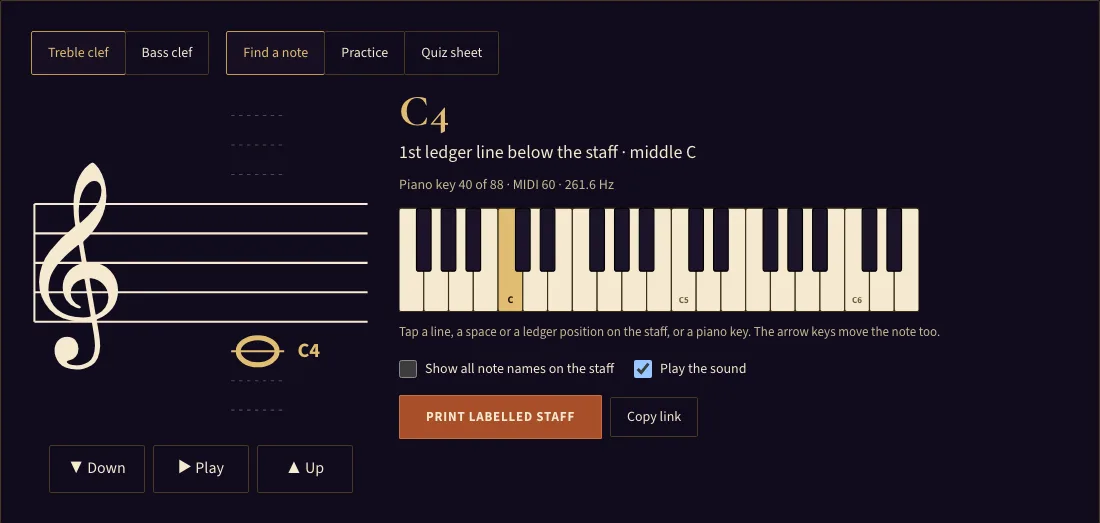
How to use the Treble clef notes tool
- Make sure Treble clef is selected in the clef toggle.
- Click or tap any line, space or ledger position on the staff. The result card shows the note name with its octave, where it sits, and its piano key number.
- Use the Down and Up buttons, or the arrow keys, to move the note one step at a time. Press Play to hear it again.
- Tick “Show all note names on the staff” to see all 21 notes labelled under the tool.
- Tick or untick “Play the sound” to turn sound on select on or off.
- Choose Practice. Pick the notes you want under “Which notes?” and set “How many?” to 10 or 20. Press Start, then tap a letter from A to G or press the matching key. Enter moves you to the next note.
- Choose Quiz sheet, set the range and count, and tick “Answer key on a second page” if you want the key. Press New sheet for a fresh sheet, then Print sheet.
- Press Print labelled staff to print the title and a labelled staff on one page.
The tool has three modes: Find a note, Practice and Quiz sheet. Start with Find a note.
On the staff, Up and Down arrows move the note, Home and End jump to the lowest and highest positions, and Enter or Space plays it. Copy link copies the current address, so a shared link opens with the same settings and the same quiz sheet.
What are the notes of the treble clef?#
The treble clef staff has five lines and four spaces, and each one has a fixed musical note name, so the musical notes of the treble clef never change. From bottom to top, the lines are E4, G4, B4, D5 and F5. The spaces are F4, A4, C5 and E5. Each name is a letter from A to G followed by an octave number; C4 is middle C.
What are the treble clef lines and spaces (mnemonics)?#
Lines are remembered with “Every Good Boy Does Fine”, read from bottom to top. The spaces spell the word FACE. These are the mnemonics the tool uses, and when you tap line 2 the result card shows “Good” to match.
What are the notes above and below the treble clef staff (ledger lines)?#
Ledger lines are short extra lines drawn above or below the staff so that notes beyond the five lines can still be written. Below the staff, the first ledger line is C4, the second is A3 and the third is F3. The spaces below the staff are D4, B3 and G3. Above the staff, the first ledger line is A5, the second is C6 and the third is E6. The spaces above are G5, B5 and D6. The tool includes three ledger lines on each side, giving 21 positions from F3 to E6.
Why is the treble clef called the G clef?#
The curl of the treble clef wraps around the second line from the bottom, and that line is G4, the G above middle C. The symbol fixes that one note, so the clef’s name comes from it. Once you know where G4 is, you can count up and down the letters to name every other line and space.
Where is middle C on the treble clef?#
Middle C (C4) sits on the first ledger line below the treble staff, one step below the space D4. It is a short line drawn just under the bottom line E4. In this tool, tapping that ledger line plays the note, shows “1st ledger line below the staff · middle C” and highlights the piano key C4. On the bass clef, the same note sits on the first ledger line above the staff.
What is the difference between treble clef and bass clef?#
Treble clef is used for higher notes and bass clef for lower ones. The two staves look the same, but the bottom line of the treble staff is E4 while the bottom line of the bass staff is G2. The bass clef’s symbol, the F clef, marks F3 on the fourth line. Piano right-hand music is usually written in treble clef and left-hand music in bass clef. The tool switches between them with the Treble clef and Bass clef buttons, keeping the selected note if it exists on the other staff, and otherwise using middle C.
Frequently asked questions
Is the treble clef notes tool free, and does it need an account?
Can I print the treble clef charts and sheets?
Can I use the printouts commercially?
Which instruments use the treble clef?
What range does the tool cover?
Why do some piano keys show a sharp sign?
Can I share the exact setup I am using?
Updated