
Printable worksheet
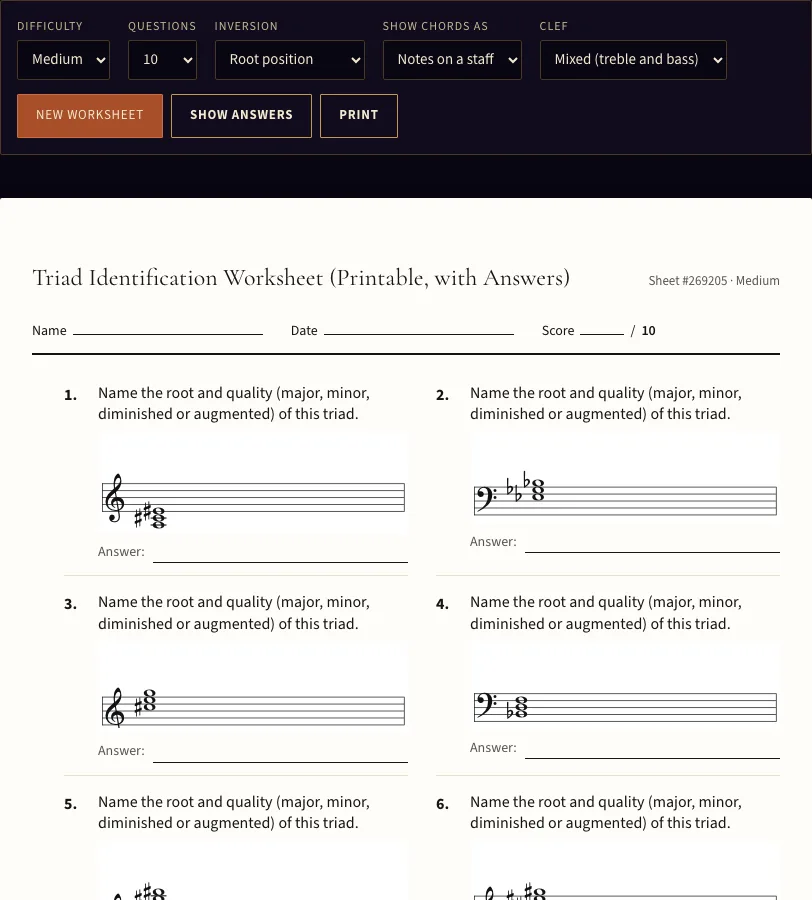
Triad Identification Worksheet (Printable, with Answers)
Free printable triad identification worksheet: name the root and quality of major, minor, diminished and augmented triads. Answer key included.
Triad Identification Worksheet (Printable, with Answers)
Sheet #
Name Date Score /
Answer key
Triad Identification Worksheet (Printable, with Answers) · Sheet #
About the Triad Identification Worksheet
The Triad Identification Worksheet is a free, browser-based tool that builds printable chord identification worksheets with an answer key. Each question shows a triad as notes on a staff or as note names, and asks you to name its root and quality: major, minor, diminished or augmented. It runs in your web browser with no sign-up, and nothing you enter is uploaded.
Use it as a triad worksheet for a music theory class, a triad quiz for self-checking, or extra practice with root position and inverted chords. You choose the difficulty, the number of questions and the inversions, then print a sheet for paper practice. Each sheet has its own sheet number, so you can rebuild or share the same worksheet later.
The sheets show written notes, not sound, so this is a reading and theory exercise rather than listening practice.
How to use the Triad Identification Worksheet
- Set Difficulty to Easy, Medium or Hard. Easy uses major and minor triads only. Medium adds diminished and augmented. Hard uses every root with a flat, natural or sharp.
- Set Questions to 10 or 20.
- Set Inversion to Root position, First inversion, Second inversion or Mixed.
- Set Show chords as to Notes on a staff or Note names.
- If you chose notes on a staff, set Clef to Mixed (treble and bass), Treble clef, Bass clef or Alto clef. The clef setting has no effect on note names.
- Click New worksheet to make a new random sheet until you find one you want.
- Have students write the root and quality on each Answer line, plus the inversion when the prompt asks for it.
- Click Show answers to show the answer under each question. Click Hide answers to hide them again.
- Click Print (or press Ctrl+P). The printout contains only the sheet, with questions in two columns. The answer key starts on a new page.
The address bar keeps your settings. The link includes the sheet number and every control, so the same link always rebuilds the identical sheet. Invalid values in the link fall back to the defaults. You can use the sheets at home, in class or in products you sell, such as KDP workbooks or Etsy printables, and no credit is needed.
How do you identify a triad?#
A triad is three notes sounded together, and you identify it by stacking those notes in thirds. The bottom note of the stack is the root, and the stack shows the quality. To check a triad:
- Move each note by octaves until each one sits a third above the one below it.
- Read the bottom note as the root.
- Measure the two intervals between the stacked notes to find the quality.
What are the four kinds of triads (major, minor, diminished, augmented)?#
Each kind is defined by two intervals counted up from the root:
- Major: major 3rd (4 semitones) plus perfect 5th (7 semitones).
- Minor: minor 3rd (3 semitones) plus perfect 5th (7 semitones).
- Diminished: minor 3rd (3 semitones) plus diminished 5th (6 semitones).
- Augmented: major 3rd (4 semitones) plus augmented 5th (8 semitones).
Triads are always spelled in thirds, so the three letter names are every other letter. This is why F♯ augmented contains C𝄪 rather than D, and E♯ augmented is E♯ – G𝄪 – B𝄪.
How do you tell a major triad from a minor triad?#
Look at the interval between the root and the third. A major triad has a major 3rd there, and a minor triad has a minor 3rd. Both usually have a perfect 5th above the root, so the third decides the quality.
G – B – D is G major, because G to B is a major 3rd. B♭ – D♭ – F is B♭ minor, because B♭ to D♭ is a minor 3rd. The same test works when the notes are not in root position: stack them in thirds first, then check the interval above the root.
How do you find the root of an inverted triad?#
In an inversion, the lowest written note is not the root. Look at that lowest note first, then restack the notes in thirds. If the lowest note is the third, the chord is in first inversion (figured bass 6). If the lowest note is the fifth, it is in second inversion (figured bass 6/4).
Take the notes C – E♭ – A♭ in that order. C is the lowest note, so it is the third, and the chord is in first inversion. Restacked in thirds from A♭, the notes are A♭ – C – E♭. A♭ to C is a major 3rd and C to E♭ is a minor 3rd, so the chord is A♭ major, first inversion.
Frequently asked questions
Is it free and does it need an account?
Can I print it with the answers?
Are triad identification worksheets from this page free for commercial use?
Can I get the same worksheet again?
Why do some questions show note names instead of a staff?
Updated