
Printable chart
Trombone slide positions chart
Trombone slide chart: pick a note to see its slide position on a 1–7 ruler, alternate positions and F attachment, hear it, quiz yourself and print.
Two pages: the positions chart and a note-by-note finder.
Download the PDF
Free to print and share. No sign-up, no e-mail, no watermark. A4 for most of the world, Letter for the US and Canada; both are black and white, with the fonts embedded.
A tenor trombone in B♭ has seven slide positions. Each step out lengthens the tube and lowers the note by one semitone, so seventh position is a tritone (six semitones) below first. Your lips choose the partial, the slide chooses the row: in first position the open series is B♭2, F3, B♭3, D4, F4, then B♭4, C5, D5.
Notes use scientific pitch notation (middle C is C4). The tenor trombone is a non-transposing instrument, so written and sounding pitch are the same; the part is normally read in bass clef.
| Position | Slide out cm / in | Partial (harmonic) played with the lips | |||||||||
|---|---|---|---|---|---|---|---|---|---|---|---|
| 1 pedal | 2 | 3 | 4 | 5 | 6 | 7 | 8 | 9 | 10 | ||
| 1st (B♭) | 0 / 0.0 | B♭1 | B♭2 | F3 | B♭3 | D4 | F4 | A♭4† | B♭4 | C5 | D5 |
| 2nd (A) | 8 / 3.2 | A1 | A2 | E3 | A3 | C♯4 | E4 | G4† | A4 | B4 | C♯5 |
| 3rd (A♭) | 17 / 6.6 | A♭1 | A♭2 | E♭3 | A♭3 | C4 | E♭4 | G♭4† | A♭4 | B♭4 | C5 |
| 4th (G) | 26 / 10.2 | G1 | G2 | D3 | G3 | B3 | D4 | F4† | G4 | A4 | B4 |
| 5th (G♭) | 36 / 14.0 | G♭1 | G♭2 | D♭3 | G♭3 | B♭3 | D♭4 | E4† | G♭4 | A♭4 | B♭4 |
| 6th (F) | 46 / 18.1 | F1 | F2 | C3 | F3 | A3 | C4 | E♭4† | F4 | G4 | A4 |
| 7th (E) | 57 / 22.4 | (E1) | E2 | B2 | E3 | G♯3 | B3 | D4† | E4 | F♯4 | G♯4 |
† Seventh partial: about 31 cents flat; play it with the slide a little shorter, or use an alternate position. Pedal notes (partial 1) are hard to produce and used rarely; the seventh-position pedal E1 is theoretical. Distances are calculated from a 9 ft tube and are only a guide.
| Trigger position | 1 pedal | 2 | 3 | 4 | 5 | 6 | Same series as |
|---|---|---|---|---|---|---|---|
| T1 (F) | F1 | F2 | C3 | F3 | A3 | C4 | 6th position |
| T2 (E) | E1 | E2 | B2 | E3 | G♯3 | B3 | 7th position |
| T3 (E♭) | E♭1 | E♭2 | B♭2 | E♭3 | G3 | B♭3 | longer than 7th |
| T4 (D) | D1 | D2 | A2 | D3 | F♯3 | A3 | longer than 7th |
| T5 (D♭) | D♭1 | D♭2 | A♭2 | D♭3 | F3 | A♭3 | longer than 7th |
| T6 (C) | C1 | C2 | G2 | C3 | E3 | G3 | longer than 7th |
Bold notes are below E2 and exist only with the trigger. T1 and T2 give the same notes as 6th and 7th position in a shorter slide length. B♮1 is not on the F side; pull the trigger tuning slide out to E to get it in a very long position.
Note finder: which position for which note
Most common position first. “short 4” means fourth position with the slide a little shorter than usual. T = F attachment (trigger) engaged, then the position. C2 to F5, bass clef, sounding pitch.
| Note | Positions | With trigger |
|---|---|---|
| C2 | — | T6 |
| C♯2 / D♭2 | — | T5 |
| D2 | — | T4 |
| D♯2 / E♭2 | — | T3 |
| E2 | 7 | T2 |
| F2 | 6 | T1 |
| F♯2 / G♭2 | 5 | — |
| G2 | 4 | T6 |
| G♯2 / A♭2 | 3 | T5 |
| A2 | 2 | T4 |
| A♯2 / B♭2 | 1 | T3 |
| B2 | 7 | T2 |
| C3 | 6 | T1 |
| C♯3 / D♭3 | 5 | — |
| D3 | 4 | — |
| D♯3 / E♭3 | 3 | — |
| E3 | 2 · 7 | — |
| F3 | 1 · 6 | — |
| F♯3 / G♭3 | 5 | — |
| G3 | 4 | — |
| G♯3 / A♭3 | 3 · 7 | — |
| A3 | 2 · 6 | — |
| A♯3 / B♭3 | 1 · 5 | — |
| B3 | 4 · 7 | — |
| C4 | 3 · 6 | — |
| C♯4 / D♭4 | 2 · 5 | — |
| D4 | 1 · 4 | — |
| D♯4 / E♭4 | 3 · short 6 | — |
| E4 | 2 · short 5 | — |
| F4 | 1 · short 4 · 6 | — |
| F♯4 / G♭4 | short 3 · 5 | — |
| G4 | short 2 · 4 | — |
| G♯4 / A♭4 | 3 · 5 | — |
| A4 | 2 · 4 | — |
| A♯4 / B♭4 | 1 · 3 | — |
| B4 | 2 · 4 | — |
| C5 | 1 · 3 | — |
| C♯5 / D♭5 | 2 · 5 | — |
| D5 | 1 · short 3 · 4 | — |
| D♯5 / E♭5 | short 2 · 3 | — |
| E5 | 2 | — |
| F5 | 1 | — |
The harmonic series in each position, on the staff
Bass clef, sounding pitch. Numbers under the notes are the partials. The note shown in grey is the seventh partial, which is flat. Press play to hear a position’s series.
One partial, seven positions (the fourth partial: B♭3 down to E3)
1st position (B♭)
2nd position (A)
3rd position (A♭)
4th position (G)
5th position (G♭)
6th position (F)
7th position (E)
Which partials are out of tune?
How far each partial sits from the nearest equal-tempered note (cents; 100 cents = a semitone). Computed from the frequency ratios of the harmonic series, matching Wikipedia’s table. Partials 2, 3, 4, 6, 8, 9 and 12 are within a few cents; the fifth and tenth are a little low, the seventh is clearly flat and the eleventh falls between two notes.
| Partial | Cents from equal temperament | What it means |
|---|---|---|
| 2 | 0 | in tune |
| 3 | +2 | in tune |
| 4 | 0 | in tune |
| 5 | -14 | a little flat: shorten the slide slightly |
| 6 | +2 | in tune |
| 7 | -31 | clearly flat: shorten the slide or use an alternate position |
| 8 | 0 | in tune |
| 9 | +4 | in tune |
| 10 | -14 | a little flat: shorten the slide slightly |
| 11 | -49 | half-way between two notes: shorten or lengthen the slide a quarter-tone |
| 12 | +2 | in tune |
The instrument at a glance
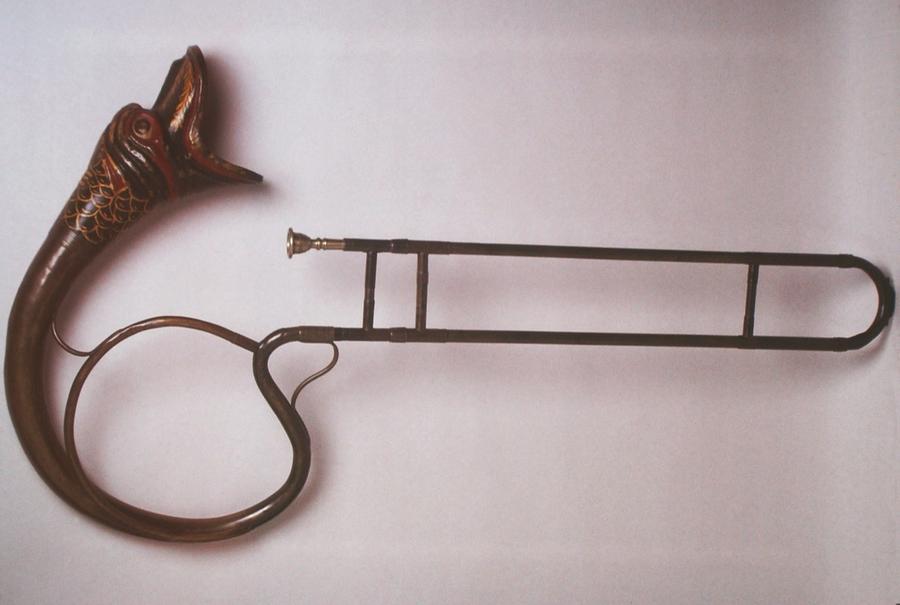
| Common size | Tenor trombone in B♭ — Wikipedia: Trombone |
|---|---|
| Tubing | about 9 ft (2.74 m), slide closed — Wikipedia: Trombone |
| Slide positions | seven chromatic positions, first described by André Braun around 1795 — Wikipedia: Trombone |
| Lowest note, no trigger | E2 (seventh position); pedal notes B♭1 and below are produced from the first partial — Wikipedia: Trombone |
| Practical top | F5, or D5 to be conservative; the range is theoretically open-ended — Wikipedia: Trombone |
| Slide bore (tenor) | 0.500–0.547 in (12.7–13.9 mm) are common — Wikipedia: Trombone |
| Written pitch | non-transposing; bass clef, tenor clef for high passages — Wikipedia: Trombone |
| F attachment | rotary valve, left thumb; lowers B♭ to F by adding about 3 ft of tubing — Wikipedia: Trombone |
How to practise with this chart
- Learn the positions as landmarks. Locate first position (closed) and seventh (the edge of the inner slide’s stockings); third and fourth can be found by comparing your right hand with the bell. Practise jumping between them with the mouthpiece buzzing, then with the instrument.
- Play each position’s open series. In one position, slur up and down the partials (for example 1st: B♭2, F3, B♭3, D4, F4). The chart shows what each position is “called” and trains the lips to find the partial the slide is set for.
- Check every position against a tuner. The fifth partial and anything above the sixth sit away from equal temperament. Mark where your slide needs to be a little shorter (D4 in first position, which is the fifth partial, and every seventh partial) and make it a habit.
- Play a chromatic scale with long and short positions. Play B♭3 up to B♭4 with the fewest shifts, then repeat using alternate positions (for example B♭3 in 5th) so you know both routes.
- Slide a glissando on one partial. A true glissando keeps the same partial and spans at most a tritone, for instance seventh position up to first on one partial.
musictheoryprint.com · free to print and share
Background
Excerpts from open reference works, reproduced as published (references, images and tables removed). Every excerpt names its source, licence and original article.
In brief
The trombone is a brass horn musical instrument. It is similar to a large trumpet, except the player pushes and pulls on its slide to change the length of the tube.
Together with vibrations from the player's lips, the trombone can play a wide range of notes. It is deeper than a trumpet and is usually one of the bass clef instruments. Music is normally written in the bass clef, but some high parts can be written in tenor clef. Some players have the music transposed into the treble clef, although infrequently. The trombone is the loudest instrument in the symphony orchestra.
Source: Simple English Wikipedia, “Trombone” — CC BY-SA 4.0 — text excerpted; see the article for the full text and authors. Revision of 2026-03-23.
Trombone: slide positions, partials and the F attachment
Basic slide positions
The modern system has seven chromatic slide positions on a tenor trombone in B♭. It was first described by Andre Braun circa 1795.
In 1811 Joseph Fröhlich wrote on the differences between the modern system and an old system where four diatonic slide positions were used and the trombone was usually keyed to A. To compare between the two styles the chart below may be helpful (take note for example, in the old system contemporary 1st-position was considered "drawn past" then current 1st). In the modern system, each successive position outward (approximately 3+1/4 in) will produce a note which is one semitone lower when played in the same partial. Tightening and loosening the lips will allow the player to "bend" the note up or down by a semitone without changing position, so a slightly out-of-position slide may be compensated for by ear.
Partials and intonation
As with all brass instruments, progressive tightening of the lips and increased air pressure allow the player to move to different partial in the harmonic series. In the first position (also called closed position) on a B♭ trombone, the notes in the harmonic series begin with B♭2 (one octave higher than the pedal B♭1), F3 (a perfect fifth higher than the previous partial), B♭3 (a perfect fourth higher), D4 (a major third higher), and F4 (a minor third higher).
F4 marks the sixth partial, or the fifth overtone. Notes on the next partial, for example A♭4 (a minor third higher) in first position, tend to be out of tune in regards to the twelve-tone equal temperament scale. A♭4 in particular, which is at the seventh partial (sixth overtone) is nearly always 31 cents, or about one third of a semitone, flat of the minor seventh. On the slide trombone, such deviations from intonation are corrected for by slightly adjusting the slide or by using an alternate position. Although much of Western music has adopted the even-tempered scale, it has been the practice in Germany and Austria to play these notes in position, where they will have just intonation.
The next higher partials—B♭4 (a major second higher), C5 (a major second higher), D5 (a major second higher)—do not require much adjustment for even-tempered intonation, but E♭5 (a minor second higher) is almost exactly a quarter tone higher than it would be in twelve-tone equal temperament. E♭5 and F5 (a major second higher) at the next partial are very high notes; a very skilled player with a highly developed facial musculature and diaphragm can go even higher to G5, A♭5, B♭5 and beyond.
The higher in the harmonic series any two successive notes are, the closer they tend to be (as evidenced by the progressively smaller intervals noted above). A byproduct of this is the relatively few motions needed to move between notes in the higher ranges of the trombone. In the lower range, significant movement of the slide is required between positions, which becomes more exaggerated on lower pitched trombones, but for higher notes the player need only use the first four positions of the slide since the partials are closer together, allowing higher notes in alternate positions. As an example, F4 (at the bottom of the treble clef) may be played in first, fourth or sixth position on a B♭ trombone. The note E1 (or the lowest E on a standard 88-key piano keyboard) is the lowest attainable note on a 9 ft B♭ tenor trombone, requiring a full 2.24 m of tubing. On trombones without an F attachment, there is a gap between B♭1 (the fundamental in first position) and E2 (the first harmonic in seventh position). Skilled players can produce "falset" notes between these, but the sound is relatively weak and not usually used in performance. The addition of an F attachment allows for intermediate notes to be played with more clarity.
Pedal tones
The B♭ pedal tone is frequently seen in commercial scoring but much less often in symphonic music, while notes below that are called for only rarely as they "become increasingly difficult to produce and insecure in quality" with A♭ or G being the bottom limit for most tenor trombonists. The trombone's tubing is largely cylindrical, which inhibits the production of the fundamental as a pedal tone pitch. Instead, trombonists use the higher harmonics of the instrument to produce pedal tones, giving them a bright and hollow tone quality. Some contemporary orchestral writing, movie or video game scoring, trombone ensemble and solo works will call for notes as low as a pedal C, B, or even double pedal B♭ on the bass trombone.
Glissando
The trombone is one of the few wind instruments that can produce a true glissando, by moving the slide without interrupting the airflow or sound production. Every pitch in a glissando must have the same harmonic number, and a tritone is the largest interval that can be performed as a glissando.
The trombone glissando can create remarkable effects, and it is used in jazz and popular music, as in the famous song "The Stripper" by David Rose and his orchestra.
'Harmonic', 'inverted', 'broken' or 'false' glissandos are those that cross one or more harmonic series, requiring a simulated or faked glissando effect.
Valve attachments
Modern trombones are often constructed with a valve attachment, an extra loop of tubing attached to the bell section and engaged by a valve operated by the left thumb by means of a lever or trigger. The valve attachment aids in increasing the lower range of the instrument, while also allowing alternate slide positions for difficult music passages. A valve can also make trills a lot easier.
The valve attachment was originally developed by German instrument maker Christian Friedrich Sattler in the late 1830s for the Tenorbaßposaune, a B♭ tenor trombone built with the wider bore and larger bell of a bass trombone that Sattler had earlier invented in 1821. Sattler's valve attachment added about 3 ft of tubing to lower the fundamental pitch from B♭ to F, controlled by a rotary valve, and is essentially unchanged in modern instruments.
Valve attachments are most commonly found on the tenor and bass trombones. However, they can appear on sizes from soprano to contrabass, in different variety of keys, depending on the size of the instrument.
In the early 2010s Torbjörn Hultmark of the Royal College of Music commissioned the first soprano trombone in B♭ with an F valve, built by Thein Brass.
Although rare on the E♭ alto trombone, a valve attachment usually lowers the instrument a perfect fourth into B♭, providing the first five or six positions from the tenor trombone slide. Some alto models also have a valve called a trill valve, providing a small loop of tubing that lowers the instrument by only a minor or major second, into D or D♭ respectively.
Tenor trombones, especially the larger bore symphonic models, commonly have a valve attachment which lowers the instrument from B♭ to F.
It provides access to the otherwise missing notes between the pedal B♭1 in first position, and the second partial E2 in seventh, as well as providing alternate slide positions for other notes in long (sixth and seventh) positions. Because the attachment tubing increases the length of the overall instrument by one-third, the distances between slide positions must also be one-third longer when the valve is engaged, resulting in only six positions available on the F slide, to low C2. Thus, the F attachment cannot provide the low B♮1, but it usually has a sufficiently long tuning slide to lower it into E as required, which will provide B♮1 in a very long position.
The modern bass trombone usually has two valve attachments to provide all of the notes that are absent on an instrument with no valves (B♮1 – E2). This allows the player to produce a complete chromatic range upwards from the pedal register.
The first valve is an F attachment the same as that found on a tenor trombone and extends the range down to C2. The second valve, engaged together with the first, lowers the instrument to D (or less commonly, E♭) and provides the low B1. The second valve can be dependent, where it serves to lower the F attachment to D and has no effect alone. More commonly the second valve is independent, where it can be engaged separately to lower the instrument to G♭, or to D when both are engaged.
Single-valve B♭ bass trombones with an F attachment are still made but are now less common than two-valve bass trombones. The single valved B♭ bass trombones are essentially very large bore tenor trombones, and likewise are unable to provide the low B♮1 without lowering the valve to E with a long tuning slide.
Contrabass trombones in F typically have two independent valves, tuned either to C and D♭ combining to A, or in European models tuned to D and B♭ combining to A♭. Contrabass trombones in low B♭ usually have only one valve in F, although Miraphone make a model in C with two independent valves in G and A♭, which combine to E.
Notation
Unlike most other brass instruments in an orchestral setting, the trombone is not usually considered a transposing instrument. Prior to the invention of valve systems, most brass instruments were limited to playing one overtone series at a time. Altering the pitch of the instrument required manually replacing a section of tubing called a crook, or swapping to another instrument of a different length. Their parts were transposed according to which crook or instrument pitch was desired at any given time, so that a particular note on the staff always corresponded to a particular partial on the instrument.
Trombones, on the other hand, have used slides since their inception, so they have always been fully chromatic. Since no such tradition of transposition was needed, orchestral trombone parts have always been notated at concert pitch. Reading in concert pitch also meant trombones did not require dedicated parts to double choir parts. While the tubing length of the tenor trombone (slide fully retracted) has remained a fairly constant 9 feet (′), the conceptual pitch of trombones has changed through history due to changing Pitch standards; a B♭ in modern A440 was a Baroque A.
Trombone music is typically notated in bass clef. Tenor clef is often used for high passages, but not usually in jazz charts. In orchestra scores, some composers wrote the entire first trombone part in alto clef, and the second part in tenor clef. As the alto trombone declined in popularity during the 19th century, this practice was gradually abandoned and trombone parts came to be notated in the tenor or bass clef. Some Russian and Eastern European composers wrote first and second tenor trombone parts on one alto clef staff (the German Robert Schumann was the first to do this). Scores by Igor Stravinsky, Sergei Prokofiev, and Dmitri Shostakovich commonly used this practice.
Trombone parts in concert band music are nearly exclusively notated in bass clef. In the British brass band, trombones are treated as B♭ transposing instruments, and read transposing B♭ treble clef, sounding a major ninth below written pitch (thus reading middle C₄ produces B♭₂).
An accomplished performer today is expected to read parts notated in bass, tenor, and alto clefs, and (more rarely) treble clef in C and B♭.
Source: Wikipedia, “Trombone” — CC BY-SA 4.0 — text excerpted; see the article for the full text and authors. Revision of 2026-06-23.
Position (music): the trombone position
Trombone position
The trombone produces notes within its range by extending the main slide to different positions. In first position, the length of the bore is at its shortest; seventh position puts the slide at its furthest extension, at the edge of the inner slide's stockings. (These are sections of slightly greater diameter at the ends of the inner slide tubes.) Positions 3 and 4 may be located by referring the player's right hand to the bell of the instrument. Each player "has a different way of visualizing where the positions of the slide trombone are in relation to each other" Positions, especially in the higher register, may need to be shortened or lengthened (sharpened or flattened) to play in tune. Lower-numbered (shorter) positions are closer together than higher-numbered ones. Positions six and seven are primarily useful in the lower part of the trombone's range.
Some notes may be sounded at more than one position; for example, D4 may be sounded either in position 1 or 4. As a result, trombonists often spend time studying a part to determine how to approach a particular phrase.
Source: Wikipedia, “Position (music)” — CC BY-SA 4.0 — text excerpted; see the article for the full text and authors. Revision of 2025-10-14.
Harmonic series: why some partials are out of tune
Harmonics and tuning
If the harmonics are octave displaced and compressed into the span of one octave, some of them are approximated by the notes of what the West has adopted as the chromatic scale based on the fundamental tone. The Western chromatic scale has been modified into twelve equal semitones, which is slightly out of tune with many of the harmonics, especially the 7th, 11th, and 13th harmonics. In the late 1930s, composer Paul Hindemith ranked musical intervals according to their relative dissonance based on these and similar harmonic relationships.
Source: Wikipedia, “Harmonic series (music)” — CC BY-SA 4.0 — text excerpted; see the article for the full text and authors. Revision of 2026-04-04.
Historical note: Grove’s Dictionary (1900)
The parallel between the Trombone and the Violin family may be carried even farther without loss of correctness; for whereas they have seven 'shifts,' the Trombone has seven 'positions.' These may be easily described as successive elongations of the sounding tube, each of which produces its own harmonic series. The seven positions may be said in a general way to be each a semitone lower than the last. The first is with the slide entirely undrawn. But in the hands of a good player, the length of slide used for each successive position is not the same. By means of a proportional scale, the writer has found that the 2nd, 5th, and 6th shifts are represented by twice 26, or 52; the 3rd and 7th by twice 15, or 30; and the 4th shift by twice 20, or 40. The reason for thus doubling the indications of the scale is the duplicity of the sliding tube, and the doubled length of vibration. The reasons for the variable length of the positions lie too deep in the theory of the scale for our present purpose. They are also, to a certain extent, due to unavoidable imperfections of manufacture, which cause it, for constructive reasons, to vary considerably from a true mathematical figure. But a judicious player, with a sensitive ear, has the remedy in his own power; and the mechanism as well as the mental sensation of Trombone-playing, when thoroughly learned, more nearly approaches that of good voice production than does that of any other instrument. Unfortunately, the quiet smooth legato method of using it is almost a lost art; having been nearly discarded for the coarse blare of the military player. For his use also modern instruments are made of too large a bore.
Source: Wikisource, A Dictionary of Music and Musicians (Grove, 1900) — “Trombone” (entry by William Henry Stone) — Public domain (published 1879–1889; authors died before 1929) — text excerpted from the transcription; see the page for the full entry.
Sources and licences for the text, scores and recordings on this page are on the credits page.
Sources: Wikipedia: Trombone, Wikipedia: Position (music), Wikipedia: Harmonic series (music), Wikipedia: Brass instrument, Micah Everett, University of Mississippi: Chromatic Slide Position Chart for Tenor and Bass Trombones (used to check every position), Grove, A Dictionary of Music and Musicians (1900): Trombone.
About the trombone slide position finder
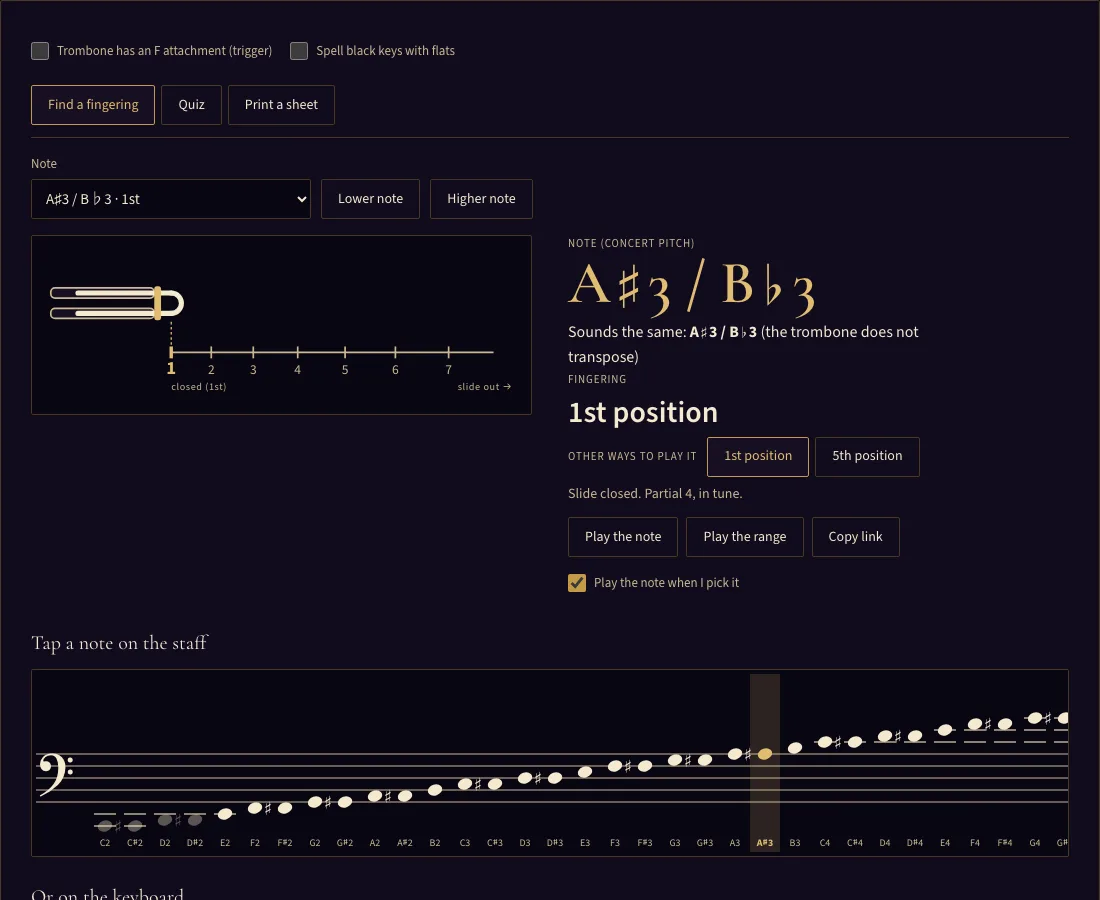
This trombone slide chart shows which slide position plays each note from C2 to F5, written in bass clef at concert pitch. It runs in your web browser, is free, and needs no sign-up. Pick a note and the tool draws the slide on a 1 to 7 ruler, names the main position and any alternate positions, and plays the note. You can also test yourself with a quiz or print a sheet. Below the tool, the page’s chart lists the trombone positions, partials and cents for each note, so you can compare the two.
How to use the trombone slide chart
- Open the Find a fingering tab.
- In Note, choose a pitch. The list has 42 notes, from C2 to F5. The default is B♭3, which is 1st position.
- Read the large note name and the Fingering line, such as “3rd position.”
- Press Other ways to play it to switch between the positions listed for that note. For D4, this toggles between 1st and 4th position.
- Press Play the note to hear the note, or Play the range to hear every note in turn. Lower note and Higher note step one semitone at a time. Press Stop to end playback.
- Tick Trombone has an F attachment (trigger) to see the trigger positions T1 to T6 for the lowest notes.
- Tick Spell black keys with flats if you prefer D♭ to C♯.
- Open the Quiz tab, press Start the quiz, and choose a position from the 1st to 7th buttons.
- Open the Print a sheet tab to print your chart, or press Copy link to share the current view.
You can also tap a note on the bass-clef staff or on the keyboard to select it. Tick Play the note when I pick it if you want each choice to sound as soon as you select it.
What are the 7 trombone slide positions?#
The seven slide positions are fixed places where the player moves the slide, numbered 1st to 7th. 1st position is with the slide closed, nearest the mouthpiece, and 7th is the longest, fully extended. Each move outward lengthens the air column, so the pitch of the same overtone drops.
How do you read a trombone slide chart?#
Find the note name, then read across to its positions. A row such as “F3: 1st position (partial 3, 2 cents); 6th position (partial 4, 0 cents, 45.9 cm)” gives the main position first and the alternates after. The partial is the overtone the player’s lips produce to reach the note. Cents show how far the note sits from equal temperament: a plus value is slightly sharp and a minus value slightly flat. The cm figure is the slide distance from 1st position. It is a guide, not a measurement of your own instrument.
What notes are in each trombone position?#
Each position plays a series of notes that rise in steps, called partials, from the same tube length. Moving the slide one position lowers that whole series, so the same partial numbers appear again at new pitches. A note can therefore show up in more than one position. The Find pane lists the main position for each note and marks the others.
What are alternate trombone positions?#
Alternate positions are other slide positions that play the same pitch, usually with a different partial. For D4, the chart lists 1st position and 4th position. In the quiz, any listed position counts as correct. “Short 4” means fourth position with the slide a little shorter. For notes that use the 7th partial, the page suggests playing with the slide a little shorter or using an alternate position.
What does the F attachment do on a trombone?#
The F attachment is a trigger valve that adds tubing and lowers the instrument by a fourth, from B♭ to F. This extends the trombone’s range below E2, the lowest note in 7th position. With the attachment on, C2, C♯2, D2 and D♯2 receive T6, T5, T4 and T3. Trigger positions have no distance in the page’s data, so the tool calculates them and marks them as a guide.
What trombone notes do beginners learn first?#
Beginners usually start with the notes that sit in 1st position, then add notes that need a small slide move. From this chart, B♭3, F3 and D4 all have a 1st position, so they are a good place to start. The quiz then helps you learn the positions of the notes around them.
Frequently asked questions
Is it free and does it need an account?
Can I print it?
Can I use the printouts commercially (KDP, Etsy, classroom packs)?
Why does C2 say "No fingering" without the F attachment?
Does the trombone transpose the notes?
What does "short 4" mean?
Are the distances exact for my trombone?
Updated