
Printable chart
Trumpet fingering chart (valve chart)
Trumpet fingering chart for B♭ trumpet: pick any note from F♯3 to C6 to see which valves to press, hear it, quiz yourself and print a sheet.
Fits on one page.
Download the PDF
Free to print and share. No sign-up, no e-mail, no watermark. A4 for most of the world, Letter for the US and Canada; both are black and white, with the fonts embedded.
Notes are written pitch for a B♭ trumpet; it sounds a major second lower than written (a written C sounds as B♭). Valves are numbered 1, 2, 3 starting from the one nearest the mouthpiece. A filled circle means the valve is pressed.
| Written note | Valves | Fingering |
|---|---|---|
| F♯3 / G♭3 | 123 | 123 |
| G3 | 123 | 13 |
| G♯3 / A♭3 | 123 | 23 |
| A3 | 123 | 12 |
| A♯3 / B♭3 | 123 | 1 |
| B3 | 123 | 2 |
| C4 (middle C) | 123 | Open |
| C♯4 / D♭4 | 123 | 123 |
| D4 | 123 | 13 |
| D♯4 / E♭4 | 123 | 23 |
| E4 | 123 | 12 |
| F4 | 123 | 1 |
| F♯4 / G♭4 | 123 | 2 |
| G4 | 123 | Open |
| G♯4 / A♭4 | 123 | 23 |
| A4 | 123 | 12 |
| A♯4 / B♭4 | 123 | 1 |
| B4 | 123 | 2 |
| C5 | 123 | Open |
| C♯5 / D♭5 | 123 | 12 |
| D5 | 123 | 1 |
| D♯5 / E♭5 | 123 | 2 |
| E5 | 123 | Open |
| F5 | 123 | 1 |
| F♯5 / G♭5 | 123 | 2 |
| G5 | 123 | Open |
| G♯5 / A♭5 | 123 | 23 |
| A5 | 123 | 12 |
| A♯5 / B♭5 | 123 | 1 |
| B5 | 123 | 2 |
| C6 | 123 | Open |
musictheoryprint.com · free to print and share
Background
Excerpts from open reference works, reproduced as published (references, images and tables removed). Every excerpt names its source, licence and original article.
Trumpet
History
The earliest trumpets date back to 2000 BC and earlier, including Tutankhamun's bronze and silver trumpets from his grave in Egypt, bronze lurs from Scandinavia, and metal trumpets from China. The Oxus civilization in the 3rd millennium BC in Central Asia had trumpets with decorated swellings in the middle, made out of one sheet of metal, which is considered a technical wonder for its time.
The Salpinx was a straight trumpet 62 in long, made of bone or bronze. Homer's Iliad (9th or 8th century BC) contains the earliest reference to its sound, and frequent descriptions are found throughout the Classical Period. Salpinx contests were a part of the original Olympic Games. The Shofar, made from a ram's horn, and the chazozra, made of metal, are both mentioned in the Bible. They were said to have been played in Solomon's Temple around 3,000 years ago, and are still used on certain religious days.
The Moche people of ancient Peru depicted trumpets in their art going back to AD 300. The earliest trumpets were signaling instruments used in military or religious contexts, rather than in music. The modern bugle continues this signaling tradition.
Improvements to instrument design and metal making in the late Middle Ages and Renaissance led to an increase in the trumpet's utility as a musical instrument. The natural trumpets of this era consisted of a coiled tube without valves which could only produce the notes of a single overtone series. Changing keys required the player to change crooks of the instrument. The development of the upper, "clarino" register by specialist trumpeters—notably Cesare Bendinelli—would lend itself well to music of the Baroque era. This was known as the "Golden Age of the natural trumpet," during which a vast body of music was written for virtuoso trumpeters. Interest in the natural trumpet was revived in the mid-20th century, and its use has become more common. Many modern players in Germany and the UK who perform Baroque music use a version of the natural trumpet fitted with three or four vent holes to aid in correcting out-of-tune notes in the harmonic series.
Construction
Trumpets are generally constructed of brass tubing, bent twice into a rounded oblong shape. They may be made from other materials, including plastic. As with all brass instruments, sound is produced by blowing air through slightly separated lips, producing a "buzzing" sound into the mouthpiece and starting a standing wave vibration in the air column inside the trumpet. The player can select the pitch from a range of overtones or harmonics by changing the lip aperture and tension (known as the embouchure).
The mouthpiece has a circular rim, which provides an environment for the lips' vibration. Directly behind the rim is the cup, which channels the air into a much smaller opening (the back bore or shank) that tapers out slightly to match the diameter of the trumpet's lead pipe. The dimensions of these parts of the mouthpiece affect the timbre or quality of sound, the ease of playability, and player comfort. Generally, the wider and deeper the cup, the darker the sound and timbre.
Modern trumpets have three (or, infrequently, four) valves, each of which increases the length of tubing when engaged, thereby lowering the pitch. Most trumpets use piston valves but some use rotary valves. The first valve lowers the instrument's pitch by a whole step (two semitones), the second valve by a half step (one semitone), and the third valve by one and a half steps (three semitones). These three valves provide eight possible valve combinations (including "none"), but only seven different tubing lengths, because the third valve alone gives the same tubing length as the 1–2 combination (there is often a deliberate difference between "1–2" and "3", allowing the player to select whichever gives the best tuning for any particular note). Used singly and in combination these valves make the instrument fully chromatic, i.e, able to play all twelve pitches. When a fourth valve is present, as on some piccolo trumpets, it usually lowers the pitch a perfect fourth (five semitones).
The overall pitch of the trumpet can be raised or lowered by the use of the tuning slide. Pulling the slide out lowers the pitch; pushing the slide in raises it. Pitch can be "bent" by adjusting the embouchure.
Renold Schilke designed a tuning-bell trumpet to reduce intonation problems. Removing the usual brace between the bell and a valve body allows a slide to be placed in the bell section for tuning. The regular tuning slide can remain completely, or nearly, pushed in, improving intonation and overall response.
A trumpet becomes a closed tube when the player presses it to the lips; therefore, the instrument only naturally produces every other overtone of the harmonic series. The shape of the bell makes the missing overtones audible. Most notes are slightly out of tune and modern trumpets have slide mechanisms for the first and third valves with which the player can compensate by extending one or both slides, using the left thumb and ring finger for the first and third valve slides respectively.
Source: Wikipedia, “Trumpet” — CC BY-SA 4.0 — text excerpted; see the article for the full text and authors. Revision of 2026-06-07.
Brass instrument valves
Overview
Brass instrument valves are valves used to change the length of tubing of a brass instrument allowing the player to reach the notes of various harmonic series. Each valve pressed diverts the air stream through additional tubing, individually or in conjunction with other valves. This lengthens the vibrating air column thus lowering the fundamental tone and associated harmonic series produced by the instrument. Valves in brass instruments require regular maintenance and lubrication to ensure fast and reliable movement.
Piston valve
The first musical instruments with piston valves were developed just after the start of the 19th century.
Stölzel valve
The first of these types was the Stölzel valve, bearing the name of its inventor Heinrich Stölzel, who first applied these valves to the French horn in 1814. Until that point, there had been no successful valve design, and horn players had to stop off the bell of the instrument, greatly compromising tone quality to achieve a partial chromatic scale.
In a Stölzel valve, the air enters through the bottom of the valve casing, up through the hollow bottom end of the piston, and through a port to the valve loop. The air is then led through an oblique port in the piston to a short tube connecting the valves where it is then directed through the second valve and out the bottom. This type of valve, however, had inherent problems. It forced the air to double back on itself and the 90 degree turns disrupted the bore, causing significant undesired back-pressure. These problems were improved upon later by the double-piston valve.
Périnet valve
The modern piston valve was invented by François Périnet and patented in 1839. They are sometimes called Périnet valves after the inventor. They work by diverting air obliquely through ports in the stock of the valve, so that a loop of tubing is included in the air stream, thus lowering the pitch. The stock of the valve is cylindrical and moves up and down through a larger cylindrical casing.
A small Périnet valve integrated into a trombone mouthpiece, perpendicular to the shank in order to change the throat diameter to facilitate the upper register, was patented by Charles E. Stacy in 1924.
Adolphe Sax invented instruments with six independent piston valves (three for each hand), but only the most dexterous musicians were able to play them. The long lengths of extra tubing used by each of the six valves also made the instruments heavy and cumbersome to play.
Modern valve brass instruments not using either rotary or Vienna valves use this type of valve in a set of three configured to lower the instrument by two, one, and three half-steps respectively, which in combination lower the instrument pitch by up to a tritone. Some instruments (e.g. the tuba and euphonium) add a fourth valve that further lowers the pitch by a perfect fourth.
Source: Wikipedia, “Brass instrument valve” — CC BY-SA 4.0 — text excerpted; see the article for the full text and authors. Revision of 2026-05-31.
Rotary valve
Use in brass instruments
In the context of brass musical instruments, rotary valves are found on horns, trumpets, trombones, flugelhorns, and tubas. The cornet derived from the posthorn, by applying rotary valves to it in the 1820s in France. An alternative to a rotary valve instrument is the more common piston valve trumpet. However, many European trumpet players tend to favor rotary valves.
Trombone F attachment valves are usually rotary, with several variations on the basic design also in use, such as the Thayer axial flow valve and the Hagmann valve.
The rotary valve was first applied to the horn in 1824 by Nathan Adams (1783–1864) of Boston and patented in 1835 by Joseph Riedl.
Source: Wikipedia, “Rotary valve” — CC BY-SA 4.0 — text excerpted; see the article for the full text and authors. Revision of 2026-04-01.
Historical note: Grove’s Dictionary (1900)
TRUMPET (Fr. Trompette; Ger. Trompete, Trummet, Tarantara; Ital. Tromba, Tr. doppia, Clarino). It is unnecessary to seek for the origin of an instrument which was already familiar when the Mosaic books were written; at Jericho performed one of the earliest miracles; figured in the Hebrew ritual; preluded to the battles around Troy; is carved on the stone chronicles of Nineveh and Egypt; and for which China claims, in the form of the 'Golden Horn' a far greater antiquity than these.
In the typical shapes above named we have evidence of an early subdivision into two forms of the sounding tube which has now become fruitful of musical results. For whereas the large-bored conical Tuba still keeps its name, and is the mother of Bugles, Serpents, Horns, Cornets à piston, Euphoniums, Bombardons and the like; the Lituus, which Forcellini derives from the Greek λιτὸς, tenuis, is the small-bored cylindrical Trumpet, and the father of all Trombones. It was early seen that two distinct varieties of tone quality could thus be obtained; the large cone and bell favouring the production of the fundamental note and the lower partial tones; whereas the long contracted pipe broke easily into harmonics, and spoke freely in its upper octaves. Hence the Orchestral Trumpet, as now used, is really an 8-foot pipe overblown, like a Harmonic stop on the Organ; to this it owes its keenness, pungency, power of travelling, and its marvellous superiority in timbre over the 4-foot Cornet.
Source: Wikisource, A Dictionary of Music and Musicians (Grove, 1900) — “Trumpet” (entry by William H. Stone) — Public domain (published 1879–1889; authors died before 1929) — text excerpted from the transcription; see the page for the full entry.
Instrument facts
| Wikidata item | Q8338 |
|---|---|
| Hornbostel–Sachs classification | 423.233 |
| Also known as | natural trumpet, slide trumpet, valve trumpet, Bb trumpet, B♭ trumpet, B-flat trumpet |
| Name in other languages | French: trompette; Italian: tromba; German: Trompete; Spanish: trompeta |
| MusicBrainz instrument ID | 1c8f9780-2f16-4891-b66d-bb7aa0820dbd |
| Wikimedia Commons category | Trumpets |
| Encyclopaedia Britannica | art/trumpet |
Source: Wikidata, item Q8338 — CC0 1.0 — facts, not prose (dump of 2026-07-22).
Sources and licences for the text, scores and recordings on this page are on the credits page.
Sources: Wikipedia: Trumpet.
About the trumpet fingering finder
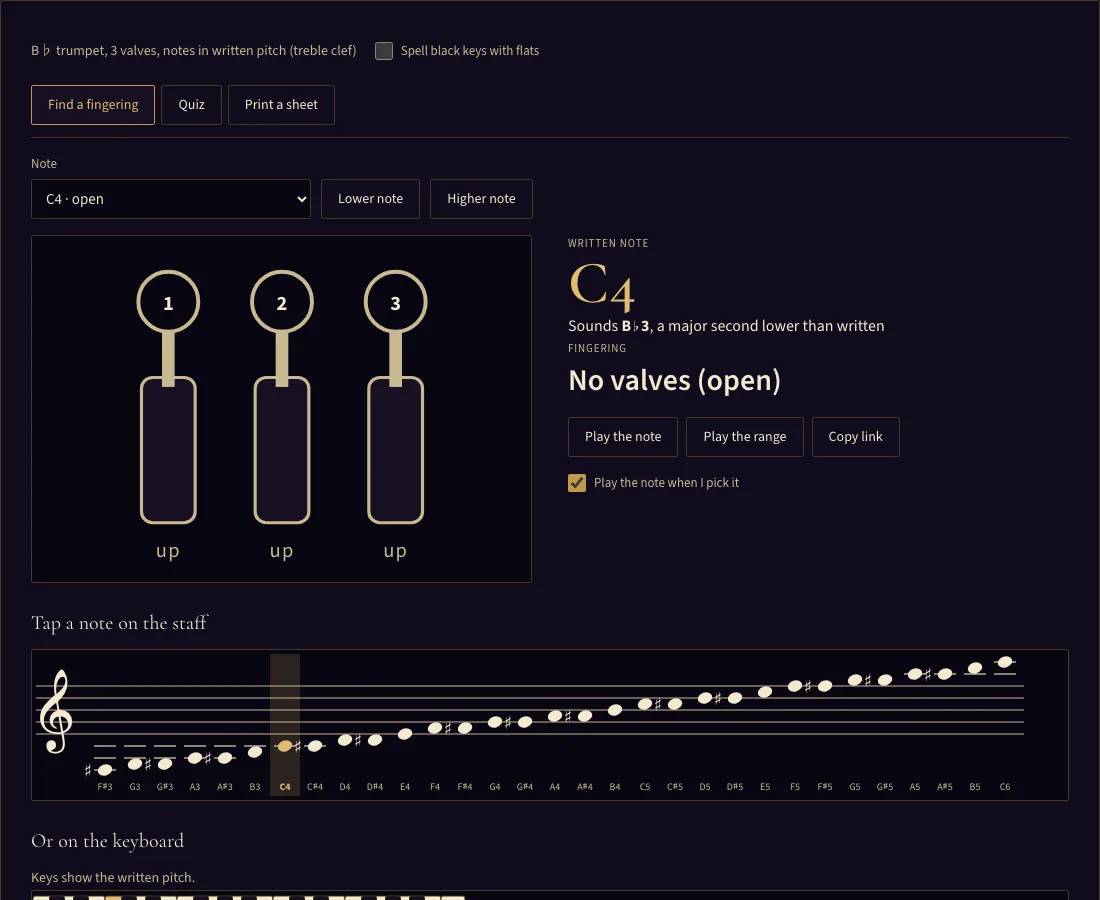
This is a free trumpet fingering chart that runs in your web browser. For a B♭ trumpet with three valves, it shows which valves to press for each written note from F♯3 to C6, 31 notes in all. Pick a note and the tool shows the pressed valves as a large piston diagram, plus the written and sounding pitch. You can hear the sounding pitch, play through the whole range, test yourself with a 10-question quiz, and print a sheet. There is no sign-up, and nothing is uploaded. Below the tool, the page keeps a printable chart with a “Print this chart” button and free PDF downloads in A4 and US Letter.
How to use the B♭ trumpet fingering finder
- Stay on the Find a fingering tab, which is selected by default.
- Open the Note list and choose a written note. Each option shows the note name and its fingering. The default is C4.
- Read the result block. It gives the Written note, the sounding pitch (for example, “Sounds … , a major second lower than written”), and the Fingering, either “Valves 1-3” or “No valves (open)”.
- Look at the piston diagram: the filled valves are the ones to press.
- Click Play the note to hear the sounding pitch. Leave Play the note when I pick it ticked if you want each choice to play automatically.
- Use Lower note and Higher note, or the arrow keys, to move one semitone at a time. You can also tap a notehead on the staff or a key on the keyboard.
- Select Quiz, then Start the quiz. You get 10 questions with four fingering choices each, then a score and a list of misses.
- Select Print a sheet, choose a scale or your own notes, and click Print this sheet.
The Spell black keys with flats checkbox changes how black keys are written on the staff, keyboard and chips. Copy link saves the current note in the web address, so you can share it.
How do you read a trumpet fingering chart?#
A trumpet fingering chart pairs each written note with the valves to press. Find the note, then read the valve numbers beside it. “Open” means no valves are pressed. “1-3” means valves 1 and 3 are pressed together.
What are the trumpet valve combinations?#
Each valve lowers the pitch of the tube by a fixed amount: valve 1 by 2 semitones, valve 2 by 1 semitone, and valve 3 by 3 semitones. When valves are combined, their amounts add up. So 1-2 lowers the pitch by 3 semitones, 2-3 by 4, 1-3 by 5, and 1-2-3 by 6. With three valves there are eight possible combinations, including open.
Why do some trumpet notes share a fingering?#
A trumpet can only sound the harmonic series of its tube, which is a set of notes at fixed intervals. The valves change the tube length, and the player’s embouchure (lip position) selects which harmonic sounds. The same valve combination therefore gives several written notes, one for each harmonic. On this chart, open fingering is shared by C4, G4 and C5, and 1-2 is shared by E4 and A4. The fingering finder’s tests confirm that each combination lands on a harmonic of the instrument.
What notes does a beginner trumpet player learn first?#
A common starting point is the open notes, which need no valves. On this chart those are C4, G4 and C5. Next come notes that use one valve, such as F4 (valve 1) and B4 (valve 2). After that, two-valve notes like E4 and A4 (both 1-2) are usually learned.
What does written pitch mean for B♭ trumpet?#
Written pitch is the note shown on the sheet music. A B♭ trumpet sounds a major second lower than the written note, so written C4 sounds B♭3. The sounding (concert) pitch is what a listener hears. Written F♯3 to C6 sounds E3 to B♭5. Trumpet players read the written note and play the fingering, and the instrument does the transposing.
What are alternate trumpet fingerings?#
An alternate fingering is a different valve combination that produces the same written note. This chart gives the standard fingering, one per note, and does not list alternates. On a real trumpet, alternates such as 1-2-3 for D4 exist mainly to fix tuning; your teacher will show you when to use them.
Frequently asked questions
Is the trumpet fingering finder free, and does it need an account?
Can I print the chart?
Can I use the printouts commercially?
Do the sounds come from a real trumpet?
Does ticking "Spell black keys with flats" change the notes?
Can I send someone a specific note?
Updated