
Printable worksheet
Tuplets worksheet
Free printable tuplets worksheet: triplets in simple time and duplets in compound time. Work out note lengths, name the tuplet and complete bars.
Tuplets worksheet
Sheet #
Name Date Score /
Answer key
Tuplets worksheet · Sheet #
About the Tuplets Worksheet
The Tuplets worksheet is a free tool that makes printable rhythm worksheets on tuplets, the groups where a different number of notes is squeezed into the time of a normal group. It covers triplets and duplets at every level, and sextuplets at Hard. Each sheet comes with an answer key. The tool runs in your web browser, needs no sign-up, and nothing you enter is uploaded.
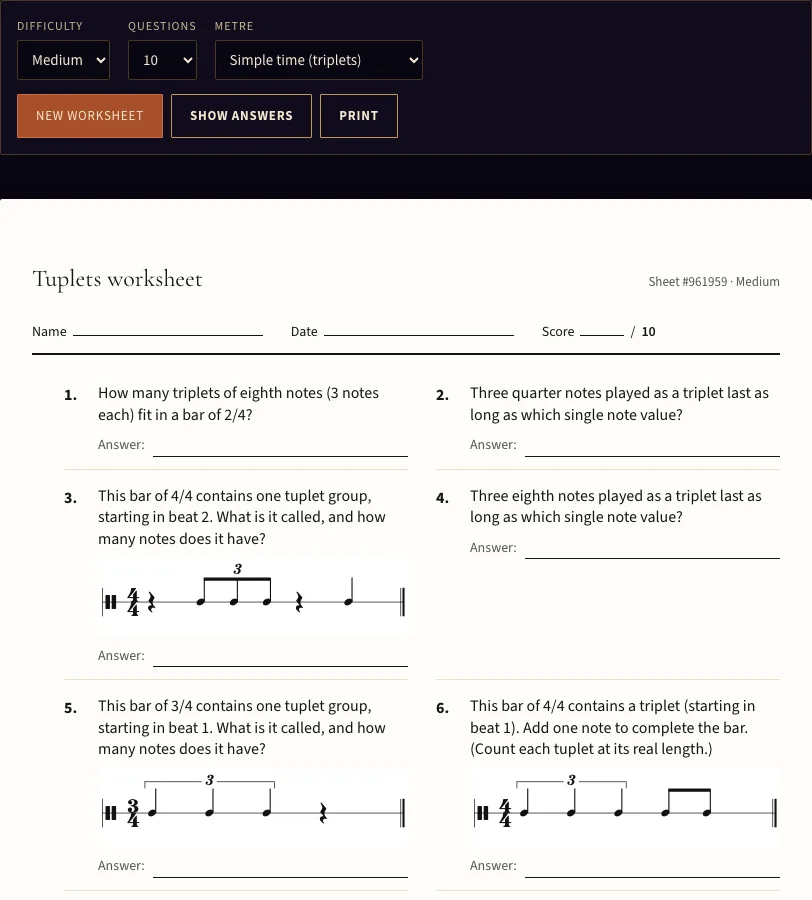
Each sheet asks a mix of questions. Some ask how long a tuplet lasts, some ask you to name a tuplet from a bar of music, and others ask you to add the missing note to a bar. You can make as many different sheets as you need, from a short Easy practice set to a Hard set of 20 questions.
How to use the Tuplets worksheet
- Set Difficulty to Easy, Medium or Hard. Medium is the default. Easy uses eighth-note groups only. Hard adds sixteenth-note triplets, sextuplets and quarter-note duplets.
- Set Questions to 10 or 20. The default is 10.
- Choose a Metre option. “Simple time (triplets)” uses triplets, “Compound time (duplets)” uses duplets, and “Triplets and duplets mixed” randomly gives a mix of both.
- Click New worksheet to make a new random sheet. Each sheet has its own six-digit sheet number at the top.
- Click Show answers to check your work on screen. The button changes to Hide answers so you can hide them again.
- Click Print (or press Ctrl+P). The printout has the questions in two columns, with blank Answer lines, and the answer key starts on a new page.
The address bar keeps your settings. The link holds the sheet number, difficulty, question count and other controls, so opening the same link rebuilds the exact same sheet. Teachers can share a link or reuse a sheet number. Invalid values in the address fall back to the defaults.
Begin with Simple time (triplets) on Easy, then try Compound time (duplets). For complete-the-bar questions, write each tuplet note’s real length above the staff, such as 1/3 beat for an eighth-note triplet, before you add up the bar. Print the sheets for students, or include them in a product you sell, such as an Etsy download or a KDP book; no credit is required.
What are tuplets in music?#
A tuplet is a group of notes that fits a different number of notes into the time that a normal group of the same note values would take. The number of notes is written above or below the group, often with a bracket. Triplets, duplets and sextuplets are the common types. The number on the group says how many notes are played; the answer key also says how many normal notes they replace, as in “3 notes in the time of 2”.
To find how long one tuplet note lasts, multiply its written value by the normal number of notes and divide by the tuplet number of notes. Every tuplet note is then counted at its real length, which is what you need when counting beats in a bar.
What is a triplet?#
A triplet puts 3 notes into the time of 2 normal notes. In simple time, three eighth notes played as a triplet take the same time as one quarter-note beat, so each eighth note lasts 1/3 beat. Three quarter notes played as a triplet last as long as a half note, and three sixteenth notes last 1/2 beat.
A sextuplet is the same idea with 6 notes in the time of 4. Six sixteenth notes take one quarter-note beat, just as four sixteenths do. Sextuplets are a Hard-level idea and appear only in simple time.
How do you count tuplets?#
Start by counting the beats in the bar. The beat is the bottom number of the time signature in simple time (in 3/4, a quarter note). In compound time, such as 6/8, 9/8 or 12/8, the beat is a dotted quarter note.
Then add up the real length of everything in the bar, counting each tuplet note at its real length. The difference between the bar length and that total is the missing note. For example, in 3/4 (3 beats), a quarter note plus a triplet of three eighth notes gives 1 + 1 = 2 beats, so the missing part is 1 beat. The missing note is a quarter note.
What do duplets and quintuplets mean?#
A duplet puts 2 notes into the time of 3. It is the compound-time version of a triplet, because compound time divides each beat into three rather than two. Two eighth notes played as a duplet last as long as a dotted quarter note, which is one beat in 6/8. Each eighth note in that duplet lasts 1/2 beat.
A quintuplet puts 5 notes into the time of 4. This worksheet does not generate quintuplets, but the same method works: divide the written value by 5 and multiply by 4 to find how long each note lasts.
Frequently asked questions
Is the Tuplets worksheet free, and does it need an account?
Can I print the Tuplets worksheet with the answers?
Is it OK to sell printed tuplet worksheets from this tool?
Can I make the same sheet again for a student or another class?
Updated