
Chart
Ukulele chord chart: open, barre and seventh chords
Loading the chord finder…
Ukulele chords for any root and type: chord diagrams with finger numbers, notes and tab (GCEA), up to 4 fingerings, play them, build and print a chord sheet.
Three pages, A4 or Letter: open chords, barre and movable chords, seventh chords. Black and white, nothing smaller than 7.5 pt.
Download the PDF kit
Free to print and share. No sign-up, no e-mail, no watermark. A4 for most of the world, Letter for the US and Canada; both are black and white, with the fonts embedded.
Quick answer
This is a printable ukulele chord chart for standard G C E A tuning, with 84 chord diagrams: 7 chord types (major, minor, sus2, sus4, dominant 7th, major 7th, minor 7th) on all 12 roots. 22 are open chords, 26 are barre and movable chords and 36 are seventh chords, on three pages for A4 or Letter paper. Each diagram shows the strings, the frets, the finger for every dot and the fret where the shape starts, and there is a button to hear it. Every shape was checked against the tuning: it sounds only notes of its chord and always includes the root and the third.
On this page: printable chart · how to read it · chords in each key · progressions · real songs · data and checks · questions
Press ▶ next to a chord to hear it (strummed from the lowest string to the highest, using exactly the strings in the diagram). The sound is made in your browser; it is a simple synthesised tone, not a recording of a ukulele.
Ukulele open chords
Played in first position, with open strings · page 1 of 3
Major chords (7)
0 0 0 3
2 2 2 0
0 3 3 1
1 4 0 2
2 0 1 0
0 2 3 2
2 1 0 0
Minor chords (7)
0 3 3 3
2 2 1 0
0 4 3 2
1 0 1 3
2 1 2 0
0 2 3 1
2 0 0 0
Suspended chords (sus2, sus4) (8)
0 2 3 3
0 0 1 3
0 2 3 0
0 0 1 3
0 2 3 0
3 0 1 1
0 2 3 3
2 2 0 0
How to read: strings run G C E A from left to right (the G is the high one). × = do not play that string, ○ = play it open, a number in a dot = the finger (1 index, 2 middle, 3 ring, 4 little), a long bar = barre (one finger across several strings), 3fr = the diagram starts at fret 3. Under each diagram: the fret of each string in the order G C E A (x = muted).
Shapes from chords-db (MIT licence), one first-choice shape per chord, each checked note by note against the tuning G C E A. musictheoryprint.com/charts/ukulele-chord-chart
Ukulele barre chords
Movable shapes: the same shape slides up the neck · page 2 of 3
Major chords (5)
1 1 1 4
3 1 2 1
1 3 4 3
3 2 1 1
4 3 2 2
Minor chords (5)
1 4 4 4
3 3 2 1
1 3 4 2
3 1 1 1
4 2 2 2
Suspended chords (sus2, sus4) (16)
1 3 4 4
2 4 5 5
3 3 1 1
4 4 2 2
1 1 2 4
1 3 4 1
2 4 5 2
3 5 6 3
4 6 7 4
1 1 2 4
1 3 4 1
2 4 5 2
4 1 2 4
1 3 4 4
3 3 1 1
4 4 2 2
How to read: strings run G C E A from left to right (the G is the high one). × = do not play that string, ○ = play it open, a number in a dot = the finger (1 index, 2 middle, 3 ring, 4 little), a long bar = barre (one finger across several strings), 3fr = the diagram starts at fret 3. Under each diagram: the fret of each string in the order G C E A (x = muted).
Shapes from chords-db (MIT licence), one first-choice shape per chord, each checked note by note against the tuning G C E A. musictheoryprint.com/charts/ukulele-chord-chart
Ukulele seventh chords
Dominant 7th, major 7th and minor 7th in all 12 keys · page 3 of 3
Dominant 7th chords (12)
0 0 0 1
1 1 1 2
2 2 2 3
3 3 3 4
1 2 0 2
2 3 1 3
3 4 2 4
0 2 1 2
1 3 2 3
0 1 0 0
1 2 1 1
2 3 2 2
Major 7th chords (12)
0 0 0 2
1 1 1 3
2 2 2 4
3 3 3 5
1 3 0 2
2 4 1 3
3 5 2 4
0 2 2 2
1 3 3 3
1 1 0 0
3 2 1 0
4 3 2 1
Minor 7th chords (12)
3 3 3 3
1 1 0 2
2 2 1 3
3 3 2 4
0 2 0 2
1 3 1 3
2 4 2 4
0 2 1 1
1 3 2 2
0 0 0 0
1 1 1 1
2 2 2 2
How to read: strings run G C E A from left to right (the G is the high one). × = do not play that string, ○ = play it open, a number in a dot = the finger (1 index, 2 middle, 3 ring, 4 little), a long bar = barre (one finger across several strings), 3fr = the diagram starts at fret 3. Under each diagram: the fret of each string in the order G C E A (x = muted).
Shapes from chords-db (MIT licence), one first-choice shape per chord, each checked note by note against the tuning G C E A. musictheoryprint.com/charts/ukulele-chord-chart
How to read a ukulele chord diagram
- Vertical lines are the strings, G C E A from left to right. The diagram is the neck seen from the front. The G (the 4th string) is tuned higher than the C beside it, which is why a ukulele has a bright, compact sound.
- Horizontal lines are the frets. The thick bar at the top is the nut. A diagram with a nut shows the first four frets.
- 2fr, 5fr … A shape played higher up the neck has no nut; the number at its left says which fret the first row is.
- A black dot is a fingertip. The number in it is the finger: 1 index, 2 middle, 3 ring, 4 little finger.
- × and ○ above a string. × means do not play that string; ○ means play it open.
- A long rounded bar is a barre: one finger lies across several strings at the same fret.
- The numbers under the diagram are the frets for the strings G, C, E, A in that order:
0 0 0 3is C major.
Hear the strings: standard ukulele tuning (G C E A)
The 4th string (G) is higher than the 3rd (C): this is called re-entrant tuning. Press a note to hear it.
| String | Open note | Hear it |
|---|---|---|
| 4th | G4 | G |
| 3rd | C4 | C |
| 2nd | E4 | E |
| 1st | A4 | A |
The chords of every key, with how often real songs use each one
Most songs in a major key are built from seven chords, one on each note of the scale: I, ii, iii, IV, V, vi and vii°. Read across for one key, down a column for the same job in every key. The share under each Roman numeral is how much of the chord labels in major-key passages of 1,156 classical art songs it makes up (see the scope note below: this is not pop music). Press a chord to hear it as the chart shape.
| Major key | I29.0% | ii6.8% | iii2.0% | IV6.8% | V24.3% | vi4.5% | vii°1.9% |
|---|---|---|---|---|---|---|---|
| C | C | Dm | Em | F | G | Am | Bdim |
| D♭ | D♭ | E♭m | Fm | G♭ | A♭ | B♭m | Cdim |
| D | D | Em | F♯m | G | A | Bm | C♯dim |
| E♭ | E♭ | Fm | Gm | A♭ | B♭ | Cm | Ddim |
| E | E | F♯m | G♯m | A | B | C♯m | D♯dim |
| F | F | Gm | Am | B♭ | C | Dm | Edim |
| F♯ | F♯ | G♯m | A♯m | B | C♯ | D♯m | E♯dim |
| G | G | Am | Bm | C | D | Em | F♯dim |
| A♭ | A♭ | B♭m | Cm | D♭ | E♭ | Fm | Gdim |
| A | A | Bm | C♯m | D | E | F♯m | G♯dim |
| B♭ | B♭ | Cm | Dm | E♭ | F | Gm | Adim |
| B | B | C♯m | D♯m | E | F♯ | G♯m | A♯dim |
The diminished chord on the 7th degree (vii°) is not on this chart; its name is shown without a button.
Minor keys
| Minor key | i24.4% | iv6.1% | V20.1% | VI4.6% | vii°4.4% |
|---|---|---|---|---|---|
| Cm | Cm | Fm | G | A♭ | Bdim |
| C♯m | C♯m | F♯m | G♯ | A | B♯dim |
| Dm | Dm | Gm | A | B♭ | C♯dim |
| E♭m | E♭m | A♭m | B♭ | C♭ | Ddim |
| Em | Em | Am | B | C | D♯dim |
| Fm | Fm | B♭m | C | D♭ | Edim |
| F♯m | F♯m | Bm | C♯ | D | E♯dim |
| Gm | Gm | Cm | D | E♭ | F♯dim |
| G♯m | G♯m | C♯m | D♯ | E | F♯♯dim |
| Am | Am | Dm | E | F | G♯dim |
| B♭m | B♭m | E♭m | F | G♭ | Adim |
| Bm | Bm | Em | F♯ | G | A♯dim |
Chord progressions quick reference
A progression is a pattern of Roman numerals, so it works in every key. These are the well-known patterns for which this site has real counts, written out in six keys. Press a row to hear it. The last two columns are not about pop songs: they say in how many of the 1,156 art songs of the OpenScore Lieder corpus the pattern appears, in any major-key passage.
| Pattern | In C | In F | In G | In D | In A | In B♭ | Songs | Share of songs |
|---|---|---|---|---|---|---|---|---|
| I–V–vi–IV | C – G – Am – F | F – C – Dm – B♭ | G – D – Em – C | D – A – Bm – G | A – E – F♯m – D | B♭ – F – Gm – E♭ | 18 | 1.6% |
| V–vi–IV–I | G – Am – F – C | C – Dm – B♭ – F | D – Em – C – G | A – Bm – G – D | E – F♯m – D – A | F – Gm – E♭ – B♭ | 12 | 1.0% |
| vi–IV–I–V | Am – F – C – G | Dm – B♭ – F – C | Em – C – G – D | Bm – G – D – A | F♯m – D – A – E | Gm – E♭ – B♭ – F | 22 | 1.9% |
| IV–I–V–vi | F – C – G – Am | B♭ – F – C – Dm | C – G – D – Em | G – D – A – Bm | D – A – E – F♯m | E♭ – B♭ – F – Gm | 16 | 1.4% |
| I–vi–IV–V | C – Am – F – G | F – Dm – B♭ – C | G – Em – C – D | D – Bm – G – A | A – F♯m – D – E | B♭ – Gm – E♭ – F | 13 | 1.1% |
| I–IV–V–I | C – F – G – C | F – B♭ – C – F | G – C – D – G | D – G – A – D | A – D – E – A | B♭ – E♭ – F – B♭ | 191 | 16.5% |
| I–vi–ii–V | C – Am – Dm – G | F – Dm – Gm – C | G – Em – Am – D | D – Bm – Em – A | A – F♯m – Bm – E | B♭ – Gm – Cm – F | 52 | 4.5% |
| I–IV–V | C – F – G | F – B♭ – C | G – C – D | D – G – A | A – D – E | B♭ – E♭ – F | 241 | 20.8% |
| I–V–I | C – G – C | F – C – F | G – D – G | D – A – D | A – E – A | B♭ – F – B♭ | 829 | 71.7% |
| ii–V–I | Dm – G – C | Gm – C – F | Am – D – G | Em – A – D | Bm – E – A | Cm – F – B♭ | 498 | 43.1% |
| IV–V–I | F – G – C | B♭ – C – F | C – D – G | G – A – D | D – E – A | E♭ – F – B♭ | 339 | 29.3% |
| V–I | G – C | C – F | D – G | A – D | E – A | F – B♭ | 1,006 | 87.0% |
Counted by these rules: sevenths and inversions count as the plain chord, repeated chords are merged, a pattern never crosses a change of key. A rotation such as vi–IV–I–V is the same loop starting on another chord and is counted separately.
What real songs use: the numbers behind the chart
In 1,156 art songs analysed by software, the most common two-chord move in a major key is V→I: 10,374 times in 1,006 songs, 19.2% of all two-chord moves. After a V chord the next chord is I 73.3% of the time. ii–V–I appears 1,256 times in 498 songs (43% of the songs). The loop I–V–vi–IV, which Wikipedia calls extremely common, is found, in any of its four rotations, in only 53 songs (4.6%).
- In major-key passages the tonic I (29.0%) and the dominant V (24.3%) together are 53% of all chord labels. In minor-key passages the tonic i (24.4%) and V (20.1%) are 45%.
- 35.2% of the chord labels carry a seventh (the pattern tables fold sevenths into the plain chord, so V7 counts as V). That is why the chart has a page of seventh chords.
- By the lowest note, 59.8% of the labels are in root position, 21.3% in first inversion and 14.8% in second inversion.
- A diminished chord (vii°) is 1.9% of the labels in major and 4.4% in minor.
Where the shapes come from and how they were checked
The shapes come from chords-db, an open database of ukulele chords by David Rubert and contributors (MIT licence). It lists 336 shapes for the 84 chords on this chart. The diagrams are drawn by the build script as static SVG, so they print sharply and need no JavaScript. Nothing was drawn or typed by hand.
The rule for the one shape shown
- Candidates: every shape that chords-db lists for the chord. For the 84 chords on this chart that is 336 shapes, 4.0 per chord.
- Pitch check: a shape is dropped if any sounding note is not a note of the chord, or if the root, the third (sus2: the 2nd, sus4: the 4th) or, in a seventh chord, the seventh does not sound. No shape had to be dropped.
- Open first: the first shape in chords-db order that is played in first position and uses at least one open string. Open shapes of major, minor and suspended chords go on the open-chords page; seventh chords stay on the seventh-chords page, open or not.
- Otherwise the shape lowest on the neck (the first one in chords-db order if two are equally low).
- Only that one shape is drawn for each chord; the ukulele has four strings, so most chords have several equally easy shapes and this chart shows just one of them.
The checks
The build stops at the first failed check. This run passed 1,358 checks for this page:
| Check | Count |
|---|---|
| Open-string notes of the tuning equal the standard tuning stored in chords-db | 5 |
| The shape has the right number of strings and every dot lies on one of the 4 drawn frets | 420 |
| Pitches worked out from the tuning and the frets equal the MIDI list stored in chords-db for that shape | 84 |
| Every sounding note is a note of the chord (no foreign note) | 84 |
| The root of the chord sounds | 84 |
| The third sounds (sus2: the 2nd, sus4: the 4th) | 84 |
| A usable shape was found for the chord by the selection rule | 51 |
| A barre spans two or more strings and never covers an open string | 74 |
| The seventh sounds in every 7, maj7 and m7 shape | 36 |
| Chords of each key: spelled two ways (letters, and line of fifths) with the same result | 432 |
| Wikipedia excerpts contain only allowed markup, no leftovers, and name source, licence and article | 4 |
Checks use only the standard tuning (G4 C4 E4 A4) and the fret numbers: the pitch of a string is the open note plus the fret. None of the 336 shapes for these chords failed the check. If you find a shape on this chart that sounds wrong, it is a bug in the page, not a different opinion about fingerings: tell us.
Licence
The chord data comes from chords-db, MIT licence, Copyright (c) 2016 David Rubert. The licence text is reproduced here as the licence requires:
MIT License

Copyright (c) 2016 David Rubert

Permission is hereby granted, free of charge, to any person obtaining a copy of this software and associated documentation files (the "Software"), to deal in the Software without restriction, including without limitation the rights to use, copy, modify, merge, publish, distribute, sublicense, and/or sell copies of the Software, and to permit persons to whom the Software is furnished to do so, subject to the following conditions:

The above copyright notice and this permission notice shall be included in all copies or substantial portions of the Software.

THE SOFTWARE IS PROVIDED "AS IS", WITHOUT WARRANTY OF ANY KIND, EXPRESS OR IMPLIED, INCLUDING BUT NOT LIMITED TO THE WARRANTIES OF MERCHANTABILITY, FITNESS FOR A PARTICULAR PURPOSE AND NONINFRINGEMENT. IN NO EVENT SHALL THE AUTHORS OR COPYRIGHT HOLDERS BE LIABLE FOR ANY CLAIM, DAMAGES OR OTHER LIABILITY, WHETHER IN AN ACTION OF CONTRACT, TORT OR OTHERWISE, ARISING FROM, OUT OF OR IN CONNECTION WITH THE SOFTWARE OR THE USE OR OTHER DEALINGS IN THE SOFTWARE.
The Wikipedia excerpts further down are under CC BY-SA 4.0 and say where they come from. The statistics come from the site’s own analysis of the CC0 OpenScore Lieder corpus. Sources and licences for everything on the page are listed on the credits page.
Every chord as fret numbers
The same shapes as text, one fret number per string in the order G C E A; x means the string is not played. Use it to copy a chord, or when you cannot see the pictures.
Show the table (84 chords)
| Chord | Frets | Starts at fret |
|---|---|---|
| C | 0 0 0 3 | 1 |
| D♭ / C♯ | 1 1 1 4 | 1 |
| D | 2 2 2 0 | 1 |
| E♭ | 0 3 3 1 | 1 |
| E | 1 4 0 2 | 1 |
| F | 2 0 1 0 | 1 |
| F♯ / G♭ | 3 1 2 1 | 1 |
| G | 0 2 3 2 | 1 |
| A♭ / G♯ | 1 3 4 3 | 1 |
| A | 2 1 0 0 | 1 |
| B♭ | 3 2 1 1 | 1 |
| B | 4 3 2 2 | 1 |
| Cm | 0 3 3 3 | 1 |
| C♯m / D♭m | 1 4 4 4 | 1 |
| Dm | 2 2 1 0 | 1 |
| E♭m | 3 3 2 1 | 1 |
| Em | 0 4 3 2 | 1 |
| Fm | 1 0 1 3 | 1 |
| F♯m / G♭m | 2 1 2 0 | 1 |
| Gm | 0 2 3 1 | 1 |
| G♯m / A♭m | 1 3 4 2 | 1 |
| Am | 2 0 0 0 | 1 |
| B♭m | 3 1 1 1 | 1 |
| Bm | 4 2 2 2 | 1 |
| Csus2 | 0 2 3 3 | 1 |
| D♭sus2 / C♯sus2 | 1 3 4 4 | 1 |
| Dsus2 | 2 4 5 5 | 2 |
| E♭sus2 | 3 3 1 1 | 1 |
| Esus2 | 4 4 2 2 | 1 |
| Fsus2 | 0 0 1 3 | 1 |
| F♯sus2 / G♭sus2 | 1 1 2 4 | 1 |
| Gsus2 | 0 2 3 0 | 1 |
| A♭sus2 / G♯sus2 | 1 3 4 1 | 1 |
| Asus2 | 2 4 5 2 | 2 |
| B♭sus2 | 3 5 6 3 | 3 |
| Bsus2 | 4 6 7 4 | 4 |
| Csus4 | 0 0 1 3 | 1 |
| D♭sus4 / C♯sus4 | 1 1 2 4 | 1 |
| Dsus4 | 0 2 3 0 | 1 |
| E♭sus4 | 1 3 4 1 | 1 |
| Esus4 | 2 4 5 2 | 2 |
| Fsus4 | 3 0 1 1 | 1 |
| F♯sus4 / G♭sus4 | 4 1 2 4 | 1 |
| Gsus4 | 0 2 3 3 | 1 |
| A♭sus4 / G♯sus4 | 1 3 4 4 | 1 |
| Asus4 | 2 2 0 0 | 1 |
| B♭sus4 | 3 3 1 1 | 1 |
| Bsus4 | 4 4 2 2 | 1 |
| C7 | 0 0 0 1 | 1 |
| D♭7 / C♯7 | 1 1 1 2 | 1 |
| D7 | 2 2 2 3 | 1 |
| E♭7 | 3 3 3 4 | 1 |
| E7 | 1 2 0 2 | 1 |
| F7 | 2 3 1 3 | 1 |
| F♯7 / G♭7 | 3 4 2 4 | 1 |
| G7 | 0 2 1 2 | 1 |
| A♭7 / G♯7 | 1 3 2 3 | 1 |
| A7 | 0 1 0 0 | 1 |
| B♭7 | 1 2 1 1 | 1 |
| B7 | 2 3 2 2 | 1 |
| Cmaj7 | 0 0 0 2 | 1 |
| D♭maj7 / C♯maj7 | 1 1 1 3 | 1 |
| Dmaj7 | 2 2 2 4 | 1 |
| E♭maj7 | 3 3 3 5 | 3 |
| Emaj7 | 1 3 0 2 | 1 |
| Fmaj7 | 2 4 1 3 | 1 |
| F♯maj7 / G♭maj7 | 3 5 2 4 | 2 |
| Gmaj7 | 0 2 2 2 | 1 |
| A♭maj7 / G♯maj7 | 1 3 3 3 | 1 |
| Amaj7 | 1 1 0 0 | 1 |
| B♭maj7 | 3 2 1 0 | 1 |
| Bmaj7 | 4 3 2 1 | 1 |
| Cm7 | 3 3 3 3 | 1 |
| C♯m7 / D♭m7 | 1 1 0 2 | 1 |
| Dm7 | 2 2 1 3 | 1 |
| E♭m7 | 3 3 2 4 | 1 |
| Em7 | 0 2 0 2 | 1 |
| Fm7 | 1 3 1 3 | 1 |
| F♯m7 / G♭m7 | 2 4 2 4 | 1 |
| Gm7 | 0 2 1 1 | 1 |
| G♯m7 / A♭m7 | 1 3 2 2 | 1 |
| Am7 | 0 0 0 0 | 1 |
| B♭m7 | 1 1 1 1 | 1 |
| Bm7 | 2 2 2 2 | 1 |
musictheoryprint.com · free to print and share
Background
Excerpts from open reference works, reproduced as published (references, images and tables removed). Every excerpt names its source, licence and original article.
Ukulele: the instrument and its tuning
Overview
The ukulele, also called a uke (informally), is a member of the lute (ancient guitar) family of instruments. The ukulele is of Portuguese origin and was popularized in Hawaii. The tone and volume of the instrument vary with size and construction. Ukuleles commonly come in four sizes: soprano, concert, tenor, and baritone.
Ukuleles generally have four nylon strings tuned to GCEA (except baritone, which is normally tuned DGBE). They have 16–22 frets depending on the size.
Size and range
Common types of ukuleles include soprano (standard ukulele), concert, tenor, and baritone. Less common are the sopranino (also called piccolo, bambino, or "pocket uke"), bass, and contrabass ukuleles. Other types of ukuleles include banjo ukuleles and electric ukuleles. Of the standard ukuleles, the soprano, often called "standard" in Hawaii, is the second smallest and was the original size. The concert size was developed in the 1920s as an enhanced soprano, slightly larger and louder with a deeper tone. Shortly thereafter, the tenor was created, having more volume and a deeper bass tone. The baritone (resembling a smaller tenor guitar) was created in the 1940s, and the contrabass and bass are recent innovations (2010 and 2014, respectively).
Source: Wikipedia, “Ukulele” — CC BY-SA 4.0 — text excerpted; see the article for the full text and authors. Revision of 2026-07-01.
Chord charts: how players write chords down
A chord chart (or chart) is a form of musical notation that describes the basic harmonic and rhythmic information for a song or tune. It is the most common form of notation used by professional session musicians playing jazz or popular music. It is intended primarily for a rhythm section (usually consisting of piano, guitar, drums and bass). In these genres the musicians are expected to be able to improvise the individual notes used for the chords (the "voicing") and the appropriate ornamentation, counter melody or bassline.
In some chord charts, the harmony is given as a series of chord symbols above a traditional musical staff. The rhythmic information can be very specific and written using a form of traditional notation, sometimes called rhythmic notation, or it can be completely unspecified using slash notation, allowing the musician to fill the bar with chords or fills any way they see fit (called comping). In Nashville notation the key is left unspecified on the chart by substituting numbers for chord names. This facilitates on-the-spot key changes to songs. Chord charts may also include explicit parts written in modern music notation (such as a musical riff that the song is dependent on for character), lyrics or lyric fragments, and various other information to help the musician compose and play their part.
Source: Wikipedia, “Chord chart” — CC BY-SA 4.0 — text excerpted; see the article for the full text and authors. Revision of 2026-04-04.
Chord (music): the idea behind every diagram
Definition
A chord is the sound of two or more notes being played at the same time. The term derives from "accord", which became "cord" in Middle English. The original meaning was an agreement or harmonious sound. In the 17th century, the spelling was changed to "chord" to prevent confusion with "cord".
Until the Middle Ages, harmony was any combination of two notes. In the Renaissance, the simultaneous sound of three notes began to be understood as the working definition of harmony. An arpeggio is a broken chord where each note is sounded successively instead of simultaneously. Chords can also be implied by melodies.
A chord progression is a collection of harmonies with a specific destination or purpose, such as reinforcing the tonic or modulation to a new pitch center. Chord progressions are common in Western music. Homophonic textures where the melody and harmony generally move in unison are considered the standard practice in classical music and remain central to music instruction. The study of harmony involves chords and progressions and the principles of connection that govern them.
Structure
Just as scales derive from the harmonic series, the major chord is likewise formed by overtones 4, 5, and 6. The next overtone creates a seventh chord. A common triad has three notes: the root, third, and fifth. The intervals are identified by their distance from the root of the chord. The notes that form a chord are sometimes called members or factors.
Continuing up in thirds yields a seventh, ninth, eleventh, and thirteenth before returning to the root again. Complex sonorities larger than a tetrad are sometimes called polychords because they can be seen as combinations of two different chords. Extended chords are one of the central characteristics of jazz harmony.
Chords are identified by their intervals. The four basic triad qualities are major, minor, diminished, and augmented. Major and minor chords derive from the quality of their thirds. Diminished and augmented chords describe the quality of the fifth. Additional intervals like sevenths are also described by their quality in relation to the root.
Composers began expanding tonality beyond the common practice and often structured chords in fourths and fifths. They were more tonally ambiguous, enabling new patterns for music. Chords also shrunk to tone clusters made of small intervals like seconds. The resulting sound mass was a common feature in the 20th century. Microtonal chords are also used by many contemporary composers.
Theorists began to analyze the structure of chords in the 16th century. Jean-Philippe Rameau developed the nomenclature for chord inversion that is still in use today.
Root position is when the lowest note of a chord is the root, regardless of how the other members are arranged above it. The chord is considered inverted when the root is not the lowest voice. When the third is the lowest sounding pitch, the chord is in first inversion. The second inversion puts the fifth in the bass and was widely seen as dissonant, even as composers put it into frequent practice.
Source: Wikipedia, “Chord (music)” — CC BY-SA 4.0 — text excerpted; see the article for the full text and authors. Revision of 2026-04-05.
Sources and licences for the text, scores and recordings on this page are on the credits page.
Sources: chords-db (MIT licence), Wikipedia: Ukulele, Wikipedia: Chord chart, Wikipedia: Chord (music), OpenScore Lieder Corpus.
About the ukulele chord finder
This ukulele chord chart shows the notes, fingering and tab for any chord on a standard four-string ukulele. It runs in your web browser, is free, and needs no sign-up. Pick a root note and a chord type, and the tool draws the diagram, lists the notes in the chord, and gives you the fingerings to try. You can also build a chord sheet for a song, hear the chords played back with a synth tone, and print the result. It works for a first C chord or for an em chord ukulele shape you can’t quite remember.
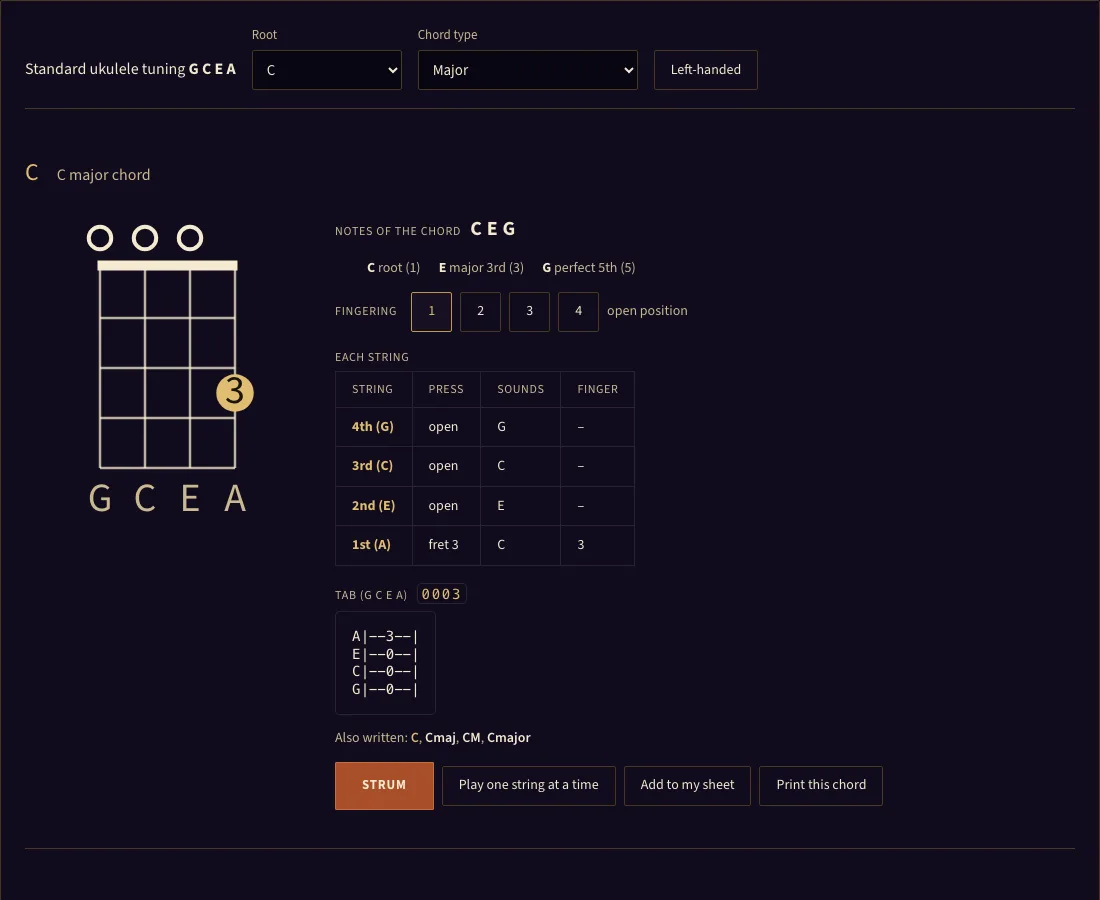
How to use the ukulele chord finder
- Choose a note in the Root menu. The default is C.
- Choose a Chord type. The default is Major. Other options include Minor, Dominant 7th (7), Minor 7th (m7) and Add 9.
- Read the result. It shows the chord name, the Notes of the chord with their intervals, and the diagram.
- Choose a shape with the Fingering buttons 1 to 4. The open position comes first. Higher shapes are labelled “from fret N”.
- Check the Each string table (String, Press, Sounds, Finger) to see which fret and finger to use on each string.
- Press Strum to hear the whole chord, or Play one string at a time to hear each string on its own.
- Press Add to my sheet to build a list of chords. Use ← and → to move a chord, ▶ to play it, and × to remove it. A sheet holds up to 24 chords.
- Press Print this chord to print the current chord, or Print the sheet to print your sheet. Turn on Large print for bigger diagrams.
The Left-handed toggle mirrors every diagram. The root, chord type, fingering and sheet are stored in the page link, so Copy link lets you return to the same chords later or share them.
What are the basic ukulele chords for beginners?#
Most beginner songs use a small set of open chords, and C, Am, F and G7 are common starting points. The C chord has the notes C, E and G, and its usual shape is 0003. In that shape the first three strings are played open and the A string is pressed at fret 3. Learn one shape at a time, and check each note against the Each string table before you strum.
How do you read a ukulele chord chart (a quick chord guide)?#
A chord chart shows the strings as vertical lines and the frets as horizontal lines. Dots or numbers show where to press. A tab gives one number per string, read in G C E A order. A 0 means the string is played open, and a 3 means press at fret 3. For frets 10 and higher, the tool separates the numbers with hyphens, as in 10-10-9-11.
What is the standard ukulele tuning?#
The standard ukulele tuning is G C E A, which is the only tuning this tool uses. The G string is re-entrant: it is tuned higher than the C string next to it, so the lowest note of an open ukulele is the C. This is why the C chord shape 0003 sounds G C E C: three open strings give G, C and E, and fret 3 on the A string gives another C.
What are the easiest ukulele chords?#
The easiest chords are usually the ones with the most open strings, because open strings need no pressing. C at 0003 has three open strings, and the common Am, F and G shapes are also built around open strings. Chords that need one finger laid across several strings, such as B♭m7 at 1111, take more practice. Start with open shapes and move to barre shapes once your fingers are used to pressing.
Do ukulele chords work on a baritone ukulele?#
Chord names and notes stay the same, but the shapes do not. A baritone ukulele is tuned DGBE, so a fingering that works on a standard uke will sound different on a baritone. This tool only offers standard G C E A tuning, and it has no baritone option. A baritone is tuned like the top four strings of a guitar, so baritone players use guitar-style shapes; see a chord chart written for DGBE tuning.
How do left-handed players read ukulele chords?#
Turn on the Left-handed toggle. It mirrors every diagram, so the strings run from right to left, which matches how a left-handed player sees the instrument. The notes and fret numbers stay the same, and only the direction of the diagram changes.
What is ukulele chord tab?#
Ukulele chord tab is a short notation that lists the fret for each string, usually as four numbers. This tool writes the tab in G C E A order, so 0003 means open G, open C, open E, and fret 3 on the A string. The tool also shows a four-line ASCII tab, which draws the same chord as four lines of text. Use it when you want a plain text version to read or copy.
Frequently asked questions
Is it free and does it need an account?
Can I print it?
Can I use the printouts commercially?
Does the tool play real recordings?
Why does one chord have several fingerings?
Which chords are in a key?
Can I return to my chords later?
Updated