
Instruments · Electrophones
Electric guitar
An electric guitar is a type of musical instrument. The first one was made in 1931 by George Beauchamp. It is a string instrument usually played with a pick and sometimes with the fingers. It uses things called "electric pickups" which are wire-wound magnets that change the vibration of the strings into electric current. This electric current is then sent to an amplifier (amp for short) that changes it to sound. This electric current can also be changed to produce effects. The main parts of an electric guitar are the neck, the pickups, the tuners, the bridge, the input, the body, the frets, the volume knobs and the tone knobs. There may also be other parts that can change other sounds. A normal electric guitar has one neck with 6 strings on it, although there are 12 string guitars and guitars with more than one neck.
Summary: Simple English Wikipedia, “Electric guitar” — CC BY-SA 4.0. Revision of 2026-03-10.
Museum photographs
These 3 photographs span 1932–1963, 1 place of origin and 2 museums. Every photograph is public domain or openly licensed, and links to the museum’s own record.
-
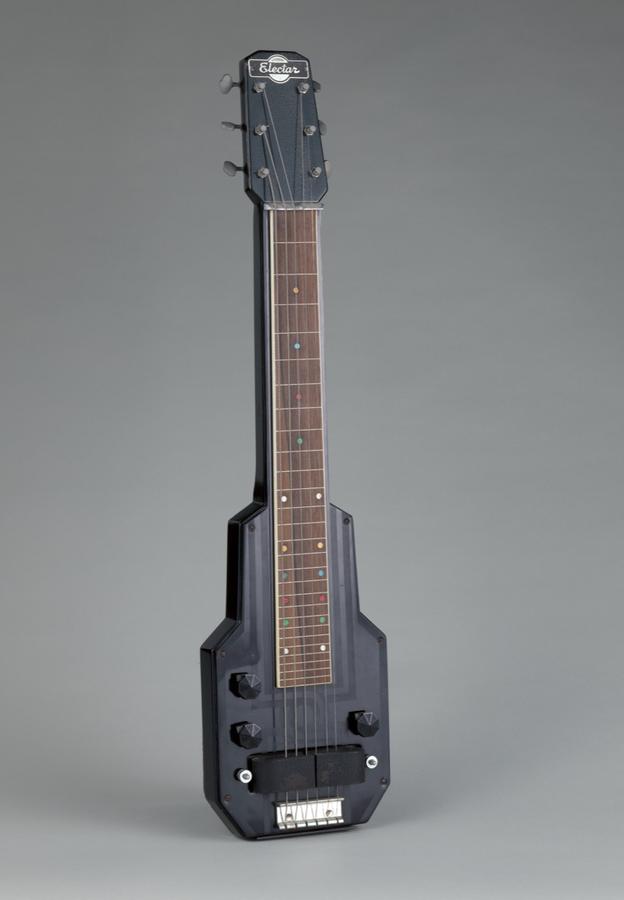
Electar Lap Steel Electric Guitarca. 1937 · American (United States) -
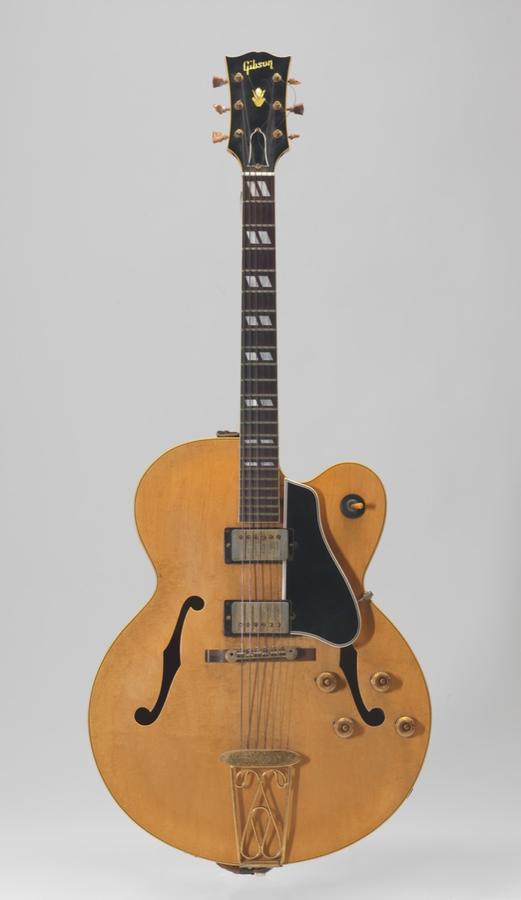
Electric guitar belonging to Chuck Berry, nicknamed "Maybellene"1959 · African Americans -
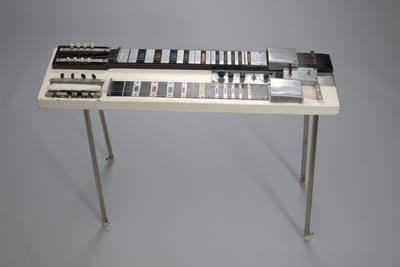
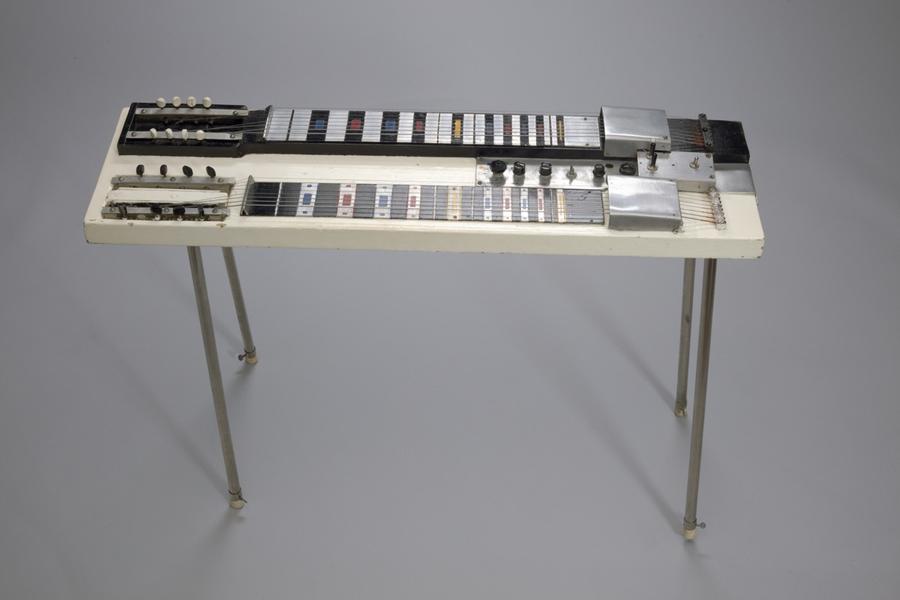
Electric console steel guitar built by Felton W. Williams, Jr.ca. 1963 · African Americans (United States)
Facts at a glance
| Hornbostel–Sachs number | 513 — Composite chordophone |
|---|---|
| Hornbostel–Sachs group | Electrophones |
| Also known as | e-guitar |
| Classification (Wikipedia infobox) | String instrument (fingered or picked or strummed) |
| Developed | 1932, United States |
| Wikidata labels | 102 languages |
| Wikipedia article | Electric guitar |
| Wikidata item | Q78987 |
| Wikimedia Commons category | Electric guitars |
| MusicBrainz instrument | 7ee8ebf5-3aed-4fc8-8004-49f4a8c45a87 |
| Encyclopaedia Britannica | art/electric-guitar |
| Audio sample (Wikimedia Commons) | Clean-gain demo melody.ogg |
Sources: Wikidata (CC0 1.0) — classification number, aliases, identifiers (dump of 2026-07-22); Wikipedia (CC BY-SA 4.0) — infobox fields (description of the classification number, development, inventors) and the names of the Hornbostel–Sachs groups (article “Hornbostel–Sachs”, revision of 2026-01-04).
The name in other languages
| Language | Name | Also written |
|---|---|---|
| English | electric guitar | e-guitar |
| French | guitare électrique | guitare éléctrique, guitares électriques, guitare electrique |
| German | Elektrogitarre | Stromgitarre, Elektro-Gitarre, elektrische Gitarre |
| Spanish | guitarra eléctrica | Guitarra electrica, Guitarras electricas, Guitarras eléctricas |
| Italian | chitarra elettrica | |
| Portuguese | guitarra elétrica | viola solo, viola ritmo, guitarra electrica |
| Dutch | elektrische gitaar | Electrische gitaar, Elektrisch gitaar |
| Russian | электрогитара | электронная гитара, электрическая гитара, электрогитарист |
| Japanese | エレクトリック・ギター | エレキ・ギター, エレキバンド, エレキギター |
| Chinese | 电吉他 | 蝉吉他, 電吉他, 电吉它 |
| Korean | 전기 기타 | 일렉 기타, 전기기타, 일렉트릭 기타 |
| Arabic | قيثارة كهربائية | الجيتار الكهربائي, غيتار كهربائي, الغيتار الكهربائي |
Sources: Wikidata (CC0 1.0) — labels and aliases; MusicBrainz (CC0 1.0) — instrument aliases (names only).
About the electric guitar: history, construction and playing
An electric guitar is a guitar that, unlike a standard acoustic guitar, requires external electric sound amplification to be heard at typical performance volumes. It uses one or more pickups to convert the vibration of its strings into electrical signals, which ultimately are reproduced as sound by loudspeakers. The sound is sometimes shaped or electronically altered to achieve different timbres or tonal qualities via amplifier settings or knobs on the guitar. Often, this is done through the use of effects such as reverb, distortion and overdrive; the latter is considered to be a key element of electric blues guitar music, rock and heavy metal guitar playing. Designs also exist combining attributes of electric and acoustic guitars: the semi-acoustic and acoustic-electric guitars.
Invented in 1932, the electric guitar was adopted by jazz guitar players, who wanted to play single-note guitar solos in large big band ensembles. Early proponents of the electric guitar on record include Les Paul, Eddie Durham, George Barnes, Lonnie Johnson, Sister Rosetta Tharpe, T-Bone Walker, and Charlie Christian. During the 1950s and 1960s, the electric guitar became the most important instrument in popular music. It has evolved into an instrument that is capable of a multitude of sounds and styles in genres ranging from pop and rock to folk to country music, blues and jazz. It served as a major component in the development of electric blues, rock and roll, rock music, heavy metal music and many other genres of music.
History
Many experiments with electrically amplifying the vibrations of a string instrument were made dating back to the early part of the 20th century. Patents from the 1910s show telephone transmitters were adapted and placed inside violins and banjos to amplify the sound. Hobbyists in the 1920s used carbon button microphones attached to the bridge; however, these detected vibrations from the bridge on top of the instrument, resulting in a weak signal.
Electric guitars were originally designed by acoustic guitar makers and instrument manufacturers. The demand for amplified guitars began during the big band era; as orchestras increased in size, guitar players soon realized the necessity in guitar amplification and electrification. The first electric guitars used in jazz were hollow archtop acoustic guitar bodies with electromagnetic transducers.
The first electrically amplified stringed instrument to be marketed commercially was a cast aluminium lap steel guitar nicknamed the "Frying Pan" designed in 1931 by George Beauchamp, the general manager of the National Stringed Instrument Corporation, with Paul Barth, who was vice president. George Beauchamp, along with Adolph Rickenbacker, invented the electromagnetic pickups. Coils that were wrapped around a magnet would create an electromagnetic field that converted the vibrations of the guitar strings into electrical signals, which could then be amplified. Commercial production began in late summer of 1932 by the Ro-Pat-In Corporation (Electro-Patent-Instrument Company), in Los Angeles, a partnership of Beauchamp, Adolph Rickenbacker (originally Rickenbacher), and Paul Barth.
In 1934, the company was renamed the Rickenbacker Electro Stringed Instrument Company. In that year Beauchamp applied for a United States patent for an Electrical Stringed Musical Instrument and the patent was later issued in 1937. By the time it was patented, other manufacturers were already making their own electric guitar designs. Early electric guitar manufacturers include Rickenbacker in 1932; Dobro in 1933; National, AudioVox and Volu-tone in 1934; Vega, Epiphone (Electrophone and Electar), and Gibson in 1935 and many others by 1936.
Solid-body
Unlike acoustic guitars, solid-body electric guitars have no vibrating soundboard to amplify string vibration. Instead, solid-body instruments depend on electric pickups, and an amplifier ("amp") and speaker. The solid body ensures that the amplified sound reproduces the string vibration alone, thus avoiding the wolf tones and unwanted feedback associated with amplified acoustic guitars. These guitars are generally made of hardwood covered with a hard polymer finish, often polyester or lacquer. In large production facilities, the wood is stored for three to six months in a wood-drying kiln before being cut to shape. Premium custom-built guitars are frequently made with much older (thus fully dried, cured and stabilized, that is to say, less prone to deformation), hand-selected wood.
One of the first solid-body guitars was invented by Les Paul. Gibson did not present their Gibson Les Paul guitar prototypes to the public, as they did not believe the solid-body style would catch on. Another early solid-body Spanish style guitar, resembling what would become Gibson's Les Paul guitar a decade later, was developed in 1941 by O.W. Appleton, of Nogales, Arizona. Appleton made contact with both Gibson and Fender but was unable to sell the idea behind his "App" guitar to either company. In 1946, Merle Travis commissioned steel guitar builder Paul Bigsby to build him a solid-body Spanish-style electric. Bigsby delivered the guitar in 1948. The first mass-produced solid-body guitar was Fender Esquire and Fender Broadcaster (later to become the Fender Telecaster), first made in 1950, five years after Les Paul made his prototype. The Gibson Les Paul appeared soon after to compete with the Broadcaster. Another notable solid-body design is the Fender Stratocaster, which was introduced in 1954 and became extremely popular among musicians in the 1960s and 1970s for its wide tonal capabilities and more comfortable ergonomics than other models. Different styles of guitar have different pick-up styles, the main being 2 or 3 "single-coil" pick-ups or a double humbucker, with the Stratocaster being a triple single-coil guitar.
Chambered-body
Some otherwise solid-bodied guitars, such as the Gibson Les Paul Supreme, the PRS Singlecut, and the Fender Telecaster Thinline, are built with hollow chambers in the body. These chambers are designed to not interfere with the critical bridge and string anchor point on the solid body. In the case of Gibson and PRS, these are called chambered bodies. The motivation for this may be to reduce weight, to achieve a semi-acoustic tone or both.
Construction
Electric guitar design and construction vary greatly in the shape of the body and the configuration of the neck, bridge, and pickups. However, some features are present on most guitars. The photo below shows the different parts of an electric guitar. The headstock (1) contains the metal machine heads (1.1), which use a worm gear for tuning. The nut (1.4)—a thin fret-like strip of metal, plastic, graphite, or bone—supports the strings at the headstock end of the instrument. The frets (2.3) are thin metal strips that stop the string at the correct pitch when the player pushes a string against the fingerboard. The truss rod (1.2) is a metal rod (usually adjustable) that counters the tension of the strings to keep the neck straight. Position markers (2.2) provide the player with a reference to the playing position on the fingerboard.
The neck and fretboard (2.1) extend from the body. At the neck joint (2.4), the neck is either glued or bolted to the body. The body (3) is typically made of wood with a hard, polymerized finish. Strings vibrating in the magnetic field of the pickups (3.1, 3.2) produce an electric current in the pickup winding that passes through the tone and volume controls (3.8) to the output jack. Some guitars have piezo pickups, in addition to or instead of magnetic pickups.
Some guitars have a fixed bridge (3.4). Others have a spring-loaded hinged bridge called a vibrato bar, tremolo bar, or whammy bar, which lets players bend notes or chords up or down in pitch or perform a vibrato embellishment. A plastic pickguard on some guitars protects the body from scratches or covers the control cavity, which holds most of the wiring. The degree to which the choice of woods and other materials in the solid-guitar body (3) affects the sonic character of the amplified signal is disputed. Many believe it is highly significant, while others think the difference between woods is subtle. In acoustic and archtop guitars, wood choices more clearly affect tone.
Bridge and tailpiece systems
The bridge and tailpiece, while serving separate purposes, work closely together to affect playing style and tone. There are four basic types of bridge and tailpiece systems on electric guitars. Within these four types are many variants.
A hard-tail guitar bridge anchors the strings at or directly behind the bridge and is fastened securely to the top of the instrument. These are common on carved-top guitars, such as the Gibson Les Paul and Paul Reed Smith models, and on slab-body guitars, such as the Music Man Albert Lee and Fender guitars that are not equipped with a vibrato arm.
A floating or trapeze tailpiece (similar to a violin's) fastens to the body at the base of the guitar. These appear on Rickenbackers, Gretsches, Epiphones, a wide variety of archtop guitars, particularly jazz guitars, and the 1952 Gibson Les Paul.
Pictured is a tremolo arm or vibrato tailpiece-style bridge and tailpiece system, often called a whammy bar or trem. It uses a lever ("vibrato arm") attached to the bridge that can temporarily slacken or tighten the strings to alter the pitch. A player can use this to create a vibrato or a portamento effect. Early vibrato systems were often unreliable and made the guitar go out of tune easily. They also had a limited pitch range. Later Fender designs were better, but Fender held the patent on these, so other companies used older designs for many years.
With the expiration of the Fender patent on the Stratocaster-style vibrato, various improvements on this type of internal, multi-spring vibrato system are now available. Floyd Rose introduced one of the first improvements on the vibrato system in many years when, in the late 1970s, he experimented with "locking" nuts and bridges that prevent the guitar from losing tuning, even under heavy vibrato bar use.
The fourth type of system employs string-through body anchoring. The strings pass over the bridge saddles, then through holes through the top of the guitar body to the back. The strings are typically anchored in place at the back of the guitar by metal ferrules. Many believe this design improves a guitar's sustain and timbre. A few examples of string-through body guitars are the Fender Telecaster Thinline, the Fender Telecaster Deluxe, the B.C. Rich IT Warlock and Mockingbird, and the Schecter Omen 6 and 7 series.
Source: Wikipedia, “Electric guitar” — CC BY-SA 4.0 — text excerpted as published (references, images and tables removed); see the article for the full text and the list of authors. Revision of 2026-07-05.
Composers who played it
6 composers on this site list the electric guitar as an instrument they played. A selection:
- Mario Lavezzi 1948–
- Scott Johnson 1952–2023
- Jim Johnston 1959–
- Takeharu Ishimoto 1970–
- David Chalmin 1980–
- Danny Baranowsky 1984–
Composers with a page on this site whose Wikidata record lists this instrument; featured and best-dated first. Data: Wikidata (property “instrument”, P1303), CC0 1.0.
Sources and licences
- Electar Lap Steel Electric Guitar, Epiphone, ca. 1937, American (United States). Maple, etched metal, rosewood, chrome. Gift of Steve Uhrik, 2016 (2016.518a–c). Museum record · CC0 1.0 (public domain dedication)
- Electric guitar belonging to Chuck Berry, nicknamed "Maybellene", 1959, African Americans. wood and metal. Collection of the Smithsonian National Museum of African American History and Culture, Donation of Charles E. Berry. Museum record · CC0 1.0 (public domain dedication)
- Electric console steel guitar built by Felton W. Williams, Jr., ca. 1963, African Americans (United States). wood, alloy steel, metal, brass, aluminum alloy, and plastic. Collection of the Smithsonian National Museum of African American History and Culture; Gift of Felton W. Williams, Jr.. Museum record · CC0 1.0 (public domain dedication)
Photographs: open-access collections of the museums named above; each is shown here reduced in size, otherwise unchanged. Text: Wikipedia (CC BY-SA 4.0), Wikidata and MusicBrainz (CC0). The full list of sources and licences is on the credits page.