
Instruments · Chordophones
Banjo
The banjo is a string instrument, that was first played by African slaves in the United States a few hundred years ago. The idea came from other African instruments. The name banjo may have come from a Kimbundu word: mbanza, but it could have also come from a Senegambian word for the bamboo stick used for the banjo's neck.
Summary: Simple English Wikipedia, “Banjo” — CC BY-SA 4.0. Revision of 2026-04-01.
Museum photographs
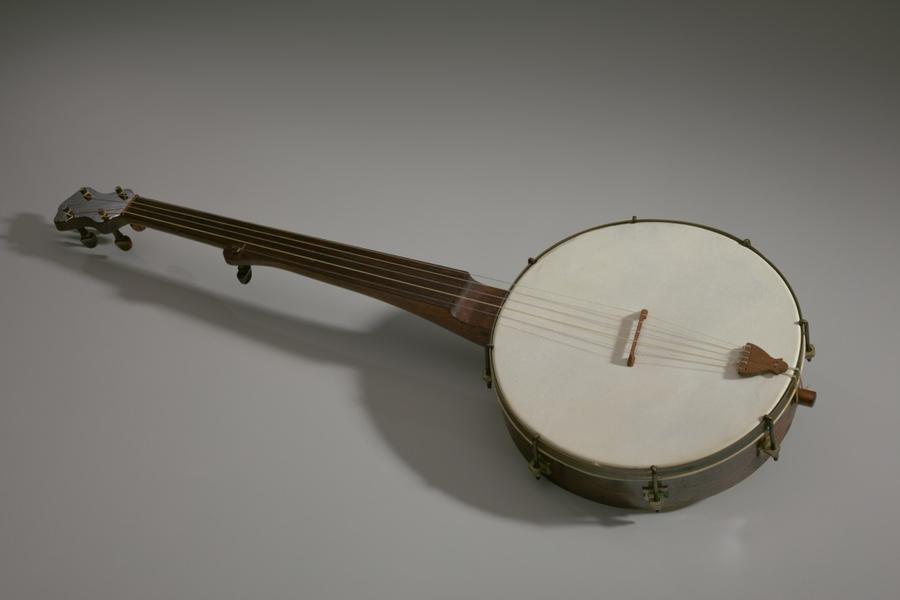
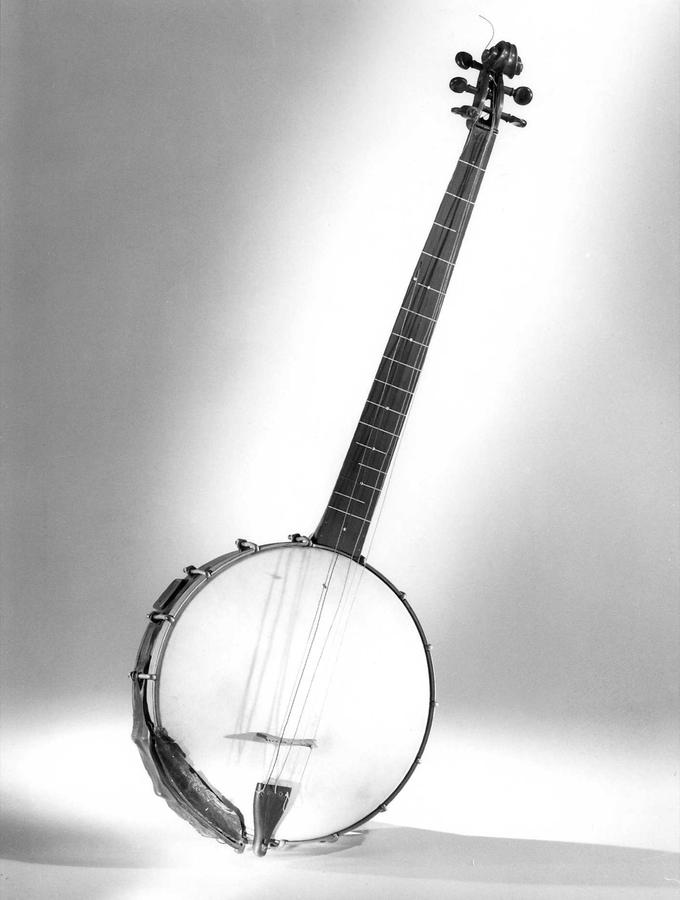
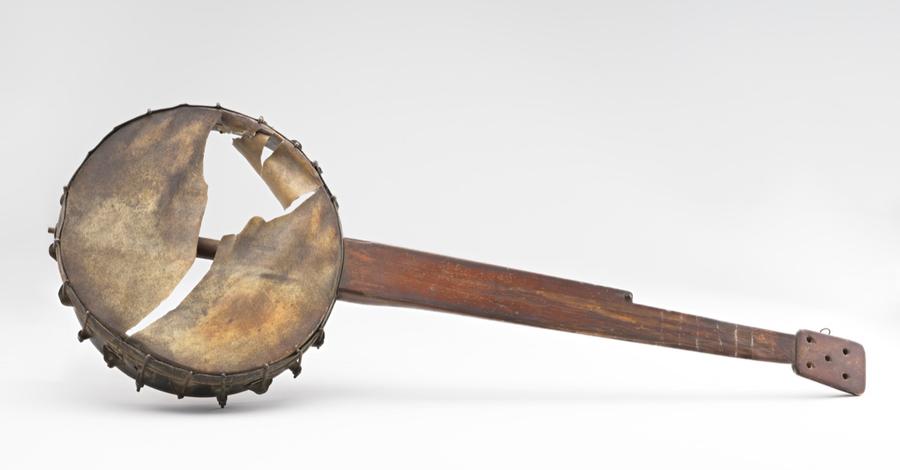
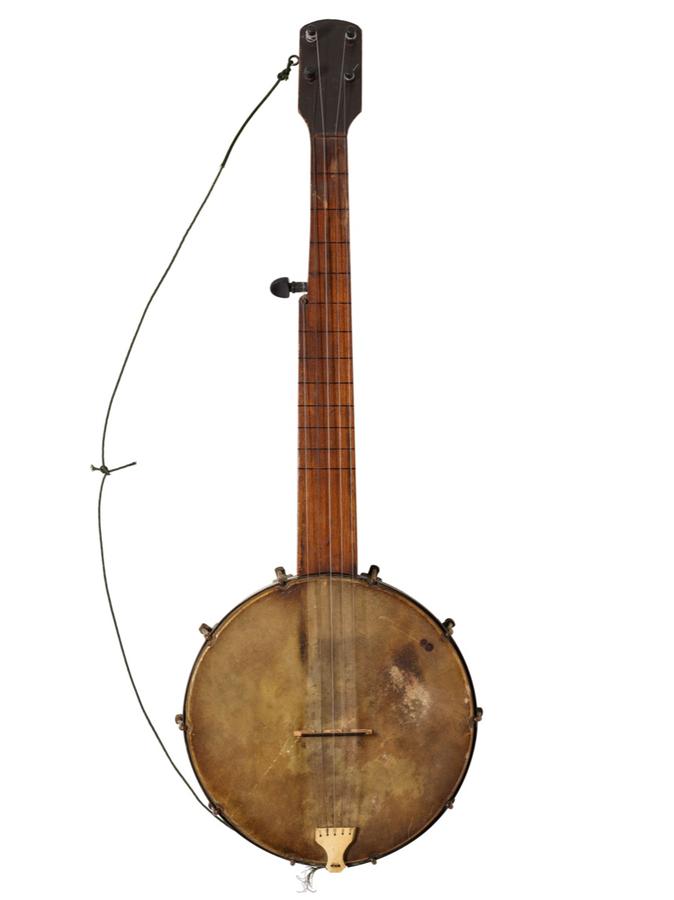
These 10 photographs span 1801–1909, 3 places of origin and 2 museums. 1 of them carry no date in the museum record. Every photograph is public domain or openly licensed, and links to the museum’s own record.
-
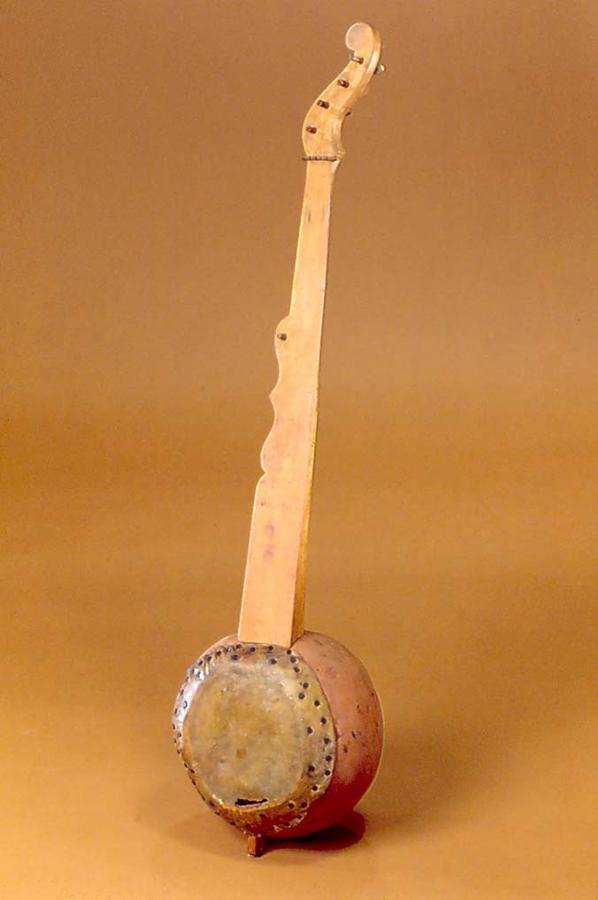
Banjoca. 1840 · American (United States) -
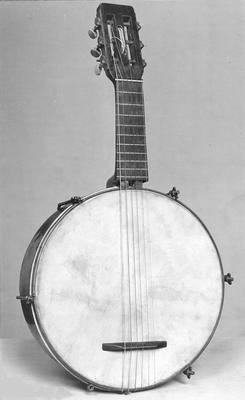
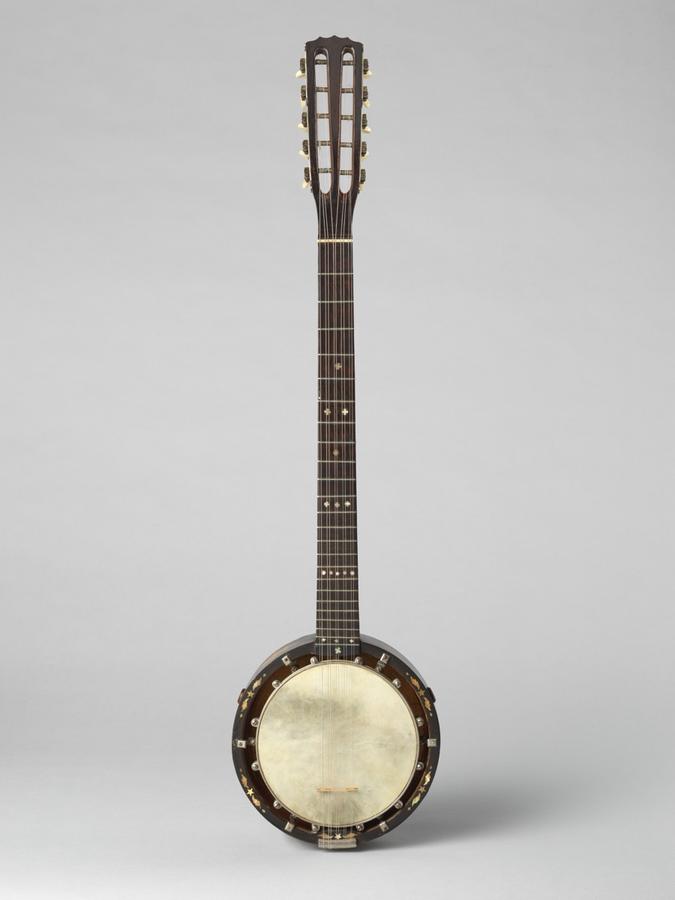
Cither Banjo19th century · Austrian (Austria) -
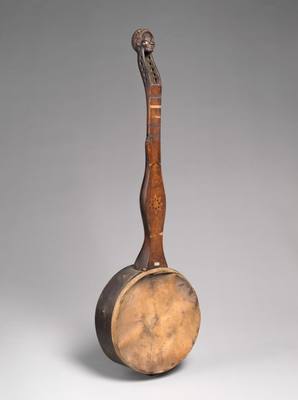
Banjomid-19th century · British (United Kingdom) -
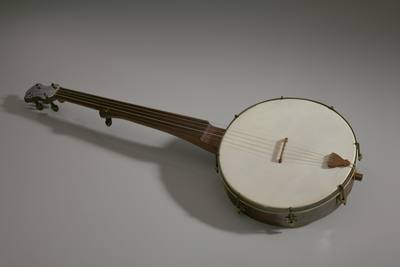
Banjo made in the style of William Esperance Boucher, Jr.ca. 1850s · African Americans; Africans (United States) -
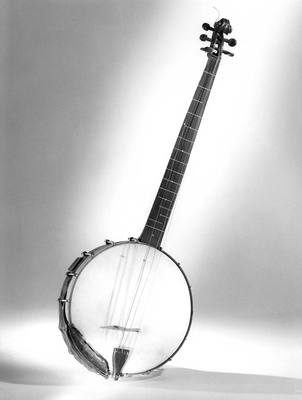
Banjoca. 1859 · American (United States) -
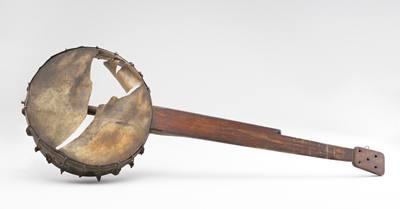
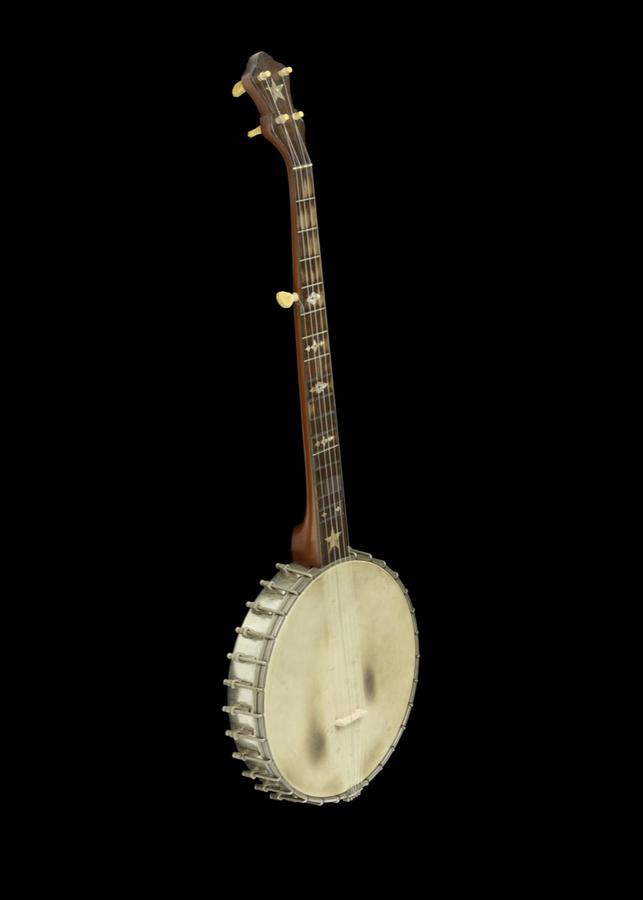
Banjo made by Lewis Snowden1860s · African Americans (United States) -
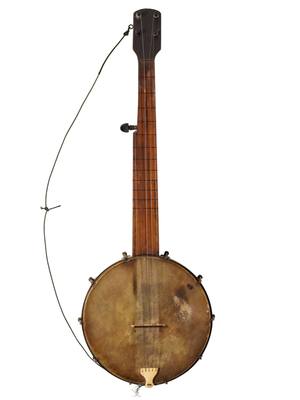
Banjo played by Lew Snowdenca 1870s · African Americans -
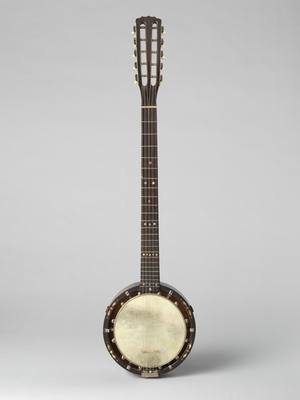
Banjoca. 1885 · American (United States) -
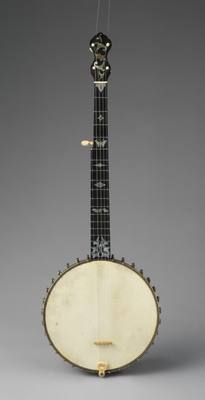
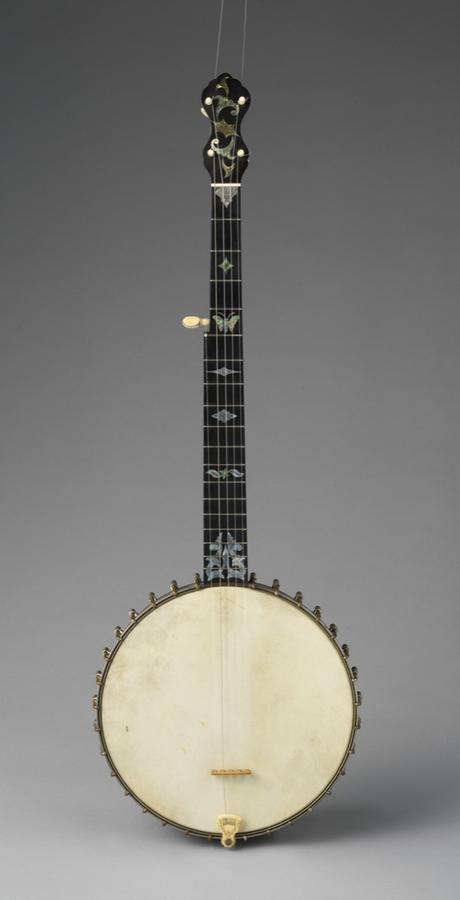
“Eclipse 4000” model banjoca. 1904-1906 · American (United States) -
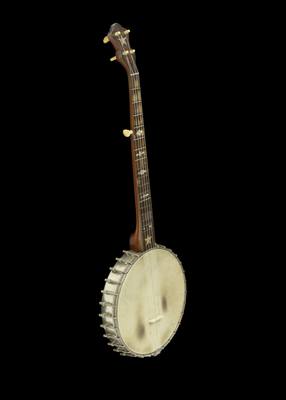
Banjo created for Charles P. Stinsonlate19th century · African Americans (United States)
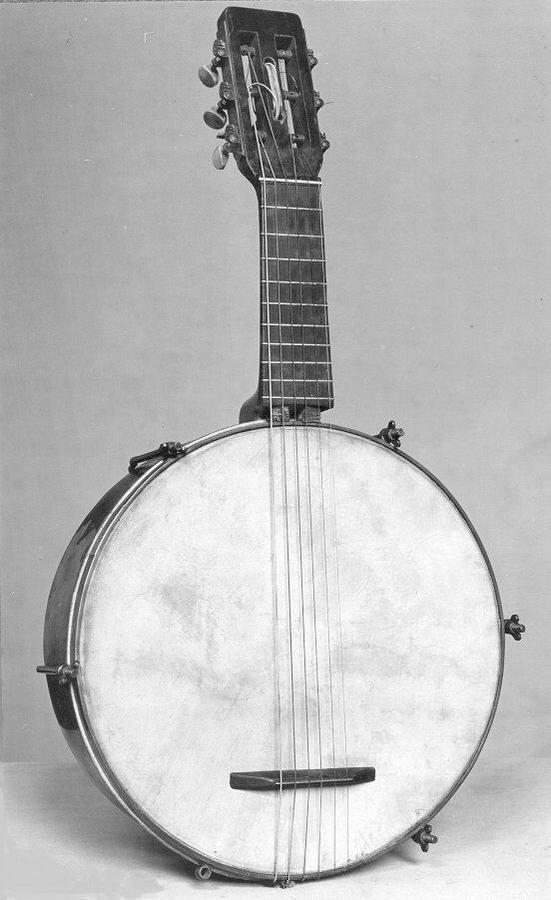
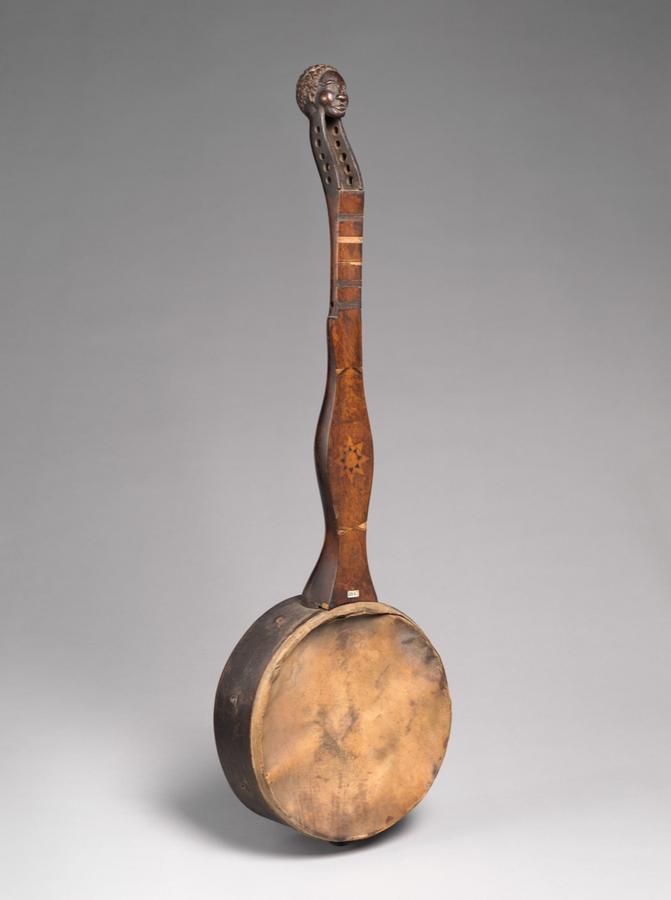
Facts at a glance
| Hornbostel–Sachs number | 321.322-8 — Composite chordophone with a neck that passes diametrically through the resonator, sounded by plectrum, finger picks, or the bare fingers |
|---|---|
| Hornbostel–Sachs group | Chordophones › Composite chordophones › Lutes |
| Developed | 18th century, United States |
| Wikidata labels | 81 languages |
| Wikipedia article | Banjo |
| Wikidata item | Q258896 |
| Wikimedia Commons category | Banjo family instruments |
| MusicBrainz instrument | 6bf88fc7-a235-4d95-a910-a4ce4a4853c6 |
| Encyclopaedia Britannica | art/banjo-musical-instrument |
| Audio sample (Wikimedia Commons) | Banjo.ogg |
Sources: Wikidata (CC0 1.0) — classification number, aliases, identifiers (dump of 2026-07-22); Wikipedia (CC BY-SA 4.0) — infobox fields (description of the classification number, development, inventors) and the names of the Hornbostel–Sachs groups (article “Hornbostel–Sachs”, revision of 2026-01-04).
The name in other languages
| Language | Name | Also written |
|---|---|---|
| English | banjo | |
| French | banjo | |
| German | Banjo | |
| Spanish | banyo | banjo |
| Italian | banjo | |
| Portuguese | banjo | |
| Dutch | banjo | |
| Russian | банджо | |
| Japanese | バンジョー | |
| Chinese | 班卓琴 | 四弦班卓琴 |
| Korean | 밴조 | |
| Arabic | بانجو |
Sources: Wikidata (CC0 1.0) — labels and aliases; MusicBrainz (CC0 1.0) — instrument aliases (names only).
About the banjo: history, construction and playing
The banjo is a stringed instrument with a thin membrane stretched over a frame or cavity to form a resonator. The membrane is typically circular, and in modern forms is usually made of BOPET, where early membranes were made of goat skin.
Early forms of the instrument were fashioned by African Americans and had African antecedents, and the instrument was strongly associated with black people. In the 19th century, interest in the instrument was spread across the United States and United Kingdom by traveling shows of the highly popular traveling blackface minstrel shows, followed by mass production and mail-order sales, including instructional books. The inexpensive or home-made banjo remained part of rural folk culture, but five-string and four-string banjos also became popular for home parlor music entertainment, college music clubs, and early 20th century jazz bands. By the early 20th century, the banjo was most frequently associated with folk, cowboy music, and country music.
By mid-century it had come to be strongly associated with bluegrass. Eventually it began to be employed occasionally and sporadically in various kinds or other kinds of popular music. Some famous American bluegrass players of the banjo are Ralph Stanley and Earl Scruggs.
Early origins
The modern banjo derives from instruments that have been recorded to be in use in North America and the Caribbean since the 17th century by enslaved people taken from West and Central Africa, such as the kora. Their African-style instruments were crafted from split gourds with animal skins stretched across them. Strings, from gut or vegetable fibers, were attached to a wooden neck. Written references to the banjo in North America and the Caribbean appear in the 17th and 18th centuries.
The earliest written indication of an instrument akin to the banjo is in the 17th century: Richard Jobson (1621) in describing The Gambia, wrote about an instrument which some consider to be similar to the banjo.
They have little varietie of instruments, that which is most common in use, is made of a great gourd, and a necke thereunto fastned, resembling, in some sort, our Bandora; but they have no manner of fret, and the strings they are either such as the place yeeldes or their invention can attaine to make, being very unapt to yeeld a sweete and musicall sound, notwithstanding with pinnes they winde and bring to agree in tunable notes, having not above sixe strings upon their greatest instrument.
Michel Étienne Descourtilz, a naturalist who visited Haiti in the early 1800s, described it as banzas, a Negro instrument, that the natives prepare by sawing one of the calabashes or a large gourd lengthwise, to which they attach a neck and sonorous strings made from the filament" of aloe plants. It was played during any occasion, from boredom to joyous parties and calendas to funeral ceremonies. It was the custom to also combine this sound with the more noisy bamboula, a type of drum made from a stick of bamboo covered on both sides with a skin that was played with fingers and knuckles while sitting astride.
Various instruments in Africa, chief among them the kora, feature a skin drumhead and gourd (or similar shell) body. These instruments differ from early African-American banjos in that the necks do not possess a Western-style fingerboard and tuning pegs; instead they have stick necks, with strings attached to the neck with loops for tuning.
Modern forms
The modern banjo comes in a variety of forms, including four- and five-string versions. A six-string version, tuned and played similarly to a guitar, has gained popularity. In almost all of its forms, banjo playing is characterized by a fast arpeggiated plucking, though many different playing styles exist.
The body, or "pot", of a modern banjo typically consists of a circular rim (generally made of wood, though metal was also common on older banjos) and a tensioned head, similar to a drum head. Traditionally, the head was made from animal skin, but today is often made of various synthetic materials. Most modern banjos also have a metal "tone ring" assembly that helps further clarify and project the sound, but many older banjos do not include a tone ring.
The banjo is usually tuned with friction tuning pegs or planetary gear tuners, rather than the worm gear machine head used on guitars. Frets have become standard since the late 19th century, though fretless banjos are still manufactured and played by those wishing to execute glissando, play quarter tones, or otherwise achieve the sound and feeling of early playing styles.
Five-string banjo
The modern five-string banjo is a variation on Sweeney's original design. The fifth string is usually the same gauge as the first, but starts from the fifth fret, three-quarters the length of the other strings. This lets the string be tuned to a higher open pitch than possible for the full-length strings. Because of the short fifth string, the five-string banjo uses a reentrant tuning – the string pitches do not proceed lowest to highest across the fingerboard. Instead, the fourth string is lowest, then third, second, first, and the fifth string is highest.
The short fifth string presents special problems for a capo. For small changes (going up or down one or two semitones, for example), simply retuning the fifth string is possible. Otherwise, various devices called "fifth-string capos" effectively shorten the vibrating part of the string. Many banjo players use model-railroad spikes or titanium spikes (usually installed at the seventh fret and sometimes at others), under which they hook the string to press it down on the fret.
Five-string banjo players use many tunings. (Tunings are given in left-to-right order, as viewed from the front of the instrument with the neck pointing up for a right-handed instrument. Left handed instruments reverse the order of the strings.) Probably the most common, particularly in bluegrass, is the Open-G tuning G4 D3 G3 B3 D4. In earlier times, the tuning G4 C3 G3 B3 D4 was commonly used instead, and this is still the preferred tuning for some types of folk music and for classic banjo. Other tunings found in old-time music include double C (G4 C3 G3 C4 D4), "sawmill", also called "mountain modal" (G4 D3 G3 C4 D4), and open D (F#4 D3 F#3 A3 D4). These tunings are often taken up a tone, either by tuning up or using a capo. For example, "double-D" tuning (A4 D3 A3 D4 E4) – commonly reached by tuning up from double C – is often played to accompany fiddle tunes in the key of D, and Open-A (A4 E3 A3 C#4 E4) is usually used for playing tunes in the key of A. Dozens of other banjo tunings are used, mostly in old-time music. These tunings are used to make playing specific tunes easier, usually fiddle tunes or groups of fiddle tunes.
Four-string banjos
The four-string plectrum banjo is a standard banjo without the short drone string. It usually has 22 frets on the neck and a scale length of 26 to 28 inches, and was originally tuned C3 G3 B3 D4. It can also be tuned like the top four strings of a guitar, which is known as "Chicago tuning". As the name suggests, it is usually played with a guitar-style pick (that is, a single one held between thumb and forefinger), unlike the five-string banjo, which is either played with a thumbpick and two fingerpicks, or with bare fingers. The plectrum banjo evolved out of the five-string banjo, to cater to styles of music involving strummed chords. The plectrum is also featured in many early jazz recordings and arrangements.
Four-string banjos can be used for chordal accompaniment (as in early jazz), for single-string melody playing (as in Irish traditional music), in "chord melody" style (a succession of chords in which the highest notes carry the melody), in tremolo style (both on chords and single strings), and a mixed technique called "duo style" that combines single-string tremolo and rhythm chords.
Four-string banjos are used from time to time in musical theater. Examples include: Hello, Dolly!, Mame, Chicago, Cabaret, Oklahoma!, Half a Sixpence, Annie, Barnum, The Threepenny Opera, Monty Python's Spamalot, and countless others. Joe Raposo had used it variably in the imaginative seven-piece orchestration for the long-running TV show Sesame Street, and has sometimes had it overdubbed with itself or an electric guitar. The banjo is still (albeit rarely) in use in the show's arrangement currently.
Six-string banjos
The six-string banjo began as a British innovation by William Temlett, one of England's earliest banjo makers. He opened a shop in London in 1846, and sold seven-string banjos which he marketed as "zither" banjos from his 1869 patent. A zither banjo usually has a closed back and sides with the drum body and skin tensioning system suspended inside the wooden rim, the neck and string tailpiece mounted on the outside of the rim, and the drone string led through a tube in the neck so that the tuning peg can be mounted on the head. They were often made by builders who used guitar tuners that came in banks of three, so five-stringed instruments had a redundant tuner; these banjos could be somewhat easily converted over to a six-string banjo.
American Alfred Davis Cammeyer (1862–1949), a young violinist turned concert banjo player, devised the six-string zither banjo around 1880. British opera diva Adelina Patti advised Cammeyer that the zither banjo might be popular with English audiences as it had been invented there, and Cammeyer went to London in 1888. With his virtuoso playing, he helped show that banjos could make more sophisticated music than normally played by blackface minstrels. He was soon performing for London society, where he met Sir Arthur Sullivan, who recommended that Cammeyer progress from arranging the music of others for banjo to composing his own music.
Modern six-string bluegrass banjos have been made. These add a bass string between the lowest string and the drone string on a five-string banjo, and are usually tuned G4 G2 D3 G3 B3 D4. Sonny Osborne played one of these instruments for several years. It was modified by luthier Rual Yarbrough from a Vega five-string model. A picture of Sonny with this banjo appears in Pete Wernick's Bluegrass Banjo method book.
Long neck banjos
Also called Seeger banjos for having been invented by Pete Seeger, these banjos feature three extra frets, giving the instrument a longer neck and greater playing versatility. With three extra frets, these banjos can be played one-and-a-half steps lower than a regular banjo, which some players find advantageous for singing or playing along. They are almost always open-backed. Notably, the drone strings on Seeger banjos are not pushed three frets back, so the tuning peg for the 5th string is in line with the 8th fret instead of the 5th fret.
Source: Wikipedia, “Banjo” — CC BY-SA 4.0 — text excerpted as published (references, images and tables removed); see the article for the full text and the list of authors. Revision of 2026-06-03.
Composers who played it
7 composers on this site list the banjo as an instrument they played. A selection:
- Clarence L. Partee 1864–1915
- Frederick J. Bacon 1871–1948
- Matelo Ferret 1918–1989
- Angy Palumbo 1923–1960
- Gustavo Santaolalla 1951–
- Dougie MacLean 1954–
- Paul Elwood 1958–
Composers with a page on this site whose Wikidata record lists this instrument; featured and best-dated first. Data: Wikidata (property “instrument”, P1303), CC0 1.0.
Sources and licences
- Banjo, William Esperance Boucher, Jr., ca. 1840, American (United States). Wood, gourds, sheepskin. The Crosby Brown Collection of Musical Instruments, 1889 (89.4.598). Museum record · CC0 1.0 (public domain dedication)
- Cither Banjo, Karl Schamal, 19th century, Austrian (Austria). brass, parchment, wire. The Crosby Brown Collection of Musical Instruments, 1889 (89.4.848). Museum record · CC0 1.0 (public domain dedication)
- Banjo, mid-19th century, British (United Kingdom). Wood, various materials. The Crosby Brown Collection of Musical Instruments, 1889 (06.1245). Museum record · CC0 1.0 (public domain dedication)
- Banjo made in the style of William Esperance Boucher, Jr., ca. 1850s, African Americans; Africans (United States). wood , metal , animal skin or synthetic materials. Collection of the Smithsonian National Museum of African American History and Culture, Gift of Robert Bockee Winans. Museum record · CC0 1.0 (public domain dedication)
- Banjo, Hercules McCord, ca. 1859, American (United States). Metal, wood. The Crosby Brown Collection of Musical Instruments, 1889 (89.4.2676). Museum record · CC0 1.0 (public domain dedication)
- Banjo made by Lewis Snowden, 1860s, African Americans (United States). wood, animal skin, metal. Collection of the Smithsonian National Museum of African American History and Culture, Gift of Howard L. Sacks and Judith Rose Sacks from the Snowden Collection. Museum record · CC0 1.0 (public domain dedication)
- Banjo played by Lew Snowden, ca 1870s, African Americans. nickel (rim material); wood (overall material); metal (overall material); skin (head material); ivory…. Gift of Howard L. Sacks and Judith Rose Sacks from the Snowden Collection. Museum record · CC0 1.0 (public domain dedication)
- Banjo, Benjamin Bradbury, ca. 1885, American (United States). Wood, strings, metal, various materials. Purchase, Mr. and Mrs. Thomas A. Cassilly Gift, 1993 (1993.111). Museum record · CC0 1.0 (public domain dedication)
- “Eclipse 4000” model banjo, William A. Cole, ca. 1904-1906, American (United States). Calfskin head, various woods (including ebony), metal hardware, mother of pearl and abalone inlays, gut…. The Metropolitan Museum of Art, New York (2026.448.4). Museum record · CC0 1.0 (public domain dedication)
- Banjo created for Charles P. Stinson, late19th century, African Americans (United States). wood, metal, calfskin, resin, mother of pearl. Collection of the Smithsonian National Museum of African American History and Culture, Gift of the Clark and Sarah Case Family. Museum record · CC0 1.0 (public domain dedication)
Photographs: open-access collections of the museums named above; each is shown here reduced in size, otherwise unchanged. Text: Wikipedia (CC BY-SA 4.0), Wikidata and MusicBrainz (CC0). The full list of sources and licences is on the credits page.