
Instruments · Chordophones
Viol
The viol (rhymes with "mile") is a string instrument that is played with a bow. The viol was a popular instrument from the 15th to the 18th century. Small viols are held on the lap, and the larger ones are held between the knees, which gave them the name of "viol da gamba", meaning a leg viol. The bow is held with the palm of the hand facing upwards: the other way round from today's bowhold for violins, violas or cellos. The viol is a gentle-sounding instrument. When the violin family became popular in the 17th century and people started to go to concerts in large concert halls, and to operas, the viols became less important.
Summary: Simple English Wikipedia, “Viol” — CC BY-SA 4.0. Revision of 2024-01-25.
Museum photographs
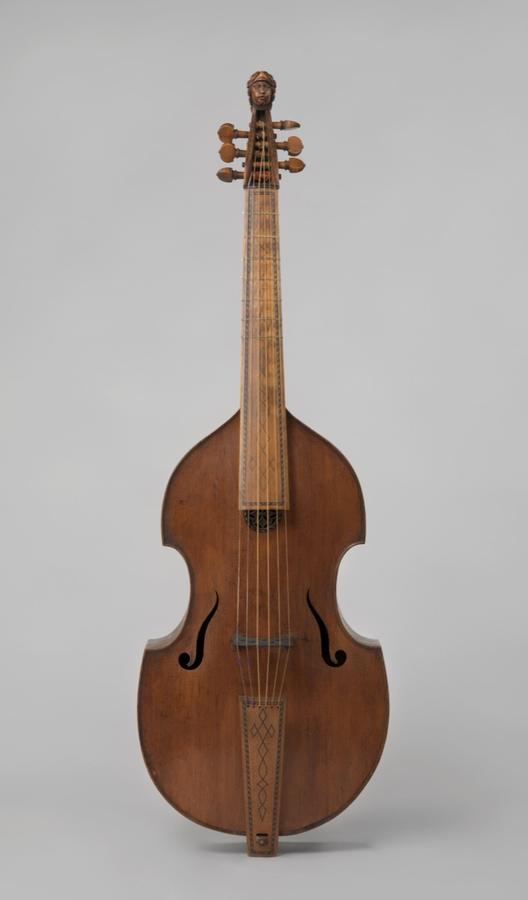
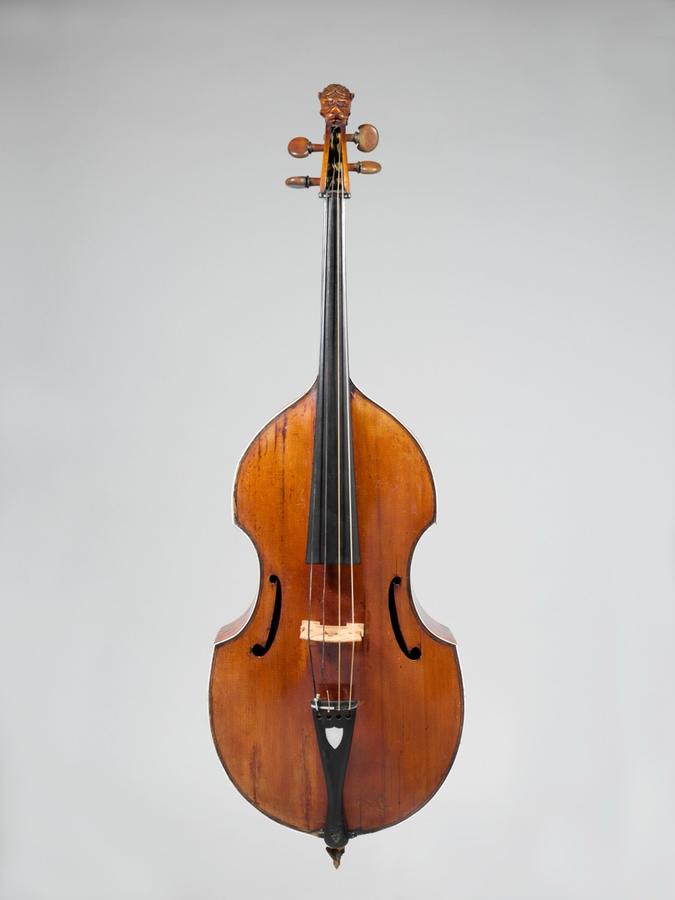
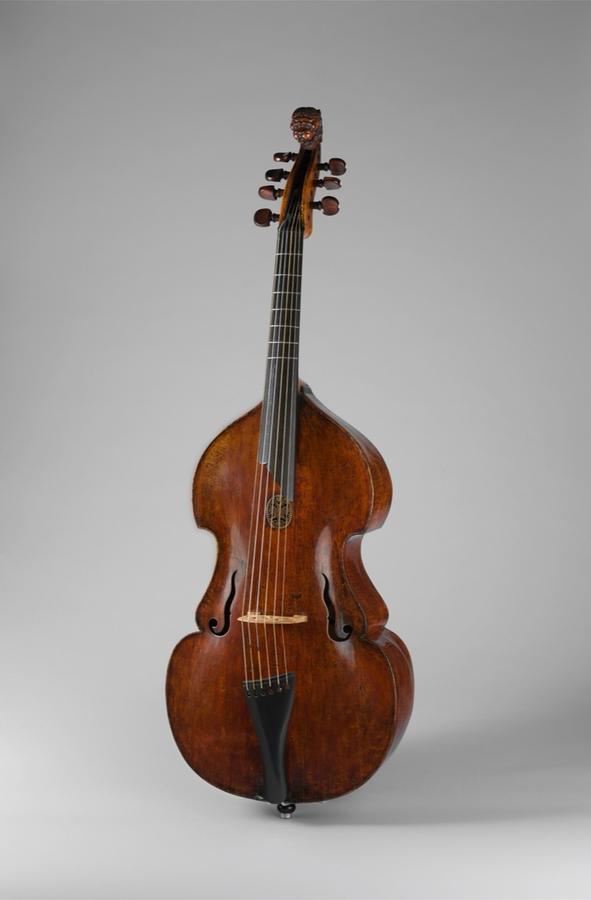
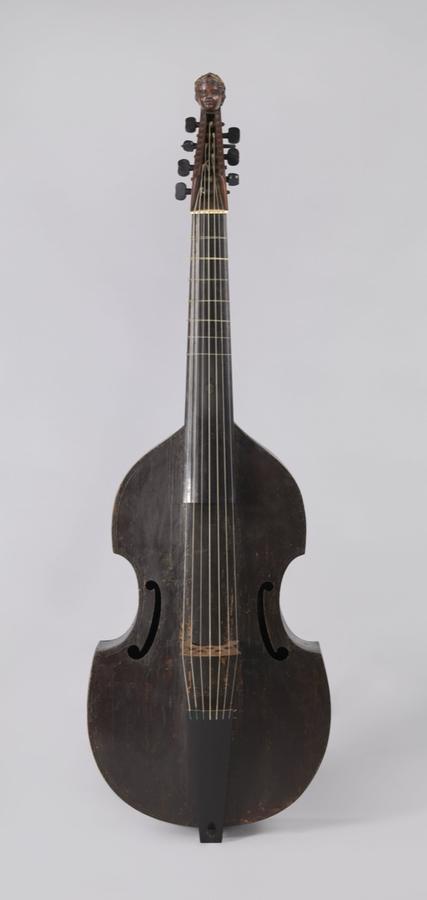
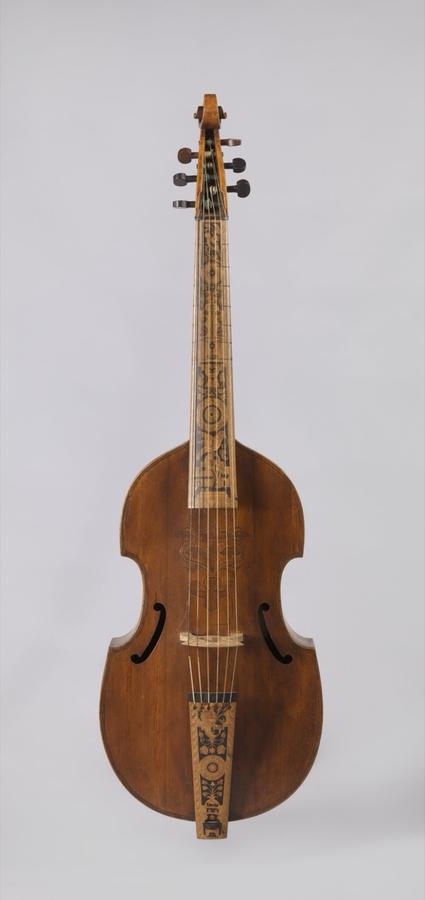
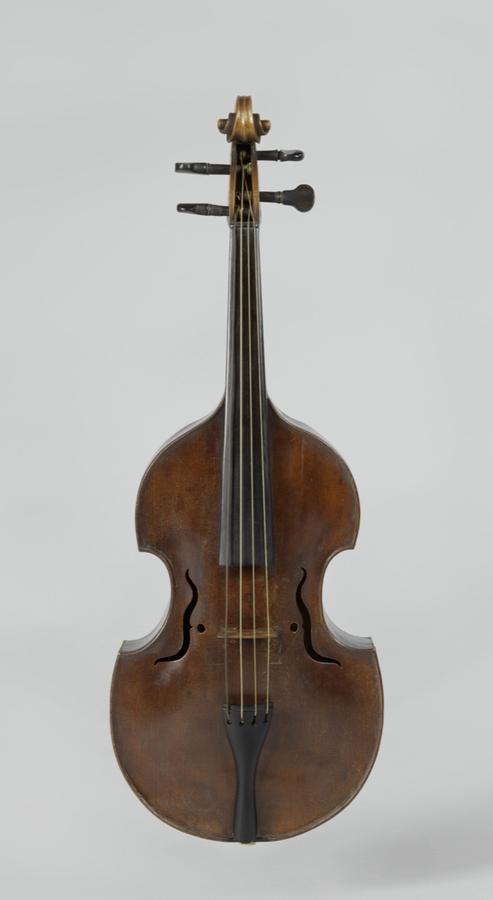
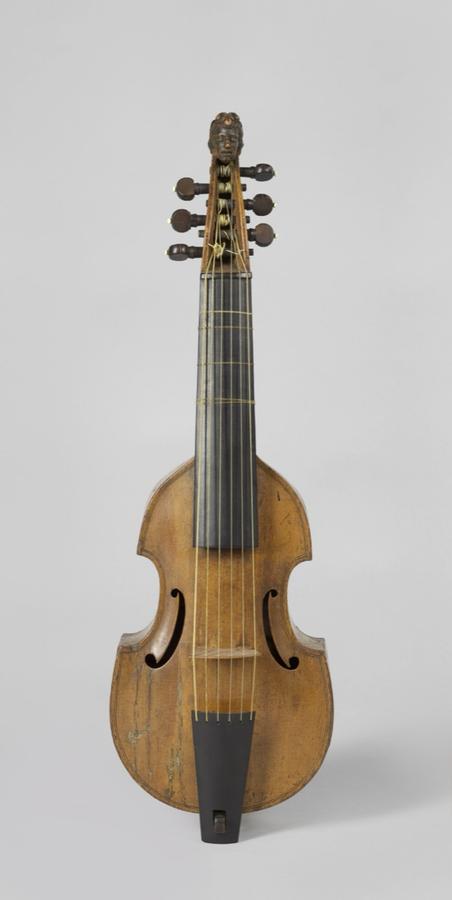
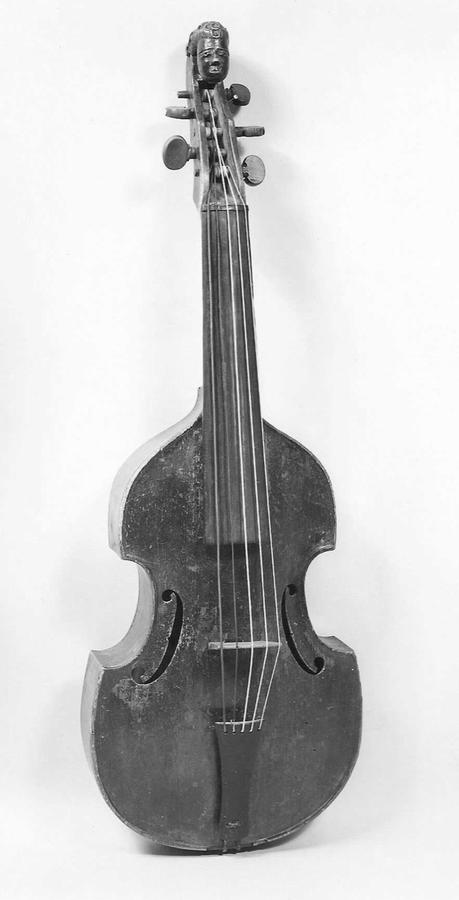
These 11 photographs span 1660–1830, 8 places of origin and 2 museums. Every photograph is public domain or openly licensed, and links to the museum’s own record.
-
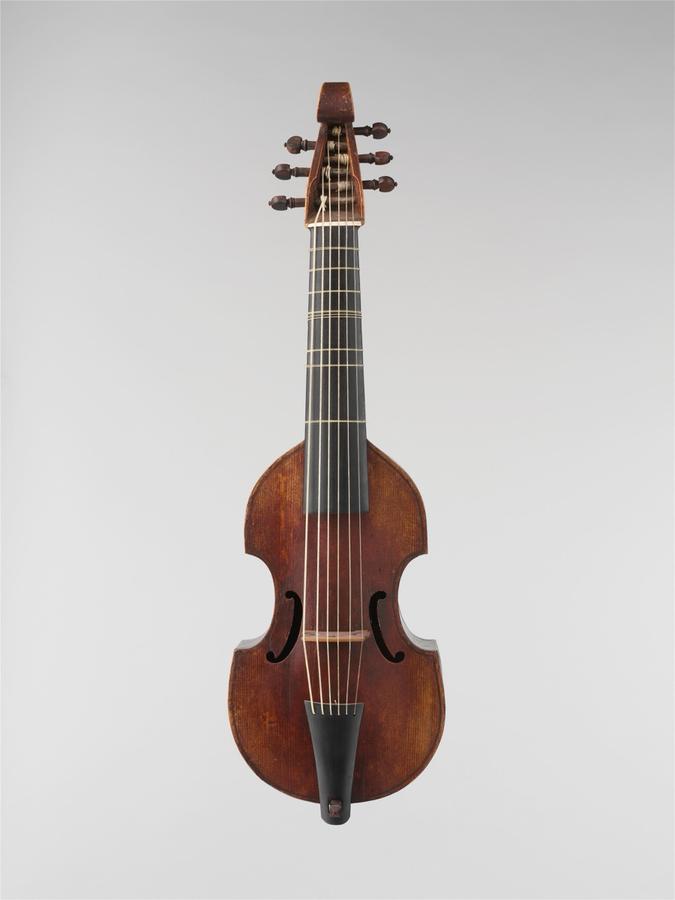
Treble Viol1726 · French (France) -
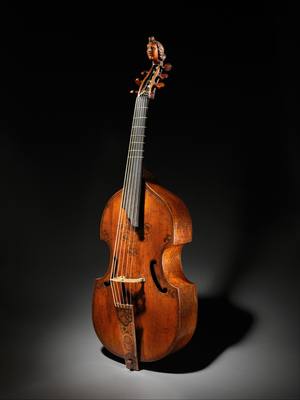
Division Violca. 1680 · British (United Kingdom) -
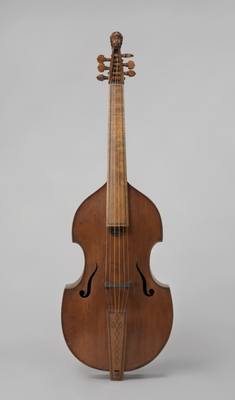
Bass violc. 1680 · Amsterdam -
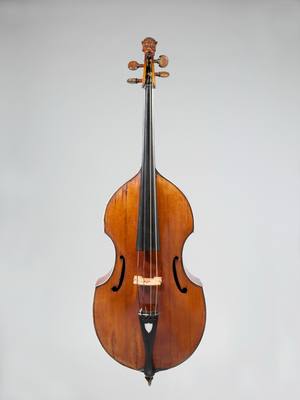
Division Violca. 1720 · Germany -
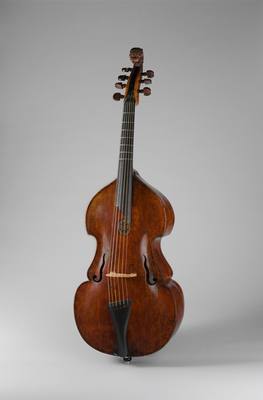
Bass Viola da Gambaearly 18th century · Austrian (Austria) -
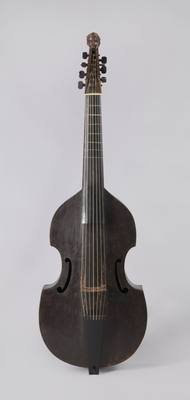
Bass Violc. 1700 · Amsterdam -
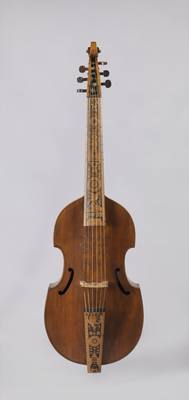
Bass viol1705 · London -
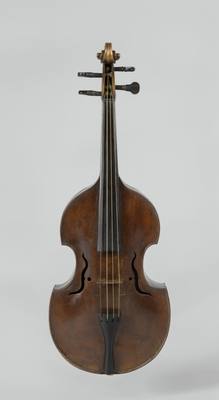
Viola (treble viol)1728 · München -
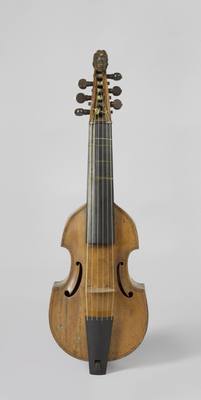
Pardessus de violec. 1730 - c. 1750 · Paris -
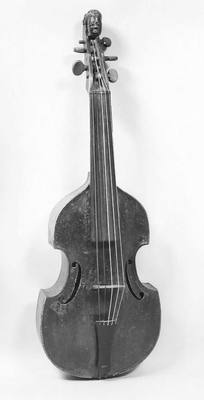
Quinton in Viol Formmid to late 18th century · French or German (France or Germany) -
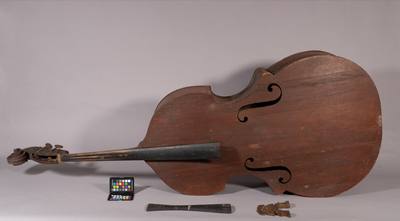
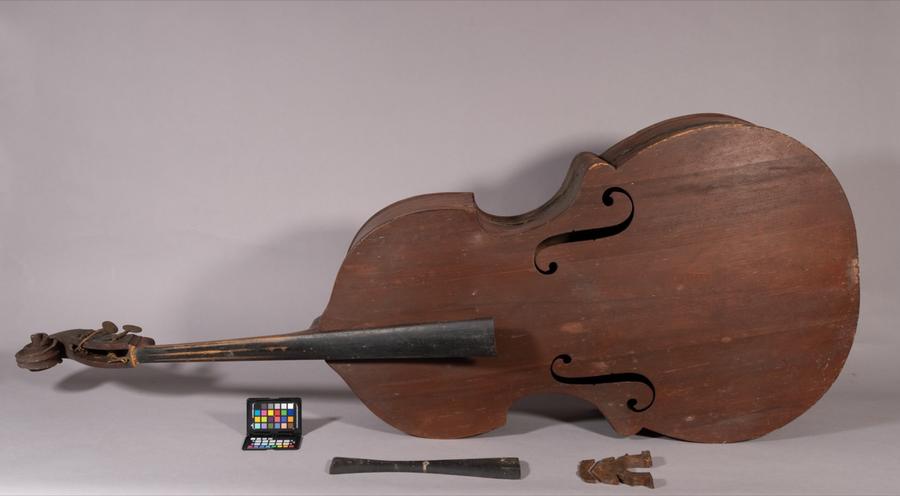
Bass Violca. 1820 · American (United States)
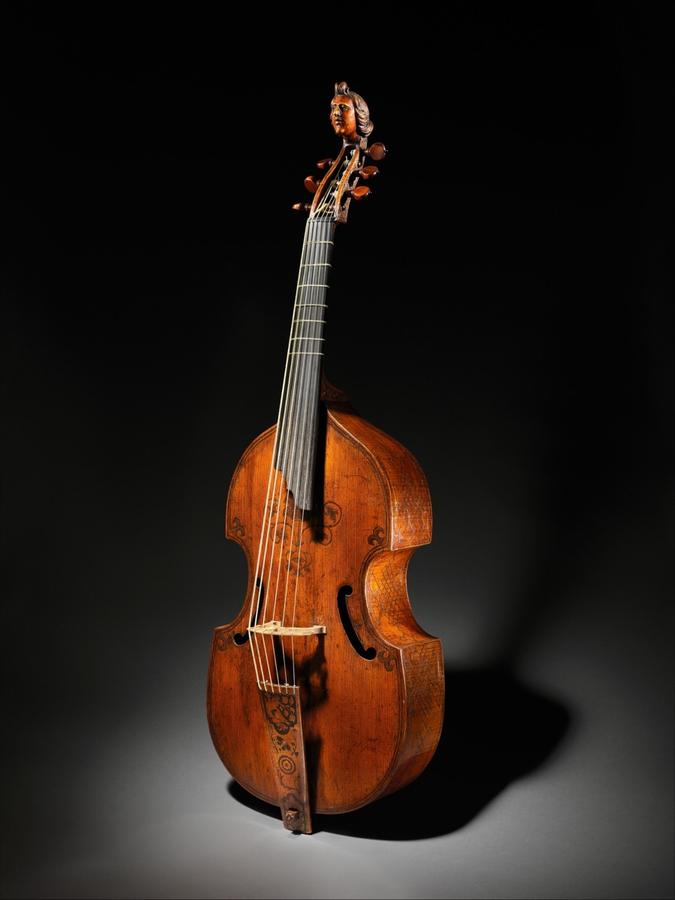
Facts at a glance
| Hornbostel–Sachs number | 321.322-71 — Composite chordophone sounded by a bow |
|---|---|
| Hornbostel–Sachs group | Chordophones › Composite chordophones › Lutes |
| Also known as | gamba (family of viols), viola da gamba (family of viols) |
| Developed | Late 15th century from the vihuela |
| Wikidata labels | 58 languages |
| Wikipedia article | Viol |
| Wikidata item | Q40125 |
| Wikimedia Commons category | Viols |
| MusicBrainz instrument | be34e4e5-6e77-46f5-ab56-c9641d3da213 |
| Encyclopaedia Britannica | art/viol |
| Audio sample (Wikimedia Commons) | Carl Friedrich Abel (1723- 1787) – Sonata in G-Major, WKO155 for Unaccompanied Viola da Gamba for Unaccompanied Viola da Gamba.ogg |
Sources: Wikidata (CC0 1.0) — classification number, aliases, identifiers (dump of 2026-07-22); Wikipedia (CC BY-SA 4.0) — infobox fields (description of the classification number, development, inventors) and the names of the Hornbostel–Sachs groups (article “Hornbostel–Sachs”, revision of 2026-01-04).
The name in other languages
| Language | Name | Also written |
|---|---|---|
| English | viol | gamba (family of viols), viola da gamba (family of viols), viol da gamba |
| French | viole de gambe | violes de gambe, basse de viole, viole |
| German | Viola da Gamba | Kniegeige, Gambe, Bassgambe |
| Spanish | viola da gamba | viola de gamba |
| Italian | viola da gamba | Viola all'inglese, Viola di Gamba |
| Portuguese | viola da gamba | Viola de gamba |
| Dutch | viola da gamba | |
| Russian | виола да гамба | гамба, виола-да-гамба |
| Japanese | ヴィオラ・ダ・ガンバ | ヴァイオル, ビオラ・ダ・ガンバ, ヴィオラダガンバ |
| Chinese | 维奥尔琴 | 古大提琴 |
| Korean | 비올족 | 비올라 다 감바, 비올 |
| Arabic | كمان الساق | الفيول, فيول |
Sources: Wikidata (CC0 1.0) — labels and aliases; MusicBrainz (CC0 1.0) — instrument aliases (names only).
About the viol: history, construction and playing
The viol, or viola da gamba, or informally gamba, is a bowed and fretted string instrument that is played da gamba (i.e. "on the leg"). It is distinct from the later violin, or viola da braccio; and it is any one of the earlier viol family of bowed, fretted, and stringed instruments with hollow wooden bodies and pegboxes where the tension on the strings can be increased or decreased to adjust the pitch of each of the strings. Although treble, tenor and bass were most commonly used, viols came in different sizes, including pardessus (high treble, developed in 18th century), treble, alto, small tenor, tenor, bass and contrabass (called violone).
These members of the viol family are distinguished from later bowed string instruments, such as the violin family, by both appearance and orientation when played—as typically the neck is oriented upwards and the rounded bottom downwards to settle on the lap or between the knees.
The viola da gamba uses the alto and bass clef. Seven and occasionally eight frets made of "stretched gut" are tied on the fingerboard around the instrument's neck. Frets tied in this manner—instead of permanently fixed as on a guitar—allow for fine-tuning of the instrument. (Frets enable the performer to stop the strings more cleanly, improve consistency of intonation and lend the stopped notes a tone that better matches the open strings.)
History
Vihuelists began playing their flat-topped, originally plucked, instruments with a bow in the second half of the 15th century. Within two or three decades, this led to the evolution of an entirely new and dedicated bowed string instrument that retained many of the features of the vihuela: e.g, a flat back, sharp waist-cuts, frets, thin ribs initially, and identical tuning—hence its original name, vihuela de arco; arco is Spanish for "bow". An influence on the playing posture has been credited to the example of Moorish rabab players.
However, Stefano Pio (2012) argues that a re-examination of documents in light of new data indicates an origin different than the vihuela de arco from Aragon. According to Pio, the viol had its origins in Venice, and evolved independently there. He asserts it was implausible that the vihuela de arco underwent such a rapid evolution by Italian rather than Venetian instrument makers. Nonetheless, a ten-year span brought the birth and diffusion in Italy of a new family of instruments (viola da gamba, or viols). These comprised instruments of different sizes, some as large as the famous violoni—as 'big as a man'—mentioned by Prospero Bernardino in 1493.
Pio also notes that the fifth string of the viola da gamba is uniquely called a bordone (drone)—both in the manuscript of the early 15th-century music theorist Antonius de Leno, and in the treatises of the Venetian Silvestro Ganassi dal Fontego and Giovanni Maria Lanfranco. However, it is not a drone and is played the same as the other strings. This inconsistency is justified, Pio argues, only by assuming the invention (in the latter 15th century) of a larger instrument derived from the medieval violetta, which gradually added more strings to allow greater extension to the low register. The fifth string was incorporated into the neck. This was surpassed by a sixth string (basso) which fixed the lower sound produced by the instrument. Pio's view was: the origin of the viola da gamba is tied to the evolution of the smaller violetta, or vielle, which was originally fitted with a fifth-string "drone"; and the name 'stuck' even after it ceased to perform this function.
Construction
Viols most commonly have six strings, although many 16th-century instruments had only four or five strings, and during the 17th century in France, some bass viols featured a seventh lower string. Viols were (and are) strung with gut strings of lower tension than on the members of the violin family. Gut strings produce a sonority far different from steel, generally described as softer and sweeter. Around 1660 in Bologna, gut or silk core strings overspun with copper wire first became available; these were then used for the lowest-pitched bass strings on viols, and many other string instruments as well. In 1664, a style of string incorporating a copper wire spun within the gut fibers, called a 'gimped' string, was introduced, mimicking the style of embroidery of the same name.
Viols are fretted like early guitars or lutes, using movable wrapped-around and tied-on gut frets. A low seventh string was supposedly added in France to the bass viol by Monsieur de Sainte-Colombe (c. 1640–1690), whose students included the French gamba virtuoso and composer Marin Marais. Also, the painting (1618) by Domenichino (1581–1641) shows what may be a seven-string viol.
Unlike members of the violin family, most of which are tuned in fifths, viols are usually tuned in fourths with a major third in the middle, mirroring the tuning employed on the vihuela de mano and lute during the 16th century and similar to that of the modern six-string guitar.
Viols were first constructed much like the vihuela de mano, with all surfaces, top, back, and sides made from flat slabs or pieces of joined wood, bent or curved as required. However, some viols, both early and later, had carved tops, similar to those more commonly associated with instruments of the violin family. The ribs or sides of early viols were usually quite shallow, reflecting more the construction of their plucked vihuela counterparts. Rib depth increased during the 16th century, finally coming to resemble the greater depth of the classic 17th-century pattern.
Viol bows
The bow is held underhand with the palm facing upward, similar to a German double bass bow grip, but away from the frog towards the balance point. The stick's curvature is generally convex as were violin bows of the period, rather than concave like a modern violin bow. The "frog" (which holds the bow hair and adjusts its tension) is also different from that of modern bows: whereas a violin bow frog has a "slide" (often made of mother of pearl), which pinches the hair and holds it flat and stationary across the frog, viol bows have an open frog that allows more movement of the hair. This facilitates a traditional playing technique where the performer uses one or two fingers of the bow hand to press the hair away from the bow stick. This dynamically increases bow hair tension to control articulation and inflection.
Different versions
Viols come in seven sizes: "pardessus de viole" (which is relatively rare, exclusively French and did not exist before the 18th century), treble (dessus in French), alto, tenor (in French taille), bass, great bass, and contrabass (the final two are often called violone, meaning large viol), the smaller one tuned an octave below the tenor (violone in G, sometimes called great bass or in French grande basse) and the larger one tuned an octave below the bass (violone in D, or the contrabass viol). This latter instrument is not to be confused with the double bass.
Their tuning alternates G and D instruments: pardessus in G, treble in D, tenor in G, bass in D (the seven-string bass was a French invention, with an added low A), small violone in G, large violone in D and the alto (between the treble and the tenor).
The treble has a size similar to a viola but with a deeper body; the typical bass is about the size of a cello. The pardessus and the treble were held vertically in the lap. The English made smaller basses known as division viols, and the still-smaller Lyra viol. The viola bastarda was a similar type of viol used in Italy for a virtuosic style of viol repertoire and performance. German consort basses were larger than the French instruments designed for continuo.
Tuning
The standard tuning of most viols is in fourths, with a major third in the middle (like the standard Renaissance lute tuning), or in fourths, with a major third in between the 2nd and 3rd strings (like a modern guitar). The following table shows the tunings that have been adopted at least somewhat widely during the 20th and 21st-century revival of the viols. (Lyra viol tunings are not included.)
Alternative tunings (called scordatura) were often employed, particularly in the solo lyra viol style of playing, which also made use of many techniques such as chords and pizzicato, not generally used in consort playing. An unusual style of pizzicato was known as a thump. Lyra viol music was also commonly written in tablature. There is a vast repertoire of this music, some by well-known composers and much by anonymous ones.
Much viol music predates the adoption of equal temperament tuning by musicians. The movable nature of the tied-on frets permits the viol player to make adjustments to the tempering of the instrument, and some players and consorts adopt meantone temperaments, which are more suited to Renaissance music. Several fretting schemes involve frets that are spaced unevenly to produce better-sounding chords in a limited number of keys. In some of these schemes, the two strands of the gut that form the fret are separated so that the player can finger a slightly sharper or flatter version of a note (for example G♯ versus A♭) to suit different circumstances.
Similar names and common confusions
The viola da gamba is occasionally confused with the viola, the alto member of the modern violin family and a standard member of both the symphony orchestra and string quartet. In the 15th century, the Italian word "viola" was a generic term used to refer to any bowed instrument, or fiddle. The word "viola" existed in Italy before the vihuela, or first viol, was brought from Spain. In Italy, "viola" was first applied to a braccio precursor to the modern violin, as described by Tinctoris (De inventione et usu musice, c. 1481–3), and then was later used to describe the first Italian viols as well. Depending on the context, the unmodified viola da braccio most regularly denoted either an instrument from the violin family, or specifically the viola (whose specific name was "alto de viola da braccio"). When Monteverdi called simply for "viole da braccio" in "Orfeo", the composer was requesting violas as well as treble and bass instruments. The full name of the viola, namely "alto de viola da braccio", was finally shortened to "viola" in some languages (e.g. English, Italian, Spanish) once viols became less common, while other languages picked some other part of the phrase to designate the instrument, e.g. "alto" in French and "Bratsche" in German (the latter derived from the Italian "braccio").
Source: Wikipedia, “Viol” — CC BY-SA 4.0 — text excerpted as published (references, images and tables removed); see the article for the full text and the list of authors. Revision of 2026-07-04.
From Grove’s Dictionary (1900)
The Gamba was for a long period the most popular of all bowed instruments, and, especially in England (which by some is believed to be its original home), Holland, and Germany, appears to have been the favourite instrument of society. Shakespeare, in 'Twelfth Night,' mentions as a special accomplishment of Sir Andrew Aguecheek that 'he plays o' the viol-de-gamboys.' In the pictures of Gerard Dow, Terburg, and other great Dutch masters of the 17th century we see again and again richly dressed ladies and gentlemen playing the gamba. At one time few noblemen's or gentlemen's houses were without a 'chest,' containing a set of four or more gambas of different size, often expensively got up, carved and inlaid with ivory or tortoise-shell. This popularity of the gamba lasted up to the middle of the 18th century, when the violoncello began gradually to supersede it. Burney, who heard it played by Abel, the last great performer upon it in London, describes its tone as 'radically crude and nasal,' and adds that 'a human voice of the same quality would be considered intolerable.' This is certainly a somewhat strong statement. In tone and character the gamba does not materially differ from the tenor of our own days; and its banishment from the modern orchestra is easily accounted for by the fact that its higher notes are equally well and more easily produced on the tenor, while the effect of the lower strings is much finer on the violoncello. The gamba was handled very much in the same way as the cello, except that some virtuosi had additional strings attached at the back of the neck, on which they played a pizzicato accompaniment with the thumb of the left hand. Sebastian Bach was the last great composer who wrote for the gamba, and he appears to have had a special predilection for it. We have from his pen three Sonatas for Clavier and Gamba (Bachgesellschaft, vol. ix.) and a number of obligato accompaniments for airs in his Cantatas and the Passion Music. He also employs it in a Concerto grosso for 2 viols da braccio, 2 viole da gamba, violoncello, violone, and harpsichord, and on other occasions uses it to attain special orchestral effects. A striking instance is the exquisitely beautiful introduction to the Cantata 'Gottes Zeit' (Bachgesellschaft, vol. xxiii.) where we find three separate gamba-parts combined with violins and flutes, which must have produced a very peculiar effect. But while in little Leipzig the gamba was still favourite, it was already out of fashion in London, and we look in vain for it in the more forcible and practical scores of Handel. By the end of the 18th century most gambas were converted into violoncellos, and for that reason but rarely met with now-a-days.
Source: Wikisource, A Dictionary of Music and Musicians (Grove, 1900) — “Gamba, Viola Da” (entry by Paul David) — Public domain (published 1879–1910; authors died before 1929) — the first paragraphs of the entry, as transcribed; see the page for the full entry.
Composers who played it
26 composers on this site list the viol as an instrument they played. A selection:
- Claudio Monteverdi 1567–1643
- Claude Gervaise 1510–1558
- Diego Ortiz 1510–1570
- Robert White 1538–1574
- Giulio Caccini 1551–1618
- Lodovico Zacconi 1555–1627
- Tobias Hume 1569–1645
- John Coprario 1570–1626
- Thomas Lupo the elder 1571–1627
- Alfonso Ferrabosco the younger 1575–1628
- Thomas Ford 1580–1648
- Christopher Simpson 1602–1669
Composers with a page on this site whose Wikidata record lists this instrument; featured and best-dated first. Data: Wikidata (property “instrument”, P1303), CC0 1.0.
Sources and licences
- Treble Viol, Jean Ouvrard, 1726, French (France). Wood. The Crosby Brown Collection of Musical Instruments, 1889 (89.4.946). Museum record · CC0 1.0 (public domain dedication)
- Division Viol, Richard Meares, ca. 1680, British (United Kingdom). Spruce, ebony, maple. Purchase, Louis V. Bell Fund, Mrs. Vincent Astor Gift, and funds from various donors, 1982 (1982.324). Museum record · CC0 1.0 (public domain dedication)
- Bass viol, Hendrik Jacobs, c. 1680, Amsterdam. maple (wood), wood (plant material), silver (metal), intestine. On loan from the Gemeentemuseum Den Haag. Museum record · Public Domain Mark 1.0
- Division Viol, School of Tielke, ca. 1720, Germany. Wood, ivory, tortoise shell. The Crosby Brown Collection of Musical Instruments, 1889 (89.4.956). Museum record · CC0 1.0 (public domain dedication)
- Bass Viola da Gamba, Andreas Jais, early 18th century, Austrian (Austria). Wood. Gift of Janos Scholz, in memory of his son, Walter Rosen Scholz, and in honor of the Centennial of The Crosby Brown Collection of Musical Instruments, 1988 (1988.365). Museum record · CC0 1.0 (public domain dedication)
- Bass Viol, Anonymous, c. 1700, Amsterdam. ebony (wood), walnut (hardwood), spruce (wood), intestine. On loan from the Koninklijk Oudheidkundig Genootschap. Museum record · Public Domain Mark 1.0
- Bass viol, Barak Norman, 1705, London. beech (wood), ebony (wood), softwood, maple (wood), intestine. On loan from the Koninklijk Oudheidkundig Genootschap. Museum record · Public Domain Mark 1.0
- Viola (treble viol), Sebastian Mayr, 1728, München. rosewood (wood), mahogany (wood), ebony (wood), maple (wood), intestine, softwood, beech (wood). Purchased with the support of the State of the Netherlands and the Vereeniging van Noord-Nederlandsche Muziekgeschiedenis. Museum record · Public Domain Mark 1.0
- Pardessus de viole, c. 1730 - c. 1750, Paris. intestine, maple (wood), ebony (wood), metal, ivory, beech (wood), softwood. On loan from the Koninklijk Oudheidkundig Genootschap. Museum record · Public Domain Mark 1.0
- Quinton in Viol Form, mid to late 18th century, French or German (France or Germany). Wood. The Crosby Brown Collection of Musical Instruments, 1889 (89.4.949). Museum record · CC0 1.0 (public domain dedication)
- Bass Viol, Abraham Prescott, ca. 1820, American (United States). Wood. Rogers Fund, 1980 (1980.492). Museum record · CC0 1.0 (public domain dedication)
Photographs: open-access collections of the museums named above; each is shown here reduced in size, otherwise unchanged. Text: Wikipedia (CC BY-SA 4.0), Grove’s Dictionary (public domain), Wikidata and MusicBrainz (CC0). The full list of sources and licences is on the credits page.