
Instruments · Idiophones
Jew's harp
The Jew's harp (also known as jaw harp or mouth harp) is a small musical instrument. It is held on the mouth and plucked. The person playing the harp changes the pitch and tone of the sound created by changing the shape of their mouth.
Summary: Simple English Wikipedia, “Jew's harp” — CC BY-SA 4.0. Revision of 2025-07-10.
Museum photographs
These 6 photographs span 1600–1968, 4 places of origin and 2 museums. Every photograph is public domain or openly licensed, and links to the museum’s own record.
-
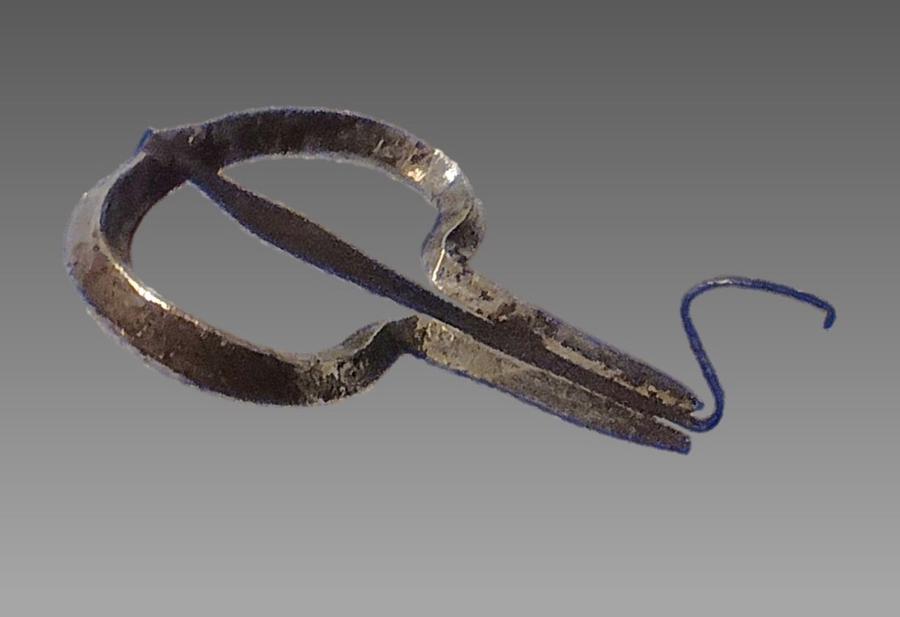
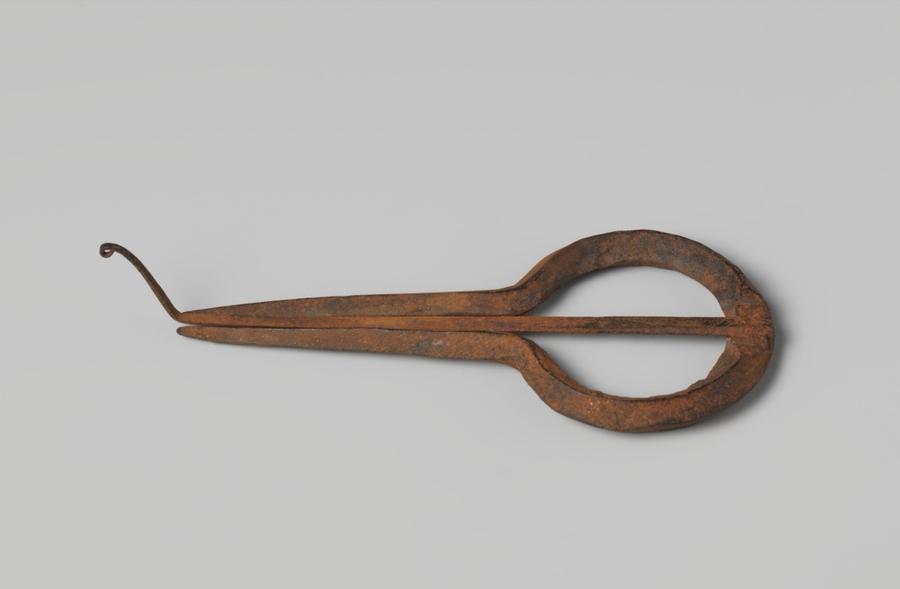
Jew's Harp19th century · Russian (Siberian) (Russian Federation) -
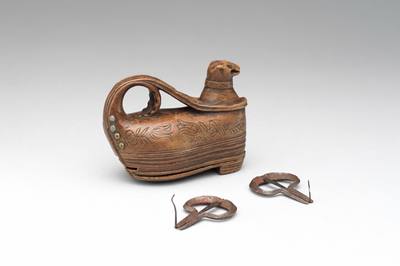
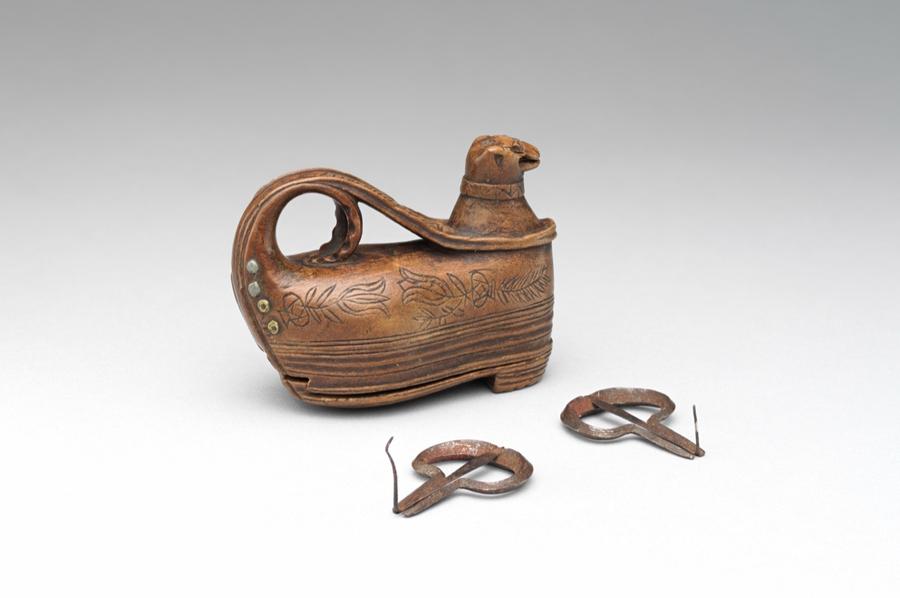
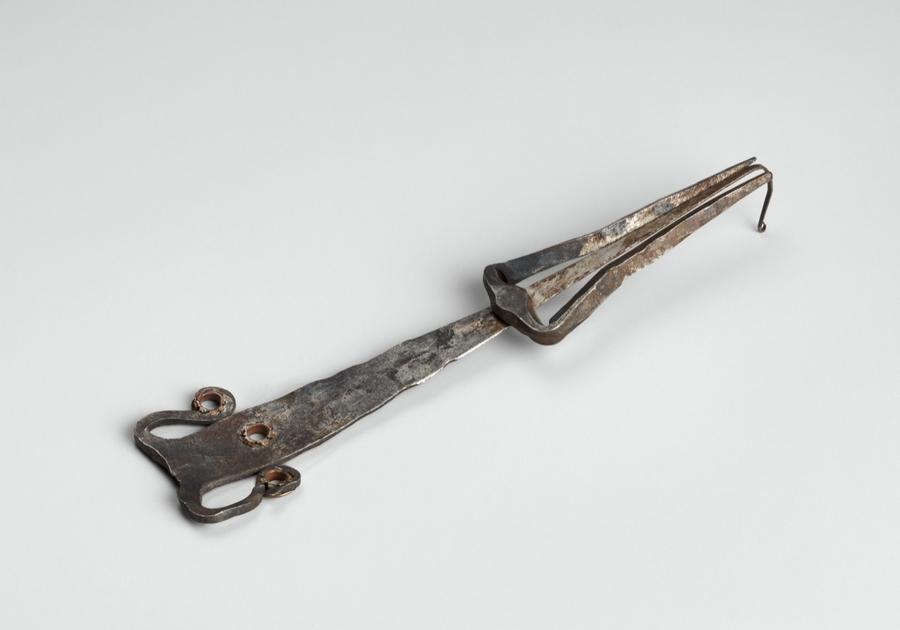
Jew's Harp17th–19th century · European -
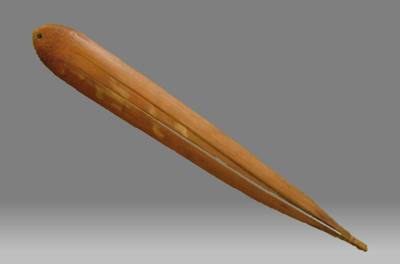
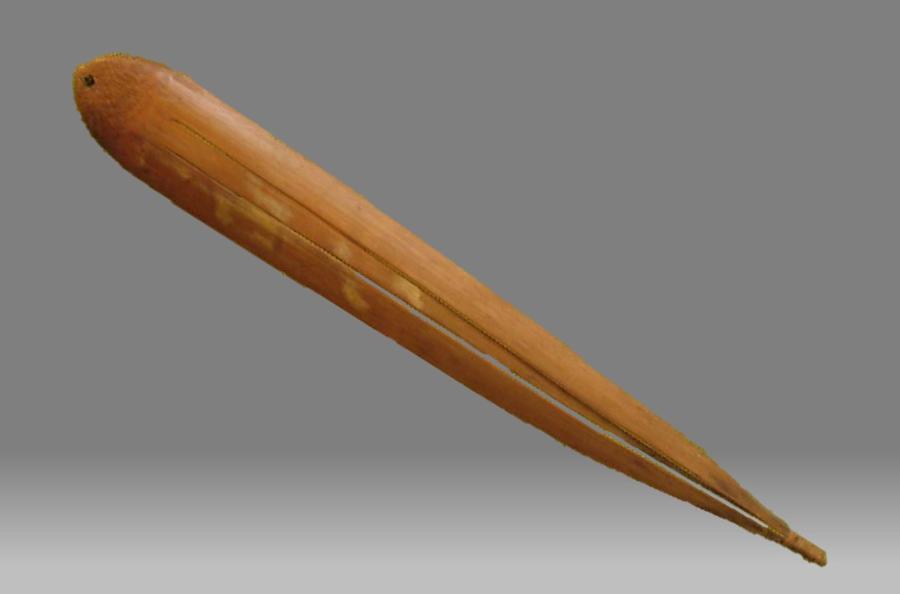
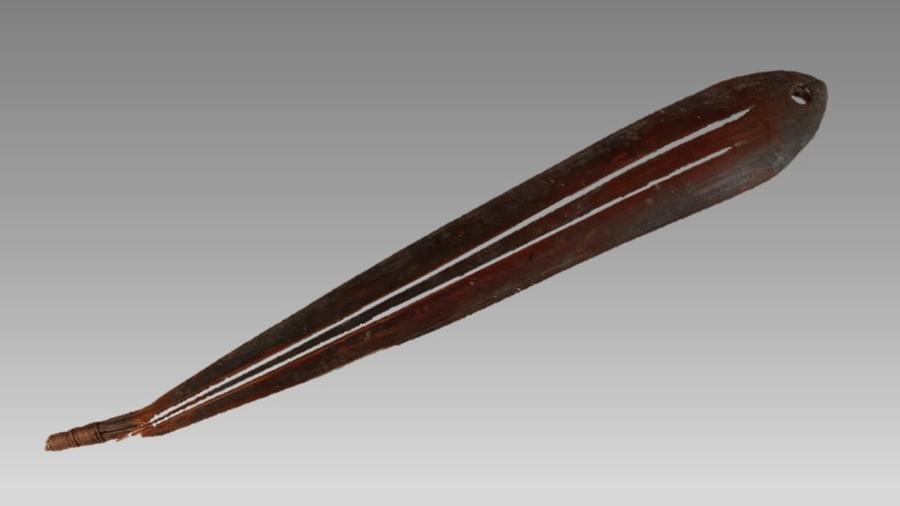
Jew's Harp19th century · New Zealander (New Zealand) -
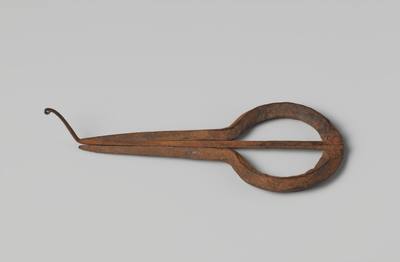
Jew's harp1800 - 1896 -
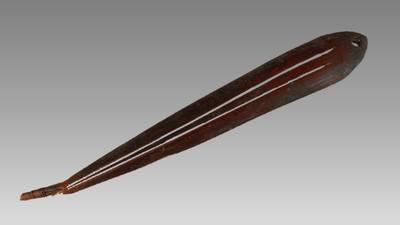
Jew's Harplate 19th century · Papua New Guinean (New Ireland) (Papua New Guinea) -
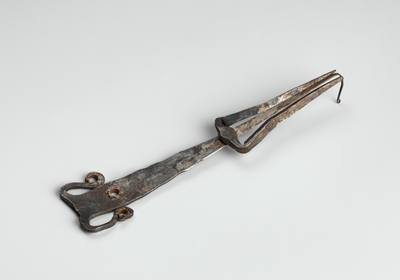
Chang (jaw harp)mid-20th century · Afghanistan
Facts at a glance
| Hornbostel–Sachs number | 121.2 — Heteroglot guimbarde (the lamella is attached to the frame) |
|---|---|
| Hornbostel–Sachs group | Idiophones › Plucked idiophones › In the form of a frame |
| Also known as | murchunga, juice harp, jaw harp, gewgaw, khomus, drimba, Galician harp, guimbardes, trump, jaw's harp |
| Classification (Wikipedia infobox) | Lamellophone |
| Wikidata labels | 90 languages |
| Wikipedia article | Jew's harp |
| Wikidata item | Q185003 |
| Wikimedia Commons category | Jaw harps |
| MusicBrainz instrument | ffaf7204-92f1-4c03-846a-748218ebf2a5 |
| Encyclopaedia Britannica | art/jews-harp |
| Audio sample (Wikimedia Commons) | Munniharppua.ogg |
Sources: Wikidata (CC0 1.0) — classification number, aliases, identifiers (dump of 2026-07-22); Wikipedia (CC BY-SA 4.0) — infobox fields (description of the classification number, development, inventors) and the names of the Hornbostel–Sachs groups (article “Hornbostel–Sachs”, revision of 2026-01-04).
The name in other languages
| Language | Name | Also written |
|---|---|---|
| English | Jew's harp | murchunga, juice harp, jaw harp |
| French | guimbarde | Muxukitarra, Vargane, Trunfa |
| German | Maultrommel | Wasser-Maultrommel, Brummeisen |
| Spanish | trompe | Guimbarda, Jews harp, arpa |
| Italian | scacciapensieri | Marranzano, Murchanga |
| Portuguese | berimbau de boca | Harpa de boca, berimbau de índio ou berimbau de boca, berimbau |
| Dutch | mondharp | |
| Russian | варган | Хомуз, Шанкобыз |
| Japanese | 口琴 | ジューズハープ, びやぼん, こうきん |
| Chinese | 口簧琴 | 口簧 |
| Korean | 주즈하프 | |
| Arabic | قيثار اليهودي | القيثار اليهودي, قيثار اليهود |
Sources: Wikidata (CC0 1.0) — labels and aliases; MusicBrainz (CC0 1.0) — instrument aliases (names only).
About the jew's harp: history, construction and playing
The Jew's harp, also known as jaw harp, juice harp, or mouth harp, is a lamellophone instrument, consisting of a flexible metal or bamboo tongue or reed attached to a frame. Despite the colloquial name, the Jew's harp most likely originated in China, with the earliest known Jew's harps dating back 4,000 years ago from Shaanxi. It has no relation to the Jewish people.
Jew's harps may be categorized as idioglot or heteroglot (whether or not the frame and the tine are one piece); by the shape of the frame (rod or plaque); by the number of tines, and whether the tines are plucked, joint-tapped, or string-pulled.
Characteristics
The frame is held firmly against the performer's parted teeth or lips (depending on the type), using the mouth (plus the throat and lungs when breathing freely) as a resonator, greatly increasing the volume of the instrument. The teeth must be parted sufficiently for the reed to vibrate freely, and the fleshy parts of the mouth should not come into contact with the reed to prevent damping of the vibrations and possible pain. The note or tone thus produced is constant in pitch, though by changing the shape of the mouth, and the amount of air contained in it (and in some traditions closing the glottis), the performer can cause different overtones to sound and thus create melodies.
According to the Encyclopædia Britannica Eleventh Edition, "The vibrations of the steel tongue produce a compound sound composed of a fundamental and its harmonics. By using the cavity of the mouth as a resonator, each harmonic in succession can be isolated and reinforced, giving the instrument the compass shown."
"The lower harmonics of the series cannot be obtained, owing to the limited capacity of the resonating cavity. The black notes on the stave show the scale which may be produced by using two harps, one tuned a fourth above the other. The player on the Jew's harp, in order to isolate the harmonics, frames their mouth as though intending to pronounce the various vowels." See Bugle scale.
History
The oldest Jew's harps were discovered in Shaanxi, China, dating back about 4,000 years ago. They were from the Neolithic site of Shimao, an important political and religious center during the Longshan culture. The earliest depiction of somebody playing what seems to be a Jew's harp is a Chinese drawing from the 3rd century BCE. Archaeological finds of surviving examples in Europe have been claimed to be almost as old, but those dates have been challenged both on the grounds of excavation techniques, and the lack of contemporary writing or pictures mentioning the instrument.
Although this instrument is used by lackeys and people of the lower class, this does not mean it is not worthy of consideration by better minds ... The trump is grasped while its extremity is placed between the teeth in order to play it and make it sound ... Now one may strike the tongue with the index finger in two ways, i.e, by lifting it or lowering it: but it is easier to strike it by raising it, which is why the extremity, C, is slightly curved, so that the finger is not injured ... Many people play this instrument. When the tongue is made to vibrate, a buzzing is heard which imitates that of bees, wasps, and flies ... [if one uses] several Jew's harps of various sizes, a curious harmony is produced.
Etymology
There are many theories for the origin of the name jew's harp. The apparent reference to Jewish people is especially misleading since it "has nothing to do with the Jewish people; neither does it look like a harp in its structure and appearance". In Sicilian it is translated as marranzanu or mariolu; both of which are derogatory terms for Jewish people also found in Italian and Spanish. In German, it is known as Maultrommel, which translates directly to 'mouth drum'. The name "Jew's Harp" first appears in 1481 in a customs account book under the name "Jue harpes". The "jaw" variant is attested at least as early as 1774 and 1809, the "juice" variant appearing only in the late 19th and 20th centuries.
It has also been suggested that the name derives from the French jeu-trompe meaning 'toy trumpet'. The current French word for the instrument is guimbarde. English etymologist Hensleigh Wedgwood wrote in 1855 that the derivation from jeu harpe opposes the French idiom, where "if two substantives are joined together, the qualifying noun is invariably the last". He refers to the jeu harpe derivation, but not to the jeu tromp derivation.
Both theories—that the name is a corruption of jaws or jeu—are described by the Oxford English Dictionary as "lacking any supporting evidence." The OED says that, "more or less satisfactory reasons may be conjectured: e.g, that the instrument was actually made, sold, or imported to England by Jewish people, or purported to be so; or that it was attributed to Jewish people, suggesting the trumps and harps mentioned in the Bible, and hence considered a good commercial name." Although the OED states that "the association of the instrument with Jewish people occurs, so far as is known, only in English", the term jødeharpe is also used in Danish.
Cambodian music
The angkuoch (Khmer: អង្គួច) is a Cambodian Jew's harp. It is a folk instrument made of bamboo and carved into a long, flat shape with a hole in the center and the tongue across the hole. There is also a metal variety, more round or tree-leaf shaped. It may also have metal bells attached. The instrument is both a wind instrument and percussion instrument. As a wind instrument, it is placed against the mouth, which acts as a resonator and tool to alter the sound. Although mainly a folk instrument, better-made examples exist. While the instrument was thought to be the invention of children herding cattle, it is sometimes used in public performance, to accompany the Mahori music in public dancing.
Brass
Brass murchangs are manufactured from ancient Indian manufacturing style brass metal casting. Brass molding is a process of shaping brass, into desired shapes using a mold. The brass is heated to a molten state and then poured or forced into the mold, where it cools and solidifies into the desired shape. Brass molding is often used to create intricate or complex shapes.
Binayo
The binayo (बिनायो बाजा) is a bamboo Jew's harp, in the Kiranti musical tradition from Malingo. It is popular in the Eastern Himalayan region of Nepal, Sikkim, Darjeeling, and Bhutan. It is a wind instrument played by blowing the air without tuning the node with fingers. The binayo is six inches long and one inch in width.
Taiwanese Indigenous music
Taiwanese indigenous peoples groups like the Atayal, Amis, and other populations make use of bamboo Jew's harps. Although construction methods vary greatly amongst the different indigenous groups, Taiwanese indigenous peoples typically take thin strips of bamboo, cut long grooves into the bamboo, and thread strings through the grooves.
Amis music
The Amis Jaw Harp, also known as tiw tiw, fijiq, and most commonly datok (pronouced “Sha-du”), can be traced back to the mid-20th century. The Amis Jaw Harp is unique from other Taiwan indigenous jaw harps due to the body and resonator system being connected by a string or cord rather than built as one entity. The Amis jaw harp has been recorded as being constructed as both an idioglot and a heteroglot. The instrument is traditionally double-reeded although, there are written records to point to the existence of a triple-reed jaw harp.
Atayal music
The Atayal jaw harp, or lubuw in the Atayal language, is the traditional multi-reeded, string-pulled Jew’s harp of the Atayal people. In traditional Atayal society, the jaw harp also functioned as a form of intimate communication for lovers during courtship and also for playing songs during joyous occasions. Its use, however, is forbidden during funerals. Learning how to play the lubuw is traditionally considered a rite of passage for young Atayal. In modern times, like many other traditional practices, its use has gradually declined and is now more commonly seen in cultural performances rather than in everyday life.
Materials for the lubuw are gendered as well. For men, the entire mouth Jew’s harp is generally made out of bamboo. While for women, the reed is often made with bronze which produces more resonance and can be more emotive. Moreover, only higher status Atayal such as chiefs and shamans are traditionally allowed to use mouth harps with multiple reeds.
The use of the lubuw faced sharp decline as a result of persecution during the Japanese colonial era. Fearing that the mouth harp could be used to pass secret signals along, the Japanese banned the use of the mouth harp, with violators facing the amputation of their fingers. This along with lubuws typically being mortuary objects meant that the cultural legacy and physical presence of the lubuw began to disappear.
However, to this day, preservation efforts of the lubuw continue to this day especially with the assistance of Atayal elders. For example, Payas Temu, one of these elders, was designated by the Taichung City government as a preserver of lubuw culture and recordings of his playing serve as key documents of the lubuw musical tradition.
Kyrgyz music
The temir komuz is made of iron, usually with a length of 100–200 mm and with a width of approximately 2–7 mm. The range of the instrument varies with the size of the instrument but generally hovers around an octave span. The Kyrgyz people are exceptionally proficient on the instrument and it is quite popular among children, although some adults continue to play the instrument. Temir komuz pieces were notated by Aleksandr Zataevich in two or three parts. An octave drone is possible, or even an ostinato alternating the fifth step of a scale with an octave.
Turkish music
In Turkish, the Jew's harp is called ağız kopuzu. The Jew's harp traditionally used in Turkish folk songs from Anatolia has fallen out of use with time. Modern renditions of Turkish folk songs with the Jew's harp have been done by artists such as Senem Diyici in the song 'Dolama Dolamayı' and Ravan Yuzkhan.
Source: Wikipedia, “Jew's harp” — CC BY-SA 4.0 — text excerpted as published (references, images and tables removed); see the article for the full text and the list of authors. Revision of 2026-05-17.
From Grove’s Dictionary (1900)
JEW'S-HARP, possibly a corruption of Jaw's-harp. In French it is called Guimbarde, and in German Maul-trommel, Mund-harmonica, or Brummeisen (i.e. buzzing-iron). In the Highlands, where it is much used, it is called Tromp. This simple instrument consists of an elastic steel tongue, rivetted at one end to a frame of brass or iron, similar in form to certain pocket corkscrews, of which the screw turns up on a hinge. The free end of the tongue is bent outwards, at a right angle, so as to allow the finger to strike it when the instrument is placed to the mouth, and firmly supported by the pressure of the frame against the teeth.
A column of air may vibrate by reciprocation with a body whose vibrations are isochronous with its own, or when the number of its vibrations are any multiple of those of the original sounding body. On this law depends the explanation of the production of sounds by the jew's-harp. The vibration of the tongue itself corresponds with a very low sound; but the cavity of the mouth is capable of various alterations; and when the number of vibrations of the contained volume of air is any multiple of the original vibrations of the tongue, a sound is produced corresponding to the modification of the oral cavity. Thus, if the primitive sound of the tongue is C, the series of reciprocated sounds would be C, E, G, B♭, C, D, E, F, G, etc, and by using two or more instruments in different keys, a complete scale may be obtained, and extremely original and beautiful effects produced.
The elucidation of this subject is due to the ingenious researches of Professor Wheatstone, which may be found in the 'Quarterly Journal of Science, Literature, and Art,' for the year 1828, 1st part, of which the above is a condensed account.
Source: Wikisource, A Dictionary of Music and Musicians (Grove, 1900) — “Jew'S-Harp” (entry by Victor de Pontigny) — Public domain (published 1879–1910; authors died before 1929) — the first paragraphs of the entry, as transcribed; see the page for the full entry.
Sources and licences
- Jew's Harp, 19th century, Russian (Siberian) (Russian Federation). Iron, steel. The Crosby Brown Collection of Musical Instruments, 1889 (89.4.316). Museum record · CC0 1.0 (public domain dedication)
- Jew's Harp, 17th–19th century, European. Metal. Purchase, Clara Mertens Gift, 1988 (1988.345.1). Museum record · CC0 1.0 (public domain dedication)
- Jew's Harp, 19th century, New Zealander (New Zealand). Bamboo, fiber.. The Crosby Brown Collection of Musical Instruments, 1889 (89.4.745). Museum record · CC0 1.0 (public domain dedication)
- Jew's harp, Anonymous, 1800 - 1896. iron (metal). Purchased with the support of the State of the Netherlands and the Vereeniging van Noord-Nederlandsche Muziekgeschiedenis. Museum record · Public Domain Mark 1.0
- Jew's Harp, late 19th century, Papua New Guinean (New Ireland) (Papua New Guinea). Bamboo. The Crosby Brown Collection of Musical Instruments, 1889 (89.4.1402). Museum record · CC0 1.0 (public domain dedication)
- Chang (jaw harp), mid-20th century, Afghanistan. iron. Gift of Mark and Greta Slobin, 2015 (2015.620.27). Museum record · CC0 1.0 (public domain dedication)
Photographs: open-access collections of the museums named above; each is shown here reduced in size, otherwise unchanged. Text: Wikipedia (CC BY-SA 4.0), Grove’s Dictionary (public domain), Wikidata and MusicBrainz (CC0). The full list of sources and licences is on the credits page.