
Instruments · Idiophones
Mbira
Mbira, also known as kalimba and zanza (or variant spellings), are a family of musical instruments, traditional to the Shona people of Zimbabwe.
The instruments consist of a wooden board (often fitted with a resonator) with attached staggered metal tines, played by holding the instrument in the hands and plucking the tines with the thumbs and/or fingers. Musicologists classify it as a lamellaphone, part of the plucked idiophone family of musical instruments.
Summary: Wikipedia, “Mbira” — CC BY-SA 4.0. Revision of 2026-06-19.
Museum photographs
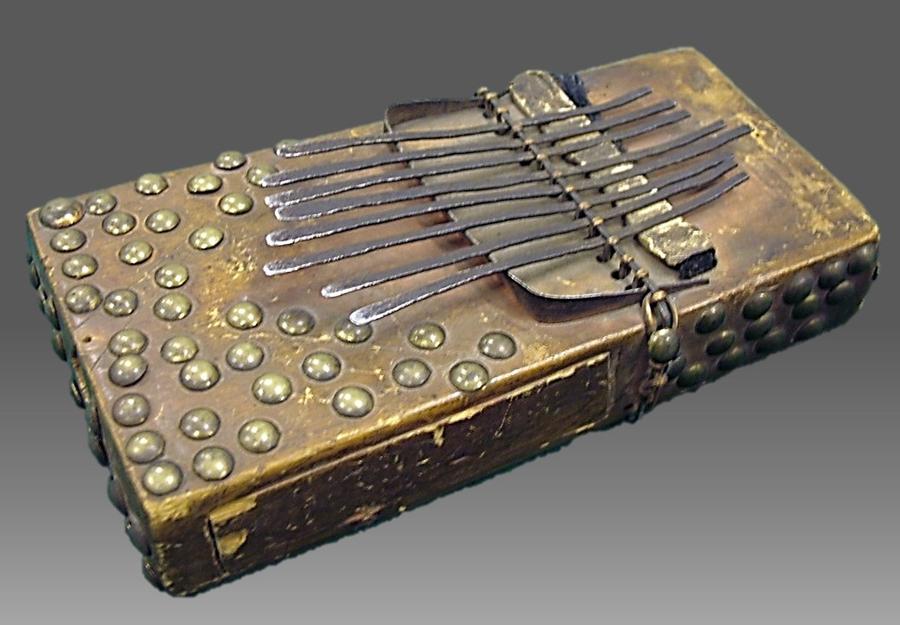
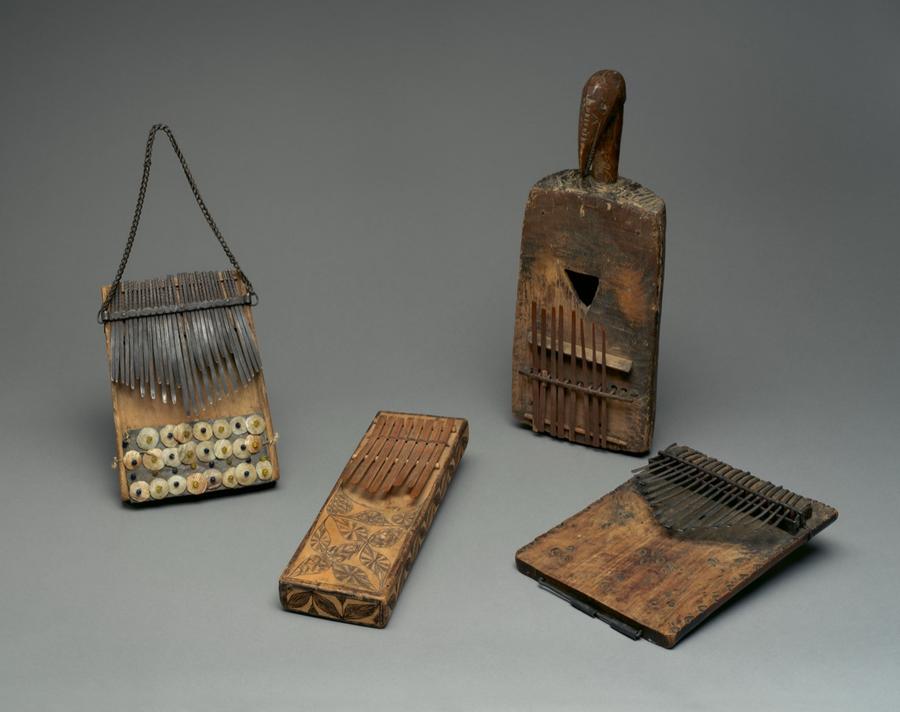
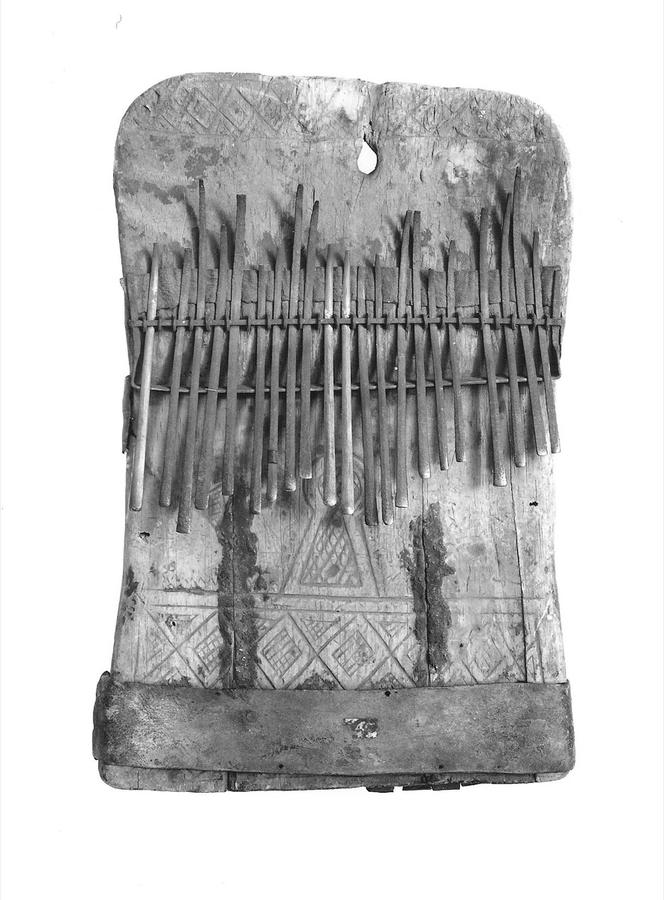
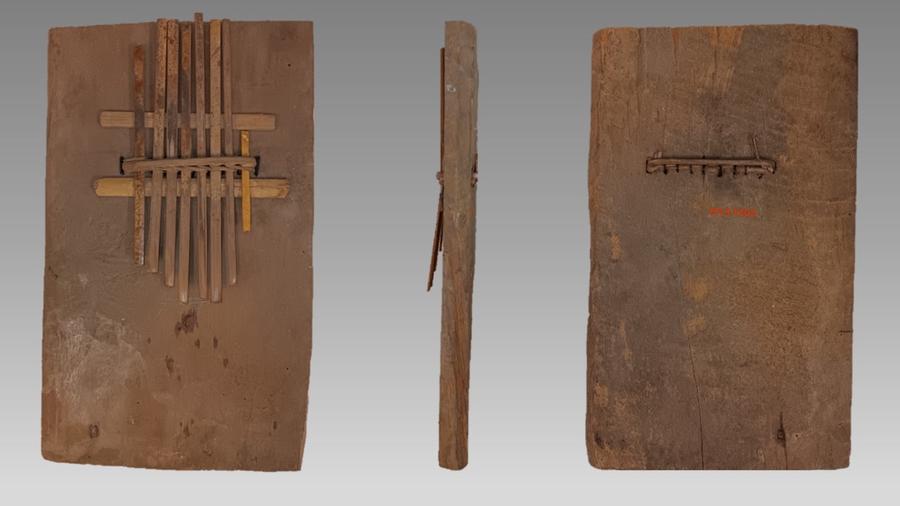
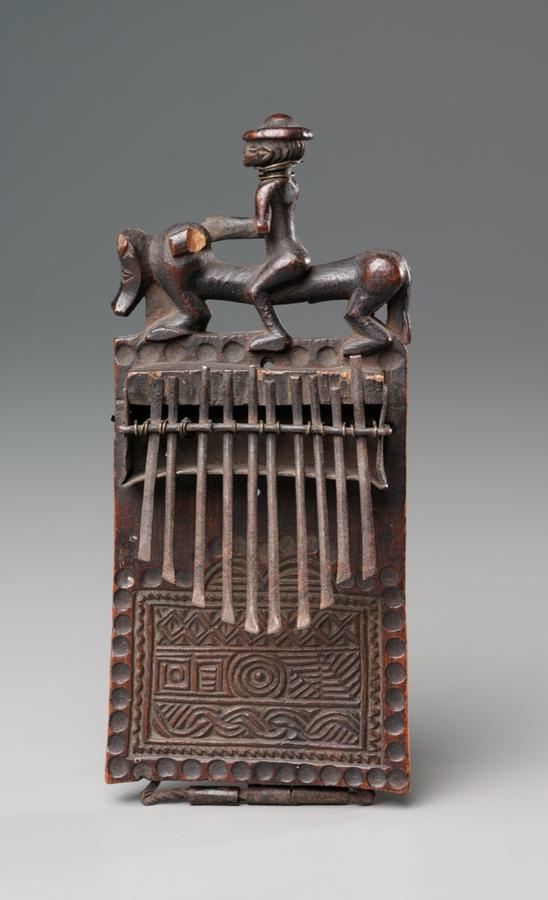
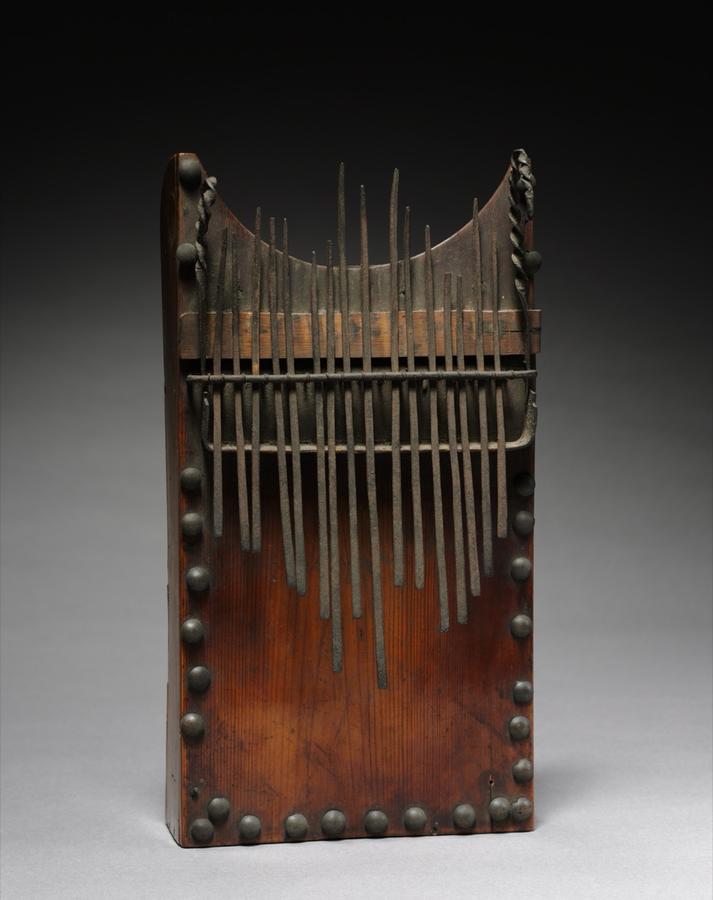
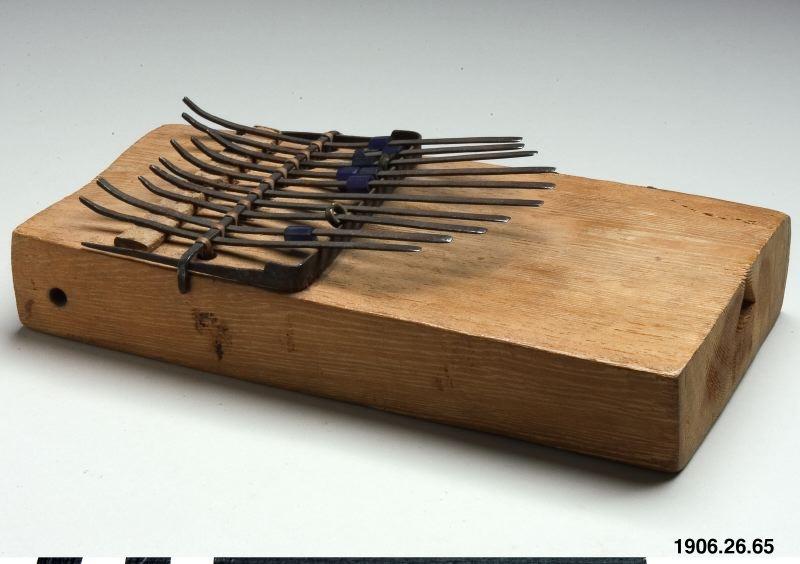
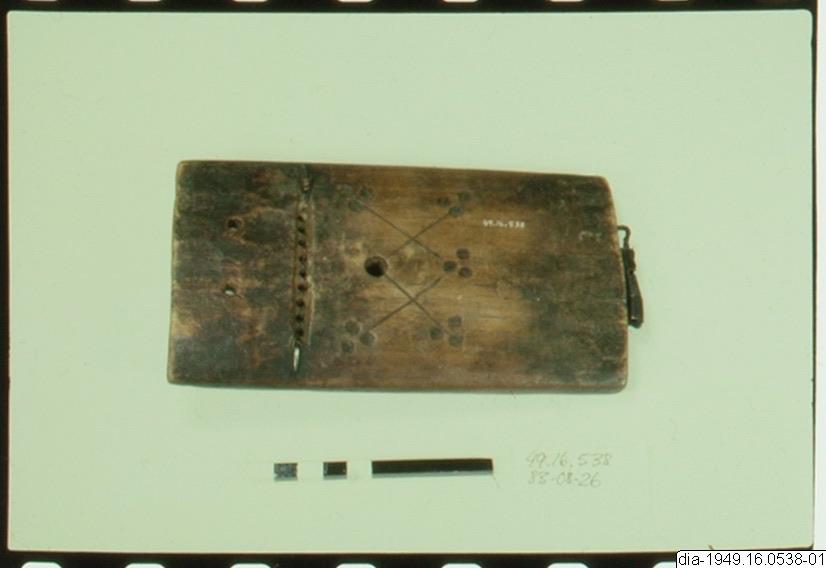
These 11 photographs span 1850–1918, 7 places of origin and 3 museums. 3 of them carry no date in the museum record. Every photograph is public domain or openly licensed, and links to the museum’s own record.
-
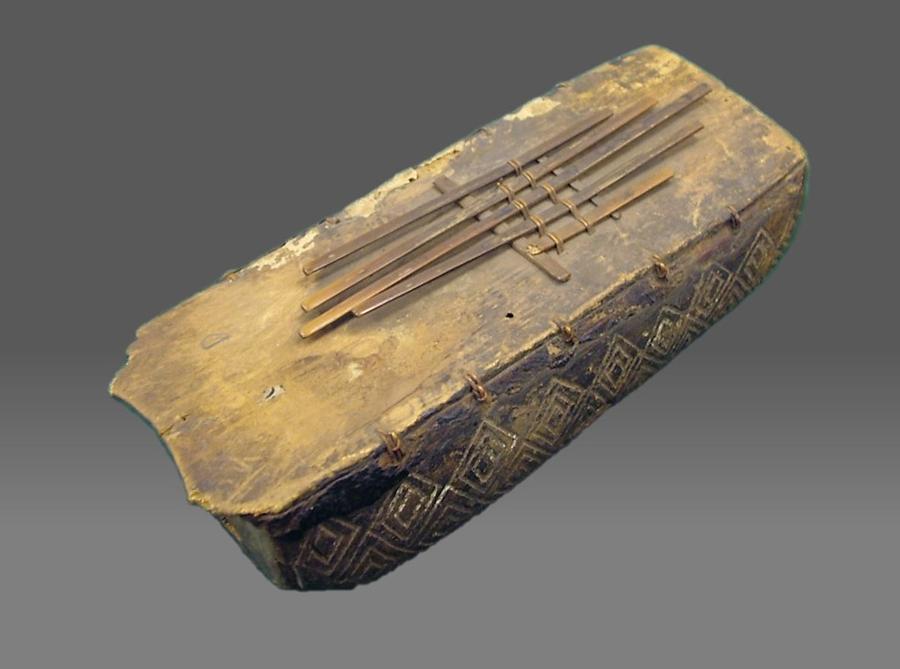
Zanzelate 19th century · Ghanian, Ashanti (Asante) (Ghana) -
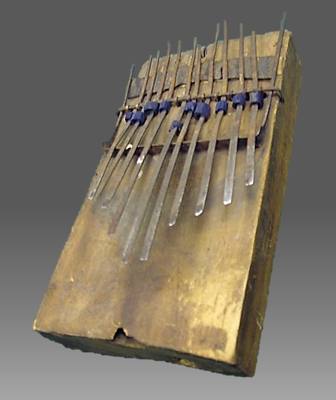
Zanzelate 19th century · Possibly Central African (Congo?) -
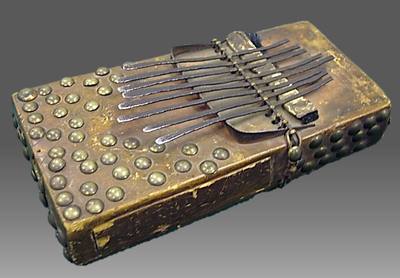
Likembelate 19th century · Bateke people (Republic of the Congo) -
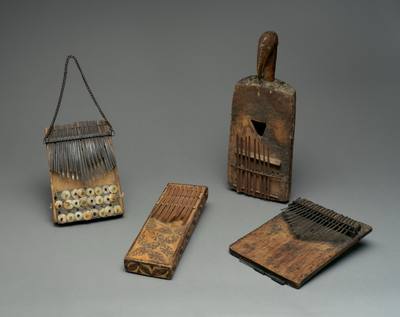
Mbiralate 19th century · Nigerian (Efik) (Nigeria) -
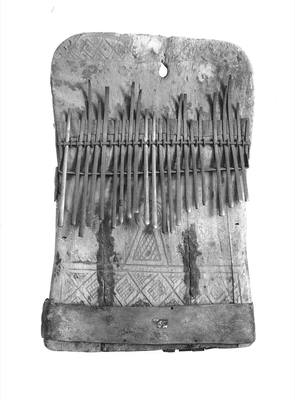
Zanzelate 19th century · Angolan (Angola) -
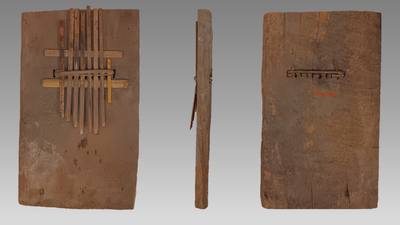
Zanzelate 19th century · probably Cameroonian (Cameroon?) -
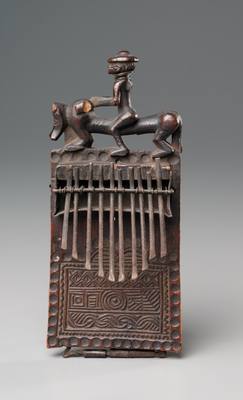
Lamellophone (chisanji)late 1800s · Africa, Central Africa, Democratic Republic of the Congo or Angola, Chokwe-style maker (Africa) -
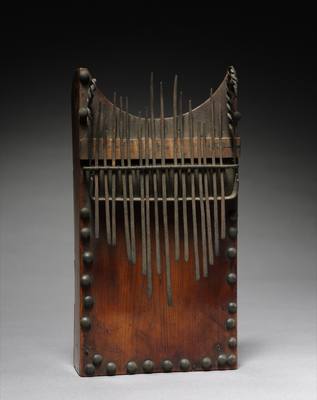
Lamellophone "thumb piano"1900s · Africa, Central Africa, Democratic Republic of Congo, Bushoong-style maker (Africa) -
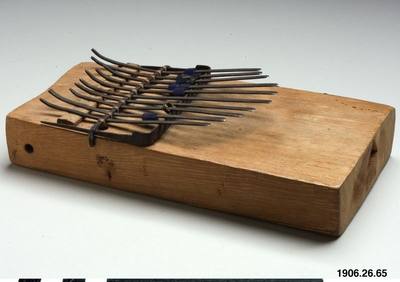
Piano, likembe, sanzaUndated · Sweden -
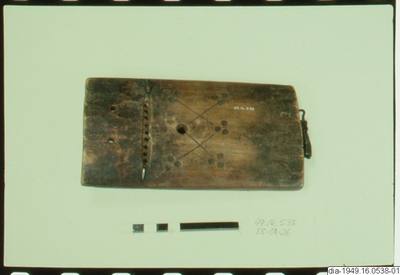
Piano, thumb piano, tsanstaUndated · Sweden -
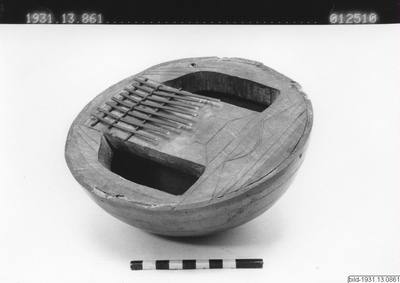
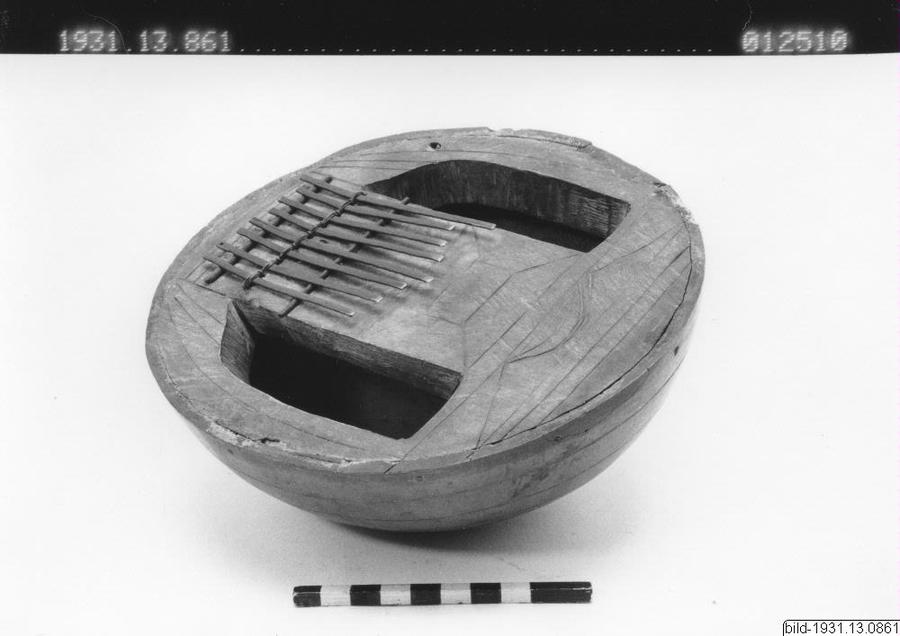
Piano, thumb pianoUndated · Sweden
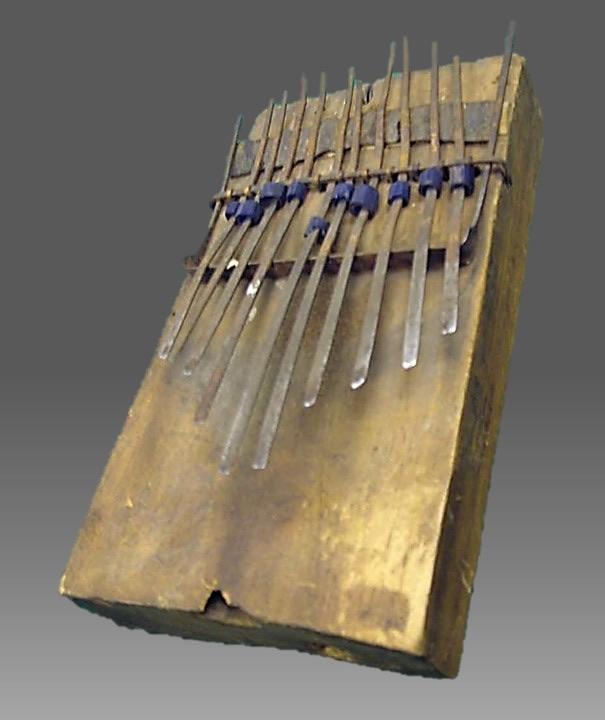
Facts at a glance
| Hornbostel–Sachs number | 122.1 — Plucked idiophone |
|---|---|
| Hornbostel–Sachs group | Idiophones › Plucked idiophones › In the form of a comb |
| Also known as | African hand piano, hand piano, kisaanj, likembe, nsansi, sansa, thumb piano, kalendi |
| Classification (Wikipedia infobox) | Lamellophone, Plucked Idiophone |
| Wikidata labels | 45 languages |
| Wikipedia article | Mbira |
| Wikidata item | Q1467960 |
| Wikimedia Commons category | Mbira |
| MusicBrainz instrument | 4dc550d6-973f-42bd-8c9b-7dfd09bd3f6e |
| Encyclopaedia Britannica | art/mbira |
Sources: Wikidata (CC0 1.0) — classification number, aliases, identifiers (dump of 2026-07-22); Wikipedia (CC BY-SA 4.0) — infobox fields (description of the classification number, development, inventors) and the names of the Hornbostel–Sachs groups (article “Hornbostel–Sachs”, revision of 2026-01-04).
The name in other languages
| Language | Name | Also written |
|---|---|---|
| English | mbira | African hand piano, hand piano, kisaanj |
| French | Mbira | Likembé, Likembe, M'bira |
| German | Lamellophon | Daumenpiano, Mbira, Daumenklavier |
| Spanish | mbira | kalimba |
| Italian | M'bira | Pianoforte a pollici, Mbira, Sanza |
| Portuguese | kalimba | |
| Dutch | Duimpiano | Mbira, Sansa, Kalimba |
| Russian | калимба | мбира |
| Japanese | カリンバ | ムビラ, サンサ |
| Chinese | 拇指琴 | 指片琴, 卡林巴琴 |
| Korean | 엠비라 | 음비라 |
| Arabic | كلمبيا | كاليمبا (آلة موسيقية) |
Sources: Wikidata (CC0 1.0) — labels and aliases; MusicBrainz (CC0 1.0) — instrument aliases (names only).
About the mbira: history, construction and playing
Mbira, also known as kalimba and zanza (or variant spellings), are a family of musical instruments, traditional to the Shona people of Zimbabwe.
The instruments consist of a wooden board (often fitted with a resonator) with attached staggered metal tines, played by holding the instrument in the hands and plucking the tines with the thumbs and/or fingers. Musicologists classify it as a lamellaphone, part of the plucked idiophone family of musical instruments.
In Eastern and Southern Africa, there are many kinds of mbira, often accompanied by the hosho, a percussion instrument. It is often an important instrument played at religious ceremonies, weddings, and other social gatherings. The "Art of crafting and playing Mbira/Sansi, the finger-plucking traditional musical instrument in Malawi and Zimbabwe" was added to the UNESCO Representative List of the Intangible Cultural Heritage of Humanity in 2020.
History
Various kinds of plucked idiophones and lamellaphones have existed in Africa for thousands of years. The tines were originally made of bamboo but over the years metal keys have been developed. These types of instrument appear to have been invented twice in Africa: a wood or bamboo-tined instrument appeared on the west coast of Africa about 3,000 years ago, and metal-tined lamellophones appeared in the Zambezi River valley around 1,300 years ago. Metal-tined instruments traveled all across the continent, becoming popular among the Shona of Zimbabwe (from which the word mbira comes) and other indigenous groups in Zimbabwe and Mozambique. The mbira was differentiated in its physical form and social uses as it spread. Kalimba-like instruments came to exist from the northern reaches of North Africa to the southern extent of the Kalahari Desert, and from the east coast to the west coast, though many or most groups of people in Africa did not possess mbiras. There were thousands of different tunings, different note layouts, and different instrument designs, but there is a hypothetical tuning and note layout of the original metal-tined instrument from 1,300 years ago, referred to as the 'kalimba core'.
In the mid 1950s mbira instruments were the basis for the development of the kalimba, a westernised version designed and marketed by the ethnomusicologist Hugh Tracey, leading to a great expansion of its distribution outside Africa.
Acoustics
Lamellophones are instruments which have little tines, or "lamellae", which are played by plucking. Unlike stringed instruments or air-column instruments like flutes, the overtones of a plucked lamella are inharmonic, giving the mbira a characteristic sound. The inharmonic overtones are strongest in the attack and die out rather quickly, leaving an almost pure tone. When a tine is plucked, the adjacent tines also create secondary vibrations that increase the harmonic complexity of an individual note.
Rhythm
Mbira music, like much of the sub-Saharan African music traditions is based on cross-rhythm. An example from the kutsinhira part of the traditional mbira dzavadzimu piece "Nhema Musasa" is given by David Peñalosa, who observes that the left hand plays the ostinato "bass line," while the right hand plays the upper melody. The composite melody is an embellishment of the 3:2 cross-rhythm (also known as a hemiola).
Tuning
It is common on African mbira and other lamellophones to have the lowest notes in the centre with higher notes to the far left and the far right—this is an ergonomic nicety, in that the thumb can pivot such that all the tines are easy to reach. However, traditional African tunings use notes that do not lie on the grid of the Western tempered scale, and traditional mbira note layouts are often idiosyncratic, sometimes with adjacent tines making part of a scale, but then an odd note thrown in that defies the pattern.
Historically, mbira tunings have not mapped exactly onto Western scales; it is not unusual for a seven-note sequence on a mbira to be "stretched" over a greater range of frequencies than a Western octave and for the intervals between notes to be different from those in a Western scale. Tunings have often been idiosyncratic with variations over time and from one player to another. A mbira key produces a rich complex of overtones that varies from one instrument to another depending on its maker's intentions and accidents of fabrication, such that some instruments simply sound better when some notes of a familiar tuning are pushed. With the increased popularity of the mbira dzavadzimu in North America, Europe, and Japan in recent decades, Zimbabwean mbira makers have tended to tune their instruments more uniformly for export, but much variation is still found among mbira in their homeland.
Tunings vary from family to family, referring to relative interval relationships and not to absolute pitches. The most common tuning played throughout Zimbabwe and among non-Zimbabwean mbira players worldwide is Nyamaropa, similar to the western Mixolydian mode. Names may also vary between different families; Garikayi Tirikoti has developed a "mbira orchestra" that has seven different tunings, each starting on a different interval of the same seven-note scale, where it is possible to play all instruments in a single performance. The seven tunings that Garikayi uses are: Bangidza, Nyabango, Nhemamusasa, Chakwi, Taireva, Mahororo, and Mavembe (all of which are also names of traditional songs save for Mavembe and Nyabango). The closest to what is commonly named "Nyamaropa" is his "Nhemamusasa" tuning.
Mbira dzavadzimu
In Shona music, the mbira dzavadzimu ("voice of the ancestors", or "mbira of the ancestral spirits", national instrument of Zimbabwe) is a musical instrument that has been played by the Shona people of Zimbabwe for thousands of years. The mbira dzavadzimu is frequently played at religious ceremonies and social gatherings called mapira (sing. "bira"). The mbira dzavadzimu can be used to play over one hundred songs, such as Kariga mombe.
A typical mbira dzavadzimu consists of between 22 and 28 keys constructed from hot- or cold-forged metal affixed to a hardwood soundboard (gwariva) in three different registers—two on the left, one on the right.
While playing, the little finger of the right hand is placed through a hole in the bottom right corner of the soundboard, with the little finger entering from the front of sound board, and the ring finger and middle finger reaching around the back to stabilise the instrument. This leaves the thumb and index finger of the right hand open to stroke the keys in the right register from above (thumb) and below (index finger). The fingers of the left hand stabilise the left side of the instrument, with most fingers reaching slightly behind the instrument. Both registers on the left side of the instrument are played with the left thumb. Some mbira possess an extra key in the upper left register which is hit from below by the left index finger.
Bottle caps, shells, or other objects ("machachara") are often affixed to the soundboard to create a buzzing sound when the instrument is played. In a traditional setting, this sound is considered extremely important, as it is believed to attract ancestral spirits.
During a public performance, an mbira dzavadzimu is frequently placed in a deze (calabash resonator) to amplify its sound.
Mbira Nyunga Nyunga
The nyunga nyunga which normally has 15 keys, originated from Manicaland where it traditionally played the entertainment role during social gatherings and commemorations. Jeke (Jack) Tapera introduced the mbira nyunga nyunga in the 1960s from Tete province of Mozambique to Kwanongoma College of African music (now United College of Music) in Bulawayo. Two keys were then added to make fifteen (Chirimumimba, 2007), in two rows. The mbira nyunga nyunga is similar in construction to the mbira dzavadzimu, but has no hole in the soundboard. Key pitch radiates out from the center, rather than from left to right.
Zimbabwe's Dumisani Maraire originated mbira nyunga nyunga number notation. The upper row keys (from left) are keys 2, 4, 6, 8, 10, 12, and 14 while the bottom row keys are notated as 1, 3, 5, 7, 9, 11, 13, and 15. Maraire brought awareness of this instrument to the United States when he came to the University of Washington as a visiting artist from 1968 to 1972.
Recently a Midlands State University (Gweru, Zimbabwe) lecturer in the department of music and musicology has suggested a letter notation; the upper keys as (from first left upper key) E, D, C, F, C, D, and E and the lower or bottom keys as (from the first lower key) A, G, F, A, F, C, D, and E. But the Maraire number notation has remained the internationally accepted system (Chirimumimba, 2007).
Dutch composer Maarten Regtien (1963) uses a Mbira Nyunga Nyunga in the electronic composition Daddy Mbira - Mbira Penguin Talks (2014), creating soundscapes and using western composition techniques like the canon, impossible to play on a mbira.
Hugh Tracey
The Hugh Tracey kalimbas are tuned diatonically in the key of G. The arrangement of the notes on the Hugh Tracey kalimba borrows from the typical scheme with the lowest notes in the center and the upper notes on the left and the right, with the notes in the ascending scale alternating strictly right-left and going outwards towards the two sides.
The diatonic western kalimba tuning which Tracey used was practical for a worldwide instrument—with hundreds of African kalimba tunings, the chosen Western standard would maximise the number of people who would immediately connect with the kalimba. The practicality of this note arrangement, with notes going up the scale in a right-left-right-left progression, is that modal 1-3-5 or 1-3-5-7 chords are made by playing adjacent tines. If chords are played in the lower octave, the same notes will appear on the opposite side of the kalimba in the upper octave, which makes it very easy to simultaneously play a melody in the upper octave and an accompanying harmony in the lower octave. So, the arrangement of notes on the Hugh Tracey kalimba (and on virtually any kalimba that copies the instrument) makes certain complex musical operations very simple.
Alternative tunings are possible, as the tines of most kalimbas are easily pushed in and out to sharpen or flatten their pitch. Some alternative tunings simply change the key of the kalimba, without changing the note layout scheme. C major is a popular tuning, sold by multiple manufacturers. Other alternative tunings move the kalimba to non-modal scales (such as Middle-Eastern scales). Each note of the kalimba can be tuned independently (unlike a guitar), so any scale, western or non-western, is possible, and traditional African scales are still accessible to this modern African instrument. Composer Georg Hajdu has tuned the Hugh Tracey alto kalimba to the chromatic steps of the Bohlen–Pierce scale in a piece called Just Her – Jester – Gesture. The Bohlen–Pierce scale subdivides the just twelfth into 13 steps.
Source: Wikipedia, “Mbira” — CC BY-SA 4.0 — text excerpted as published (references, images and tables removed); see the article for the full text and the list of authors. Revision of 2026-06-19.
Sources and licences
- Zanze, Ashanti (Asante), late 19th century, Ghanian, Ashanti (Asante) (Ghana). Wood. Gift of Joseph W. Drexel, 1889 (89.2.190). Museum record · CC0 1.0 (public domain dedication)
- Zanze, late 19th century, Possibly Central African (Congo?). Wood, metal, glass beads. The Crosby Brown Collection of Musical Instruments, 1889 (89.4.478). Museum record · CC0 1.0 (public domain dedication)
- Likembe, Bateke people, late 19th century, Bateke people (Republic of the Congo). Wood, metal. The Crosby Brown Collection of Musical Instruments, 1889 (89.4.481). Museum record · CC0 1.0 (public domain dedication)
- Mbira, late 19th century, Nigerian (Efik) (Nigeria). Kapok wood (Ceiba pentandra Gaertn). The Crosby Brown Collection of Musical Instruments, 1889 (89.4.482). Museum record · CC0 1.0 (public domain dedication)
- Zanze, late 19th century, Angolan (Angola). Wood. Metal bridge. 26 metal keys.. The Crosby Brown Collection of Musical Instruments, 1889 (89.4.486). Museum record · CC0 1.0 (public domain dedication)
- Zanze, late 19th century, probably Cameroonian (Cameroon?). Wood. The Crosby Brown Collection of Musical Instruments, 1889 (89.4.1263). Museum record · CC0 1.0 (public domain dedication)
- Lamellophone (chisanji), late 1800s, Africa, Central Africa, Democratic Republic of the Congo or Angola, Chokwe-style maker (Africa). Wood, iron, and wire. The Harold T. Clark Educational Extension Fund. Museum record · CC0 1.0 (public domain dedication)
- Lamellophone "thumb piano", 1900s, Africa, Central Africa, Democratic Republic of Congo, Bushoong-style maker (Africa). Wood, iron, and upholstery studs. The Charles G. King Jr. collection; Gift of Ralph King in memory of Charles G. King Jr.. Museum record · CC0 1.0 (public domain dedication)
- Piano, likembe, sanza, Undated, Sweden. Museum of Ethnography / Swedish Open Cultural Heritage (via Europeana). Museum record · CC0 1.0 (public domain dedication)
- Piano, thumb piano, tsansta, Undated, Sweden. Museum of Ethnography / Swedish Open Cultural Heritage (via Europeana). Museum record · CC0 1.0 (public domain dedication)
- Piano, thumb piano, Undated, Sweden. Museum of Ethnography / Swedish Open Cultural Heritage (via Europeana). Museum record · CC0 1.0 (public domain dedication)
Photographs: open-access collections of the museums named above; each is shown here reduced in size, otherwise unchanged. Text: Wikipedia (CC BY-SA 4.0), Wikidata and MusicBrainz (CC0). The full list of sources and licences is on the credits page.