
Printable chart
Tuba and euphonium fingering chart
Fingering chart for the B♭ euphonium and BB♭ tuba with three or four valves: 4th-valve fingerings, compensating systems and other tubas. Printable PDF.
Two pages: the fingering chart and the tuba-sizes table.
Download the PDF
Free to print and share. No sign-up, no e-mail, no watermark. A4 for most of the world, Letter for the US and Canada; both are black and white, with the fonts embedded.
Tubas and euphoniums use the same valve arithmetic as a trumpet (valve 2 = 1 semitone, 1 = 2, 3 = 3) plus a fourth valve that lowers the pitch a perfect fourth (5 semitones). Notes are read in bass clef at concert pitch in orchestras and bands, so a player has to learn the fingerings for the size of tuba in the hands: the chart below is for B♭ euphonium and BB♭ tuba (an octave lower), and the sizes table shows the same fingerings on CC, E♭ and F tubas.
Notes are concert (sounding) pitch, as read from bass clef in orchestras and concert bands. Euphonium is the upper note of each row; BB♭ tuba sounds an octave lower on the same fingering. A filled circle means the valve is pressed.
Chromatic fingering, B♭ euphonium and BB♭ tuba (4 valves; † = needs the fourth valve).
| Euphonium | BB♭ tuba | Valves | Fingering |
|---|---|---|---|
| B1† | B0 | 1234 1-2-3-4 | 1-2-3-4 |
| C2† | C1 | 1234 1-3-4 | 1-3-4 |
| C♯2/D♭2† | C♯1/D♭1 | 1234 2-3-4 | 2-3-4 |
| D2† | D1 | 1234 1-2-4 | 1-2-4 |
| D♯2/E♭2† | D♯1/E♭1 | 1234 1-4 | 1-4 |
| E2† | E1 | 1234 2-4 | 2-4 or 1-2-3 |
| F2† | F1 | 1234 4 | 4 or 1-3 |
| F♯2/G♭2 | F♯1/G♭1 | 1234 2-3 | 2-3 |
| G2 | G1 | 1234 1-2 | 1-2 or 3 |
| G♯2/A♭2 | G♯1/A♭1 | 1234 1 | 1 |
| A2 | A1 | 1234 2 | 2 |
| A♯2/B♭2 | A♯1/B♭1 | 1234 open | open |
| B2† | B1 | 1234 2-4 | 2-4 or 1-2-3 |
| C3† | C2 | 1234 4 | 4 or 1-3 |
| C♯3/D♭3 | C♯2/D♭2 | 1234 2-3 | 2-3 |
| D3 | D2 | 1234 1-2 | 1-2 or 3 |
| D♯3/E♭3 | D♯2/E♭2 | 1234 1 | 1 |
| E3 | E2 | 1234 2 | 2 |
| F3 | F2 | 1234 open | open |
| F♯3/G♭3 | F♯2/G♭2 | 1234 2-3 | 2-3 |
| G3 | G2 | 1234 1-2 | 1-2 or 3 |
| G♯3/A♭3 | G♯2/A♭2 | 1234 1 | 1 |
| A3 | A2 | 1234 2 | 2 |
| A♯3/B♭3 | A♯2/B♭2 | 1234 open | open |
| B3 | B2 | 1234 1-2 | 1-2 |
| C4 | C3 | 1234 1 | 1 |
| C♯4/D♭4 | C♯3/D♭3 | 1234 2 | 2 |
| D4 | D3 | 1234 open | open |
| D♯4/E♭4 | D♯3/E♭3 | 1234 1 | 1 |
| E4 | E3 | 1234 2 | 2 |
| F4 | F3 | 1234 open | open |
| F♯4/G♭4 | F♯3/G♭3 | 1234 2-3 | 2-3 |
| G4 | G3 | 1234 1-2 | 1-2 or 3 |
| G♯4/A♭4 | G♯3/A♭3 | 1234 1 | 1 |
| A4 | A3 | 1234 2 | 2 |
| A♯4/B♭4 | A♯3/B♭3 | 1234 open | open |
| B4 | B3 | 1234 2 | 2 |
| C5 | C4 | 1234 open | open |
| C♯5/D♭5 | C♯4/D♭4 | 1234 2 | 2 |
| D5 | D4 | 1234 open | open |
Valve 1 = whole tone, 2 = semitone, 3 = minor third, 4 = perfect fourth. The last column repeats the main fingering as numbers and lists the alternates (for example 1-2 or 3, 4 or 1-3, 2-4 or 1-2-3). On a three-valve instrument the lowest chromatic note is E2 (euphonium) or E1 (tuba): use the alternate without the fourth valve. Fingerings are for a compensating four-valve instrument; the second sheet shows the non-compensating low notes.
Brass-band parts (treble clef, transposing)
| Instrument | Written | Sounds | Interval |
|---|---|---|---|
| Euphonium (B♭) | C4 | B♭2 | a major ninth lower |
| E♭ tuba (E♭ bass) | C4 | E♭2 | an octave and a major sixth lower |
| B♭ tuba (BB♭ bass) | C4 | B♭1 | two octaves and a major second lower |
The same fingering on every size of tuba
The open note is the second partial: B♭1 on the BB♭ tuba, C2 on the CC, E♭2 on the E♭ and F2 on the F tuba; the euphonium is in B♭ an octave higher, B♭2. Each row is a fingering and the note it gives on each instrument.
| Valves | Lowers by (semitones) | Euphonium (B♭) | BB♭ tuba | CC tuba | E♭ tuba | F tuba | Tuning without compensation |
|---|---|---|---|---|---|---|---|
| 1234 open | 0 | B♭2 | B♭1 | C2 | E♭2 | F2 | — |
| 1234 2 | 1 | A2 | A1 | B1 | D2 | E2 | — |
| 1234 1 | 2 | A♭2 | A♭1 | B♭1 | D♭2 | E♭2 | — |
| 1234 1-2 / 3 | 3 | G2 | G1 | A1 | C2 | D2 | very slightly sharp |
| 1234 2-3 | 4 | G♭2 | G♭1 | A♭1 | B1 | D♭2 | slightly sharp |
| 1234 4 / 1-3 | 5 | F2 | F1 | G1 | B♭1 | C2 | sharp (1-3 only) |
| 1234 2-4 / 1-2-3 | 6 | E2 | E1 | G♭1 | A1 | B1 | very sharp (1-2-3 only) |
| 1234 1-4 | 7 | E♭2 | E♭1 | F1 | A♭1 | B♭1 | sharp |
| 1234 1-2-4 | 8 | D2 | D1 | E1 | G1 | A1 | sharp |
| 1234 2-3-4 | 9 | D♭2 | D♭1 | E♭1 | G♭1 | A♭1 | sharp |
| 1234 1-3-4 | 10 | C2 | C1 | D1 | F1 | G1 | sharp |
| 1234 1-2-3-4 | 11 | B1 | B0 | D♭1 | E1 | G♭1 | sharp |
Lowest notes: compensating or not
| Euphonium / tuba | Compensating | Non-compensating |
|---|---|---|
| D♯2/E♭2 / D♯1/E♭1 | 1-4 | 1-2-4, 1-4 |
| D2 / D1 | 1-2-4 | 2-3-4 |
| C♯2/D♭2 / C♯1/D♭1 | 2-3-4 | 1-3-4 |
| C2 / C1 | 1-3-4 | 1-2-3-4 |
| B1 / B0 | 1-2-3-4 | not reliable |
Without compensation the combinations that use valve 4 play sharp, so the note is fingered a semitone lower and lipped into tune.
Pedal tones
| Euphonium / tuba | Valves |
|---|---|
| A♯1/B♭1 / A♯0/B♭0 | open |
| A1 / A0 | 2 |
| G♯1/A♭1 / G♯0/A♭0 | 1 |
| G1 / G0 | 1-2 |
| F♯1/G♭1 / F♯0/G♭0 | 2-3 |
| F1 / F0 | 4 |
Pedal tones (first partial) use the same fingerings as the open series an octave higher.
The open series and the valve pattern, on the staff
Bass clef, sounding pitch. Numbers under the notes are the partials; the seventh partial (grey) is flat and avoided. Press play to hear them.
BB♭ tuba, open series
B♭ euphonium, open series (an octave higher)
Euphonium: B♭2 down to F2, labels are the valves
The instrument at a glance
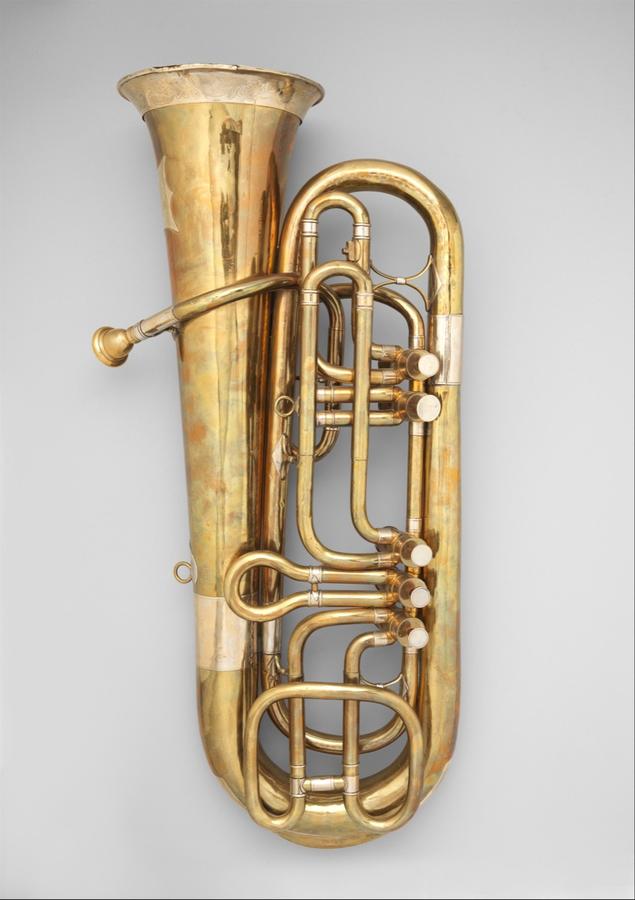
| Euphonium | 9 ft B♭, a conical bore an octave below the B♭ trumpet; usually four valves, compensating; three top-action pistons for fingers and a fourth side valve — Wikipedia: Euphonium |
|---|---|
| Tuba sizes | F 12 ft, E♭ 13 ft (bass tubas); C 16 ft, B♭ 18 ft (contrabass tubas, “CC” and “BB♭”) — Wikipedia: Tuba |
| Valves | three to six; four and five are most common among professional tubists; the sousaphone usually has three — Wikipedia: Tuba |
| Valve amounts | 1st lowers by 2 semitones, 2nd by 1, 3rd by 3; the 4th by 5 (a perfect fourth) — Wikipedia: Tuba |
| Tuba range | F1 to C4 easy; pedal tones to B♭0 or lower, and up to C5 — Wikipedia: Tuba |
| Euphonium range | E2 to about G4 easy; pedal range B♭1 down to B0; up to D5 — Wikipedia: Euphonium |
| Written pitch | orchestra and concert band: concert pitch, bass clef. British brass band: transposing, treble clef — Wikipedia: Tuba, Euphonium |
| Hornbostel–Sachs | 423.232, valved lip-reed aerophone with wide conical bore — Wikidata / Wikipedia |
More photographs and the history of the instrument: Tuba →
Frequently asked questions
What is the fingering for the notes on a tuba?
On a BB♭ tuba the open note is B♭1, and the same fingerings used on a trumpet lower it: 2 for A1, 1 for A♭1, 1-2 (or 3) for G1, 2-3 for G♭1, and 4 (or 1-3) for F1. The open notes are B♭1, F2, B♭2, D3, F3, B♭3, C4 and D4, and the same fingering pattern repeats below each of them. The chart lists every note from B0 to D5.
What does the fourth valve do?
It lowers the pitch by a perfect fourth, five semitones. It replaces the combination 1-3, which plays sharp on most instruments, and it extends the range down to the fundamental: with 4 and combinations of 1, 2 and 3 the instrument reaches all the way down to the pedal tone, although some of those low notes are sharp unless the instrument is compensating.
What is the difference between BB♭ and CC tuba?
The BB♭ tuba (18 ft) has B♭ as its open note, the CC tuba (16 ft) has C. A fingering on the CC tuba therefore gives a note a whole tone higher than the same fingering on the BB♭ tuba: open is C2 against B♭1, 2 is B1 against A1, and so on. Players of a non-transposing bass-clef part have to learn a different set of fingerings for each size; the sizes table shows them side by side. The CC is the most widely used orchestral tuba outside Germany and Russia; the BB♭ is the most common school instrument and the standard in British brass bands.
Are euphonium and tuba fingerings the same?
The valve combinations are the same, but the euphonium is pitched in B♭ an octave above the BB♭ tuba, so each fingering gives a note an octave higher. A euphonium player can read a BB♭ tuba chart and play the same fingering an octave up; a CC tuba player has to shift notes by a whole tone.
What is the lowest note on a three-valve euphonium or tuba?
All instruments are chromatic down to E2 on a euphonium (E1 on a BB♭ tuba) with three valves. Below that you need the fourth valve; three-valve players can use the “false” or “falset” notes, which are weaker, to reach lower. Four-valve instruments extend that range down to at least C2 on the euphonium.
What is the difference between compensating and non-compensating?
On a non-compensating four-valve instrument the fourth valve’s tubing is only correct for the open horn: when you press it with other valves the added length is too short and the note is sharp. Players move one semitone down to fingering, for example E♭ is 1-2-4 rather than 1-4. A compensating system routes the fourth valve’s tubing back through the first three valves to add small corrections, so the textbook fingerings are in tune. It was patented by David Blaikley in 1878 and is common on British and British-style euphoniums and E♭ and B♭ tubas.
Is the tuba read in bass clef or treble clef?
In orchestras and concert bands the tuba is written at concert pitch in bass clef, as a non-transposing instrument. In British brass bands every instrument except the bass trombone is a transposing instrument written in treble clef: the E♭ tuba sounds an octave and a sixth below written and the B♭ tuba two octaves and a second below. The euphonium is written in treble clef a major ninth above the sound.
Are baritone horn and euphonium fingerings the same?
Yes. The two instruments have essentially identical range and fingering, which is why one player can double both, with some adjustment of breath and embouchure. The euphonium has a wider conical bore and a larger bell.
How to practise with this chart
- Learn the open notes and the first descent. On a BB♭ tuba slur B♭1-F2-B♭2-D3-F3, then play from B♭1 down chromatically: 2, 1, 1-2, 2-3, 4. The fingerings repeat on every partial.
- Use the fourth valve for low sharp notes. Play the low register (E1 and below on tuba, E2 and below on euphonium) with the fourth valve combination in the chart and a tuner, and move the slide or lip the note as the chart’s tuning column suggests.
- Learn 3-valve and 4-valve alternates. Notes lowered by 3, 5 or 6 semitones have two fingerings (1-2 or 3; 4 or 1-3; 2-4 or 1-2-3). Practise a scale using only the main one, then only the alternates, so you can choose the more in-tune combination by ear.
- Transpose fingerings by size. If you switch between BB♭ and CC tuba, write the open note beside each fingering and find the new notes with the sizes table. The pattern is the same; the notes shift by a whole tone.
- Practise long tones in the pedal register. The pedal tones are easier on a tuba or euphonium than on other brass; play B♭ down to F with the pedal fingerings in the chart, long and soft.
musictheoryprint.com · free to print and share
What the chart shows#
Each row is one concert-pitch note, read from the bass clef. The left note is the B♭ euphonium, the second is the BB♭ tuba, which sounds an octave lower on the same fingering. The valve circles show the main fingering for a four-valve instrument, and the last column repeats it as numbers and lists the alternates. Notes marked † need the fourth valve; where an alternate without it is listed (for example 1-3 for 4, or 1-2-3 for 2-4) a three-valve instrument can use that, and below E2 (euphonium) or E1 (tuba) it can only use weaker falset notes.
The valves#
The first three valves lower the pitch by 2, 1 and 3 semitones (valve 1 a whole tone, valve 2 a semitone, valve 3 a minor third); combinations add up. The fourth valve lowers the pitch by a perfect fourth, 5 semitones. Written as sums:
- 2 = 1 semitone, 1 = 2, 1-2 or 3 = 3, 2-3 = 4,
- 4 or 1-3 = 5, 2-4 or 1-2-3 = 6,
- 1-4 = 7, 1-2-4 = 8, 2-3-4 = 9, 1-3-4 = 10, 1-2-3-4 = 11.
On the euphonium the open note is B♭2, so 4 gives F2 and 1-2-3-4 gives B1; on the BB♭ tuba everything is an octave lower. The sizes table at the end of the PDF shows the same combinations on CC, E♭ and F tubas.
Why there is a fourth valve#
The combination 1-3 also lowers the pitch by a fourth, but it plays sharp, as does 1-2-3. The fourth valve replaces both of them (4 for 1-3, 2-4 for 1-2-3) and gives access to the low notes between the open note and the pedal tone. Used with any or all of the first three valves it extends the range down to the fundamental, although on an instrument without compensation some of those low notes come out sharp.
Compensating and non-compensating instruments#
In a non-compensating four-valve instrument the fourth valve adds the length of a fourth to the open tube, which is too short once other valves are already pressed. The result is that 1-4, 1-2-4, 2-3-4 and 1-3-4 are all sharp, so players finger the note a semitone lower than the one wanted (for example E♭ as 1-2-4 and C as 1-2-3-4) and adjust with a slide or lip. In a compensating instrument, introduced by David Blaikley in 1878, the fourth valve’s airway goes back through the first three valves and adds extra loops, so the chart’s ordinary fingerings are in tune; that is the system on most British-style euphoniums. The low-notes table shows both.
BB♭, CC, E♭ and F tubas#
Tubas come in four main sizes: F (12 ft) and E♭ (13 ft) bass tubas, and C (16 ft) and B♭ (18 ft) contrabass tubas, called CC and BB♭ from an archaic English version of Helmholtz pitch notation. A tubist reading bass clef at concert pitch must learn the fingerings of the instrument in use, because the same note needs a different fingering on each. The pattern never changes, only the open note: B♭ for the BB♭ tuba, C for the CC, E♭ and F. Professional CC and F tubas usually have five or six valves, which provide in-tune alternatives to the sharp combinations; the fifth valve is usually tuned a flattened whole tone (about two and a half semitones).
Euphonium and baritone horn#
The euphonium is a B♭ instrument an octave above the BB♭ tuba, so it uses the same fingerings an octave higher, and the baritone horn has essentially identical range and fingering. The euphonium is most often written in bass clef at concert pitch in orchestras and US bands, and in transposing treble clef (a major ninth above the sound) in British brass bands; many concert-band editions give both.
Background
Excerpts from open reference works, reproduced as published (references, images and tables removed). Every excerpt names its source, licence and original article.
In brief
The tuba is the biggest of all the brass, string, musical instruments. They are the newest part of the symphony orchestra, first showing up in the mid-19th century. Most orchestras have a tuba now. The standard tuba has about 16 feet of tubes.
Tubas are normally in the key of F, Eb, CC, or BBb and can have 3 to 6 valves. Because they are so big, some tubas have a compensating system. This means a fourth, fifth or sixth valve is used to make the instrument sound more in tune - especially the lowest notes.
Source: Simple English Wikipedia, “Tuba” — CC BY-SA 4.0 — text excerpted; see the article for the full text and authors. Revision of 2025-04-26.
Tuba: sizes, valves, notation and range
Sizes
Tubas are made in four pitches, determined by the length of the open tubing with no valves engaged. The smaller is built in 12-foot (12′) F or 13′ E♭, while the larger is built in 16′ C or 18′ B♭. Often the contrabass tubas are called "CC" or "BB♭" tubas, based on an archaic English variant of Helmholtz pitch notation. The terms bass and contrabass are not often used by composers, with the choice of instrument left to the player, often based on the desired timbre rather than the range required by the part.
The modern F tuba descends from the original 1835 Baß-Tuba in F. It is commonly used by professional players as a solo instrument, or to play higher parts in orchestras where a C tuba would be the usual instrument. In most of Europe, the F is the standard orchestral tuba, the larger C or B♭ tuba used only when the extra weight is desired. In Vienna, the Wienerkonzerttuba is an F tuba with six rotary valves, three for each hand. The British orchestral tuba from the late 19th century until the 1950s was in F with four or five piston valves, and a narrower bore profile closer to that of the euphonium.
The E♭ tuba is most commonly found in brass and military bands. Often called the "E♭ bass" in bands, it is built in saxhorn form with three top-mounted piston valves, and usually a fourth compensating valve on one side. In British orchestras, the E♭ tuba displaced the old British F tuba in the 1960s, and is still found in British orchestras today, although some players have adopted the C tuba since the 1990s. E♭ tubas are also sometimes found in German form with five rotary valves, mostly in Scandinavian orchestras.
The tuba in C (sometimes denoted "CC") is the most widely used orchestral tuba outside of Germany and Russia, and all professional models have five non-compensating valves. It is also found in concert bands in the US. On piston-valve C tubas, the fifth valve is usually a rotary valve.
The largest tuba, the contrabass in B♭ is the tuba of choice in German, Austrian, and Russian orchestras, usually with rotary valves. In the United States, the B♭ tuba usually has front-action piston valves. It is the most common in schools, largely due to the use of B♭ sousaphones in high school marching bands. The B♭ tuba is also built in saxhorn style with three top-mounted piston valves, and usually a fourth compensating side valve. It is standard in British brass bands, where it is often denoted as the "BB♭ bass" or the "double B".
Valves
Modern tubas are made with either piston valves or rotary valves. Rotary valves, patented in Prussia by Joseph Riedl in 1835, were first used on Austro-Hungarian tubas made in the 1850s by Červený. Around the same time in France and Britain, the modern piston valve developed by François Périnet in 1839 had begun to replace the Berlin valves used on early saxhorn instruments.
Pistons can be top-action, oriented vertically so the buttons are operated from the top of the instrument, or front-action (sometimes called side-action), oriented horizontally so the buttons are at the front, operated from the side.
Tubas are made with three to six valves, but among professional players, tubas with four and five are the most common. Three-valve tubas are usually inexpensive student models, or smaller marching instruments made to conserve weight; the sousaphone usually has three valves. F tubas usually have five or six valves, including the six-valved Wienerkonzerttuba used in Austria.
Depressing a valve adds a length of tubing to the instrument, lowering its fundamental pitch. On modern tubas, the first three valves work the same way as other valved brass instruments: the first lowers the pitch by two semitones (whole step), the second by one semitone (half step), and the third by three semitones (minor third).
Fourth, fifth, and sixth valves
The fourth valve lowers the pitch by five semitones (a perfect fourth). The combination of valves 1 and 3 also lowers the pitch by a fourth, but this combination, and the 1-2-3 combination, tend to produce pitches that are slightly sharp. Using the fourth valve helps solve these intonation problems. Using the fourth valve with any or all of the first three extends the range down to the fundamental pitch, but some of these lower notes will be sharp.
The fifth and sixth valves, if fitted, provide alternative fingering possibilities to improve intonation, particularly in the octave between the fundamental pitch (pedal tone) and the second partial, and for smooth trills and ease of playing. Usually, the fifth valve is tuned to two and a half semitones (flattened whole step), and the sixth to one and a half semitones (flattened half step). On C tubas with five valves, the fifth valve may be tuned as a flattened whole step or as a minor third, depending on the instrument. B♭ instruments rarely have a fifth valve, but if they do, it is tuned similarly to that of a C tuba.
Compensating valves
Most high-end saxhorn-style tubas in E♭ and B♭, instead of providing a fifth or sixth valve, provide a compensating system on the fourth valve to adjust intonation when using valves in combination. This reduces the need to constantly adjust tuning slides while playing, and also simplifies fingering. The compensating piston valve was invented in the 1870s by David Blaikley (1846–1936), the factory manager at Boosey & Co, who patented it in 1878. The patent limited its application outside of Britain, and tubas with compensating valves are mainly found in Britain and British Commonwealth countries. The tubing of the fourth valve is re-routed back through the other three valves to add an extra set of small correcting tubing loops. This achieves correct intonation in the lower range of the instrument when using the fourth valve. Compensating valves can make the instrument significantly more "stuffy" or resistant to air flow when compared to a non-compensating tuba, and also make the instrument heavier.
Notation
In orchestras and symphonic bands, the tuba is written at concert pitch in the bass clef as a non-transposing instrument. Tuba players reading music in bass clef must therefore learn the different valve fingerings for each size of tuba. Unlike other bass clef instruments like the trombone, cello, or bassoon, high passages for tuba are not written in tenor clef, and players are used to reading up to five leger lines above and below the bass staff.
In British brass bands, all instruments except the bass trombone are transposing instruments using the treble clef notation popularized in France by the instrument maker Adolphe Sax for his families of instruments. Thus the tuba parts are notated in treble clef, sounding an octave and a sixth below written for E♭ tuba, like the baritone saxophone, or two octaves and a second for B♭ tuba, like the contrabass clarinet. This allows band musicians to change instruments without having to learn new fingerings for the same written music.
Concert band music sometimes provides tuba parts in E♭ and B♭ treble clef as well, to accommodate players from either background, although professional players are usually familiar with either notation.
Range
The written range of the tuba is large, partly because different-sized instruments have been used at different times and in different regions. The C or B♭ contrabass tubas called for by Wagner and later German composers could scarcely reach middle C, while the range of the euphonium-like French C tuba built an octave higher reaches the C5 above middle C. On any tuba, the range from F1 to C4 (middle C) is easily accessible, but the full working range from contemporary solo repertoire includes the pedal range to at least B♭0, and extends up to at least C5.
Higher notes are possible, since the upper range is limited only by the fitness of the player's embouchure, although notes above the bell cutoff frequency around the tenth harmonic are difficult to center; continuous glissandi are possible, making valve fingering largely redundant. The wide bore profile of the tuba means that pedal tones are easily produced, compared to other brass instruments.
Resonance and false tones
Some tubas have a strong, useful resonance that deviates from the instrument's principal harmonic series. For example, most large B♭ tubas have a strong resonance around the low E♭1 between the B♭0 pedal and its second partial an octave above. These alternative resonances are often known as false, factitious or privileged tones, and allow the instrument to play chromatically from E1 down to the B♭ pedal of the open horn using only three valves.
Source: Wikipedia, “Tuba” — CC BY-SA 4.0 — text excerpted; see the article for the full text and authors. Revision of 2026-07-06.
Euphonium: valves, notation and range
Overview
The euphonium (eufonio; bombardino) is a tenor- and baritone-voiced valved brass instrument pitched in 9-foot (9′) B♭ an octave below the B♭ trumpet or cornet, employed chiefly in brass, military, and concert bands. As with any brass instrument, sound is produced with a lip vibration or "buzz" in the mouthpiece. The euphonium is a member of the large family of valved bugles, along with the tuba and flugelhorn, characterized by a wide conical bore. Most instruments have four valves, usually compensating piston valves, although instruments with four or five rotary valves are common in Eastern and Central Europe.
Euphonium repertoire can be notated in concert pitch in the bass clef, or in the treble clef as a transposing instrument in B♭. In British brass bands, it is typically treated as a treble-clef instrument, while in American band music, parts may be written in either treble clef or bass clef, or both. A musician who plays the euphonium is known as a euphoniumist, a euphonist, or simply a euphonium player.
Construction
The euphonium, like the tenor trombone, is pitched in 9-foot (9′) B♭ an octave below the trumpet or cornet, and played with a mouthpiece similar to those used on the ophicleide or bass trombone. When no valves are in use, the instrument will produce partials of the B♭ harmonic series which result from the vibrating air column within its 9 ft of tubing.
The euphonium has a wide conical bore, gradually increasing in diameter throughout its length (apart from the necessarily cylindrical valve tubing). The bore ranges from .563 to .654 in at the first valve, and the bell ranges from 10 to 12 in. Like the flugelhorn and tuba, the conical bore of the euphonium emphasises lower frequency spectral content by favouring the lower partials, resulting in a mellower tone compared to cylindrical-bore instruments such as the trumpet or trombone.
The valves each add lengths of tubing to lower the pitch of the instrument, combining to produce a fully chromatic scale and range. Euphoniums commonly have three top-action piston valves, played with the first three fingers of the right hand, plus a fourth valve, generally found midway down the right side of the instrument and played with the left index or middle finger. On most models, the fourth valve is a compensating valve which resolves intonation issues below E2. On European instruments with rotary valves, the three or four valves are operated together by the right hand and are non-compensating; some include a fifth valve to allow for alternate intonation fingerings instead. Beginner models often have only the three top-action valves and no fourth valve, while some intermediate models may have a non-compensating fourth top-action valve placed next to the other three and played with the fourth finger of the right hand.
Compensating valves
The modern compensating euphonium uses four valves and routes the tubing of the fourth valve back through the other three valves to add an extra set of small correcting tubing loops. This achieves correct intonation in the lower range of the instrument when using the fourth valve, the range being from E2 down to B1.
Less commonly, there are three-valve compensating euphoniums. Usually older instruments, these have a similar compensating mechanism, but route the tubing of the third valve back through extra loops on the other two valves. This corrects the intonation, of C3 and B2 in particular. This compensating system is also found on some three-valve British-style baritone horns.
Notation
In British brass bands, all instruments except the bass trombone are transposing instruments using the treble clef notation popularized in France by instrument maker Adolphe Sax for his families of instruments. Thus the euphonium, along with the tenor trombones and baritones, are notated as B♭ instruments in treble clef sounding a major ninth lower than written, like the tenor saxophone and bass clarinet.
In orchestras, concert bands, and US military bands, the euphonium is generally written at concert pitch in the bass clef, treating the euphonium as a non-transposing instrument like the orchestral trombone, with high passages often written in tenor clef. Concert band music often provides the euphonium parts in both bass and B♭ treble clef, to accommodate players from either background, although professional players are usually familiar with either notation. In continental European band music, parts for the euphonium are occasionally written in transposing B♭ in bass clef, sounding a major second lower than written.
Range
The euphonium has a large range of at least four octaves. The range from E2 to about G4 is easily accessible, but the full working range from contemporary solo repertoire includes the pedal range from B♭1 down to B0, and extends up to at least D5. Higher notes are possible since the upper range is limited only by the fitness of the players' embouchure, although notes above the bell cutoff frequency, around the tenth harmonic in tuba family instruments (D5 on euphonium), are difficult to centre and continuous glissandi are possible, making valve fingering largely redundant.
The lowest notes obtainable depend on the valve set-up of the instrument. All instruments are chromatic down to E2, and four-valved instruments extend that down to at least C2. Non-compensating four-valved instruments suffer from intonation problems in this range and cannot produce low B1. These problems are solved with the modern compensating fourth valve, or with five non-compensating rotary valves on some European models, using a flat whole-tone tuning for the fifth valve, as is common on five-valve tubas. Although less satisfactory, a good player can also provide these notes on a three-valve instrument using falset tones, which are more distinct on instruments with wide conical bores and large bells. From B♭1 down lies the pedal range, the fundamentals of the instrument's harmonic series. They are more easily produced on the euphonium and tuba than on other brass instruments, and the extent of the pedal range similarly depends on the instrument.
Source: Wikipedia, “Euphonium” — CC BY-SA 4.0 — text excerpted; see the article for the full text and authors. Revision of 2026-06-18.
Brass instrument: tuning compensation
Tuning compensation
The additional tubing for each valve usually features a short tuning slide of its own for fine adjustment of the valve's tuning, except when it is too short to make this practicable. For the first and third valves this is often designed to be adjusted as the instrument is played, to account for the deficiencies in the valve system.
In most trumpets and cornets, the compensation must be provided by extending the third valve slide with the third or fourth finger, and the first valve slide with the left hand thumb. This is used to lower the pitch of the 1–3 and 1–2–3 valve combinations. On the trumpet and cornet, these valve combinations correspond to low D, low C♯, low G, and low F♯, so chromatically, to stay in tune, one must use this method.
In instruments with a fourth valve, such as tubas, euphoniums, piccolo trumpets, etc. that valve lowers the pitch by a perfect fourth; this is used to compensate for the sharpness of the valve combinations 1–3 and 1–2–3 (4 replaces 1–3, 2–4 replaces 1–2–3). All three normal valves may be used in addition to the fourth to increase the instrument's range downwards by a perfect fourth, although with increasingly severe intonation problems.
When four-valved models without any kind of compensation play in the corresponding register, the sharpness becomes so severe that players must finger the note a half-step below the one they are trying to play. This eliminates the note a half-step above their open fundamental.
Compensation system
In the Compensation system, each of the first two (or three) valves has an additional set of tubing extending from the back of the valve. When the third (or fourth) valve is depressed in combination with another one, the air is routed through both the usual set of tubing plus the extra one, so that the pitch is lowered by an appropriate amount. This allows compensating instruments to play with accurate intonation in the octave below their open second partial, which is critical for tubas and euphoniums in much of their repertoire.
The compensating system was applied to horns to serve a different purpose. It was used to allow a double horn in F and B♭ to ease playing difficulties in the high register. In contrast to the system in use in tubas and euphoniums, the default 'side' of the horn is the longer F horn, with secondary lengths of tubing coming into play when the first, second or third valves are pressed; pressing the thumb valve takes these secondary valve slides and the extra length of main tubing out of play to produce a shorter B♭ horn. A later "full double" design has completely separate valve section tubing for the two sides, and is considered superior, although rather heavier in weight.
Source: Wikipedia, “Brass instrument” — CC BY-SA 4.0 — text excerpted; see the article for the full text and authors. Revision of 2026-07-04.
Historical note: Grove’s Dictionary (1900)
EUPHONIUM. A name given to the bass instrument of the Saxhorn family, usually tuned in B♭ or C. It only differs from the barytone Saxhorn in the larger diameter of its bore, which thus produces a louder and somewhat deeper quality of tone. It is usually furnished with four valves, sometimes even with five, the first three worked by the fingers of the right hand, and severally depressing the pitch by a semitone, a tone, and a minor third; the fourth by the left hand applied to a different part of the instrument, and lowering the pitch by two tones and a semitone.
From the gradual disuse of the Serpent and Ophicleide, the Euphonium is becoming the chief representative of the eight-foot octave among the brass instruments; with the exception of the few notes attainable on the French horn in that register. In quality it is however less sympathetic than its forerunners, and less able to blend with the stringed instruments. It therefore serves chiefly as a solo instrument, in which capacity it affords considerable support to the brass or military band. It possesses the usual harmonic series of open notes. Its compass is to a considerable degree dependent on the lip of the individual player. The fundamental note is obviously C or B♭ according to the pitch of the instrument, and the gap between this and the next harmonic above is more or less bridged over according to the number of the valves. The valves also admit of being used, together or separately, as integral parts of the tube, thus lowering the fundamental tone obtained, even to the extent of an octave.
Source: Wikisource, A Dictionary of Music and Musicians (Grove, 1900) — “Euphonium” (entry by William H. Stone) — Public domain (published 1879–1889; authors died before 1929) — text excerpted from the transcription; see the page for the full entry.
The tuba in museum collections
-
Tubaca. 1855 · The Met -
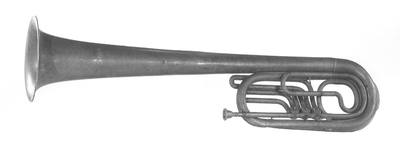
Tuba in E-flatmid-19th century · The Met -
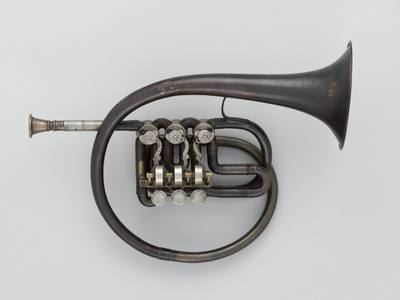
Soprano Helicon in B-flatmid-19th century · The Met
Photographs from the open-access collections of museums (public domain or open licence); credits for each are on the instrument page.
Sources and licences for the text, scores and recordings on this page are on the credits page.
Sources: Wikipedia: Tuba, Wikipedia: Euphonium, Wikipedia: Brass instrument, Micah Everett, University of Mississippi: Chromatic Fingering Chart for BB♭ Tuba (used to check every fingering), Micah Everett: Chromatic Fingering Chart for Euphonium and Baritone Horn (Bass Clef), Galvanized Jazz: The Standard 4th valve (non-compensating low notes), Grove, A Dictionary of Music and Musicians (1900): Euphonium.