
Printable chart
French horn fingering chart
French horn fingering chart from F♯2 to C6: single F horn and both sides of the double horn, written and sounding pitch, and which side to use. Printable.
Fits on one page.
Download the PDF
Free to print and share. No sign-up, no e-mail, no watermark. A4 for most of the world, Letter for the US and Canada; both are black and white, with the fonts embedded.
Horn music is written a perfect fifth higher than it sounds (for the horn in F). The three valves work like a trumpet’s, but a double horn has a fourth, thumb-operated valve that switches between the F side (longer, darker) and the B♭ side (shorter, brighter). The same written note has a different fingering on each side; the chart gives both and marks the side most players choose.
Notes are written pitch (new notation in bass clef). The horn sounds a perfect fifth lower than written, so written C4 sounds F3. 0 = no valves, T = thumb valve down (B♭ side).
Horn in F, written pitch. The boxed fingering is the side most double-horn players use for that note.
| Written | Sounds | F side | B♭ side (thumb) |
|---|---|---|---|
| F♯2/G♭2, sounds B1 | B1 | 123 123 | — |
| G2, sounds C2 | C2 | 123 13 | — |
| G♯2/A♭2, sounds C♯2 / D♭2 | C♯2/D♭2 | 123 23 | — |
| A2, sounds D2 | D2 | 123 12 | — |
| A♯2/B♭2, sounds D♯2 / E♭2 | D♯2/E♭2 | 123 1 | — |
| B2, sounds E2 | E2 | 123 2 | T123 |
| C3, sounds F2 | F2 | 123 open | T123 |
| C♯3/D♭3, sounds F♯2 / G♭2 | F♯2/G♭2 | 123 123 | T123 |
| D3, sounds G2 | G2 | 123 13 | T123 |
| D♯3/E♭3, sounds G♯2 / A♭2 | G♯2/A♭2 | 123 23 | T123 |
| E3, sounds A2 | A2 | 123 12 | T123 |
| F3, sounds A♯2 / B♭2 | A♯2/B♭2 | 123 1 | T123 |
| F♯3/G♭3, sounds B2 | B2 | 123 2 | T123 |
| G3, sounds C3 | C3 | 123 open | T123 |
| G♯3/A♭3, sounds C♯3 / D♭3 | C♯3/D♭3 | 123 23 | T123 |
| A3, sounds D3 | D3 | 123 12 | T123 |
| A♯3/B♭3, sounds D♯3 / E♭3 | D♯3/E♭3 | 123 1 | T123 |
| B3, sounds E3 | E3 | 123 2 | T123 |
| C4, sounds F3 | F3 | 123 open | T123 |
| C♯4/D♭4, sounds F♯3 / G♭3 | F♯3/G♭3 | 123 12 | T123 |
| D4, sounds G3 | G3 | 123 1 | T123 |
| D♯4/E♭4, sounds G♯3 / A♭3 | G♯3/A♭3 | 123 2 | T123 |
| E4, sounds A3 | A3 | 123 open | T123 |
| F4, sounds A♯3 / B♭3 | A♯3/B♭3 | 123 1 | T123 |
| F♯4/G♭4, sounds B3 | B3 | 123 2 | T123 |
| G4, sounds C4 | C4 | 123 open | T123 |
| G♯4/A♭4, sounds C♯4 / D♭4 | C♯4/D♭4 | 123 23 | T123 |
| A4, sounds D4 | D4 | 123 12 | T123 |
| A♯4/B♭4, sounds D♯4 / E♭4 | D♯4/E♭4 | 123 1 | T123 |
| B4, sounds E4 | E4 | 123 2 | T123 |
| C5, sounds F4 | F4 | 123 open | T123 |
| C♯5/D♭5, sounds F♯4 / G♭4 | F♯4/G♭4 | 123 2 | T123 |
| D5, sounds G4 | G4 | 123 open | T123 |
| D♯5/E♭5, sounds G♯4 / A♭4 | G♯4/A♭4 | 123 2 | T123 |
| E5, sounds A4 | A4 | 123 open | T123 |
| F5, sounds A♯4 / B♭4 | A♯4/B♭4 | 123 1 | T123 |
| F♯5/G♭5, sounds B4 | B4 | 123 2 | T123 |
| G5, sounds C5 | C5 | 123 open | T123 |
| G♯5/A♭5, sounds C♯5 / D♭5 | C♯5/D♭5 | 123 23 | T123 |
| A5, sounds D5 | D5 | 123 12 | T123 |
| A♯5/B♭5, sounds D♯5 / E♭5 | D♯5/E♭5 | 123 1 | T123 |
| B5, sounds E5 | E5 | 123 2 | T123 |
| C6, sounds F5 | F5 | 123 open | T123 |
Filled circle = valve pressed; T = thumb valve down (B♭ side); on a single F horn use the F-side column, on a single B♭ horn the B♭-side column. The notes written E2 and F2 are only pedal tones on the B♭ side (T-2 and T) and are rarely written. Fingerings assume an open hand in the bell.
Written and sounding pitch, on the staff
The same tune twice: first as the horn player reads it (treble clef, in C), then as the audience hears it (bass clef, a perfect fifth lower, in F). The play button plays the sounding version.
Written (what the player reads)
Sounding (concert pitch, a fifth lower)
The open notes of each side
With no valves pressed the lips choose the partial. Written pitch, treble clef. Numbers are partials; the seventh partial (grey) is flat and avoided.
F side open series (written)
B♭ side open series (written)
The same valve pattern below any open note
From the open written C4 on the F side, each added valve lowers the note: B3 with valve 2, B♭3 with valve 1, A3 with 1-2, A♭3 with 2-3, and G3 is the next open partial. Labels are the F-side fingerings.
C4 down to G3
Old and new bass-clef notation
Until about 1920 horn parts in the bass clef were often written an octave lower than they are now. The table shows the same sounding note written both ways (Wikipedia, French horn; Grove 1900).
| Sounds | New notation, written | Old notation, written |
|---|---|---|
| F2 | C3 (a fifth above the sound) | C2 (a fourth below the sound) |
| C3 | G3 (a fifth above the sound) | G2 (a fourth below the sound) |
| B2 | F♯3 (a fifth above the sound) | F♯2 (a fourth below the sound) |
The instrument at a glance
| Common types | single horn in F or B♭; double horn in F/B♭ (most common in orchestras and bands); compensating double; triple — Wikipedia: French horn |
|---|---|
| Double horn | fourth (thumb) valve changes between the F and B♭ tubing; prototype by Eduard Kruspe, 1897 — Wikipedia: French horn |
| Valves | three valves for the left hand’s fingers, plus a thumb valve on a double; usually rotary, lever operated — Wikipedia: French horn |
| Bore (French style) | 10.8–11.0 mm; the German horn is about 11.5 mm — Wikipedia: Horn (instrument) |
| Sounds | a perfect fifth lower than written (horn in F) — Wikipedia: French horn |
| Written range on this chart | F♯2 to C6, which sounds B1 to F5 — computed |
| Clefs | treble clef; bass clef for low notes (written an octave above the sound in the new notation) — Wikipedia: French horn |
| Hornbostel–Sachs | 423.232, valved lip-reed aerophone with moderately conical bore — Wikidata / Wikipedia |
More photographs and the history of the instrument: French horn →
Frequently asked questions
Does the French horn sound a fifth lower than written?
Yes. Horn parts are written for the horn in F, which sounds a perfect fifth below the written note: a written C4 sounds F3 and a written G4 sounds C4. Double horns are written the same way; the B♭ side is simply an alternative set of fingerings for the same written notes, not a different transposition.
What is the difference between the F side and the B♭ side of a double horn?
The fourth valve, worked by the thumb, switches the air between two sets of tubing. The F side is the longer one, with a darker, warmer tone. The B♭ side is shorter (pitched a fourth higher), brighter and more secure in the high register where the partials crowd together. The same written note needs a different fingering on each side.
Which side should I use for which note?
Practices vary, but a common pattern in the United States (the one boxed in the chart) is the thumb valve for C♯3 up to F3 and for A♭4 and every written note above, and the F side for the rest. Players also choose a side for intonation, to avoid awkward fingerings, or for colour; there is no single correct choice for every phrase.
Why are the valve combinations on the horn different from the trumpet’s?
The valves lower the pitch by the same amounts (valve 2 one semitone, valve 1 two, valve 3 three), but the horn’s open series begins on a different note. On the F side the open written notes are C3, G3, C4, E4, G4, then C5, D5, E5 and G5; on the B♭ side they are F3, C4, F4, A4 and C5, then F5, G5, A5 and C6. A fingering therefore lowers a different starting note on each side.
Is valve 3 the same as 1-2 on the horn?
Valve 3 alone lowers the pitch by the same minor third as 1-2, and Wikipedia’s valve table lists them together as “1+2 or 3”. Horn charts normally print 1-2 as the main fingering, which is what this chart does, and some players use 3 as an alternative; check either against a tuner.
How do I read bass-clef horn parts? What is old and new notation?
In new notation, which is now standard, bass-clef notes are written a fifth above the sound, exactly like treble-clef notes. In old notation, used until about 1920, notes in the bass clef were written an octave lower, so they sound a perfect fourth higher than written. When a part does not say which one it uses, horn players look at the register of the passage; in a modern edition assume new notation.
What is a single F horn, and why is it hard to play high?
A single F horn has three valves and one set of tubing. The high register lies high in its harmonic series where partials are close together, so accuracy above about the third-space C of the treble staff is a concern for most players. That is why the B♭ horn and then the double horn were developed.
Does hand position matter for fingering?
Yes. The right hand sits in the bell, and the pitch of any note can be raised or lowered by changing its position. Partly closing the bell lowers a note (by up to about a semitone), and closing it completely, which muffles the tone, raises it by about a semitone on a horn near F; a stopping valve on some horns does the same mechanically. Fingerings in the chart assume an open hand.
How to practise with this chart
- Learn the open series first. On the F side, slur C3-G3-C4-E4-G4 with no valves, then do the same with valves 2, 1 and 1-2 held down. This teaches the “same pattern, different starting note” idea that makes every fingering predictable.
- Play the same passage on both sides. Take a written scale, G4 to C6, once on the F side and once with the thumb down. Notice where the B♭ side feels more secure and where the F side is the better tone.
- Mark the side change in your part. Pencil a small “T” or “F” above the notes where you change sides, and practise the change slowly so the thumb moves before the lips do.
- Sing or hum the sounding pitch. Since the horn sounds a fifth lower than written, sing the written note down a fifth before you play it. This builds the ear-to-fingers link that makes the instrument feel less like a lottery.
- Use a tuner on the high register. The sixth to twelfth partials sit close together. Play the chart’s upper rows slowly with a tuner, and use hand position to correct, not valve slides.
musictheoryprint.com · free to print and share
Written pitch and sounding pitch#
The horn is a transposing instrument. Parts are written for the horn in F, which sounds a perfect fifth lower than written: a written C4 (middle C) sounds F3, and a written G4 sounds C4. On a double horn the music is written exactly the same way whichever side you play; the B♭ side is an alternative set of fingerings, not a different transposition.
To find the sounding pitch of a horn note, count down a fifth. To turn a concert-pitch melody into a horn part, write it a perfect fifth higher (a melody in C becomes a part in G). The chart prints the sounding note beside every written note so that you can check both.
Old and new bass clef notation#
Horn parts in the bass clef used to follow a different convention. In new notation, which became standard in the early twentieth century, notes in the bass clef are written an octave above the sound just like treble-clef notes, a perfect fifth above. In old notation, found in parts printed before about 1920, bass-clef notes were written an octave lower, so they sound a perfect fourth higher than written. Grove (1900) explains the habit as a “freak of notation” in which the low notes were referred to a 16-foot scale. The table in this page shows the same sounding pitch in both systems. If a part does not say which it uses, judge by the register: in new notation a bass-clef note written below F♯2 would sound below the horn’s low B1, so such a note can only be old notation.
How the valves work on the horn#
Valve 2 lowers the pitch by a semitone, valve 1 by a whole tone and valve 3 by three semitones; combinations add up. These are the same amounts as on a trumpet, so the three valves give the same pattern of fingerings above any open note, and that pattern is why the chart looks regular: open, 2, 1, 1-2, 2-3, 1-3, 1-2-3 take you down one, two, three, four, five and six semitones from an open partial.
What differs from the trumpet is the open series. On the F side the open written notes are C3, G3, C4, E4, G4 and C5 (the seventh partial, a flat B♭4, is avoided), then D5, E5 and G5. On the B♭ side, which is a fourth higher, they are F3, C4, F4, A4 and C5, then F5, G5, A5 and C6. Pressing the thumb valve also changes the lengths the three main valves need, which is why a double horn has a separate set of valve slides for each side.
Single F, single B♭ and the double horn#
A single horn has three valves and one set of tubing, usually in F or B♭. The single F has the characteristic horn sound but is hard to control above about the third-space C, because the harmonics of a long tube crowd together there. The single B♭ is more secure in the high register but does not have the notes below written B2. The double horn, for which Eduard Kruspe made a prototype in 1897, combines both in one frame and lets the thumb switch between them: the F side thumb up, the B♭ side thumb down. A compensating double has full-length slides only for the B♭ side; a full double has a complete set for each. A triple horn adds a third, descant side in high F or E♭.
Which side for which note?#
The boxed fingering in the chart is the side most double-horn players use for that written note: the B♭ side (thumb down) for C♯3 to F3 and from A♭4 upwards, and the F side for the rest. This is a convention rather than a rule. The upper register is easier to centre on the B♭ side, where the partials lie further apart; and for C♯3 to F3 the F-side fingerings (1-2-3, 1-3, 2-3, 1-2 and 1) include the combinations 1-3 and 1-2-3, which tend to play sharp on valved brass instruments, so the B♭ side gives easier and truer fingerings there. On a single F horn use the F-side column throughout; on a single B♭ horn use the B♭-side column and ignore the notes below B2.
Notes the chart gives only on one side exist only there: written F♯2 to B♭2 are available on the F side alone, because the B♭ side’s lowest notes are the pedal tones E2 and F2 (rarely written). From written A♭5 up, the F-side fingerings use the thirteenth to sixteenth partials, which players almost never use, so the chart’s F-side column there is for completeness and the B♭ side is the practical choice.
Hand in the bell#
The horn is played with the right hand cupped in the bell. Moving the hand changes pitch: closing the bell part way lowers the note (by up to about a semitone), opening it raises it, and a fully stopped hand muffles the tone and raises the note by about a semitone on a horn near F. Players use the hand for fine tuning of every note, and some double horns have a stopping valve that does the same mechanically.
Background
Excerpts from open reference works, reproduced as published (references, images and tables removed). Every excerpt names its source, licence and original article.
In brief
The horn is a brass instrument in the horn family, made of tubing wrapped into a coil with a large flared bell and rotary valves. The term French horn refers to horns with piston valves, seldom used today; the double horn in F/B♭, a variety of German horn, is the horn most often used by players in professional orchestras and bands, although the descant and triple horn have become increasingly popular. A musician who plays a horn is known as a horn player or hornist.
Source: Wikipedia, “French horn” — CC BY-SA 4.0 — text excerpted; see the article for the full text and authors. Revision of 2026-06-23.
French horn: single, double and triple horns, old and new bass clef notation
Overview
The horn is a brass instrument in the horn family, made of tubing wrapped into a coil with a large flared bell and rotary valves. The term French horn refers to horns with piston valves, seldom used today; the double horn in F/B♭, a variety of German horn, is the horn most often used by players in professional orchestras and bands, although the descant and triple horn have become increasingly popular. A musician who plays a horn is known as a horn player or hornist.
Pitch is controlled through the combination of the following factors: speed of air through the instrument (controlled by the player's lungs and thoracic diaphragm); diameter and tension of lip aperture (by the player's lip muscles—the embouchure) in the mouthpiece; plus, in a modern horn, the operation of valves by the left hand, which route the air into extra sections of tubing. Most horns have lever-operated rotary valves, but some, especially older horns, use piston valves (similar to a trumpet's) and the Vienna horn uses double-piston valves, or pumpenventil. The backward-facing orientation of the bell relates to the perceived desirability to create a subdued sound in concert situations, in contrast to the more piercing quality of the trumpet. A horn without valves is known as a natural horn, changing pitch along the natural harmonics of the instrument, similar to a bugle. Pitch may also be controlled by the position of the hand in the bell, in effect reducing the bell's diameter. The pitch of any note can easily be raised or lowered by adjusting the hand position in the bell. The key of a natural horn can be changed by adding different crooks of different lengths.
Three valves control the flow of air in the single horn, which is tuned to F or less commonly B♭. The more common double horn has a fourth, trigger valve, usually operated by the thumb, which routes the air to one set of tubing tuned to F or another tuned to B♭ which expands the horn range to over four octaves and blends with flutes or clarinets in a woodwind ensemble. Triple horns with five valves are also made, usually tuned in F, B♭, and a descant E♭ or F. There are also double horns with five valves tuned in B♭, descant E♭ or F, and a stopping valve, which greatly simplifies the complicated and difficult hand-stopping technique, though these are rarer. Also common are descant doubles, which typically provide B♭ and alto F branches.
A crucial element in playing the French horn deals with the mouthpiece. The mouthpiece is usually placed about 2/3 on the lips with more on the upper. Because of differences in the formation of the lips and teeth of different players, some tend to play with the mouthpiece slightly off center. Although the exact side-to-side placement of the mouthpiece varies for most horn players, the up-and-down placement of the mouthpiece is generally two-thirds on the upper lip and one-third on the lower lip. When playing higher notes, the majority of players exert a small degree of additional pressure on the lips using the mouthpiece. However, this is undesirable from the perspective of both endurance and tone: excessive mouthpiece pressure makes the horn sound forced and harsh and decreases the player's stamina due to the resulting constricted flow of blood to the lips and lip muscles. Added pressure from the lips to the mouthpiece can also result in tension in the face resulting in what brass players often call "pushing". As mentioned before, this results in an undesirable sound, and loss of stamina.
Single horn
Single horns use a single set of tubes connected to the valves. This allows for simplicity of use and a much lighter weight. They are usually in the keys of F or B♭, although many F horns have longer slides to tune them to E♭, and almost all B♭ horns have a valve to put them in the key of A. The problem with single horns is the inevitable choice between accuracy or tone – while the F horn has the "typical" horn sound, above third-space C accuracy is a concern for the majority of players because, by its nature, one plays high in the horn's harmonic series where the overtones are closer together. This led to the development of the B♭ horn, which, although easier to play accurately, has a less desirable sound in the mid and especially the low register where it is not able to play all of the notes. The solution has been the development of the double horn, which combines the two into one horn with a single lead pipe and bell. Both main types of single horns are still used today as student models because they are cheaper and lighter than double horns. In addition, the single B♭ horns are sometimes used in solo and chamber performances and the single F survives orchestrally as the Vienna horn. Additionally, single F alto and B♭ alto descants are used in the performance of some baroque horn concertos and F, B♭ and F alto singles are occasionally used by jazz performers.
Dennis Brain's benchmark recordings of the Mozart Horn Concerti were made on a single B♭ instrument by Gebr. Alexander, now on display at the Royal Academy of Music in London.
Double horn
Despite the introduction of valves, the single F horn proved difficult for use in the highest range, where the partials grew closer and closer, making accuracy a great challenge. An early solution was simply to use a horn of higher pitch—usually B♭. The use of the F versus the B♭ horn was extensively debated among horn players of the late 19th century, until the German horn maker Eduard Kruspe (namesake of his family's brass instrument firm) produced a prototype of the "double horn" in 1897.
The double horn also combines two instruments into a single frame: the original horn in F, and a second, higher horn keyed in B♭. By using a fourth valve (usually operated by the thumb), the horn player can quickly switch from the deep, warm tones of the F horn to the higher, brighter tones of the B♭ horn, or vice versa, as the horn player may choose to have the horn set into B♭ by default by making a simple adjustment to the valves. The two sets of tones are commonly called "sides" of the horn. Using the fourth valve not only changes the basic length (and thus the harmonic series and pitch) of the instrument, it also causes the three main valves to use proportionate slide lengths.
In the United States, the two most common styles ("wraps") of double horns are named Kruspe and Geyer/Knopf, after the German instrument makers who first developed and standardized them. The Kruspe wrap locates the B♭ change valve above the first valve, near the thumb. The Geyer wrap has the change valve behind the third valve, near the little finger (although the valve's trigger is still played with the thumb). In effect, the air flows in a completely different direction in the two models. Kruspe-wrap horns tend to be larger in the bell throat than the Geyer-wrap horns. Typically, Kruspe models are constructed from nickel silver (also called German silver), while Geyer horns tend to be of yellow brass. Both models have their own strengths and weaknesses, and while the choice of instrument is very personal, an orchestral horn section is usually found to have either one or the other, owing to the differences in tone color, response, and projection of the two different styles.
In Europe the most popular German horns are arguably those made by Alexander Brothers of Mainz and by Paxman in London. In Germany and the Benelux countries, the Alexander 103 is extremely popular. These horns do not fit strictly into the Kruspe or Knopf camps, but have features of both. Alexander prefers the traditional medium bell size, which they have produced for many years, whereas Paxman offer their models in a range of bell throat sizes. In the United States, the Conn 8D, a mass-produced instrument based on the Kruspe design, has been extremely popular in many areas (New York, Los Angeles, Cleveland, Philadelphia). Since roughly the early 1990s, however, for reasons ranging from changing tastes to a general dislike of Conn's newer 8Ds, orchestras have been moving away from the popular Conn 8D. Geyer model horns (by Carl Geyer, Karl Hill, Keith Berg, Steve Lewis, Jerry Lechniuk, Dan Rauch, and Ricco-Kuhn) are used in other areas (San Francisco, Chicago, Pittsburgh, Boston, Houston). The CF Schmidt double, with its unique piston change valve, is occasionally found in sections playing Geyer/Knopf model equipment.
Compensating double horn
A full double horn has two full-length sets of slides (one set for the B♭ side and a longer set for the F side); a compensating double horn only has full-length slides for the B♭ side and a shorter set of slides whose length can be added to the B♭ slides to give the necessary tubing length for playing in F. As for the full double horn, the air is routed through the appropriate slide(s) by use of the fourth valve. Compensating double horns are lighter than full double horns because of this design.
Triple horn
In the second half of the twentieth century, the principle of the German double horn was extended by adding yet another "side" to create the triple horn. This design was developed by the horn player Richard Merewether and the London firm of Paxman to afford the player even more security in the high register. One variation adds to the F and B♭ horns a third, descant horn in high F, an octave above the normal F horn, though it may alternatively be pitched in E♭. It is activated through the use of a second thumb valve. The triple horn was met with considerable resistance when it first appeared. Horn players were reluctant to spend far more money for a triple horn than they would for a double horn, and they were much heavier than the average double horn. Players noted that their arms became fatigued much faster. Moreover, the combination of three different horns creates issues with sonority, because the piping shared among all three sides (that is, the lead pipe and bell) are mathematically disproportionate to two or all three horn lengths. Horn makers have had to make concessions to "even out" the sound between all three, often to the loss of sound quality of each side or entire ranges of the instrument. Advances in horn production are gradually eliminating these drawbacks, and the triple horn is gaining popularity. They are rarely available in anything lower than professional quality. Like double horns, triple horns can come in both full and compensating wraps. Today they are found being played in many professional orchestras, although the substantial cost difference between double and triple horns limits their usage elsewhere.
Bass clef old notation vs. new notation
Notation in the bass clef for the horn has undergone a convention shift. Prior to approximately 1920, horn parts employing the bass clef often used what is now referred to as old notation. In this system, notes in the bass clef were written in octaves below concert pitch rather than above. By the early 20th century, as the valve horn became standard, the new notation gradually replaced the old system. In new notation, transposition in the bass clef follows the same rule as the treble clef, that is, to write notes in the octave above concert pitch.
Usually there is no indication on the score for whether the horn parts are written in old or new notation. However, horn players have developed a general-rule-of-thumb to determine which notation is being used.
Source: Wikipedia, “French horn” — CC BY-SA 4.0 — text excerpted; see the article for the full text and authors. Revision of 2026-06-23.
Brass instrument: the compensating double horn
Compensation system
In the Compensation system, each of the first two (or three) valves has an additional set of tubing extending from the back of the valve. When the third (or fourth) valve is depressed in combination with another one, the air is routed through both the usual set of tubing plus the extra one, so that the pitch is lowered by an appropriate amount. This allows compensating instruments to play with accurate intonation in the octave below their open second partial, which is critical for tubas and euphoniums in much of their repertoire.
The compensating system was applied to horns to serve a different purpose. It was used to allow a double horn in F and B♭ to ease playing difficulties in the high register. In contrast to the system in use in tubas and euphoniums, the default 'side' of the horn is the longer F horn, with secondary lengths of tubing coming into play when the first, second or third valves are pressed; pressing the thumb valve takes these secondary valve slides and the extra length of main tubing out of play to produce a shorter B♭ horn. A later "full double" design has completely separate valve section tubing for the two sides, and is considered superior, although rather heavier in weight.
Source: Wikipedia, “Brass instrument” — CC BY-SA 4.0 — text excerpted; see the article for the full text and authors. Revision of 2026-07-04.
Natural horn
The natural horn is a musical instrument descending from the hunting horn, and is the predecessor to the modern-day French horn. Differentiated by its lack of valves, natural horn relies on a variety of crooks and hand stopping techniques to play the instruments full range. Throughout the seventeenth and eighteenth centuries, the natural horn evolved separate from the trumpet by widening of the bell and lengthening of the tubes. Natural horn consists of a mouthpiece, a pitched crook, foundational tubing, and flared bell. This instrument was used extensively until the emergence of the valved horn in the early 19th century.
Source: Wikipedia, “Natural horn” — CC BY-SA 4.0 — text excerpted; see the article for the full text and authors. Revision of 2026-06-01.
Historical note: Grove’s Dictionary (1900), on hand stopping
The method of stopping the Horn is not by introducing the closed fist into the bell, but the open hand, with the fingers close together, some way up the bore. By drawing the fingers back, the natural sounds are again produced. The degree in which the Horn is stopped is not the same for all stopped notes: there being half and whole stopping. In the first, by raising the hand the bell alone is, as it were, closed: in the second the hand is introduced as far as if it were intended almost to prevent the passage of air.
Between the stopped or 'hand notes' and the open notes there is an obvious difference in character and quality which it is impossible wholly to suppress, but which may be sufficiently modified so as not to offend the ear. This object is attained by blowing the open notes softly, so as to reduce the contrast between their sonorousness, and the closed or 'stuffed' (étouffé) character of those modified by means of the hand. Much difference of opinion exists as to the superiority of the simple Handhorn, or the more modern instrument furnished with valves. It appears certain that the lightness and vibratile power of the former, added to the absence of abrupt bends and sinuosities in the bore, adds materially to the brilliancy of the tone. But, on the other hand, in rapid melodic passages, such as it is now the fashion to write, the alternation of open and stopped notes tends to produce uncertainty and unevenness. The older composers, especially Mozart, seem to have been aware of this fact, and employ both open and stopped notes with full consciousness of their respective effects. Many examples could be given of the mournful and mysterious effect of the stopped notes judiciously used. A convenient compromise between the two forms of the instrument has been adopted by fixing a pair of valves on the tuning slide named above. It is quaintly termed a 'grasshopper' action, and can easily be removed when the simple tube is preferred. Mr. Ford has registered a sliding action like that of the trombone, or slide trumpet, in place of the valves, by means of which notes can be depressed to any extent according to the ear of the performer. This excellent plan, which would at once give the horn the enharmonic accuracy now possessed by the trumpet and trombone alone among wind instruments, does not seem to have attracted the notice it deserves. The same may be said of Mr. Bassett's comma valve, applicable both to Horn and Trumpet, by which the error existing between major and minor tones may be corrected. [See Trumpet.]
Source: Wikisource, A Dictionary of Music and Musicians (Grove, 1900) — “Horn” (entry by William H. Stone) — Public domain (published 1879–1889; authors died before 1929) — text excerpted from the transcription; see the page for the full entry.
The french horn in museum collections
-
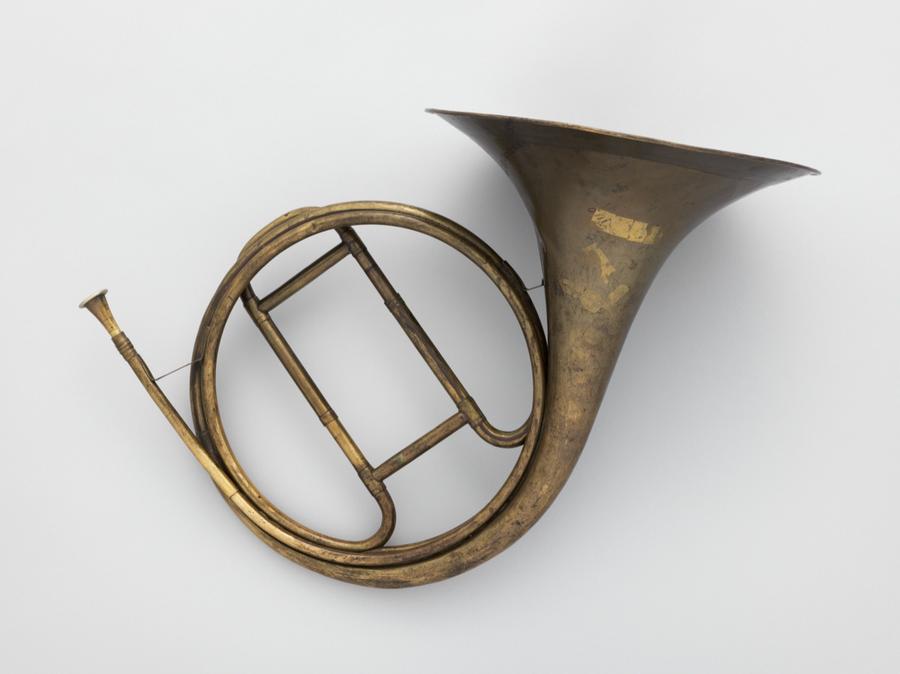
Orchestral Hornca. 1830 · The Met -
Natural hornc. 1750 - c. 1800 · Rijksmuseum -
Horn in Fca. 1860 · The Met -
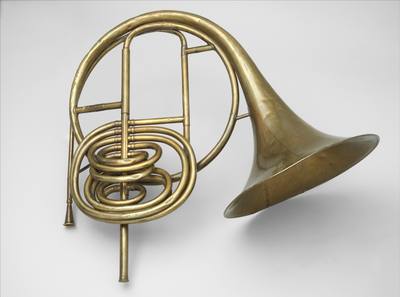
Cor omnitonique1833 · The Met -
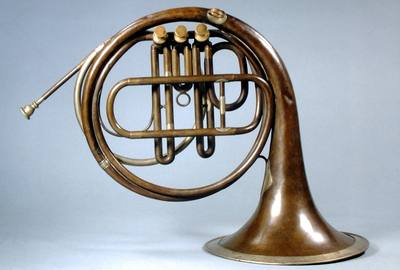
French Horn in F1862–70 · The Met -
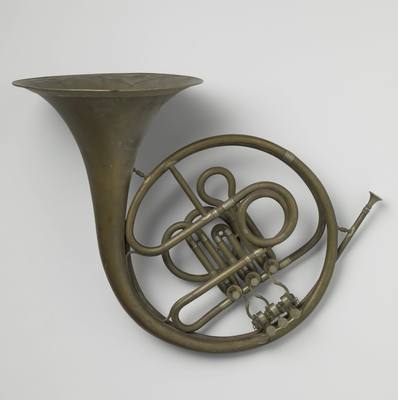
Valve hornc. 1860 - c. 1870 · Rijksmuseum
Photographs from the open-access collections of museums (public domain or open licence); credits for each are on the instrument page.
Sources and licences for the text, scores and recordings on this page are on the credits page.
Sources: Wikipedia: French horn, Wikipedia: Horn (instrument), Wikipedia: Brass instrument, Wikipedia: Hand-stopping, John Ericson, Horn Matters: Single F, Double, and Single B♭ Fingering Charts (used to check every fingering), Grove, A Dictionary of Music and Musicians (1900): Horn.