
Instruments · Aerophones
French horn
The horn is a brass instrument in the horn family, made of tubing wrapped into a coil with a large flared bell and rotary valves. The term French horn refers to horns with piston valves, seldom used today; the double horn in F/B♭, a variety of German horn, is the horn most often used by players in professional orchestras and bands, although the descant and triple horn have become increasingly popular. A musician who plays a horn is known as a horn player or hornist.
Summary: Wikipedia, “French horn” — CC BY-SA 4.0. Revision of 2026-06-23.
Hear the real instrument
These are recordings of a real horn in F, not a synthesiser. Click or tap a key to hear that note, or press Play the range to hear every note the instrument was recorded on, from lowest to highest.
| Recorded instrument | Horn in F |
|---|---|
| Sounding range | G1 to F5 — the pitches you hear |
| Written range | D2 to C6 — the notes the player reads on the page |
| Transposition | The horn in F sounds a perfect fifth lower than written. |
| Notes | 47 recorded notes, one for every semitone from lowest to highest. Middle C is C4. |
Without JavaScript: play the lowest note (G1) or the highest note (F5) as MP3 files.
Recordings: IRCAM SOL (TinySOL), CC BY 4.0, Cella et al. Each note is cut from the original recording, levelled in loudness and converted to a short MP3; the playing technique is ordinary (ordinario), mostly at mezzo-forte.
Museum photographs
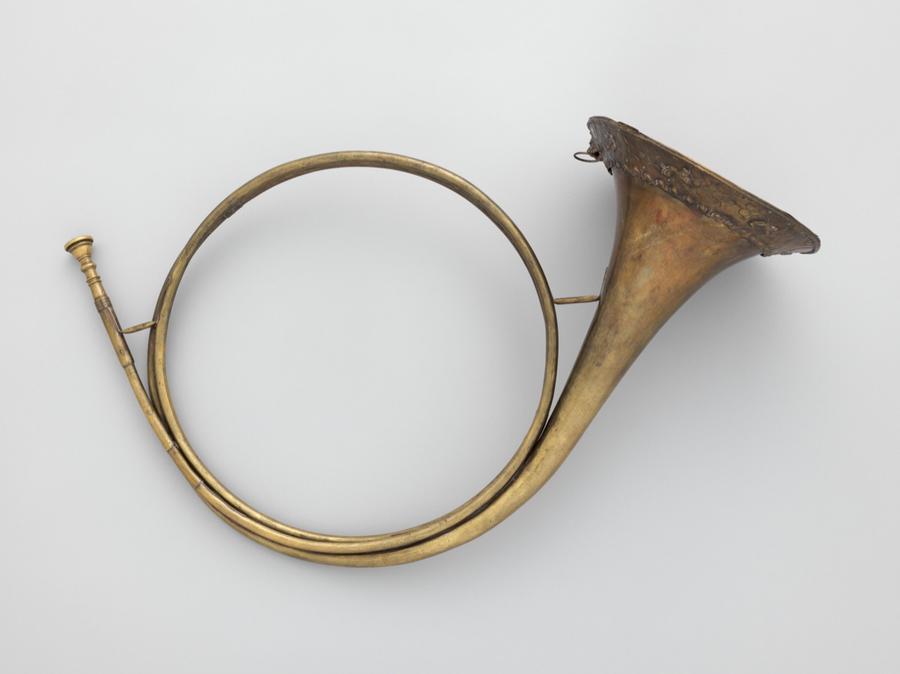
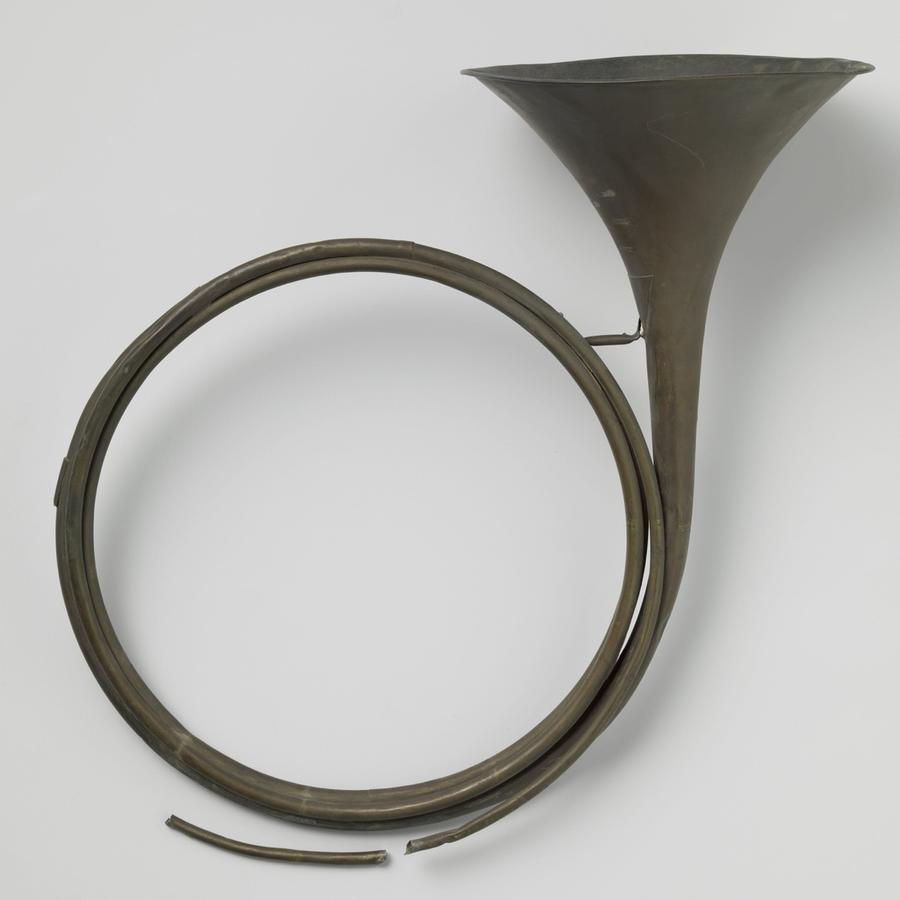
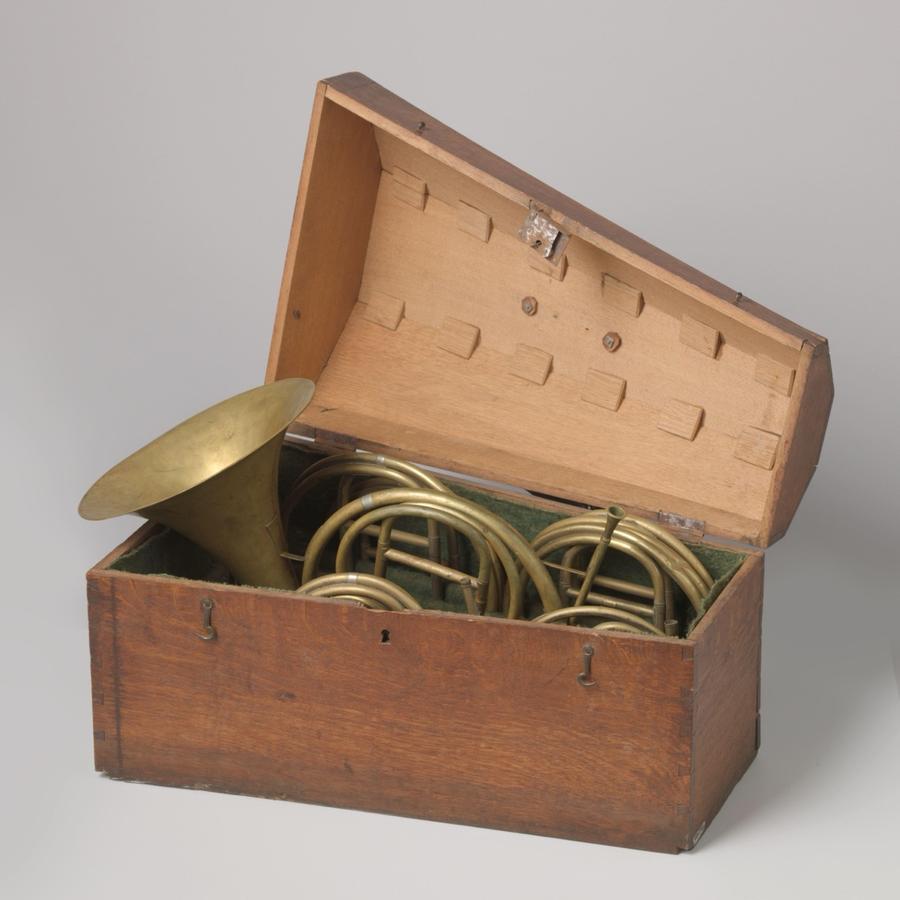
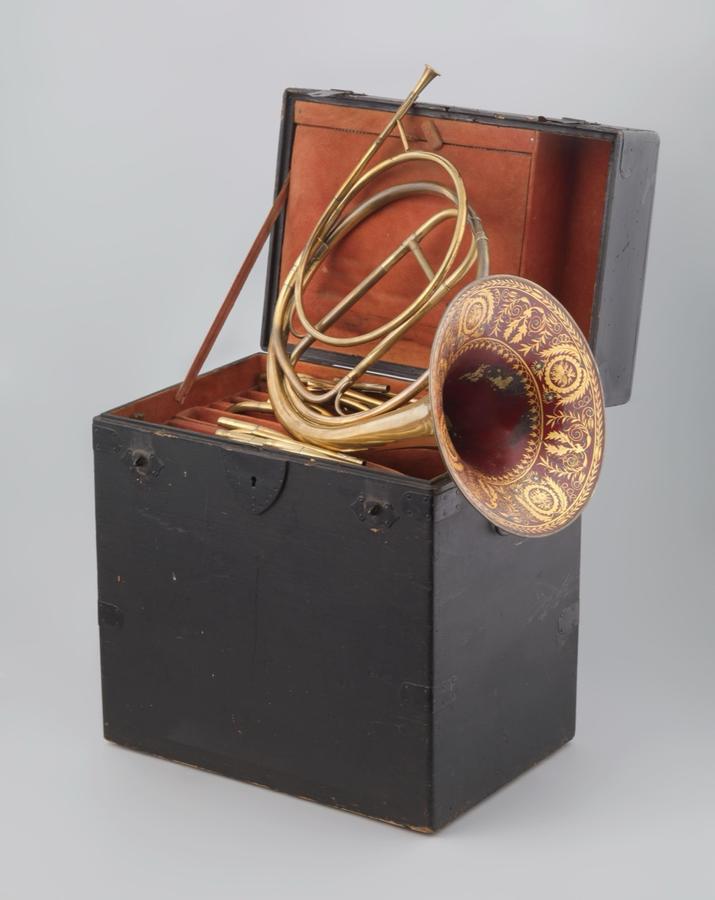
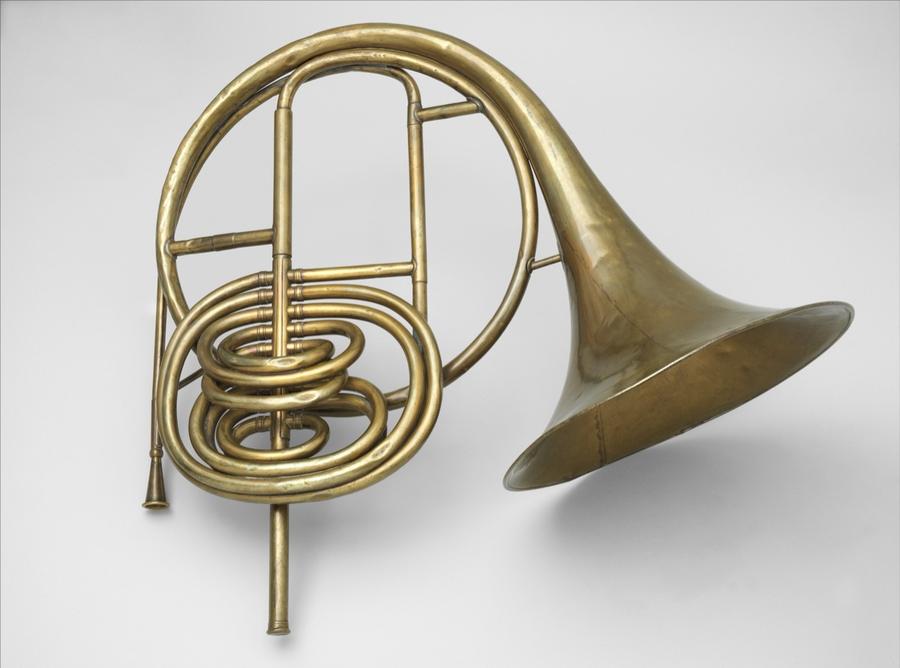
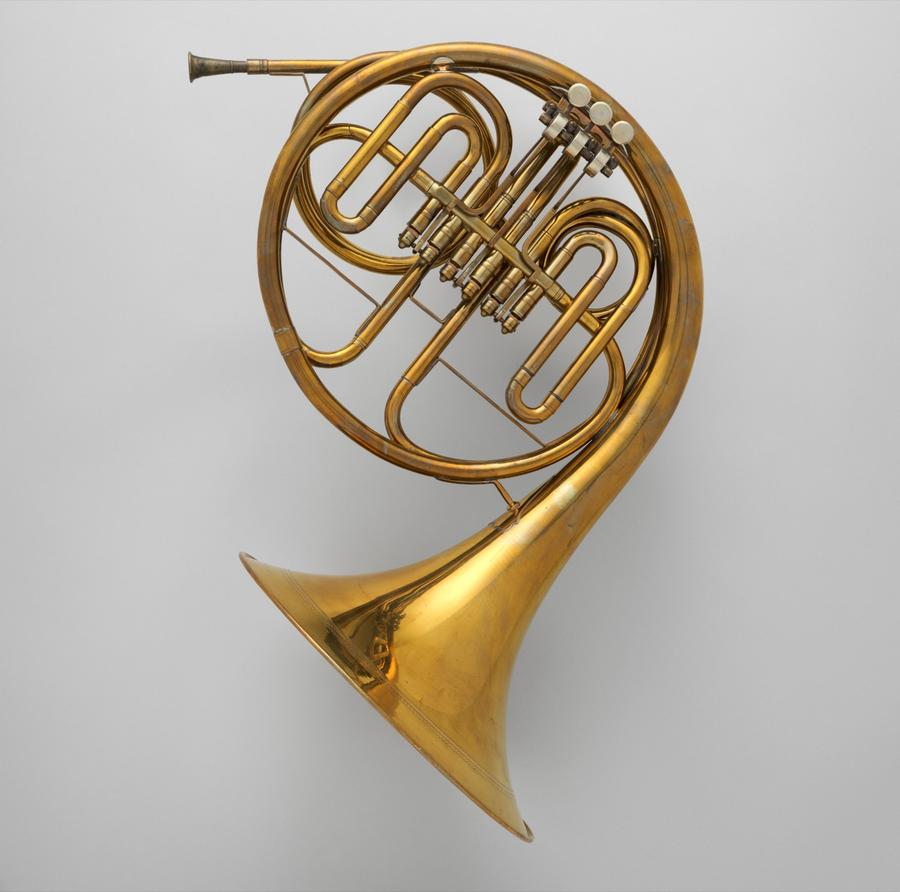
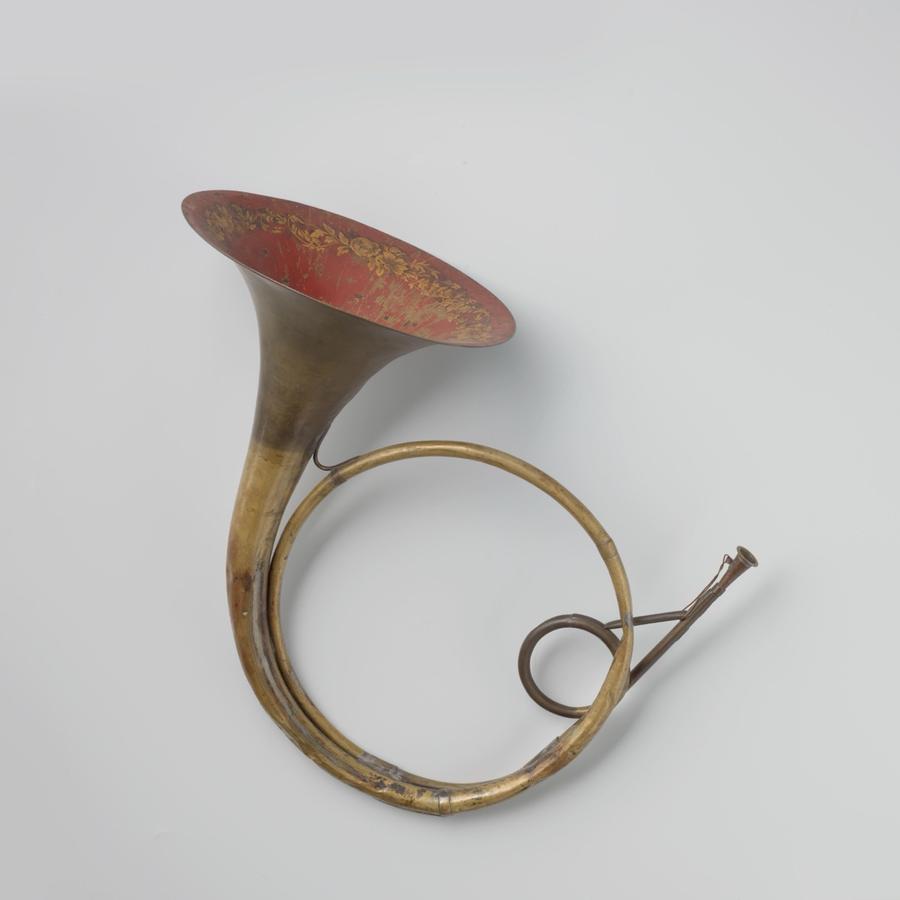
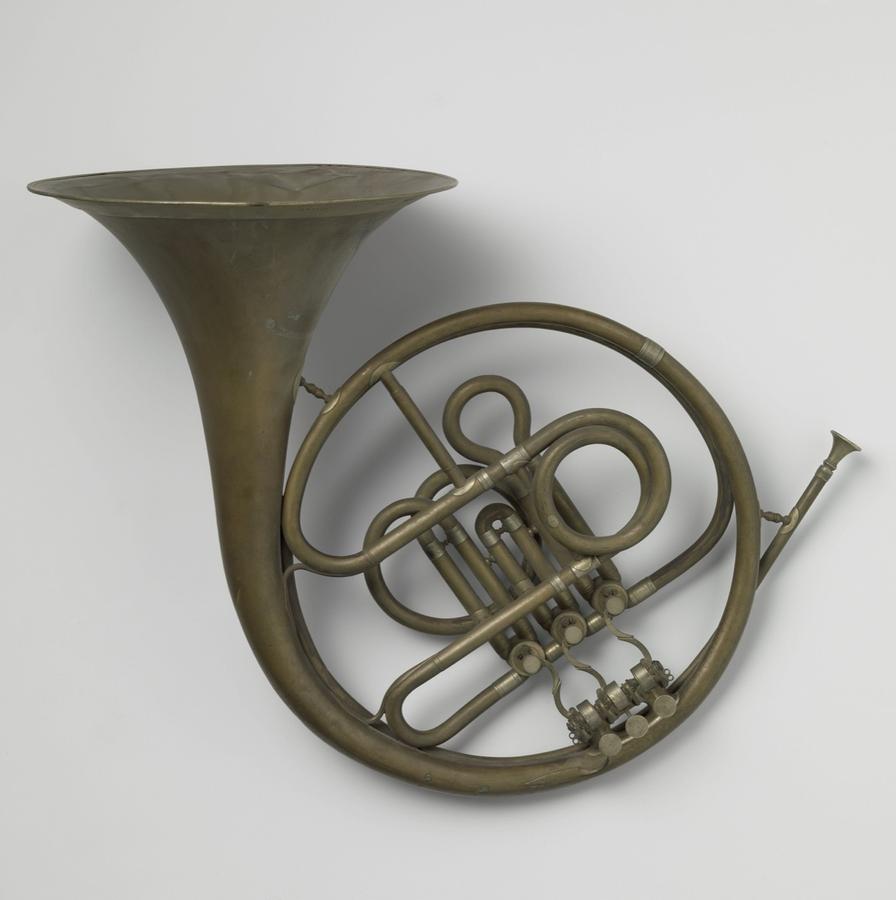
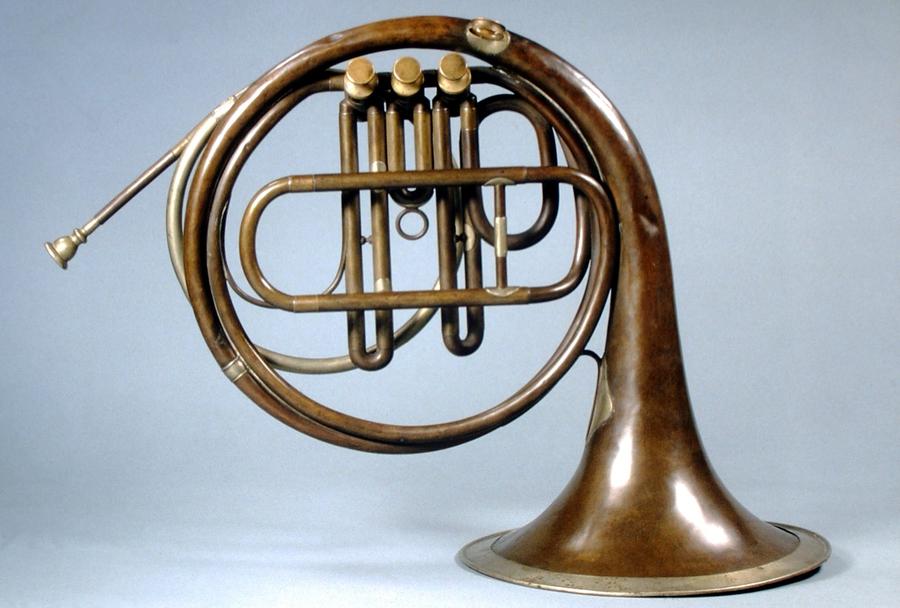
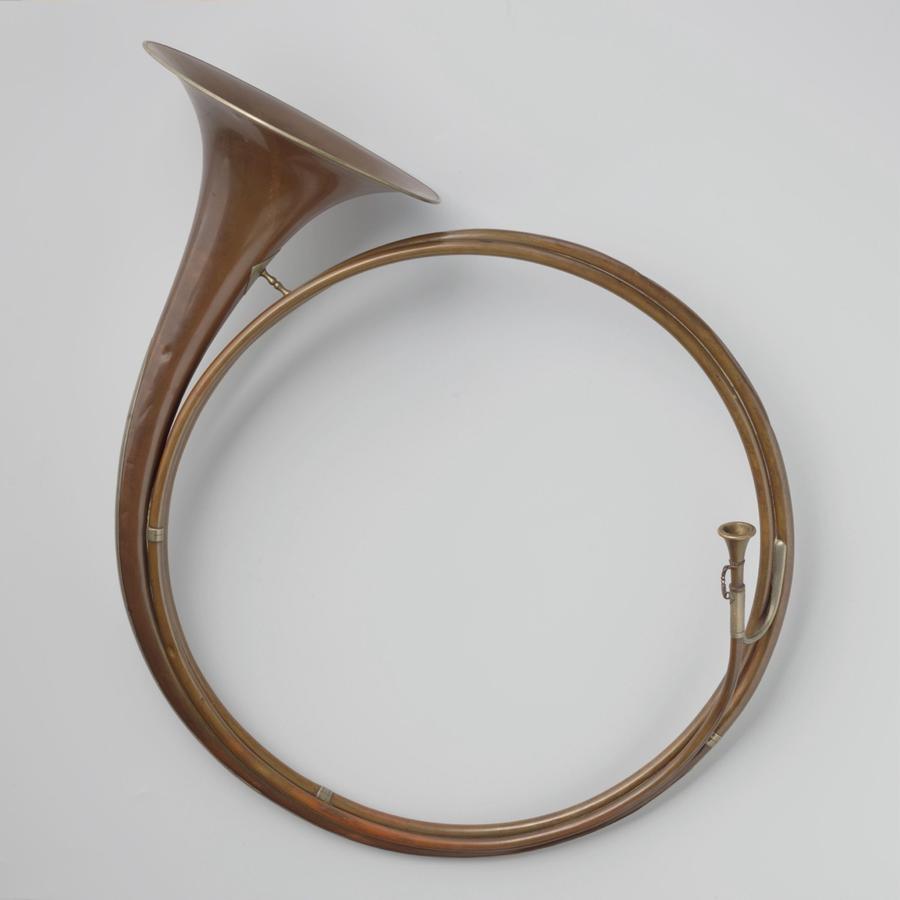
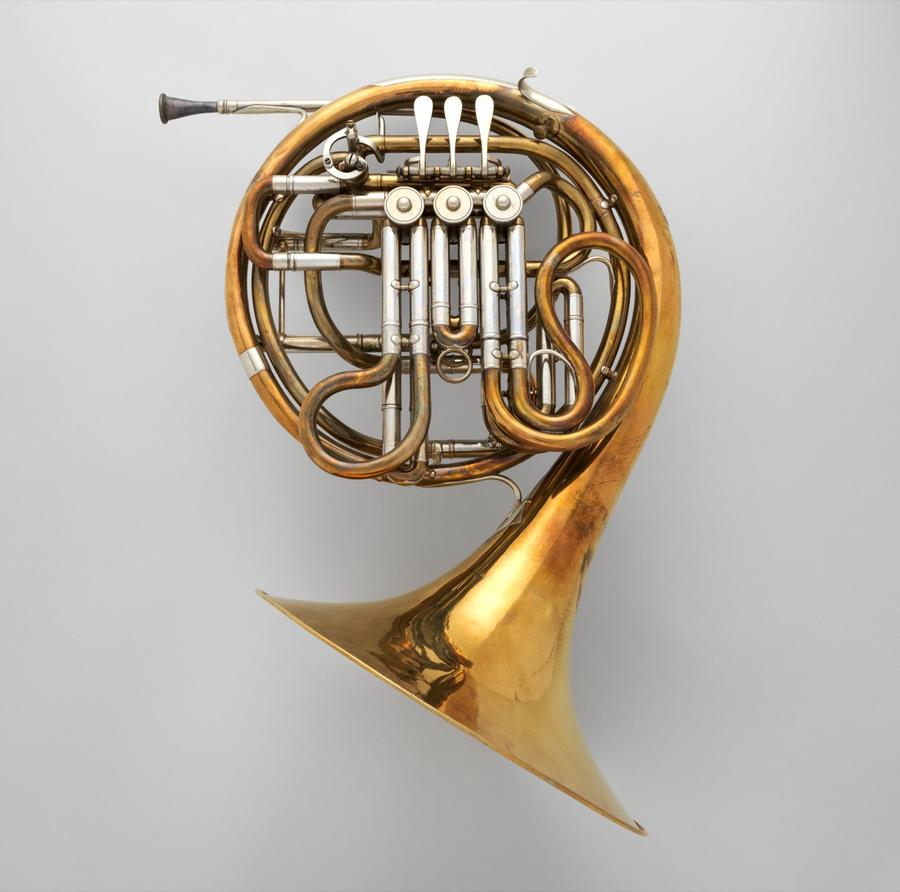
These 12 photographs span 1660–1919, 8 places of origin and 2 museums. Every photograph is public domain or openly licensed, and links to the museum’s own record.
-
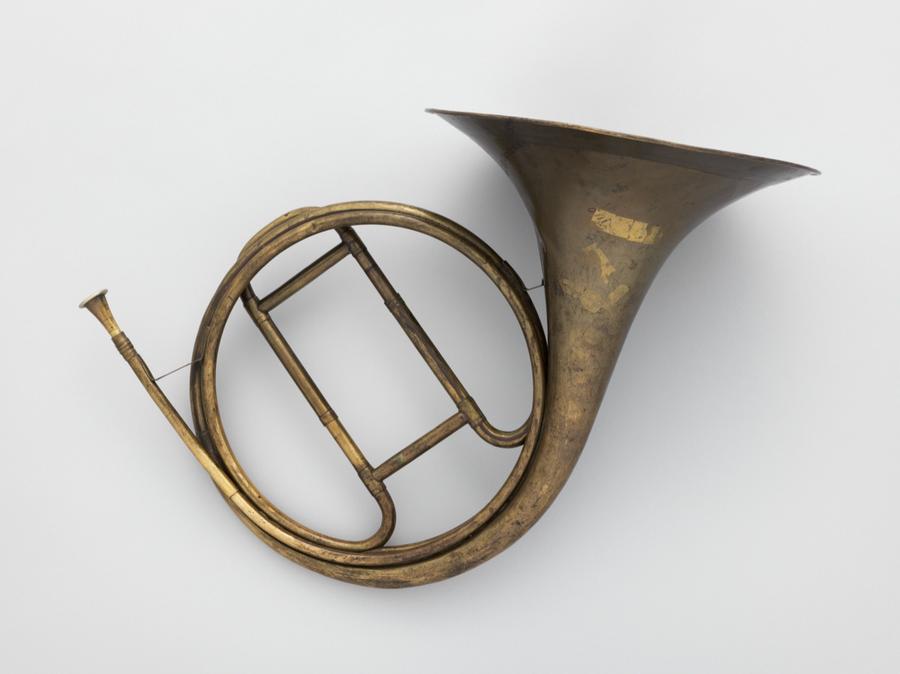
Orchestral Hornca. 1830 · Germany -
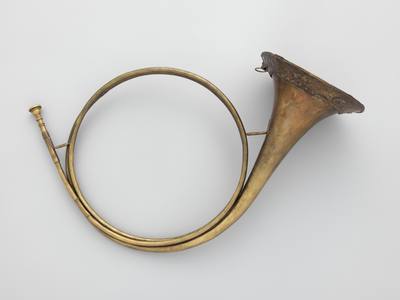
Hunting Horn in D1660–1720 · Germany -
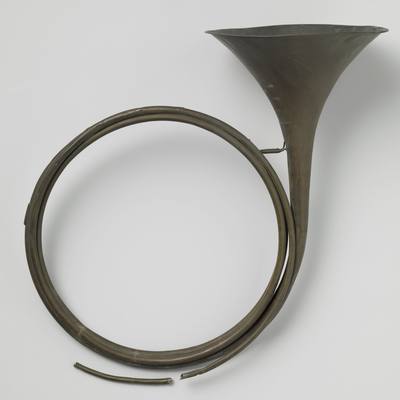
Natural hornc. 1750 - c. 1800 · Paris -
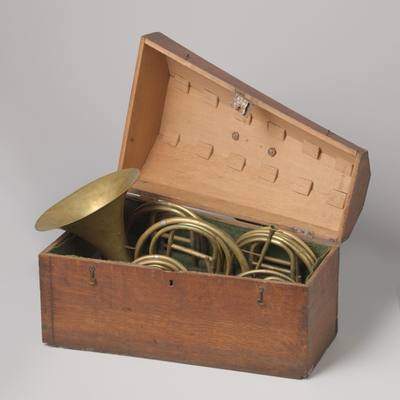
Invention horn (orchestral horn)after 1824 - before 1850 · Markneukirchen -
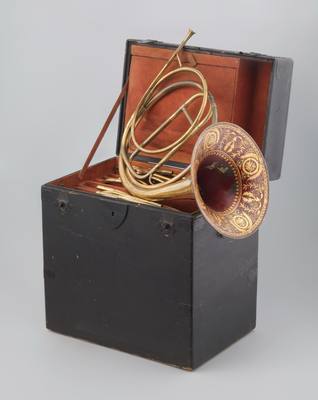
Hornc. 1830 - c. 1850 · Paris -
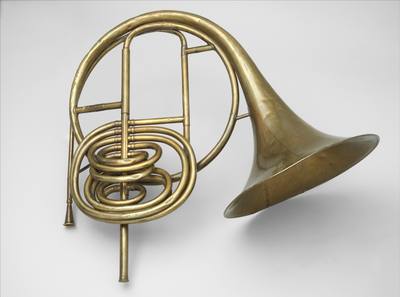
Cor omnitonique1833 · Belgian (Belgium) -
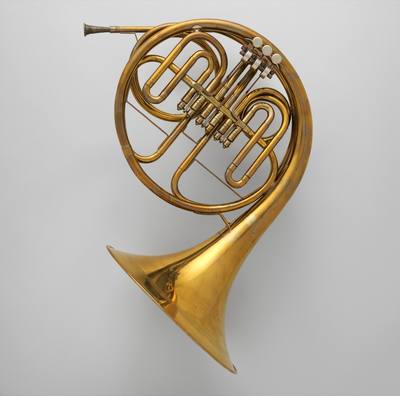
Horn in Fca. 1860 · Austrian (Austria) -
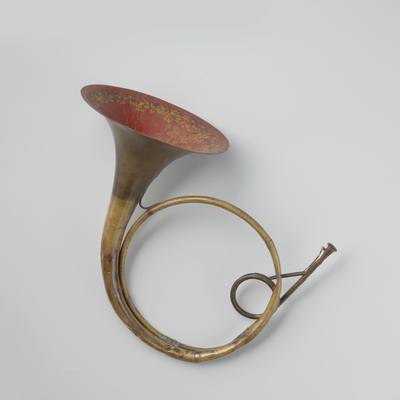
Natural hornin or after c. 1850 · Lierre -
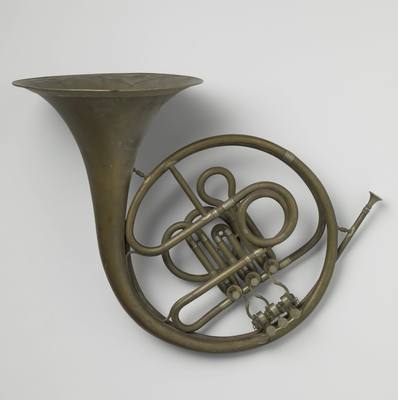
Valve hornc. 1860 - c. 1870 · München -
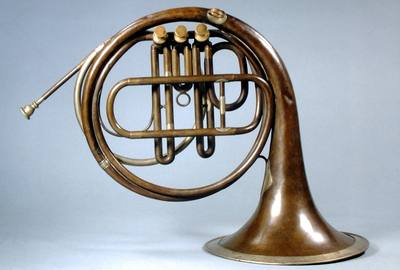
French Horn in F1862–70 · American or German (United States, Germany) -
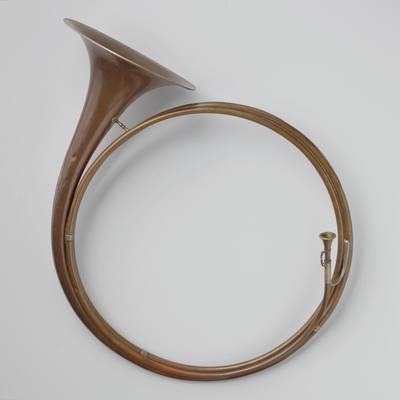
Natural horn (hunting horn)c. 1876 - c. 1896 · Königgrätz -
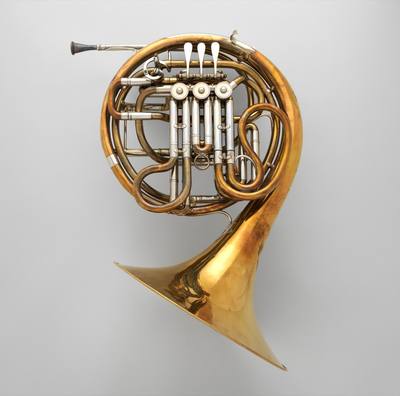
Double Horn in F / B-flat1904–19 · Germany
Facts at a glance
| Hornbostel–Sachs number | 423.232 — Valved lip-reed aerophone with moderately conical bore |
|---|---|
| Hornbostel–Sachs group | Aerophones › Non-free aerophones (wind instruments proper) › Trumpets |
| Also known as | corno, French horn |
| Wikidata labels | 82 languages |
| Wikipedia article | French horn |
| Wikidata item | Q163759 |
| Wikimedia Commons category | French horns |
| MusicBrainz instrument | f9abcd44-52d6-4424-b3a0-67f003bbbf3d |
| Encyclopaedia Britannica | art/horn-musical-instrument-group |
Sources: Wikidata (CC0 1.0) — classification number, aliases, identifiers (dump of 2026-07-22); Wikipedia (CC BY-SA 4.0) — infobox fields (description of the classification number, development, inventors) and the names of the Hornbostel–Sachs groups (article “Hornbostel–Sachs”, revision of 2026-01-04).
The name in other languages
| Language | Name | Also written |
|---|---|---|
| English | horn | corno, French horn |
| French | cor d'harmonie | Cors d'harmonie, Cor moderne, Cor d’harmonie |
| German | Horn | Waldhorn |
| Spanish | trompa | Trompa de pistones, Corno Francés, Corno frances |
| Italian | corno | corno francese |
| Portuguese | trompa | |
| Dutch | hoorn | Franse hoorn, waldhoorn, hoorns |
| Russian | валторна | |
| Japanese | ホルン | ウインナホルン, ヴァルヴ・ホルン, バルブ・ホルン |
| Chinese | 法國號 | |
| Korean | 호른 | 프렌치 호른, 프렌치호른 |
| Arabic | بوق فرنسي | البوق الفرنسي, صور فرنسي |
Sources: Wikidata (CC0 1.0) — labels and aliases; MusicBrainz (CC0 1.0) — instrument aliases (names only).
About the french horn: history, construction and playing
The horn is a brass instrument in the horn family, made of tubing wrapped into a coil with a large flared bell and rotary valves. The term French horn refers to horns with piston valves, seldom used today; the double horn in F/B♭, a variety of German horn, is the horn most often used by players in professional orchestras and bands, although the descant and triple horn have become increasingly popular. A musician who plays a horn is known as a horn player or hornist.
Name
The name "French horn" first came into use in the late 17th century. At that time, French makers were preeminent in the manufacture of hunting horns and were credited with creating the now-familiar, circular "hoop" shape of the instrument. As a result, these instruments were often called, even in English, by their French names: trompe de chasse or cor de chasse (lit. trumpet of hunt—the clear modern distinction between trompes [trumpets] and cors [horns] did not exist at that time).
German makers first devised crooks to make such horns playable in different keys—so musicians came to use "French" and "German" to distinguish the simple hunting horn from the newer horn with crooks, which in England was also called the Italian name corno cromatico (chromatic horn).
More recently, "French horn" is often used colloquially, though the adjective has normally been avoided when referring to the European orchestral horn, ever since the German horn began replacing the French-style instrument in British orchestras around 1930. The International Horn Society has recommended since 1971 that the instrument be simply called the horn.
There is also a more specific use of "French horn" to describe a particular horn type, differentiated from the German horn and Vienna horn. In this sense, "French horn" refers to a narrow-bore instrument (10.8 - 11.0 mm) with three Périnet (piston) valves. It retains the narrow bell-throat and mouthpipe crooks of the orchestral hand horn of the late 18th century, and most often has an "ascending" third valve. This is a whole-tone valve arranged so that with the valve in the "up" position the valve loop is engaged, but when the valve is pressed the loop is cut out, raising the pitch by a whole tone.
History
As the name indicates, humans originally used to blow on the actual horns of animals before starting to emulate naturally occurring horns with metal ones. The use of animal horns survives with the shofar, a ram's horn, which plays an important role in Jewish religious rituals.
Early metal horns were less complex than modern horns, consisting of valveless brass tubes, wound around a few times, with a slightly flared opening (the bell). These early "hunting" horns (French: cors de chasse) were originally played on a hunt, often while mounted, and the sound they produced was called a recheat. Change of pitch on these hunting horns was controlled entirely by the lips, as the use of valves and insertion of a hand in the bell to change pitch were later innovations. Without valves, only the notes within the harmonic series are available. By combining a long length with a narrow bore, the French horn's design allows the player to easily reach the higher overtones which differ by whole tones or less, thus making it capable of playing melodies before valves were invented.
Early horns were commonly pitched in B♭ alto, A, A♭, G, F, E, E♭, D, C, and B♭ basso. Since the only notes available were those on the harmonic series of one of those pitches, horn-players had no ability to play in different keys. The remedy for this limitation was the use of crooks, i.e, sections of tubing of differing length that, when inserted, altered the length of the instrument, and thus its pitch.
In the mid-18th century, horn players began to insert the right hand into the bell to change the length of the instrument, adjusting the tuning up to the distance between two adjacent harmonics depending on how much of the opening was covered.
Character
The sound and playing character of the German horn is distinctly different from those of the French model (the instrument of Franck, Debussy and Ravel), which is smaller in volume and regarded as more refined. The tone of the German horn is warm, rich, and dark in contrast to the French horn, which is light, brilliant, and open.
Single horn
Single horns use a single set of tubes connected to the valves. This allows for simplicity of use and a much lighter weight. They are usually in the keys of F or B♭, although many F horns have longer slides to tune them to E♭, and almost all B♭ horns have a valve to put them in the key of A. The problem with single horns is the inevitable choice between accuracy or tone – while the F horn has the "typical" horn sound, above third-space C accuracy is a concern for the majority of players because, by its nature, one plays high in the horn's harmonic series where the overtones are closer together. This led to the development of the B♭ horn, which, although easier to play accurately, has a less desirable sound in the mid and especially the low register where it is not able to play all of the notes. The solution has been the development of the double horn, which combines the two into one horn with a single lead pipe and bell. Both main types of single horns are still used today as student models because they are cheaper and lighter than double horns. In addition, the single B♭ horns are sometimes used in solo and chamber performances and the single F survives orchestrally as the Vienna horn. Additionally, single F alto and B♭ alto descants are used in the performance of some baroque horn concertos and F, B♭ and F alto singles are occasionally used by jazz performers.
Dennis Brain's benchmark recordings of the Mozart Horn Concerti were made on a single B♭ instrument by Gebr. Alexander, now on display at the Royal Academy of Music in London.
Double horn
Despite the introduction of valves, the single F horn proved difficult for use in the highest range, where the partials grew closer and closer, making accuracy a great challenge. An early solution was simply to use a horn of higher pitch—usually B♭. The use of the F versus the B♭ horn was extensively debated among horn players of the late 19th century, until the German horn maker Eduard Kruspe (namesake of his family's brass instrument firm) produced a prototype of the "double horn" in 1897.
The double horn also combines two instruments into a single frame: the original horn in F, and a second, higher horn keyed in B♭. By using a fourth valve (usually operated by the thumb), the horn player can quickly switch from the deep, warm tones of the F horn to the higher, brighter tones of the B♭ horn, or vice versa, as the horn player may choose to have the horn set into B♭ by default by making a simple adjustment to the valves. The two sets of tones are commonly called "sides" of the horn. Using the fourth valve not only changes the basic length (and thus the harmonic series and pitch) of the instrument, it also causes the three main valves to use proportionate slide lengths.
In the United States, the two most common styles ("wraps") of double horns are named Kruspe and Geyer/Knopf, after the German instrument makers who first developed and standardized them. The Kruspe wrap locates the B♭ change valve above the first valve, near the thumb. The Geyer wrap has the change valve behind the third valve, near the little finger (although the valve's trigger is still played with the thumb). In effect, the air flows in a completely different direction in the two models. Kruspe-wrap horns tend to be larger in the bell throat than the Geyer-wrap horns. Typically, Kruspe models are constructed from nickel silver (also called German silver), while Geyer horns tend to be of yellow brass. Both models have their own strengths and weaknesses, and while the choice of instrument is very personal, an orchestral horn section is usually found to have either one or the other, owing to the differences in tone color, response, and projection of the two different styles.
Compensating double horn
A full double horn has two full-length sets of slides (one set for the B♭ side and a longer set for the F side); a compensating double horn only has full-length slides for the B♭ side and a shorter set of slides whose length can be added to the B♭ slides to give the necessary tubing length for playing in F. As for the full double horn, the air is routed through the appropriate slide(s) by use of the fourth valve. Compensating double horns are lighter than full double horns because of this design.
Triple horn
In the second half of the twentieth century, the principle of the German double horn was extended by adding yet another "side" to create the triple horn. This design was developed by the horn player Richard Merewether and the London firm of Paxman to afford the player even more security in the high register. One variation adds to the F and B♭ horns a third, descant horn in high F, an octave above the normal F horn, though it may alternatively be pitched in E♭. It is activated through the use of a second thumb valve. The triple horn was met with considerable resistance when it first appeared. Horn players were reluctant to spend far more money for a triple horn than they would for a double horn, and they were much heavier than the average double horn. Players noted that their arms became fatigued much faster. Moreover, the combination of three different horns creates issues with sonority, because the piping shared among all three sides (that is, the lead pipe and bell) are mathematically disproportionate to two or all three horn lengths. Horn makers have had to make concessions to "even out" the sound between all three, often to the loss of sound quality of each side or entire ranges of the instrument. Advances in horn production are gradually eliminating these drawbacks, and the triple horn is gaining popularity. They are rarely available in anything lower than professional quality. Like double horns, triple horns can come in both full and compensating wraps. Today they are found being played in many professional orchestras, although the substantial cost difference between double and triple horns limits their usage elsewhere.
Source: Wikipedia, “French horn” — CC BY-SA 4.0 — text excerpted as published (references, images and tables removed); see the article for the full text and the list of authors. Revision of 2026-06-23.
From Grove’s Dictionary (1900)
HORN, FRENCH HORN (Fr. Cor, Cor de Chasse; Ger. Horn, Waldhorn; Ital. Corno, Corno di Caccia). One of the most characteristic and important instruments among those played by means of a cupped circular mouthpiece (Trumpet, Trombone, Cornet, etc.). It differs from all others of this family by the considerably greater length of its tube, the wider expansion of its bell, the spiral form in which its convolutions are arranged, the softer quality of its tone, and its great compass.
The crook for the C alto pitch, a minor third above A♮, and shorter in proportion, would, if in use, reduce the total length of the instrument to about 8 feet, while with that for the C basso pitch it is 16 feet and a fraction long.
The mouthpiece consists of a funnel-shaped tube of brass or silver, terminating at its upper extremity in a rounded ring of metal for the application of the lips. The bore tapers downwards in a curved conical form, from about three-quarters of an inch in diameter at the embouchure, to a size enabling the smaller end of the mouthpiece to be slipped tightly into the upper orifice of the crook. It is to be noted that the cavity into which the lips vibrate is thus not cup-shaped, as in the trumpet and cornet, but conoidal downwards, with curved sides approximately hyperbolic in contour. The peculiar softness of quality of the Horn is in some measure due to this fact. The mouthpiece used in playing first-horn parts is about an eighth of an inch less in diameter than that appropriated to the second horn.
Source: Wikisource, A Dictionary of Music and Musicians (Grove, 1900) — “Horn” (entry by William H. Stone) — Public domain (published 1879–1910; authors died before 1929) — the first paragraphs of the entry, as transcribed; see the page for the full entry.
Composers who played it
26 composers on this site list the horn as an instrument they played. A selection:
- Johannes Brahms 1833–1897
- Christian Mengis 1745–1766
- Giovanni Punto 1746–1803
- Ludwig Wenzel Lachnith 1746–1820
- Johann Vogel 1756–1788
- Georg Abraham Schneider 1770–1839
- Louis François Dauprat 1781–1868
- Carlo Yvon 1798–1854
- Franz Strauss 1822–1905
- Arthur Wellesley Hughes 1870–1950
- Siegmund von Hausegger 1872–1948
- York Bowen 1884–1961
Composers with a page on this site whose Wikidata record lists this instrument; featured and best-dated first. Data: Wikidata (property “instrument”, P1303), CC0 1.0.
Sources and licences
- Orchestral Horn, Unknown, ca. 1830, Germany. brass. The Crosby Brown Collection of Musical Instruments, 1889 (89.4.1110a–j). Museum record · CC0 1.0 (public domain dedication)
- Hunting Horn in D, Jacob Schmidt, 1660–1720, Germany. Brass. The Crosby Brown Collection of Musical Instruments, 1889 (89.4.1117). Museum record · CC0 1.0 (public domain dedication)
- Natural horn, c. 1750 - c. 1800, Paris. copper (metal). Rijksmuseum, Amsterdam. Museum record · Public Domain Mark 1.0
- Invention horn (orchestral horn), Carl Gottlob Schüster, after 1824 - before 1850, Markneukirchen. copper (metal). Purchased with the support of the State of the Netherlands and the Vereeniging van Noord-Nederlandsche Muziekgeschiedenis. Museum record · Public Domain Mark 1.0
- Horn, Halary, c. 1830 - c. 1850, Paris. brass (alloy). Gift of J.A. Prinsen, Bloemendaal, former hornist at the Koninklijk Concertgebouw Orkest. Museum record · Public Domain Mark 1.0
- Cor omnitonique, Charles Joseph Sax, 1833, Belgian (Belgium). Brass. The Crosby Brown Collection of Musical Instruments, 1889 (89.4.2418). Museum record · CC0 1.0 (public domain dedication)
- Horn in F, Ignaz Lorenz, ca. 1860, Austrian (Austria). Brass, nickel-silver. Purchase, Robert Alonzo Lehman Bequest, 2003 (2003.340). Museum record · CC0 1.0 (public domain dedication)
- Natural horn, in or after c. 1850, Lierre. copper (metal). Rijksmuseum, Amsterdam. Museum record · Public Domain Mark 1.0
- Valve horn, Georg Johann Ottensteiner, c. 1860 - c. 1870, München. copper (metal). Gift of the Koninklijke Militaire Academie. Museum record · Public Domain Mark 1.0
- French Horn in F, J. L. Allen?, 1862–70, American or German (United States, Germany). Brass, nickel-silver. The Crosby Brown Collection of Musical Instruments, 1889 (89.4.2198). Museum record · CC0 1.0 (public domain dedication)
- Natural horn (hunting horn), c. 1876 - c. 1896, Königgrätz. German silver. Purchased with the support of the State of the Netherlands and the Vereeniging van Noord-Nederlandsche Muziekgeschiedenis. Museum record · Public Domain Mark 1.0
- Double Horn in F / B-flat, Eduard Kruspe, 1904–19, Germany. Brass, nickel-silver. Purchase, Susan M. Greenberg Gift, in honor of Edward J. Greenberg, 2002 (2002.324a, b). Museum record · CC0 1.0 (public domain dedication)
Photographs: open-access collections of the museums named above; each is shown here reduced in size, otherwise unchanged. Text: Wikipedia (CC BY-SA 4.0), Grove’s Dictionary (public domain), Wikidata and MusicBrainz (CC0). The full list of sources and licences is on the credits page.