
Instruments · Aerophones
Cornett
The cornett is a brass instrument from the Medieval, Renaissance, and Baroque times. It is also called a zink, cornetto, or by its Italian name, cornetto curvo. It is different from the modern cornet, also a brass instrument. It has only one feature shared with the cornett.
Summary: Simple English Wikipedia, “Cornett” — CC BY-SA 4.0. Revision of 2023-06-04.
Museum photographs
These 5 photographs span 1560–1900, 2 places of origin and 2 museums. Every photograph is public domain or openly licensed, and links to the museum’s own record.
-
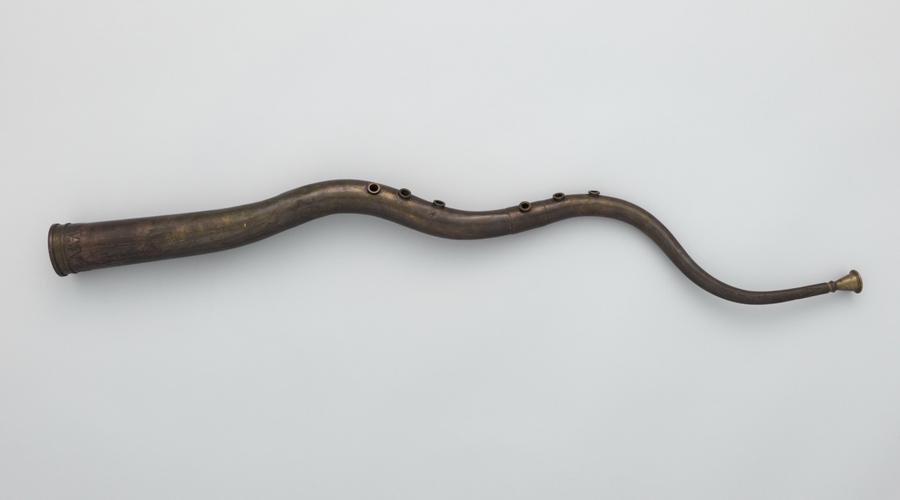
Tenor cornett19th century · Probably French (France?) -
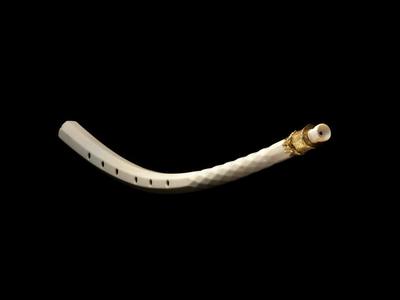
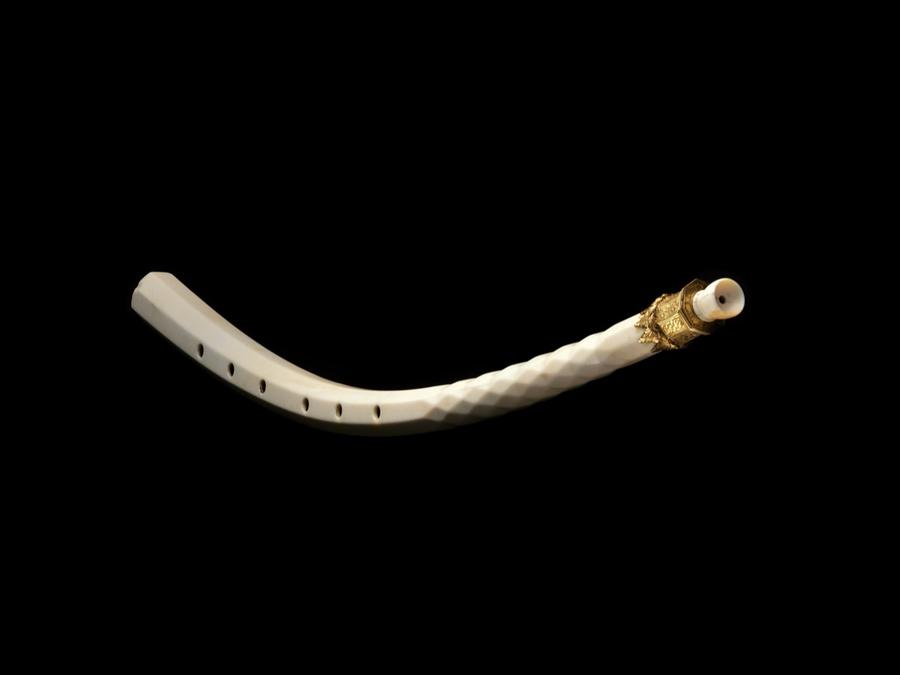
Cornetto in Aca. 1575 · Germany -
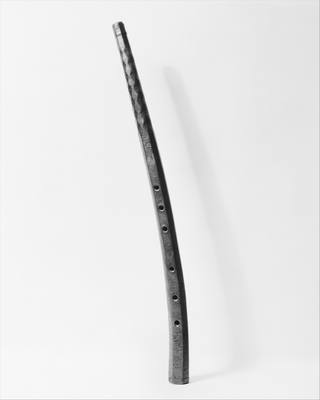
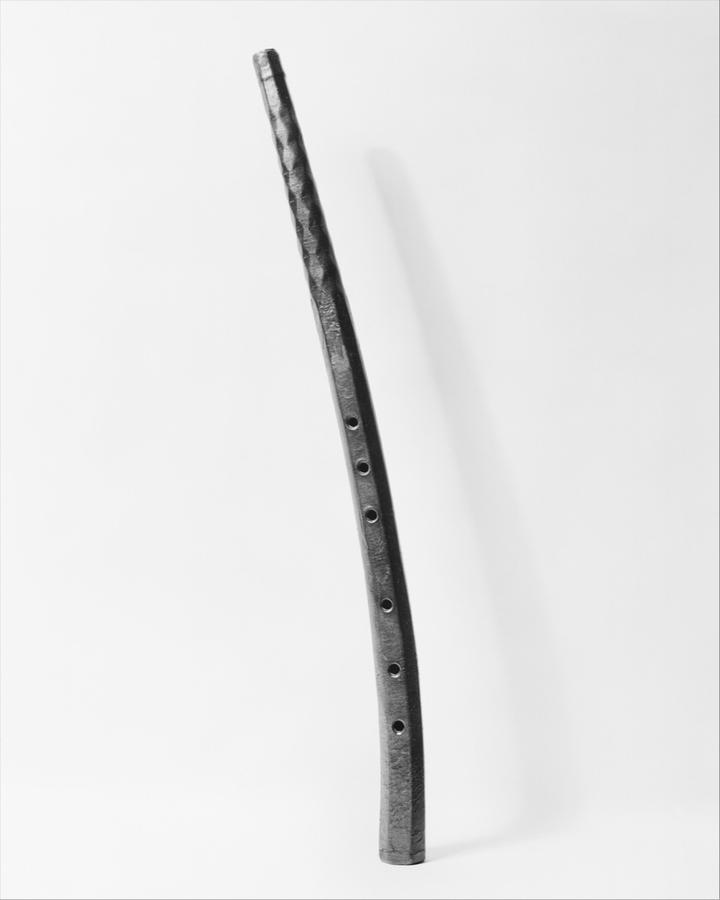
Cornetto in A17th century · Germany -
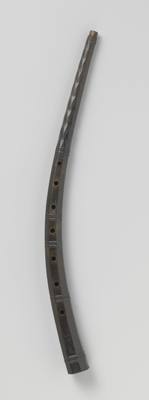
Two Cornettic. 1600 - c. 1650 -
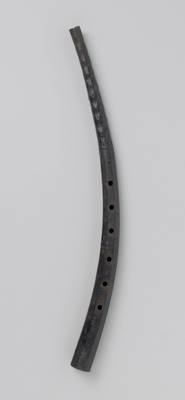
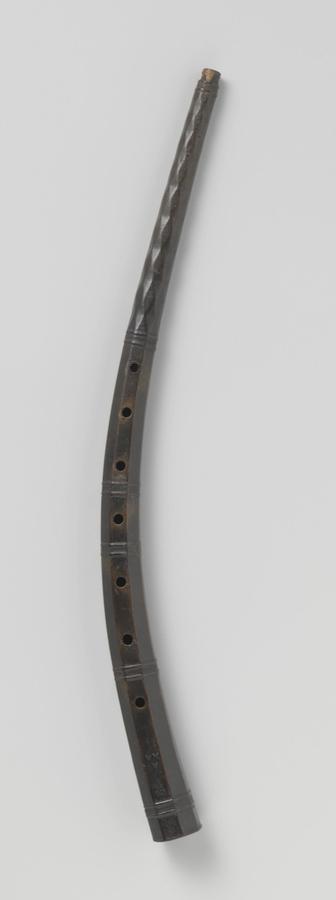
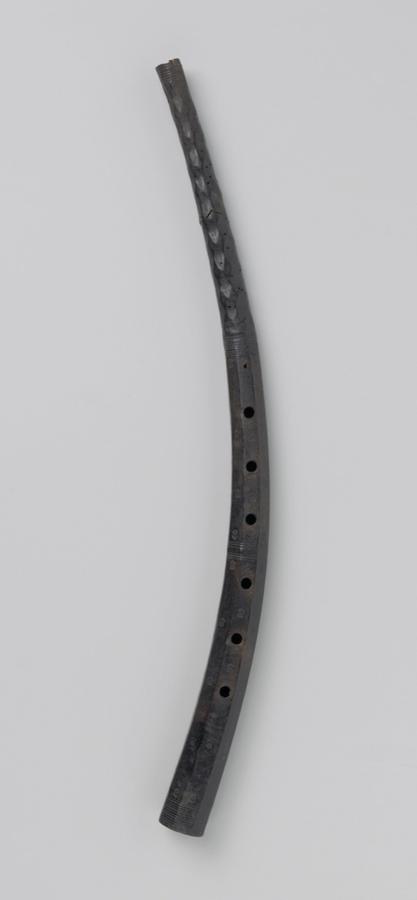
Cornettc. 1600 - c. 1650
Facts at a glance
| Hornbostel–Sachs number | 423.21 — Lip-reed aerophone with tone holes or keys and irregular/moderately conical bore |
|---|---|
| Hornbostel–Sachs group | Aerophones › Non-free aerophones (wind instruments proper) › Trumpets |
| Also known as | zink, cornetto |
| Classification (Wikipedia infobox) | Brass instrument Horn |
| Wikidata labels | 32 languages |
| Wikipedia article | Cornett |
| Wikidata item | Q204638 |
| Wikimedia Commons category | Cornetts |
| MusicBrainz instrument | 29b024c3-f6cd-4415-83ec-2b6765856881 |
| Encyclopaedia Britannica | art/cornett |
Sources: Wikidata (CC0 1.0) — classification number, aliases, identifiers (dump of 2026-07-22); Wikipedia (CC BY-SA 4.0) — infobox fields (description of the classification number, development, inventors) and the names of the Hornbostel–Sachs groups (article “Hornbostel–Sachs”, revision of 2026-01-04).
The name in other languages
| Language | Name | Also written |
|---|---|---|
| English | cornett | zink, cornetto |
| French | cornet à bouquin | |
| German | Zink | |
| Spanish | cornetto | corneta curva |
| Italian | cornetto | |
| Portuguese | corneto | |
| Dutch | zink | |
| Russian | корнет | цинк |
| Japanese | ツィンク | |
| Chinese | 木管號 | |
| Korean | 코르넷 |
Sources: Wikidata (CC0 1.0) — labels and aliases; MusicBrainz (CC0 1.0) — instrument aliases (names only).
About the cornett: history, construction and playing
The cornett (cornetto, Zink) is a lip-reed wind instrument that dates from the Medieval, Renaissance and Baroque periods, popular from 1500 to 1650. Although smaller and larger sizes were made in both straight and curved forms, surviving cornetts are mostly curved, built in the treble size from 51 to 63 cm in length, usually described as in G. The note sounded with all finger-holes covered is A3, which can be lowered a further whole tone to G by slackening the embouchure. The name cornett comes from the Italian cornetto, meaning "small horn".
It was used in performances by professional musicians for both state and liturgical music, especially accompanying choral music. It also featured in popular music in alta capella or loud wind ensembles. British organologist Anthony Baines wrote that the cornett "was praised in the very terms that were to be bestowed upon the oboe [...]: it could be sounded as loud as a trumpet and as soft as a recorder, and its tone approached that of the human voice more nearly than that of any other instrument." It was popular in Germany, where trumpet-playing was restricted to professional trumpet guild members. As well, the mute cornett variant was a quiet instrument, playing "gentle, soft and sweet."
Construction
Pipes as short as the cornett are able to play only four or five notes of the harmonic series when sounded with all finger-holes closed; these harmonics are used as part of the standard fingering within the cornett's designated range. Other short trumpets, including King Tut's Trumpet, are capable of playing only two notes without a modern mouthpiece.
The instrument has features of both the trumpet and a woodwind instrument. Like the trumpet, the cornett has a small cup-shaped mouthpiece, where the instrument is sounded with the player's lips. Like many woodwind instruments, it has fingered tone holes (and rarely, keys) to determine the pitch by shortening the vibrating air column, although pitch can also be adjusted by varying the tension of the player's embochure.
The cornett has six finger holes and, like the recorder, a single thumb hole on the opposite side. Together these allow the instrument to play a diatonic scale. A small number of cornetts were built with seven holes, and French instruments often lacked a thumbhole. By using "cross fingering" and by varying the embouchure tension, the instrument can play a chromatic scale. A player in 1738 who mastered the cross-fingering and lip tension was documented to have reached 27 notes and half notes. In comparison, Praetorius gave cornetts credit for achieving 15 notes, before players used techniques to expand the range.
The cornett has a conical bore, narrow at the mouthpiece and widening towards the bell. The ordinary curved treble cornett is made by splitting a length of wood, usually walnut, boxwood or other tonewoods like plum, cherry or pear. The bore is carved out and the two halves then glued back together, and the outside planed to an octagonal cross section. The whole is then further bound tightly in thin black leather or parchment. A small number of surviving instruments were made from one straight piece, bored on a lathe, and then bent into a curve with steam. The finger holes and thumb hole are then bored in the instrument, and are slightly undercut.
Cornett family
Cornetts were built in two styles, curved and straight.
Most cornetts are shaped with gradual curve, greater than 90°, a single curve like a comma, or an S-curve. The instrument has a conical bore, and the outside shaped to have an octagonal cross-section. Curved cornets were traditionally black, the wood covered in thin black leather. The cornett was, like many Renaissance and Baroque instruments, made in a family of sizes. Four extant sizes are the soprano (cornettino), the treble or curved cornett, the alto, the tenor or lizard and the rare bass cornett, which was supplanted by the serpent in the 17th century.
Descant
The cornettino is the descant, or sometimes "soprano" member of the cornett family. In Syntagma Musicum, it was presented as being about 45 cm long and had a range from E4 to E6 in the 16th and 17th centuries. In the 18th century that changed to D4 to D6.
Treble
The 1911 Encyclopædia Britannica defined this instrument using its French name dessus (lit. top), and gave its fingered range as A3 to A5, the lowest being one note higher than that of the alto. To play notes below A3, players can slacken their embouchure. Sibyl Marcuse did not name the normal cornett, but gave the treble's range. David Jarratt-Knock counted surviving instruments in museums to arrive at the treble cornett being the most commonly found cornett. From the 1619 scaled drawings in Syntagma Musicum, a variant of the treble is called the Alto. the instrument was about 2 ft long. It was built to start playing a tone lower than the treble and has a fingered range from G3 to G5. With good technique the lowest note is F3. The 1911 Encyclopædia Britannica called this the haute-contre or alto cornet. Baines said that the use of this variant for an alto part was "widely speculated."
Bass
There are very few surviving examples of instruments larger than the tenor cornett. One is called hautecontre de cornet à bouquin. The other should be called contrebass de cornet à bouquin according to Marcuse and Baines, and there are only two examples of it, one in the Paris Conservatoire museum and the other in Hamburg. These were tuned "a pitch or so below the type instrument" or an octave below the cornettino. The Paris instrument is described as having "an octagonal exterior and 4 extension keys." The Hamburg example has 2 extension keys.
Mute cornett
A mute cornett (French: cornet muet, German: stiller Zink, Italian: cornetto muto) is a straight cornett with a narrower bore and integrated mouthpiece carved into the end of the instrument's body. The instrument tapers in thickness, until at the top it is about 1.3 cm wide. The instruments were mainly treble cornetts, tuned to the same range as the curved treble cornett, G3 to A5. The others found in museums are soprano cornetts, also tuned like curved instruments to E4 to E6.
This instrument's name tells something of its tonal nature. Its "gentle, soft and sweet" sound is different than the other cornetts because of its mouthpiece, and can be used in a consort of viols or recorders. The mouthpiece is similar to that in a French horn; instead of being a cup like the other cornetts, it is a cone, about 9 mm deep. Inside it transitions from cone to instrumental bore smoothly, without "sharpness." On the outside, there isn't an obvious lip carved.
Praetorius drew a tenor mute cornett, with a seventh hole covered and labeled that a lower note could be reached by covering the base. In that range, the six holes with thumb hole could have delivered A3 to F5. The extra plate would make it G3 to F5, with the base covered F3 to F5.
Origins
Aurignacian pipes, fashioned with four finger holes 26,000–40,000 years ago from the slender bones of bird wings or mammoth ivory, have long been considered flutes. Recovered from Vogelherdhöhle and other caves in the Swabian Jura in Germany, they are among the oldest musical instruments yet discovered. British music archaeologist Graeme Lawson found that a replica of a complete specimen played as a flute has an indistinct whispery sound, but produces the first five notes of the diatonic series in a clear, strident tone when played as an end-blown lip reed instrument. He contends that this method of playing is supported by microscopic wear patterns, the absence of a fipple or blowhole, and the well-rounded end aperture.
In modern history, the cornett has been considered by musical historians to be a development of the medieval horn, such as a cow's horn. Francis Galpin believed the horns preceding the cornett to be goat horns.
Plain horns in the shape of animal horns have been found in medieval European art as far back as the Utrecht Psalter in the 9th century. However, horns with fingerholes also began appearing in manuscript miniatures in the 10th century. By the 12th century, these were being carved with a six sided or 8 sided exterior. In the 11th century, some of the fingerhole horns began to be made longer and thinner, beginning to take on the appearance of the cornett.
The French coradoiz, rendered now as cor à doigts, meant "fingerhole horn", was seen in the 13th to 15th centuries.
The earliest cowhorn instruments were played with one hand covering four or fewer fingerholes and the other stopping the bell to create additional tones, much like on a French horn. In Northern Europe, these horns, referred to in Scandinavian languages as bukkehorns, were made from natural animal horns.
The name cornet was printed in English in the Morte d'Arthure, completed by Sir Thomas Mallory about 1470.
The cornett in its current form was developed by about 1500, as an improvement over earlier designs of fingerhole horns.
Playing the cornett
The cornett's pitches are controlled using a combination of the player's lips and fingerholes. The lips change pitch through different tensions. The fingerholes alter the length of the sound column.
Cornetts are made with a mouthpiece, similar to that on brass instruments, but very small. Unlike the brass mouthpieces, players don't press the instrument to the center of their mouths, as on a trumpet. Rather the technique to produce sound is to hold the instrument to the side of the mouth, where the player's lips are thinner. Players stretch their lips to tighten them, with help from cheek muscles.
The technique is not unique to cornets, but has also been used for the traditional animal-horn horns, such as the shofur and Slovak shepherd's horn, as well as for folk horns such as the Russian rozhok.
Girolamo dalla Casa wrote about how the coronet should sound when played, and in doing so revealed other ways it could sound as well. He felt that the instrument was meant to imitate the human voice, saying, "The cornetto is the most excellent of the wind instruments since it imitates the human voice better than the other instruments." He warned that improperly played, it would sound "horn-like or muted."
To play it properly, he said that player's must focus on the tone (with lips not spread apart and loose, or too tight and shrill). He felt tonguing was important to the sound, with energy but not too aggressive. Finally he felt that divisions or diminutions should be used, but sparingly and well. He said that cornettists should focus on making their playing sound like the human voice.
Source: Wikipedia, “Cornett” — CC BY-SA 4.0 — text excerpted as published (references, images and tables removed); see the article for the full text and the list of authors. Revision of 2026-04-02.
Sources and licences
- Tenor cornett, 19th century, Probably French (France?). Brass. The Crosby Brown Collection of Musical Instruments, 1889 (89.4.1669). Museum record · CC0 1.0 (public domain dedication)
- Cornetto in A, ca. 1575, Germany. Ivory, gilt ferrule. Funds from various donors, 1952 (52.96.1). Museum record · CC0 1.0 (public domain dedication)
- Cornetto in A, 17th century, Germany. Wood, leather. Gift of The University Museum, University of Pennsylvania, 1953 (53.56.9). Museum record · CC0 1.0 (public domain dedication)
- Two Cornetti, c. 1600 - c. 1650. wood (plant material), leather. On loan from the City of Amsterdam. Museum record · Public Domain Mark 1.0
- Cornett, c. 1600 - c. 1650. leather, boxwood. On loan from the City of Amsterdam. Museum record · Public Domain Mark 1.0
Photographs: open-access collections of the museums named above; each is shown here reduced in size, otherwise unchanged. Text: Wikipedia (CC BY-SA 4.0), Wikidata and MusicBrainz (CC0). The full list of sources and licences is on the credits page.