
Instruments · Aerophones
Saxhorn
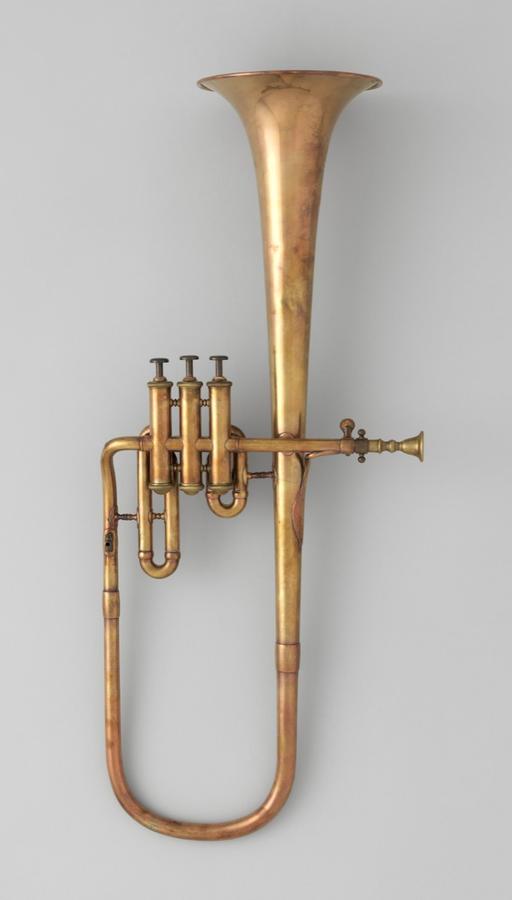
The saxhorn is a family of valved brass instruments that have conical bores and deep cup-shaped mouthpieces. The saxhorn family was developed by Adolphe Sax, who is also known for creating the saxophone family. The sound of the saxhorn has a characteristic mellow tone quality and blends well with other brass.
Summary: Wikipedia, “Saxhorn” — CC BY-SA 4.0. Revision of 2026-06-15.
Museum photographs
These 7 photographs span 1850–1900, 4 places of origin and 2 museums. Every photograph is public domain or openly licensed, and links to the museum’s own record.
-
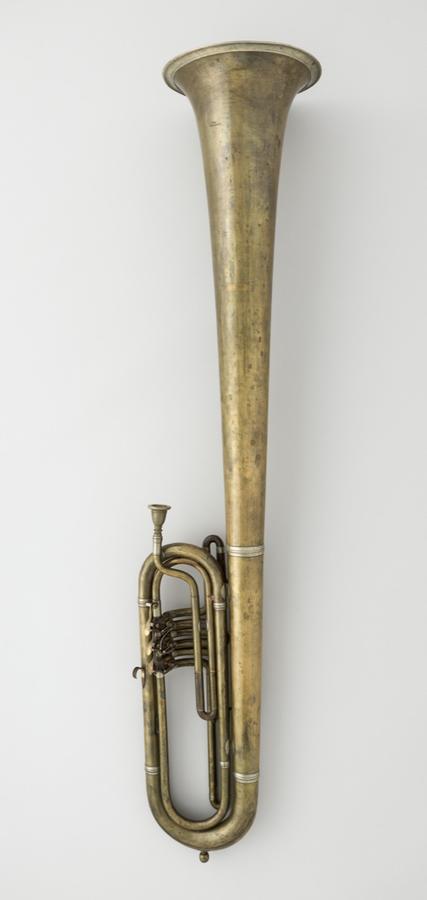
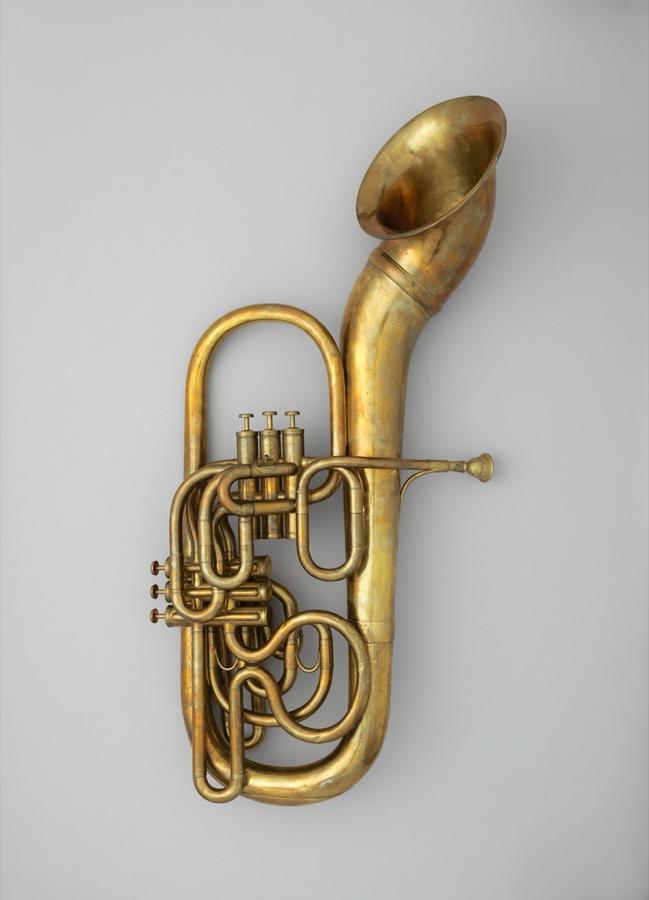
Over-the-Shoulder bass saxhorn in E-flatca. 1870 · American (United States) -
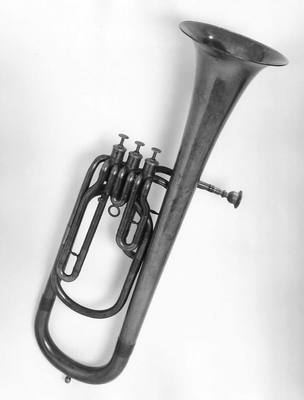
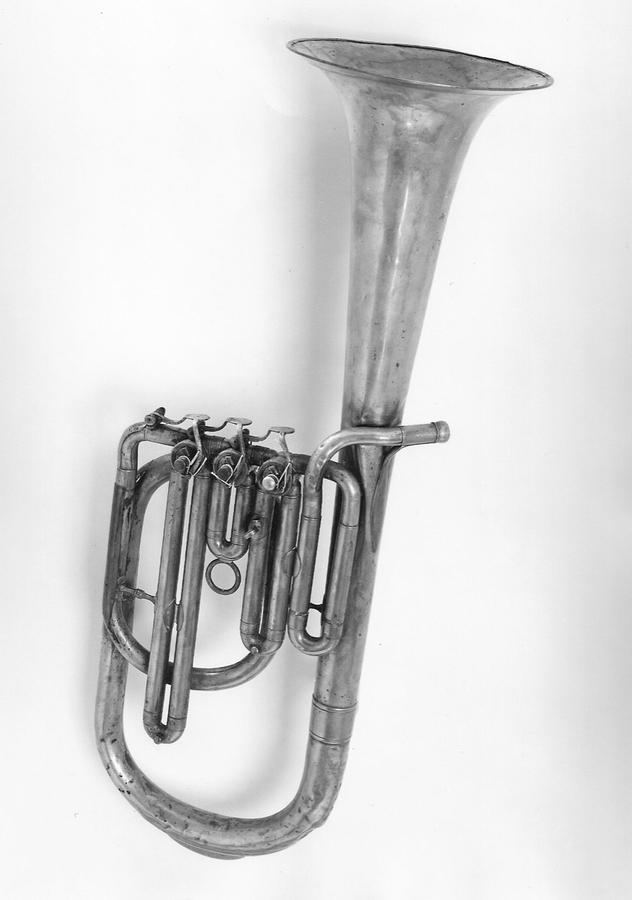
Baritone Saxhorn in B-flat1850–79 · French or German (France or Germany) -
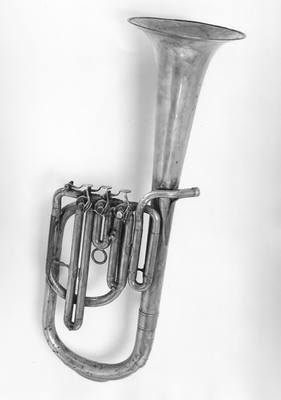
Alto Saxhorn in E-flat1850–75 · American or German (United States or Germany) -
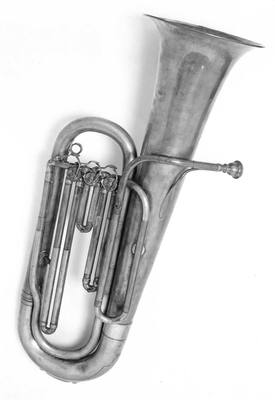
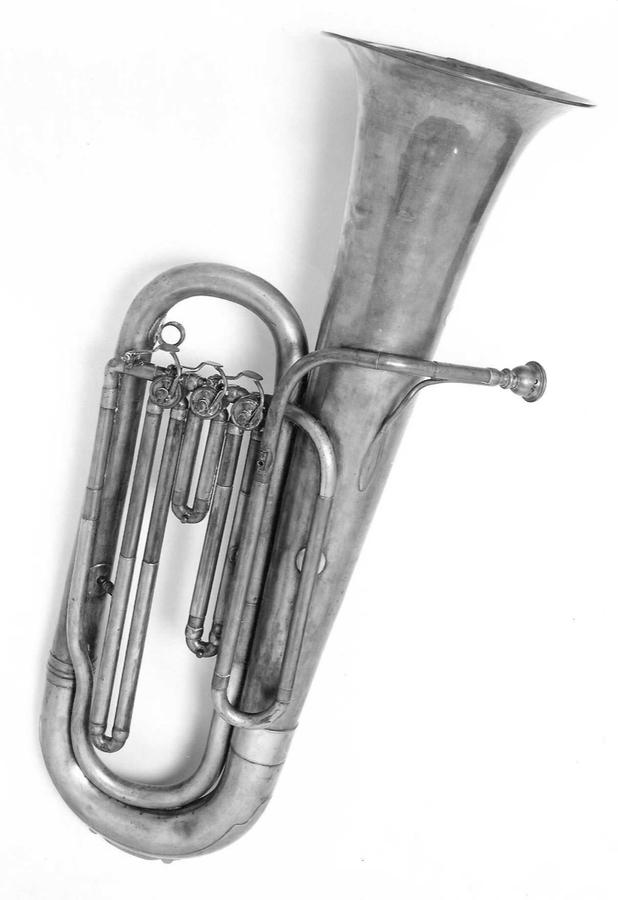
Contrabass Saxhorn in E-flatmid to late 19th century · American (United States) -
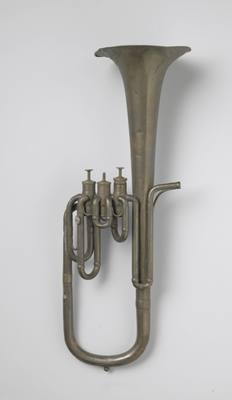
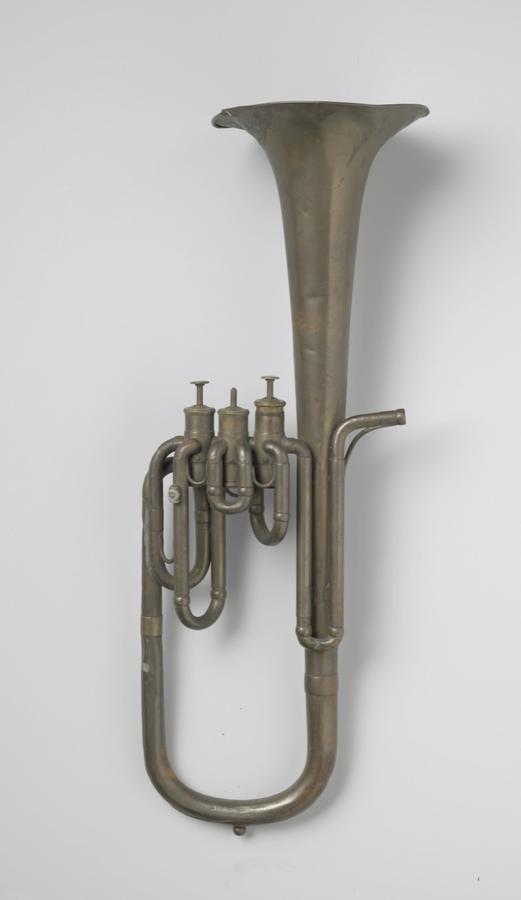
Alto saxhornc. 1860 - c. 1880 · Paris -
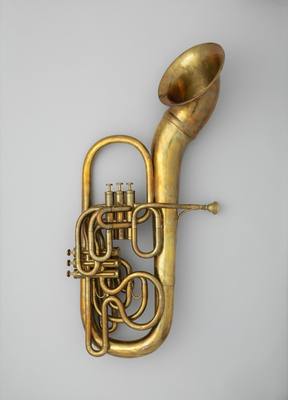
Bass saxhorn in B-flat1863 · French (France) -
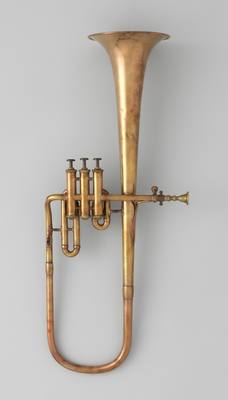
Alto Saxhorn in B-flatca. 1900 · French (France)
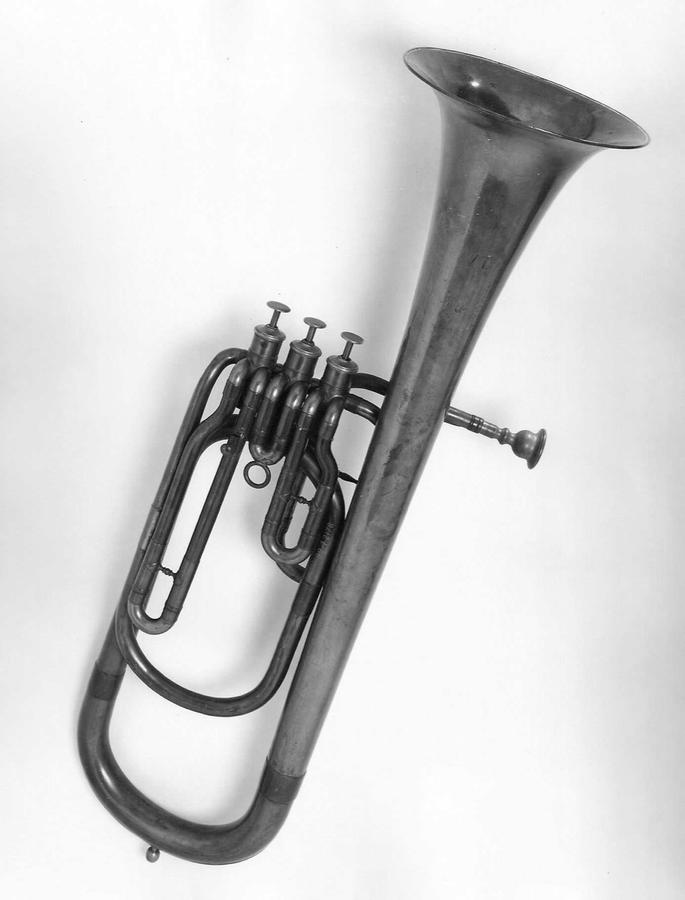
Facts at a glance
| Hornbostel–Sachs number | 423.232.2 — Valved aerophone sounded by lip vibration |
|---|---|
| Hornbostel–Sachs group | Aerophones › Non-free aerophones (wind instruments proper) › Trumpets |
| Also known as | saxwey |
| Developed | Mid 19th century by Adolphe Sax |
| Wikidata labels | 36 languages |
| Wikipedia article | Saxhorn |
| Wikidata item | Q787557 |
| Wikimedia Commons category | Saxhorns |
| Encyclopaedia Britannica | art/saxhorn |
Sources: Wikidata (CC0 1.0) — classification number, aliases, identifiers (dump of 2026-07-22); Wikipedia (CC BY-SA 4.0) — infobox fields (description of the classification number, development, inventors) and the names of the Hornbostel–Sachs groups (article “Hornbostel–Sachs”, revision of 2026-01-04).
The name in other languages
| Language | Name | Also written |
|---|---|---|
| English | saxhorn | saxwey |
| French | saxhorn | saxhorns |
| German | Bügelhorn | |
| Spanish | saxhorno | saxcorno |
| Italian | flicorni | |
| Portuguese | saxotrompa | |
| Dutch | saxhoorn | saxhoorns |
| Russian | саксгорн | саксгорны |
| Japanese | サクソルン | |
| Chinese | 薩克斯號 | |
| Arabic | ساكسهورن |
Sources: Wikidata (CC0 1.0) — labels and aliases; MusicBrainz (CC0 1.0) — instrument aliases (names only).
About the saxhorn: history, construction and playing
The saxhorn is a family of valved brass instruments that have conical bores and deep cup-shaped mouthpieces. The saxhorn family was developed by Adolphe Sax, who is also known for creating the saxophone family. The sound of the saxhorn has a characteristic mellow tone quality and blends well with other brass.
The saxhorn family
The saxhorns form a family of seven brass instruments (although at one point ten different sizes seem to have existed). Designed for band use, they are pitched alternately in E♭ and B♭, like the saxophone group.
Modern saxhorns still manufactured and in use:
- B♭ soprano saxhorn: flugelhorn
- E♭ alto or tenor saxhorn: tenor horn
- B♭ baritone saxhorn: baritone horn
- B♭ bass saxhorn: euphonium
- E♭ bass saxhorn: E♭ bass tuba
- B♭ contrabass saxhorn: B♭ contrabass tuba
Historically, much confusion exists as to the nomenclature of the various instruments in different languages.
The following table lists the members of the saxhorn family as described in the orchestration texts of Hector Berlioz and Cecil Forsyth, the J. Howard Foote catalog of 1893, and modern names. The modern instrument names continue to exhibit inconsistency, denoted by a "/" between the two names in use. Pitch given is the sounding pitch of a written middle C (second partial, no valves depressed), in scientific pitch notation.
This list is not exhaustive of historic nomenclature for the saxhorns, for which there may exist no comprehensive and authoritative source.
Ranges of individual members
The saxhorn is based on the same three-valve system as most other valved brass instruments. Each member of the family is named after the root note produced by the second partial with no valves actuated. Each member nominally possesses or possessed the typical three-valve brass range from the note one tritone below that root note (second partial, all valves actuated) to the note produced by eighth partial with no valves actuated, i.e, the note two octaves above the root note.
All the modern members of the family are transposing instruments written in the treble clef with the root note produced by the second partial with no valves actuated being written as middle C, though the baritone horn often plays bass clef parts, especially in concert band music and when playing parts written for the trombone.
History
Developed during the mid-to-late 1830s, the saxhorn family was patented in Paris in 1845 by Adolphe Sax. During the 19th century, the debate as to whether the saxhorn family was truly new, or rather a development of previously existing instruments, was the subject of prolonged lawsuits.
Throughout the mid-1850s, Sax continued to experiment with the instrument's valve pattern.
The Trojan March (Marche Troyenne) of the Berlioz opera Les Troyens (1856–58) features an on-stage band which includes a family of saxhorns. The Royal Hunt and Storm (Chasse Royale) from the same opera uses them orchestrally. Sir John Eliot Gardiner wanted to use them in his 2003 recording, but was unable to borrow them from major conservatoires; he was eventually put in touch with a private collector who loaned him a set.
Saxhorns were popularized by the distinguished Distin Quintet, who toured Europe during the mid-19th century. This family of musicians, publishers and instrument manufacturers had a significant impact on the growth of the brass band movement in Britain during the mid- to late-19th century.
The saxhorn was the most common brass instrument in American Civil War bands. The over-the-shoulder variety of the instrument was used, as the backward-pointing bell of the instrument allowed troops marching behind the band to hear the music.
Contemporary works featuring this instrument are Désiré Dondeyne's Tubissimo for bass tuba or saxhorn and piano (1983), Olivier Messiaen's Et exspecto resurrectionem mortuorum (1964), and Dmitri Shostakovich's "March of the Soviet Militia" (1970).
Source: Wikipedia, “Saxhorn” — CC BY-SA 4.0 — text excerpted as published (references, images and tables removed); see the article for the full text and the list of authors. Revision of 2026-06-15.
From Grove’s Dictionary (1900)
SAXHORN (Saxtuba, Saxotromba). The name given to a family of brass instruments with valves, invented by the late M. Sax.
'No one can be ignorant,' say the editors of the Method for Saxhorn and Saxo-tromba, 'of the deplorable state in which brass instruments were when M. Sax's method made its appearance. No coherence, no unity between the individual members of the group; in one case keys, in another valves; a small compass, an imperfect scale, lack of accurate intonation throughout, bad quality of tone, variations of fingering requiring fresh study in passing from one instrument to another. The keyed bugle, built on false proportions, offered no prospect of improvement; the mechanism of the valves themselves, by their abrupt angles, deteriorated the quality of tone; and the absence of intermediate instruments caused gaps in the general scale, and at times false combinations.'
Six or even more instruments of different size compose the Sax family, the chief of these being the soprano in F, E♭, or D, the contralto in C and B♭, the tencr in F and E♭, the barytone in C and B♭, the bass in F and E♭, and the contrabass, or circular bass, in B♭. Several of these are known under special names; the tenor for instance as the Althorn; the smaller bored Barytone under that appellation; the larger bored of similar pitch as the Euphonium; the bass or double bass as the Bombardon or Contra Bombardon.
Source: Wikisource, A Dictionary of Music and Musicians (Grove, 1900) — “Saxhorn” (entry by William H. Stone) — Public domain (published 1879–1910; authors died before 1929) — the first paragraphs of the entry, as transcribed; see the page for the full entry.
Sources and licences
- Over-the-Shoulder bass saxhorn in E-flat, Ernst Seltmann, ca. 1870, American (United States). Brass, nickel-silver. The Crosby Brown Collection of Musical Instruments, 1889 (89.4.2301). Museum record · CC0 1.0 (public domain dedication)
- Baritone Saxhorn in B-flat, 1850–79, French or German (France or Germany). Brass. The Crosby Brown Collection of Musical Instruments, 1889 (89.4.2178). Museum record · CC0 1.0 (public domain dedication)
- Alto Saxhorn in E-flat, 1850–75, American or German (United States or Germany). Brass. The Crosby Brown Collection of Musical Instruments, 1889 (89.4.2184). Museum record · CC0 1.0 (public domain dedication)
- Contrabass Saxhorn in E-flat, C. A. Zoebisch, mid to late 19th century, American (United States). Brass, nickel-silver. The Crosby Brown Collection of Musical Instruments, 1889 (89.4.2188). Museum record · CC0 1.0 (public domain dedication)
- Alto saxhorn, Pierre Louis Gautrot, c. 1860 - c. 1880, Paris. copper (metal). Gift of the Koninklijke Militaire Academie. Museum record · Public Domain Mark 1.0
- Bass saxhorn in B-flat, Adolphe (Antoine Joseph) Sax, 1863, French (France). Brass. Purchase, Clara Mertens Bequest, in memory of André Mertens, 1993 (1993.164). Museum record · CC0 1.0 (public domain dedication)
- Alto Saxhorn in B-flat, Gautrot aîné, ca. 1900, French (France). Brass. The Crosby Brown Collection of Musical Instruments, 1889 (89.4.2347). Museum record · CC0 1.0 (public domain dedication)
Photographs: open-access collections of the museums named above; each is shown here reduced in size, otherwise unchanged. Text: Wikipedia (CC BY-SA 4.0), Grove’s Dictionary (public domain), Wikidata and MusicBrainz (CC0). The full list of sources and licences is on the credits page.