
Instruments · Aerophones
Trumpet
A trumpet is a brass instrument used mainly in Classical music and jazz music. The most common type of trumpet is a B♭ trumpet, meaning that if the player plays a C, it will sound like a B♭ in concert pitch. The trumpet is played by blowing into the mouthpiece and making a "buzzing" sound. The buzzing sound is made by the vibration of the lips blown by the player. There are three keys called valves that the player can press to change the pitch.
Summary: Simple English Wikipedia, “Trumpet” — CC BY-SA 4.0. Revision of 2025-09-10.
Hear the real instrument
These are recordings of a real C trumpet, not a synthesiser. Click or tap a key to hear that note, or press Play the range to hear every note the instrument was recorded on, from lowest to highest.
| Recorded instrument | C trumpet |
|---|---|
| Range recorded | F♯3 to D6 |
| Notes | 33 recorded notes, one for every semitone from lowest to highest. Middle C is C4. |
The recordings are a C trumpet, which sounds as written. The more common B♭ trumpet sounds a major second lower than written.
Without JavaScript: play the lowest note (F♯3) or the highest note (D6) as MP3 files.
Recordings: IRCAM SOL (TinySOL), CC BY 4.0, Cella et al. Each note is cut from the original recording, levelled in loudness and converted to a short MP3; the playing technique is ordinary (ordinario), mostly at mezzo-forte.
Museum photographs
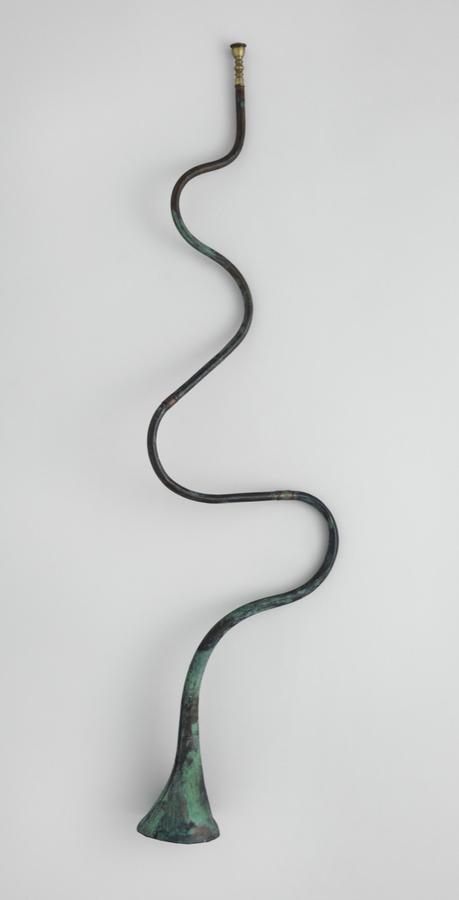
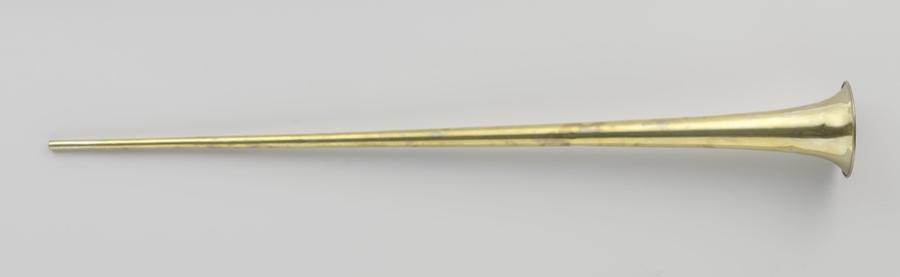
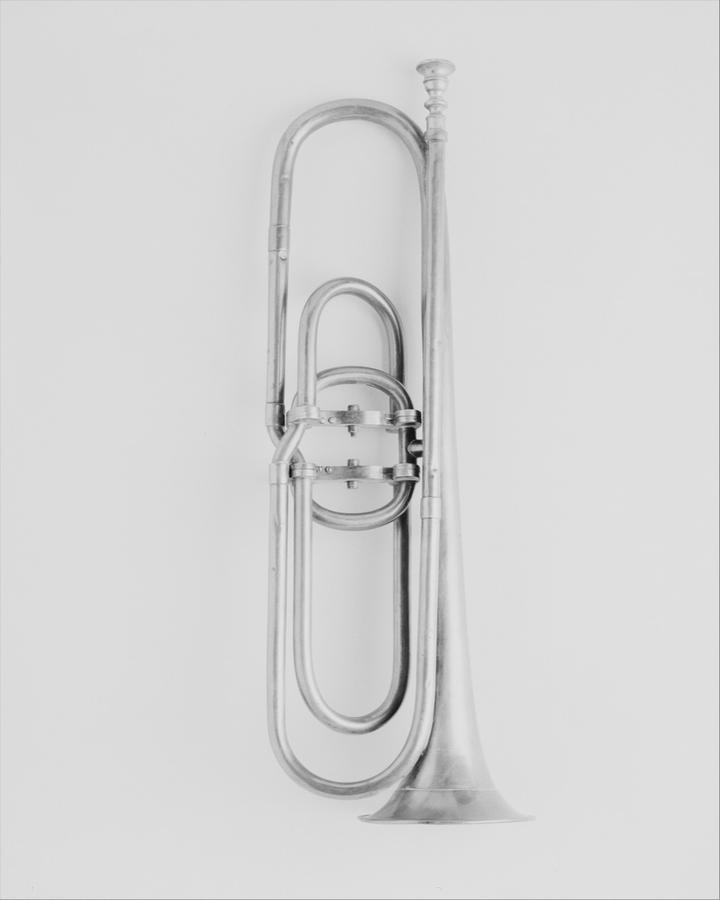
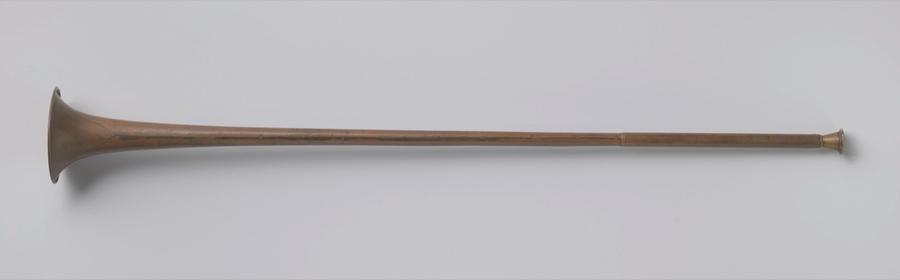
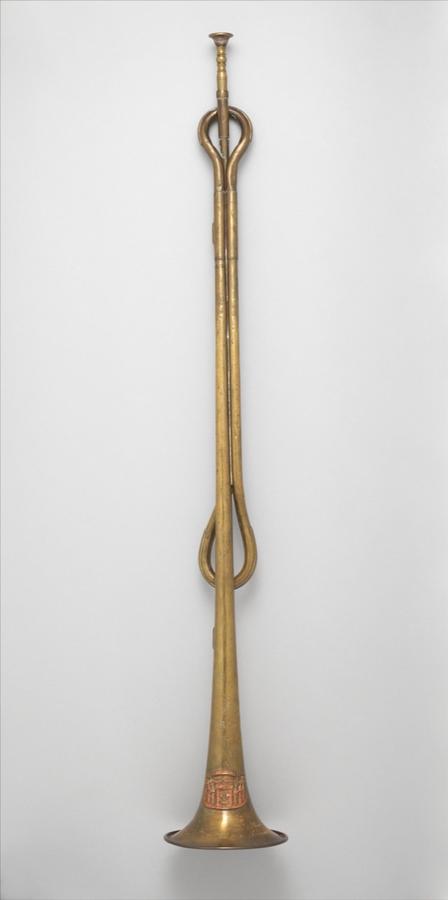
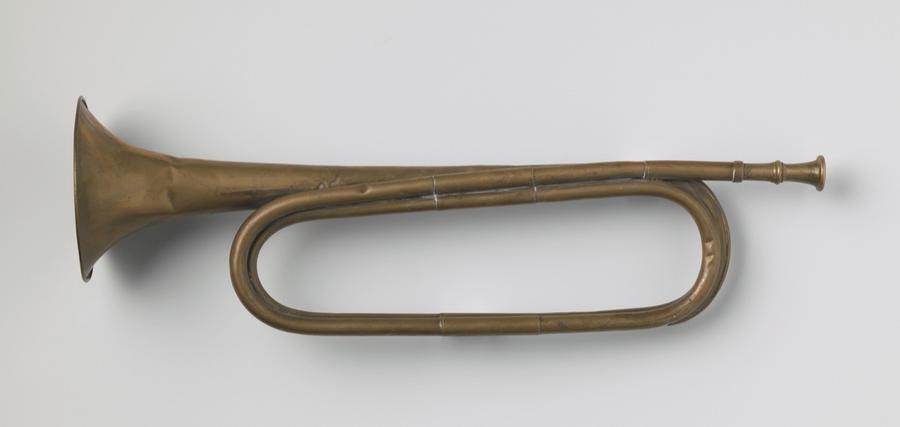
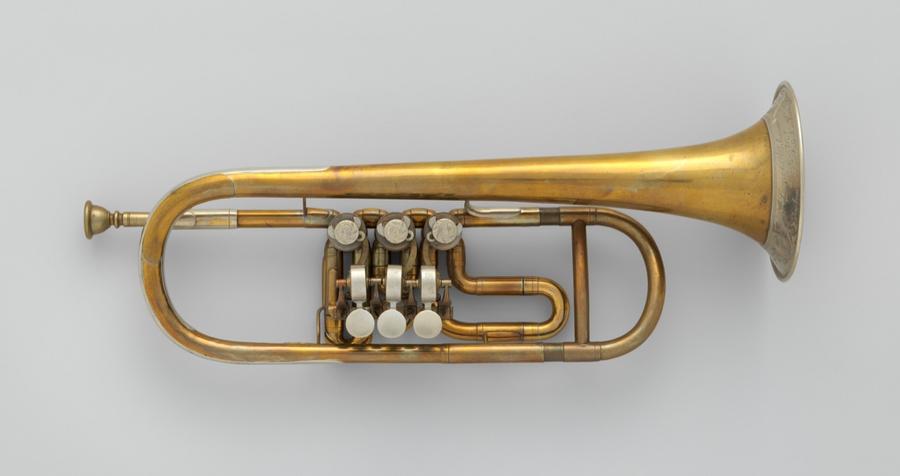
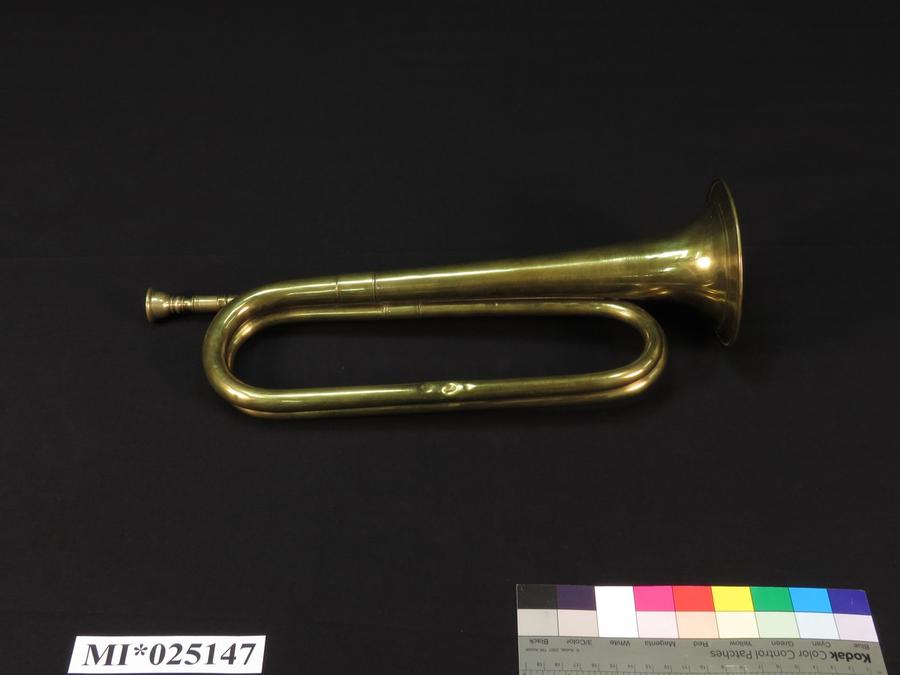
These 12 photographs span 1695–1920, 7 places of origin and 4 museums. Every photograph is public domain or openly licensed, and links to the museum’s own record.
-
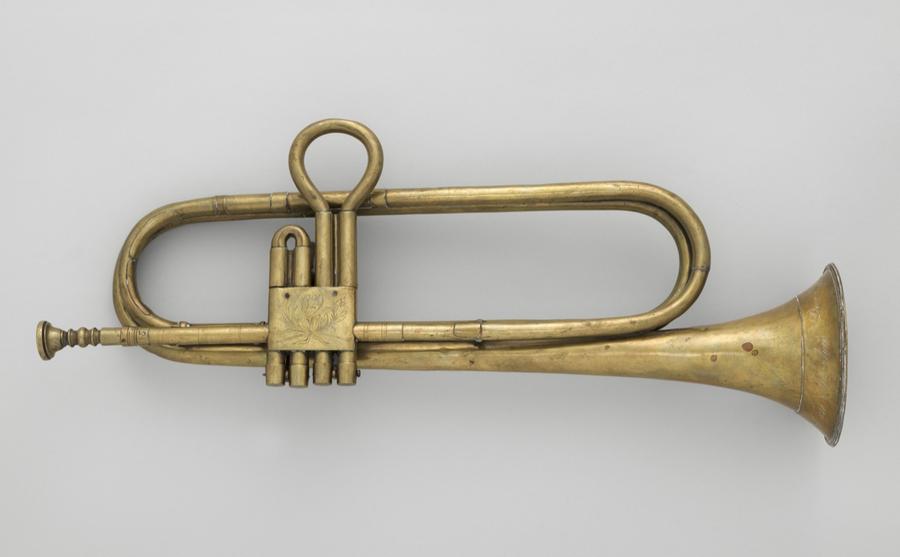
Trumpet in G1829 · Germany -
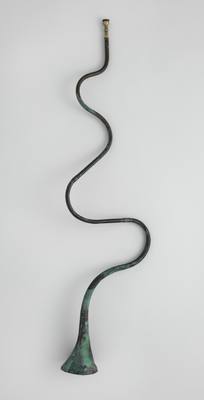
Parade Trumpetca. 1700 · probably Germany -
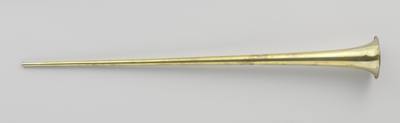
Fanfare trumpetc. 1815 - c. 1830 · Europe -
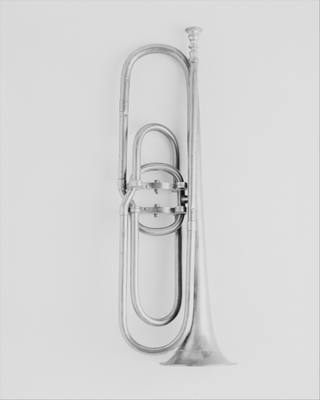
Valve Trumpet in Fca. 1842 · British (United Kingdom) -
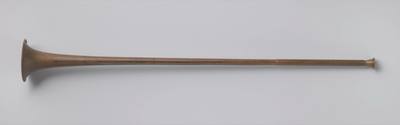
Fanfare trumpetc. 1850 - c. 1896 -
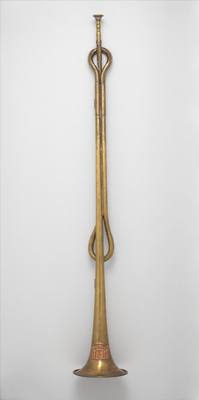
Fanfare trumpet in E-flat1856 · French (France) -
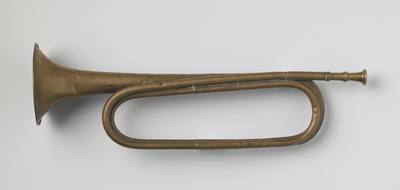
Cavalry trumpetc. 1862 - c. 1886 · Amsterdam -
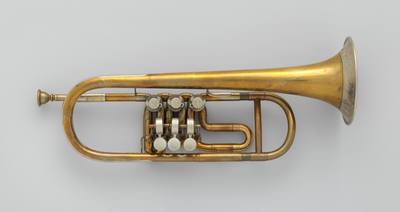
Valve Trumpet in C1870–80 · Austrian (Austria) -
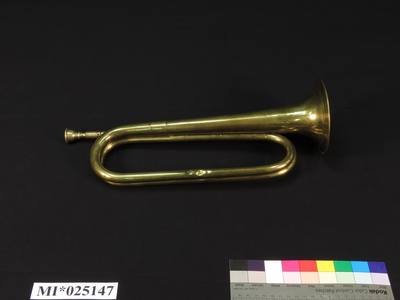
U.S. Army Trumpet1879-1891 · United States -
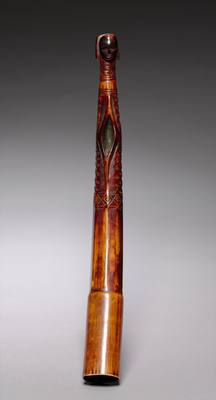
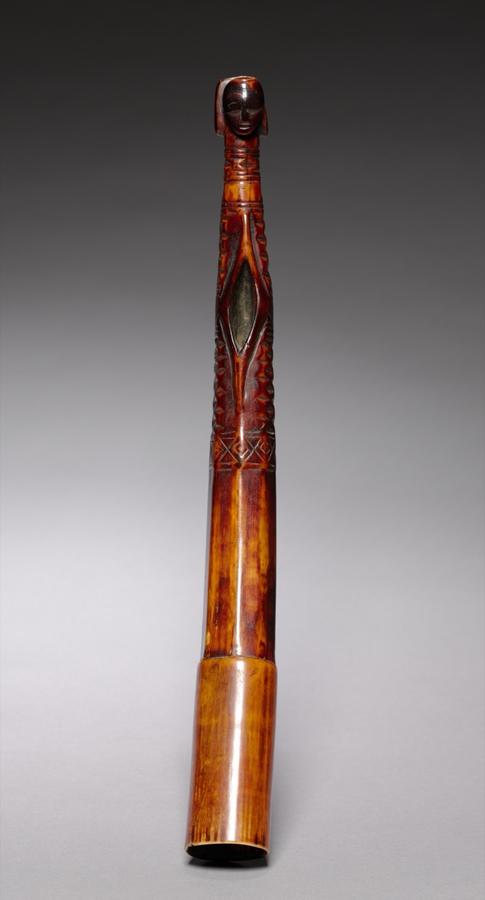
Side-Blown Trumpetlate 1800s · Equatorial Africa, Cameroon; Fang, 19th century (Equatorial Africa) -
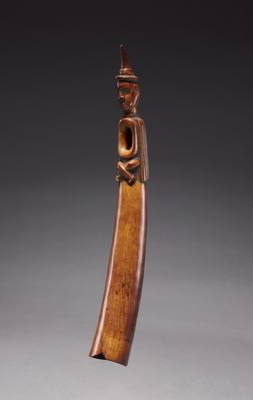
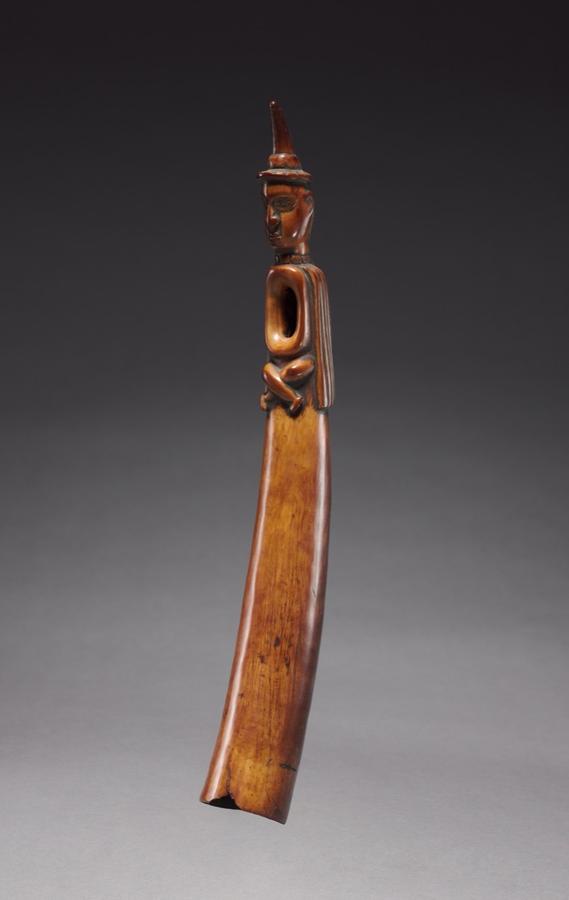
Oliphant (Side-Blown Trumpet)late 1800s–early 1900s · Africa, Central Africa, Democratic Republic of Congo (most likely), Cabinda, or Republic of the Congo, probably Yombe-style maker (Africa) -
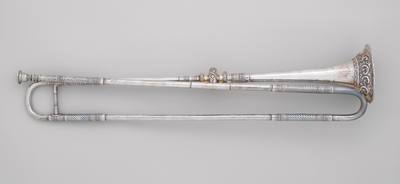
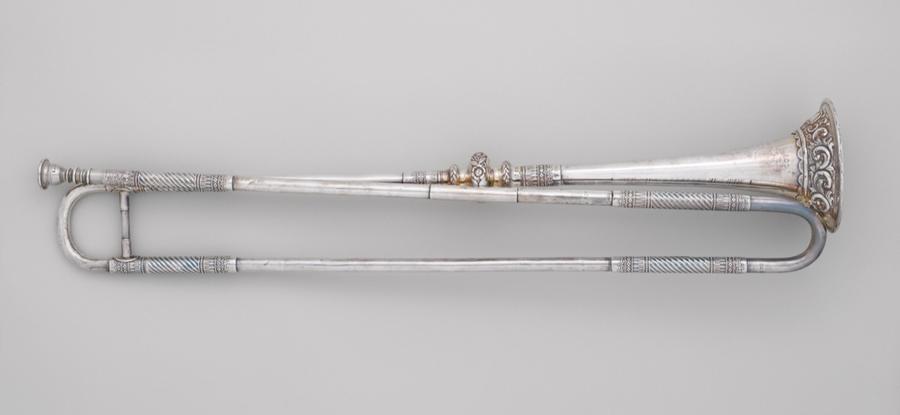
Trumpet in E-flat1894 · British (United Kingdom)
Facts at a glance
| Hornbostel–Sachs number | 423.233 — Valved aerophone sounded by lip vibration |
|---|---|
| Hornbostel–Sachs group | Aerophones › Non-free aerophones (wind instruments proper) › Trumpets |
| Also known as | natural trumpet, slide trumpet, valve trumpet, Bb trumpet, B♭ trumpet, B-flat trumpet |
| Wikidata labels | 140 languages |
| Wikipedia article | Trumpet |
| Wikidata item | Q8338 |
| Wikimedia Commons category | Trumpets |
| MusicBrainz instrument | 1c8f9780-2f16-4891-b66d-bb7aa0820dbd |
| Encyclopaedia Britannica | art/trumpet |
Sources: Wikidata (CC0 1.0) — classification number, aliases, identifiers (dump of 2026-07-22); Wikipedia (CC BY-SA 4.0) — infobox fields (description of the classification number, development, inventors) and the names of the Hornbostel–Sachs groups (article “Hornbostel–Sachs”, revision of 2026-01-04).
The name in other languages
| Language | Name | Also written |
|---|---|---|
| English | trumpet | natural trumpet, slide trumpet, valve trumpet |
| French | trompette | |
| German | Trompete | Drommete, Ventiltrompete, Dromette |
| Spanish | trompeta | |
| Italian | tromba | |
| Portuguese | trompete | |
| Dutch | trompet | |
| Russian | труба | |
| Japanese | トランペット | |
| Chinese | 小號 | 小喇叭, 小号 |
| Korean | 트럼펫 | |
| Arabic | بوق | ترومبيت, ترمبيت, نفير |
Sources: Wikidata (CC0 1.0) — labels and aliases; MusicBrainz (CC0 1.0) — instrument aliases (names only).
About the trumpet: history, construction and playing
The trumpet is a brass instrument. The most common type of trumpet is a transposing instrument in B♭, with pitches sounding a whole step lower than written. The trumpet family includes instruments ranging from the piccolo trumpet, with the highest register in the brass family, to the bass trumpet, pitched one octave below the standard B♭ or C trumpet.
Trumpet-like instruments have historically been used as signaling devices in battle or hunting, with examples dating back to the 2nd Millennium BC. They began to be used as musical instruments only in the late 14th or early 15th century. Trumpets are used in art music styles, appearing in orchestras, concert bands, chamber music groups, and jazz ensembles. They are also common in popular music and are generally included in school bands. Sound is produced by vibrating the lips in a mouthpiece, which starts a standing wave in the air column of the instrument. Since the late 15th century, trumpets have primarily been constructed of brass tubing, usually bent twice into a rounded rectangular shape.
Etymology
The English word trumpet was first used in the late 14th century. The word came from Old French trompette, which is a diminutive of trompe. The word trump, meaning trumpet, was first used in English in 1300. The word comes from Old French trompe 'long, tube-like musical wind instrument' (c. 1100s), cognate with Provençal tromba, Italian tromba, all probably from a Germanic source (compare Old High German trumpa, Old Norse trumba 'trumpet'), of imitative origin."
History
The earliest trumpets date back to 2000 BC and earlier, including Tutankhamun's bronze and silver trumpets from his grave in Egypt, bronze lurs from Scandinavia, and metal trumpets from China. The Oxus civilization in the 3rd millennium BC in Central Asia had trumpets with decorated swellings in the middle, made out of one sheet of metal, which is considered a technical wonder for its time.
The Salpinx was a straight trumpet 62 in long, made of bone or bronze. Homer's Iliad (9th or 8th century BC) contains the earliest reference to its sound, and frequent descriptions are found throughout the Classical Period. Salpinx contests were a part of the original Olympic Games. The Shofar, made from a ram's horn, and the chazozra, made of metal, are both mentioned in the Bible. They were said to have been played in Solomon's Temple around 3,000 years ago, and are still used on certain religious days.
The Moche people of ancient Peru depicted trumpets in their art going back to AD 300. The earliest trumpets were signaling instruments used in military or religious contexts, rather than in music. The modern bugle continues this signaling tradition.
Improvements to instrument design and metal making in the late Middle Ages and Renaissance led to an increase in the trumpet's utility as a musical instrument. The natural trumpets of this era consisted of a coiled tube without valves which could only produce the notes of a single overtone series. Changing keys required the player to change crooks of the instrument. The development of the upper, "clarino" register by specialist trumpeters—notably Cesare Bendinelli—would lend itself well to music of the Baroque era. This was known as the "Golden Age of the natural trumpet," during which a vast body of music was written for virtuoso trumpeters. Interest in the natural trumpet was revived in the mid-20th century, and its use has become more common. Many modern players in Germany and the UK who perform Baroque music use a version of the natural trumpet fitted with three or four vent holes to aid in correcting out-of-tune notes in the harmonic series.
Construction
Trumpets are generally constructed of brass tubing, bent twice into a rounded oblong shape. They may be made from other materials, including plastic. As with all brass instruments, sound is produced by blowing air through slightly separated lips, producing a "buzzing" sound into the mouthpiece and starting a standing wave vibration in the air column inside the trumpet. The player can select the pitch from a range of overtones or harmonics by changing the lip aperture and tension (known as the embouchure).
The mouthpiece has a circular rim, which provides an environment for the lips' vibration. Directly behind the rim is the cup, which channels the air into a much smaller opening (the back bore or shank) that tapers out slightly to match the diameter of the trumpet's lead pipe. The dimensions of these parts of the mouthpiece affect the timbre or quality of sound, the ease of playability, and player comfort. Generally, the wider and deeper the cup, the darker the sound and timbre.
Modern trumpets have three (infrequently, four) valves, each of which increases the length of tubing when engaged, thereby lowering the pitch. Most trumpets use piston valves but some use rotary valves. The first valve lowers the instrument's pitch by a whole step (two semitones), the second valve by a half step (one semitone), and the third valve by one and a half steps (three semitones). These three valves provide eight possible valve combinations (including "none"), but only seven different tubing lengths, because the third valve alone gives the same tubing length as the 1–2 combination (there is often a deliberate difference between "1–2" and "3", allowing the player to select whichever gives the best tuning for any particular note). Used singly and in combination these valves make the instrument fully chromatic, i.e, able to play all twelve pitches. When a fourth valve is present, as on some piccolo trumpets, it usually lowers the pitch a perfect fourth (five semitones).
The overall pitch of the trumpet can be raised or lowered by the use of the tuning slide. Pulling the slide out lowers the pitch; pushing the slide in raises it. Pitch can be "bent" by adjusting the embouchure.
Types
The most common type is the B♭ trumpet, a transposing instrument that sounds a whole step lower than written. Trumpets in C are non-transposing instruments sounding at concert pitch, commonly used in American orchestral playing alongside the B♭ trumpet. There is classical literature for trumpet in D, E♭, and for piccolo trumpet (in B♭ or A, an octave above the standard B♭ instrument), and trumpets in A, E, low F, and G also exist. Bass trumpets, pitched an octave lower than the standard B♭ or C instrument, have a mouthpiece similar to that of a trombone, and are usually played by trombonists. Orchestral trumpet players learn to transpose music at sight and generally use the more common B♭ or C trumpet to play music written for D or E♭ trumpet, or for the rare A, E, F, B, C♯, F♯ or G instruments.
Piccolo trumpets are generally built to play in both B♭ and A, with separate leadpipes for each key. The tubing in the B♭ piccolo trumpet is one-half the length of that in a standard B♭ trumpet, making it sound an octave higher. Piccolo trumpets in G, F, and C are also manufactured, but are less common. Almost all piccolo trumpets have four valves instead of three—the fourth valve usually lowers the pitch by a fourth, making some lower notes accessible and creating alternate fingerings for certain trills. Maurice André, Håkan Hardenberger, David Mason, and Wynton Marsalis are some well-known trumpet players known for their virtuosity on the piccolo trumpet.
Trumpets pitched in the key of low G are also called sopranos, or soprano bugles, after their adaptation from military bugles. Traditionally used in drum and bugle corps, sopranos employ either rotary valves or piston valves. Trumpets in low F were common in the nineteenth century, composed for by Richard Wagner, Franz Liszt, and Anton Bruckner, among others. These parts are in the upper register (unlike parts for alto trumpet, which are intended for the lower register) and are typically played on the B♭ or C trumpets today.
Fingering
On any modern trumpet, cornet, or flugelhorn, pressing the valves indicated by the numbers below produces the written notes shown. "Open" means all valves up, "1" means first valve, "1–2" means first and second valve simultaneously, and so on. The sounding pitch depends on the transposition of the instrument. Engaging the fourth valve, if present, usually drops any of these pitches by a perfect fourth as well. Within each overtone series, the different pitches are attained by changing the embouchure.
Each overtone series on the trumpet begins with the first overtone—the fundamental of each overtone series cannot be produced except as a pedal tone. Notes in parentheses are the sixth overtone, representing a pitch with a frequency of seven times that of the fundamental; while this pitch is close to the note shown, it is flat relative to equal temperament, and use of those fingerings is generally avoided.
The fingering schema arises from the length of each valve's tubing (a longer tube produces a lower pitch). Valve "1" increases the tubing length enough to lower the pitch by one whole step, valve "2" by one half step, and valve "3" by one and a half steps. This scheme and the nature of the overtone series create the possibility of alternate fingerings for certain notes. For example, third-space "C" can be produced with no valves engaged (standard fingering) or with valves 2–3. Also, any note produced with 1–2 as its standard fingering can also be produced with valve 3 – each drops the pitch by 1 1/2 steps. Alternate fingerings may be used to improve facility in certain passages or to aid in intonation. Extending the third valve slide when using the fingerings 1–3 or 1-2-3 further lowers the pitch slightly to improve intonation.
Some of the partials of the harmonic series that a modern B♭ trumpet can play for each combination of valves pressed are in tune with 12-tone equal temperament and some are not.
Mutes
Various types of mutes can be placed in or over the bell, which decreases volume and changes timbre. Trumpets have a wide selection of mutes: common ones include the straight mute, cup mute, harmon mute (wah-wah or wow-wow mute, among other names), plunger, bucket mute, and practice mute. A straight mute is generally used when the type of mute is not specified. Jazz and commercial music call for a wider range of mutes than most classical music and many mutes were invented for jazz orchestrators.
Mutes can be made of many materials, including fiberglass, plastic, cardboard, metal, and "stone lining", a trade name of the Humes & Berg company. They are often held in place with cork. To better keep the mute in place, players sometimes dampen the cork by blowing warm, moist air on it.
Source: Wikipedia, “Trumpet” — CC BY-SA 4.0 — text excerpted as published (references, images and tables removed); see the article for the full text and the list of authors. Revision of 2026-06-07.
From Grove’s Dictionary (1900)
TRUMPET (Fr. Trompette; Ger. Trompete, Trummet, Tarantara; Ital. Tromba, Tr. doppia, Clarino). It is unnecessary to seek for the origin of an instrument which was already familiar when the Mosaic books were written; at Jericho performed one of the earliest miracles; figured in the Hebrew ritual; preluded to the battles around Troy; is carved on the stone chronicles of Nineveh and Egypt; and for which China claims, in the form of the 'Golden Horn' a far greater antiquity than these.
In the typical shapes above named we have evidence of an early subdivision into two forms of the sounding tube which has now become fruitful of musical results. For whereas the large-bored conical Tuba still keeps its name, and is the mother of Bugles, Serpents, Horns, Cornets à piston, Euphoniums, Bombardons and the like; the Lituus, which Forcellini derives from the Greek λιτὸς, tenuis, is the small-bored cylindrical Trumpet, and the father of all Trombones. It was early seen that two distinct varieties of tone quality could thus be obtained; the large cone and bell favouring the production of the fundamental note and the lower partial tones; whereas the long contracted pipe broke easily into harmonics, and spoke freely in its upper octaves. Hence the Orchestral Trumpet, as now used, is really an 8-foot pipe overblown, like a Harmonic stop on the Organ; to this it owes its keenness, pungency, power of travelling, and its marvellous superiority in timbre over the 4-foot Cornet.
On this passage Forcellini comments, 'Sunt qui lituum a tubâ distinguunt, ex eo quod ille equitum sit, hæc vero peditum.' The distinction is good to-day. The Tuba was the 'Infantry Bugle'; the Lituus the 'Cavalry Trumpet.'
Source: Wikisource, A Dictionary of Music and Musicians (Grove, 1900) — “Trumpet” (entry by William H. Stone) — Public domain (published 1879–1910; authors died before 1929) — the first paragraphs of the entry, as transcribed; see the page for the full entry.
Composers who played it
71 composers on this site list the trumpet as an instrument they played. A selection:
- Carl Nielsen 1865–1931
- Daniel Speer 1636–1707
- Gottfried Reiche 1667–1734
- Johann Ernst Altenburg 1734–1801
- Hans Christian Lumbye 1810–1874
- Enderby Jackson 1827–1903
- John Bayley 1847–1910
- Ruperto Chapí 1851–1909
- Enrico Martinelli 1852–1922
- Vassily Brandt 1869–1923
- Oskar Böhme 1870–1938
- Guillaume Balay 1871–1943
Composers with a page on this site whose Wikidata record lists this instrument; featured and best-dated first. Data: Wikidata (property “instrument”, P1303), CC0 1.0.
Sources and licences
- Trumpet in G, Michael Saurle, 1829, Germany. Brass. The Crosby Brown Collection of Musical Instruments, 1889 (89.4.1098). Museum record · CC0 1.0 (public domain dedication)
- Parade Trumpet, ca. 1700, probably Germany. Copper. The Crosby Brown Collection of Musical Instruments, 1889 (89.4.2425). Museum record · CC0 1.0 (public domain dedication)
- Fanfare trumpet, Anonymous, c. 1815 - c. 1830, Europe. copper (metal). Gift of the Koninklijke Militaire Academie. Museum record · Public Domain Mark 1.0
- Valve Trumpet in F, John Augustus Köhler, ca. 1842, British (United Kingdom). Brass. The Crosby Brown Collection of Musical Instruments, 1889 (89.4.2532). Museum record · CC0 1.0 (public domain dedication)
- Fanfare trumpet, Anonymous, c. 1850 - c. 1896. copper (metal). Purchased with the support of the State of the Netherlands and the Vereeniging van Noord-Nederlandsche Muziekgeschiedenis. Museum record · Public Domain Mark 1.0
- Fanfare trumpet in E-flat, Adolphe (Antoine Joseph) Sax, 1856, French (France). Brass. The Crosby Brown Collection of Musical Instruments, 1889 (89.4.1628). Museum record · CC0 1.0 (public domain dedication)
- Cavalry trumpet, c. 1862 - c. 1886, Amsterdam. copper (metal). Rijksmuseum, Amsterdam. Museum record · Public Domain Mark 1.0
- Valve Trumpet in C, Leopold Uhlmann, 1870–80, Austrian (Austria). Brass, nickel-silver. Gift of Irving S. and Cele Laken, 1978 (1978.553). Museum record · CC0 1.0 (public domain dedication)
- U.S. Army Trumpet, Klemm & Brothers, 1879-1891, United States. brass (overall material). Transfer from U.S. War Department. Museum record · CC0 1.0 (public domain dedication)
- Side-Blown Trumpet, late 1800s, Equatorial Africa, Cameroon; Fang, 19th century (Equatorial Africa). Elephant ivory. John L. Severance Fund. Museum record · CC0 1.0 (public domain dedication)
- Oliphant (Side-Blown Trumpet), late 1800s–early 1900s, Africa, Central Africa, Democratic Republic of Congo (most likely), Cabinda, or Republic of the Congo, probably Yombe-style maker (Africa). Ivory. René and Odette Delenne Collection, Leonard C. Hanna Jr. Fund. Museum record · CC0 1.0 (public domain dedication)
- Trumpet in E-flat, Henry Keat & Sons, 1894, British (United Kingdom). Silver. Purchase, Clara Mertens Bequest, in memory of André Mertens, and The Barrington Foundation Inc., Laura Benedek and Mrs. Kay Krechmer Gifts, 1991 (1991.15). Museum record · CC0 1.0 (public domain dedication)
Photographs: open-access collections of the museums named above; each is shown here reduced in size, otherwise unchanged. Text: Wikipedia (CC BY-SA 4.0), Grove’s Dictionary (public domain), Wikidata and MusicBrainz (CC0). The full list of sources and licences is on the credits page.