
Instruments · Aerophones
Shofar
A shofar is an ancient musical horn, typically a ram's horn, used for Jewish ritual purposes. Like the modern bugle, the shofar lacks pitch-altering devices, with all pitch control done by the player's varying their embouchure. The shofar is blown in synagogue services on Rosh Hashanah and at the end of Yom Kippur; it is also blown every weekday morning in the month of Elul running up to Rosh Hashanah. Shofars come in a variety of sizes and shapes, depending on the choice of animal and level of finish.
Summary: Wikipedia, “Shofar” — CC BY-SA 4.0. Revision of 2026-06-23.
Museum photographs
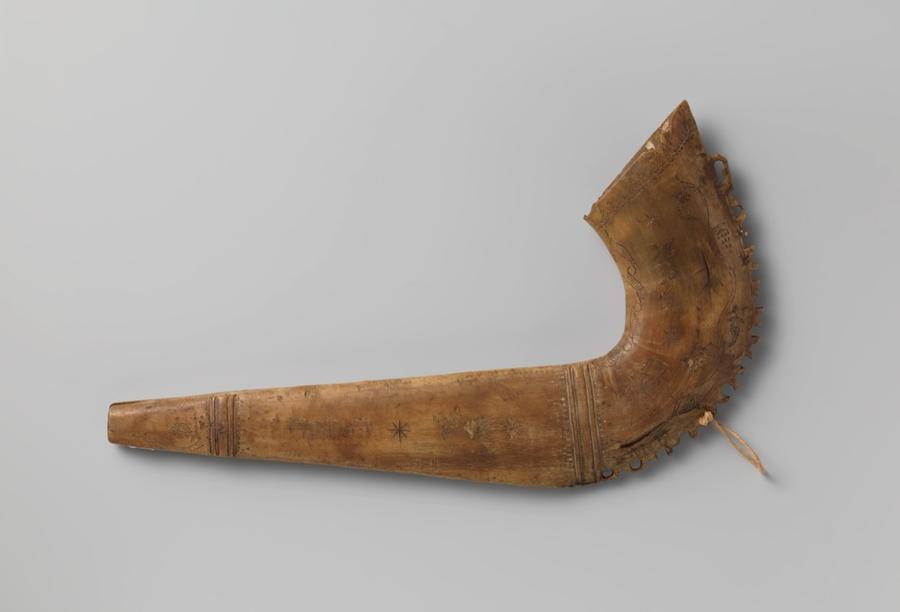
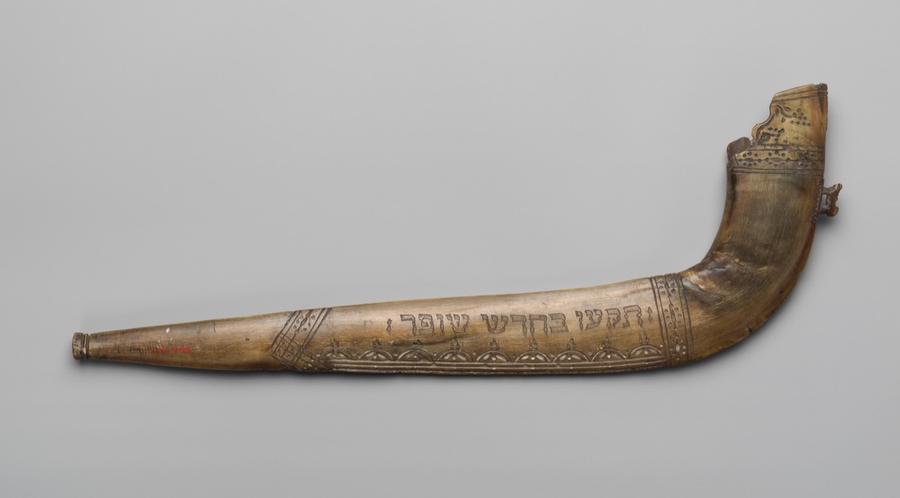
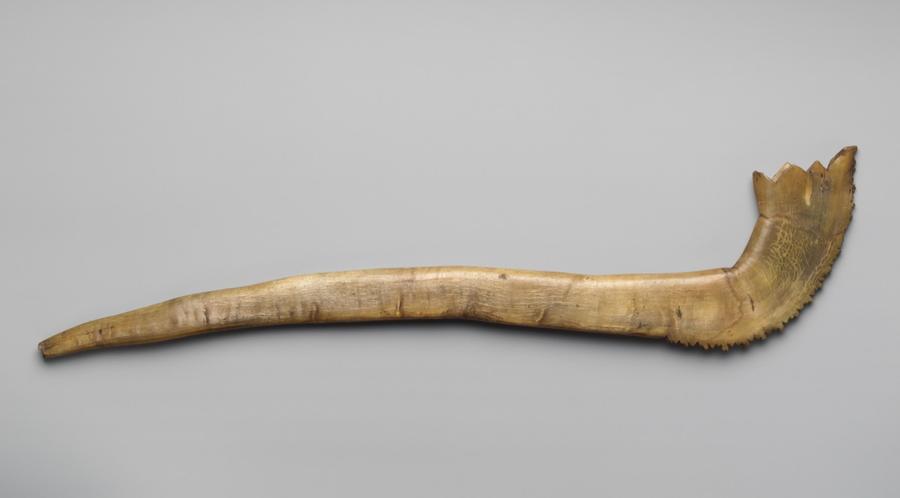
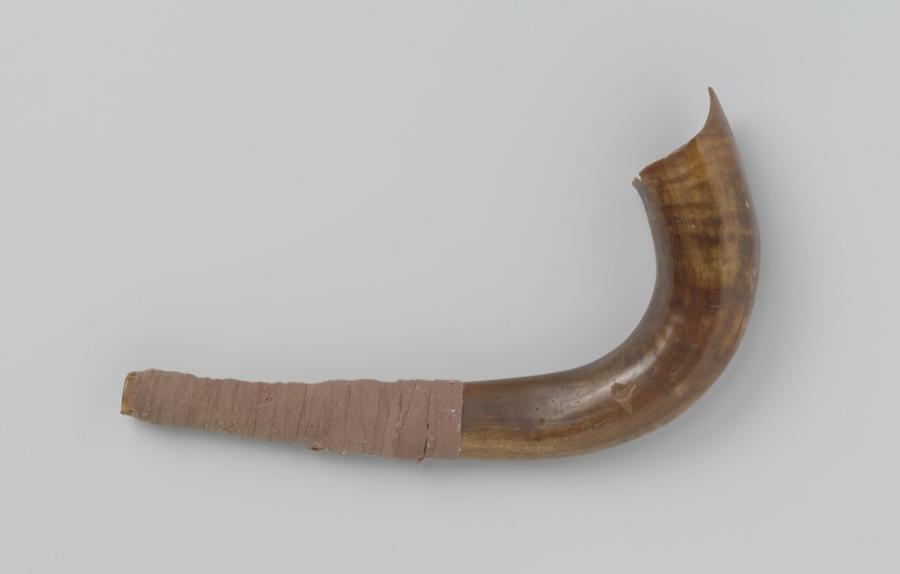
These 8 photographs span 1600–1946, 2 places of origin and 2 museums. Every photograph is public domain or openly licensed, and links to the museum’s own record.
-
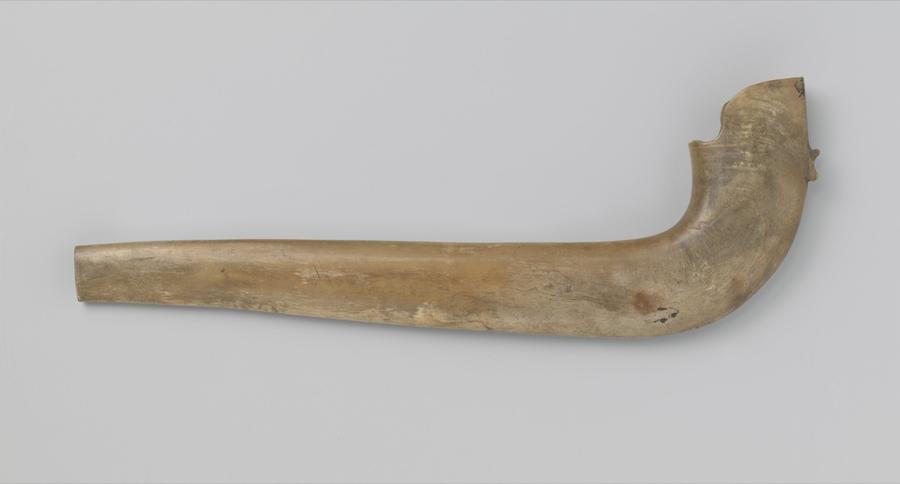
Shofarc. 1600 - in or before 1897 · Netherlands -
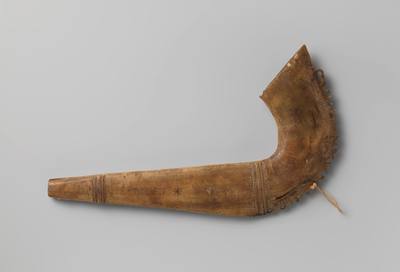
Shofar1600 - 1699 -
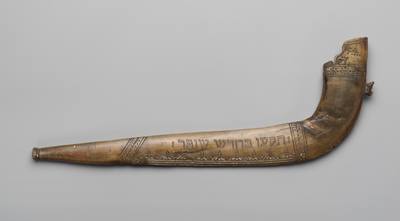
Shofar18th century (?) · Jewish -
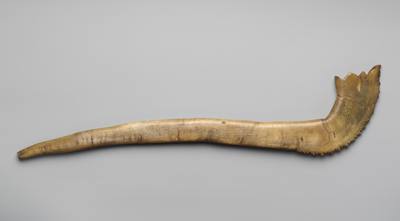
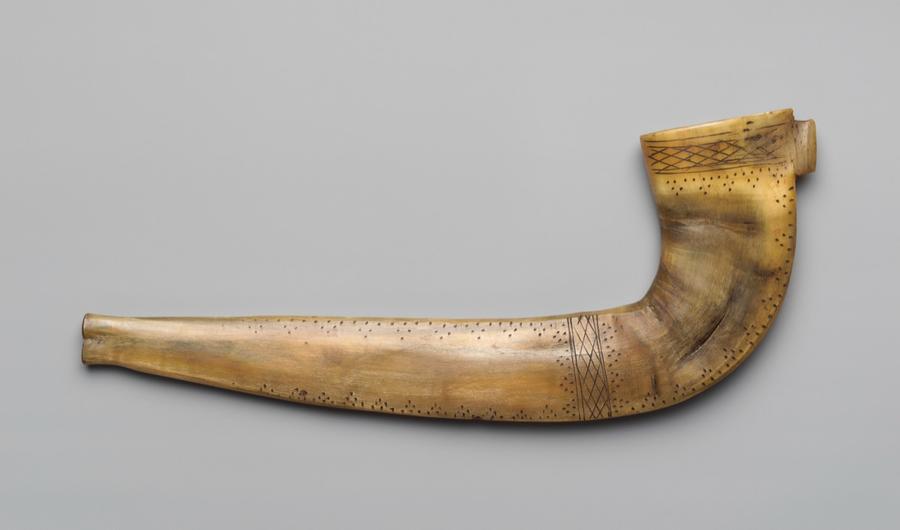
Shofar18th or 19th century · Jewish -
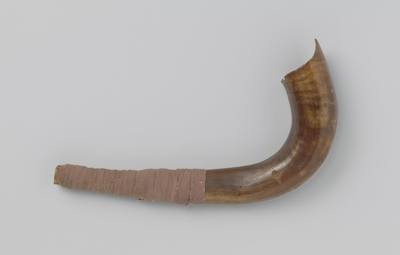
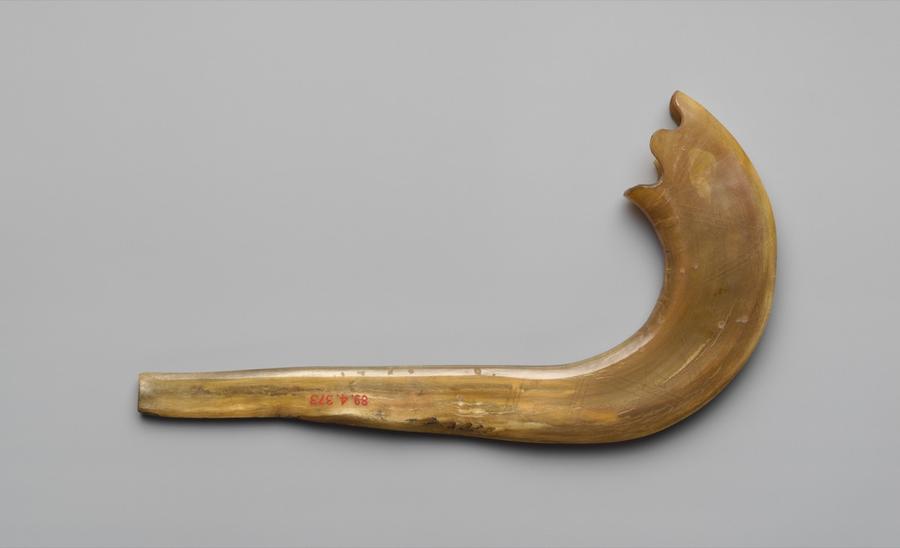
Shofarc. 1750 - c. 1800 · Europe -
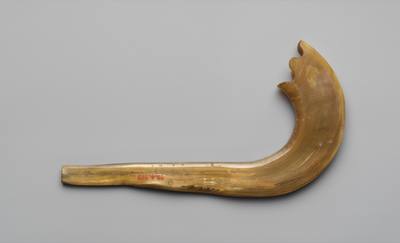
Shofar19th century · European -
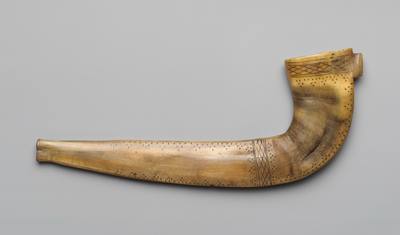
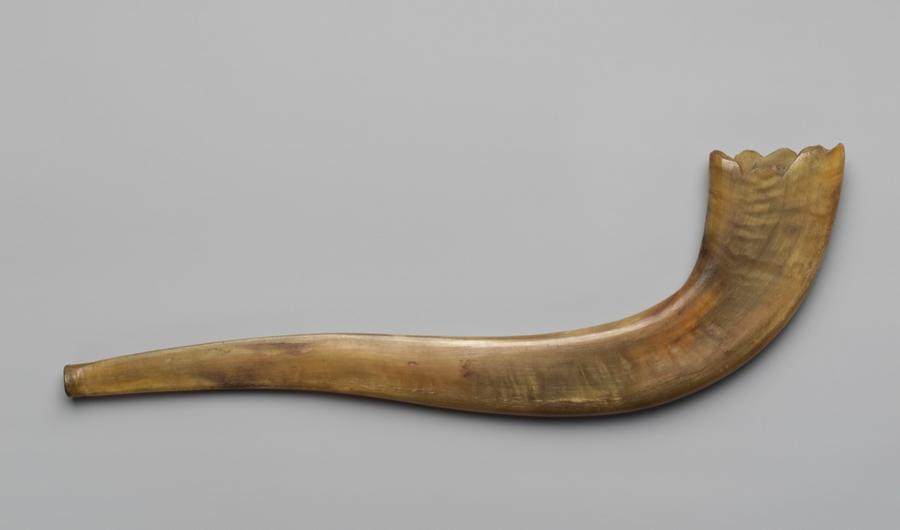
Shofar19th century · Russian (Russia) -
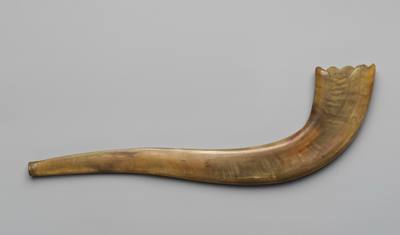
Shofarca. 1850–1946 · Jewish
Facts at a glance
| Hornbostel–Sachs number | 423.121.2 |
|---|---|
| Hornbostel–Sachs group | Aerophones › Non-free aerophones (wind instruments proper) › Trumpets |
| Also known as | ram's horn |
| Wikidata labels | 48 languages |
| Wikipedia article | Shofar |
| Wikidata item | Q48298 |
| Wikimedia Commons category | Shofars |
| MusicBrainz instrument | 7cb02b35-2fea-4d24-88d4-92413f090e3f |
| Encyclopaedia Britannica | topic/shofar |
Sources: Wikidata (CC0 1.0) — classification number, aliases, identifiers (dump of 2026-07-22); Wikipedia (CC BY-SA 4.0) — infobox fields (description of the classification number, development, inventors) and the names of the Hornbostel–Sachs groups (article “Hornbostel–Sachs”, revision of 2026-01-04).
The name in other languages
| Language | Name | Also written |
|---|---|---|
| English | shofar | ram's horn |
| French | chophar | shoffar, schofar, shophar |
| German | Schofar | Schoifer, Shoyfar, Schofarhorn |
| Spanish | Shofar | Shofár |
| Italian | shofar | sofar |
| Portuguese | shofar | |
| Dutch | sjofar | tekia, ramshoorn, teroe'a |
| Russian | шофар | |
| Japanese | ショファー | ショファール, 角笛 |
| Chinese | 唢发 | 肖法號角, 肖法号角 |
| Arabic | شوفار |
Sources: Wikidata (CC0 1.0) — labels and aliases; MusicBrainz (CC0 1.0) — instrument aliases (names only).
About the shofar: history, construction and playing
A shofar is an ancient musical horn, typically a ram's horn, used for Jewish ritual purposes. Like the modern bugle, the shofar lacks pitch-altering devices, with all pitch control done by the player's varying their embouchure. The shofar is blown in synagogue services on Rosh Hashanah and at the end of Yom Kippur; it is also blown every weekday morning in the month of Elul running up to Rosh Hashanah. Shofars come in a variety of sizes and shapes, depending on the choice of animal and level of finish.
Bible and rabbinic literature
The shofar is mentioned frequently in the Hebrew Bible, the Talmud and rabbinic literature. In the first instance, in, the blast of a shofar emanating from the thick cloud on Mount Sinai makes the Israelites tremble in awe.
The shofar was used to announce the new moon and the Jubilee year. The first day of Tishrei (now known as Rosh Hashana) is termed a "memorial of blowing", or "day of blowing", the shofar. Shofars were used for signifying the start of a war. They were also employed in processions as musical accompaniment, and were inserted into the temple orchestra by David. Note that the "trumpets" described in Numbers 10 are a different instrument, described by the Hebrew word for 'trumpet' (חצוצרה), not shofar (שופר).
In the Temple in Jerusalem, the shofar was sometimes used together with the trumpet. On Rosh Hashana, the principal ceremony was conducted with the shofar, with the instrument placed in the center with a trumpet on either side; it was the horn of an ibex (a type of wild goat) and straight in shape, being ornamented with gold at the mouthpiece. On fast days, the principal ceremony was conducted with the trumpets in the center and with a shofar on either side. On those occasions, the shofarot were rams' horns curved in shape and ornamented with silver at the mouthpieces.
On Yom Kippur of the jubilee year, the ceremony was performed with the shofar as on New Year's Day. Shofar first indicated in Yovel (Jubilee Year—Lev. 25:8–13). Indeed, in Rosh Hashanah 33b, the sages ask why the Shofar sounded in Jubilee year. Rosh Hashanah 29a indicates that in ordinary years both Shofars and trumpets are sounded but in the Jubilee Year only the Shofar blasts. The Rabbis created the practice of the Shofar's sounding every Yom Kippur rather than just on the Jubilee Year (once in 50 years).
Otherwise, for all other special days, the Shofar is sounded shorter and two special silver trumpets announced the sacrifice. When the trumpets sound the signal, all the people who were within the Temple complex prostrate themselves, stretching out flat, face down, and on the ground.
Post-Biblical times
While the shofar is best known nowadays for its use on Rosh Hashana, it also has a number of other ritual uses. It is blown each morning (and in some communities in the afternoon as well) during the month of Elul, and to mark the end of the day of fasting on Yom Kippur, once the services have been completed in the evening.
In Talmudic times the shofar was also blown to introduce Shabbat. It was also used both to initiate and dissolve a Herem.
At the inception of the diaspora, during the short-lived ban on playing musical instruments, the shofar was enhanced in its use, as a sign of mourning for the destruction of the temple. The declaration of the ban's source was in fact set to the music itself as the lamentation "Al Naharoth Bavel" within a few centuries of the ban. (A full orchestra played in the temple. The ban was so that this would not be taken for granted, hence the wording of the ban, "if I forget thee, O Jerusalem, over my chiefest joy...".) The shofar is generally no longer used for secular purposes.
Halakha (Jewish law) rules that the Rosh Hashana shofar blasts may not be sounded on Shabbat, due to the potential that the ba'al tekiah (shofar sounder) may inadvertently carry it, which is in a class of forbidden Shabbat work. Some explain this prohibition as stemming from the spiritual effects of the shofar which are matched by the spiritual energy of Shabbat, making Shofar blowing unnecessary. Originally, the shofar was sounded on Shabbat in the Temple in Jerusalem. After the temple's destruction, the sounding of the shofar on Shabbat was restricted to the place where the great Sanhedrin was located. However, when the Sanhedrin ceased to exist, the sounding of the shofar on Shabbat was discontinued.
Mitzvah
The Sages indicated that the mitzvah was to hear the sounds of the shofar. The sages received the tradition to derive from the three times the blowing of the Shofar is mentioned in the Torah in association with the high holidays, that the Shofar must be sounded three times. Customarily, each complex sound would be preceded and succeeded by a simple, straight sound, totalling nine sounds. Due to confusion whether the main complex sound was a series of three shortened sounds, nine staccato blasts, or possibly a combination of both, all three were formed into independent series of 9, 9, and 12 sounds respectively. This is the main obligation of Shofar on Rosh Hashanah.
There are many reasons cited for this Mitzvah. The most famous list was compiled by the medieval sage Saadia Gaon, cited in Abudraham.
- To remind us of the creation of the world
- to remind us of the beginning of the new year
- to remind us of the Mt. Sinai experience
- to remind us of the inspiring words of the prophets
- to remind us of the destruction of the Holy Temple
- to remind us of the Binding of Isaac.
- to arouse in us fear and awe of G‑d Al-mighty
- to arouse in us fear and awe for the Day of Judgment
- to arouse our belief in the future ingathering of the exiles and ultimate redemption of Mashiach, and inspire our yearning for it
- to arouse our belief in the future Resurrection of the Dead.
If a shofar was blown into a pit or cave, one fulfilled the mitzvah if they heard the original sound, but not if they heard the echo. Thus, most modern halakhic authorities hold that hearing a shofar on the radio or the Internet would not be valid to satisfy the mitzvah because "electronically reproduced sounds do not suffice for mitzvot that require hearing a specific natural sound.... However, one should consult a competent rabbi if an unusually pressing situation arises, as some authorities believe that performing mitzvot through electronically reproduced sound is preferable to not performing them at all."
According to Jewish law women and minors are exempt from the commandment of hearing the shofar blown (as is the case with any positive, time-bound commandment), but they are encouraged to attend the ceremony.
Qualifications
The expert who blows (or "blasts" or "sounds") the shofar is termed the ba'al tokeah or ba'al tekiah (lit. "master of the blast"). Being a ba'al tekiah is an honor. Every male Jew is eligible for this sacred office, providing he is acceptable to the congregation. The one who blows the shofar on Rosh Hashanah should be learned in the Torah and shall be God-fearing.
The Shulchan Aruch discusses who is fit to blow the shofar on behalf of a congregation:
- Anyone not obligated to fulfill the mitzvah of sounding the shofar cannot fulfill the commandment for (cover) another whose duty it is to perform the mitzvah.
- Although a woman (who is exempt from this mitzvah because it is time-bound) may not blow the shofar for men (whose duty it is to perform the mitzvah), a woman may intone the shofar for herself and other women. The Halakhic authorities debate whether a woman may recite a blessing on commandments that they are not commanded to perform; generally, Ashkenazic women recite a blessing and Sephardic women do not.
- Only a freeman (not even a slave who will become free in the next month) can be a Ba'al Tekiah.
Choice of animal
According to the Talmud, a shofar may be made from the horn of any animal from the Bovidae family except that of a cow, although a ram is preferable. Bovidae horns are made of a layer of keratin (the same material as human toenails and fingernails) around a core of bone, with a layer of cartilage in between, which can be removed to leave the hollow keratin horn. An antler, on the other hand, is made of solid bone, so an antler cannot be used as a shofar because it cannot be hollowed out.
There is no requirement for ritual slaughter (shechita). Theoretically, the horn can come from a non-kosher animal, because under most (but not all) interpretations of Jewish law, the shofar is not required to be muttar be-fikha ('permissible in your mouth'); the mitzvah is hearing the shofar, not eating the animal it came from. The shofar falls into the category of tashmishei mitzvah – objects used to perform a mitzvah that do not themselves have inherent holiness. Moreover, because horn is always inedible, it is considered afra be-alma ('mere dust') and not a non-kosher substance.
The Elef Hamagen (586:5) delineates the order of preference: 1) curved ram; 2) curved other sheep; 3) curved other animal; 4) straight—ram or otherwise; 5) non-kosher animal; 6) cow. The first four categories are used with a bracha (blessing), the fifth without a bracha, and the last, not at all.
Construction
In practice, two species are generally used: the Ashkenazi and Sefardi shofar is made from the horn of a domestic ram, while a Yemeni shofar is made from the horn of a kudu. A Moroccan shofar is flat, with a single, broad curve. A crack or hole in the shofar affecting the sound renders it unfit for ceremonial use. A shofar may not be painted in colors, but it may be carved with artistic designs. Shofars (especially the Sephardi shofars) are sometimes plated with silver across part of their length for artistic display purposes, although this invalidates them for use in religious ritual practices.
The horn is flattened and shaped by the application of heat, which softens it. A hole is made from the tip of the horn to the natural hollow inside. It is played much like a European brass instrument, with the player blowing through the hole while buzzing the lips, causing the air column inside to vibrate. Sephardi shofars do usually have a carved mouthpiece resembling that of a European trumpet or French horn, but smaller. Ashkenazi shofars do not.
Because the hollow of the shofar is irregular in shape, the harmonics obtained when playing the instrument can vary: rather than a pure perfect fifth, intervals as narrow as a fourth, or as wide as a sixth may be produced.
Source: Wikipedia, “Shofar” — CC BY-SA 4.0 — text excerpted as published (references, images and tables removed); see the article for the full text and the list of authors. Revision of 2026-06-23.
Sources and licences
- Shofar, Anonymous, c. 1600 - in or before 1897, Netherlands. horn (animal material). Gift of Boutelje, Amsterdam. Museum record · Public Domain Mark 1.0
- Shofar, Anonymous, 1600 - 1699. horn (animal material). Gift of Kolfschoten, Kerkdriel. Museum record · Public Domain Mark 1.0
- Shofar, 18th century (?), Jewish. ram's horn. The Crosby Brown Collection of Musical Instruments, 1889 (89.4.2899). Museum record · CC0 1.0 (public domain dedication)
- Shofar, 18th or 19th century, Jewish. Horn. The Crosby Brown Collection of Musical Instruments, 1889 (89.4.1501). Museum record · CC0 1.0 (public domain dedication)
- Shofar, Anonymous, c. 1750 - c. 1800, Europe. horn (animal material). Purchased with the support of the Johan Huizinga Fonds/Rijksmuseum Fonds. Museum record · Public Domain Mark 1.0
- Shofar, 19th century, European. Animal horn. The Crosby Brown Collection of Musical Instruments, 1889 (89.4.373). Museum record · CC0 1.0 (public domain dedication)
- Shofar, 19th century, Russian (Russia). horn. The Crosby Brown Collection of Musical Instruments, 1889 (89.4.3375). Museum record · CC0 1.0 (public domain dedication)
- Shofar, ca. 1850–1946, Jewish. Horn. Gift of The University Museum, University of Pennsylvania, 1953 (53.56.7). Museum record · CC0 1.0 (public domain dedication)
Photographs: open-access collections of the museums named above; each is shown here reduced in size, otherwise unchanged. Text: Wikipedia (CC BY-SA 4.0), Wikidata and MusicBrainz (CC0). The full list of sources and licences is on the credits page.