
Instruments · Aerophones
Bugle
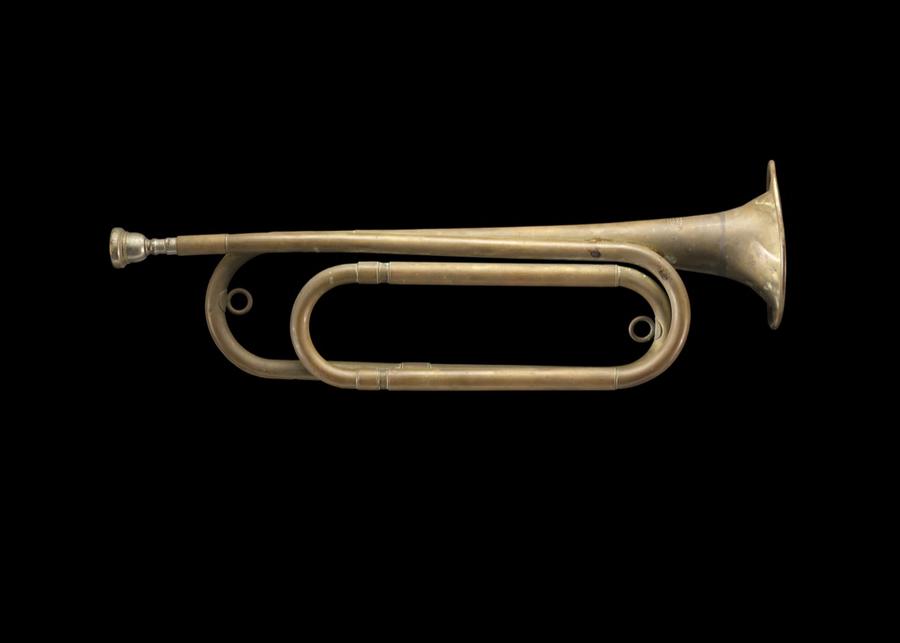
The bugle is a very simple brass instrument. It has no valves or other mechanisms, the only way the player has to control the pitch is changing the shape of his lips. This means that only notes from the harmonic series can be played.
Summary: Simple English Wikipedia, “Bugle” — CC BY-SA 4.0. Revision of 2021-05-28.
Museum photographs
These 8 photographs span 1800–1970, 6 places of origin and 3 museums. Every photograph is public domain or openly licensed, and links to the museum’s own record.
-
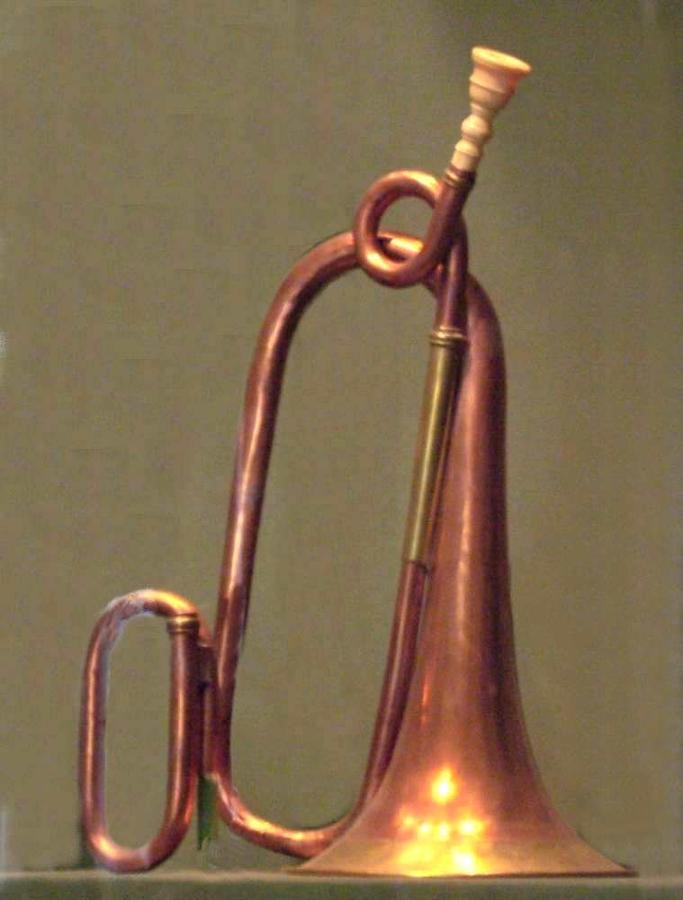
Bugle in Eca. 1810 · German (Ireland or United Kingdom) -
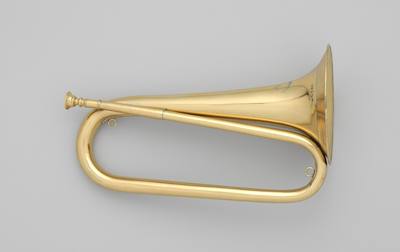
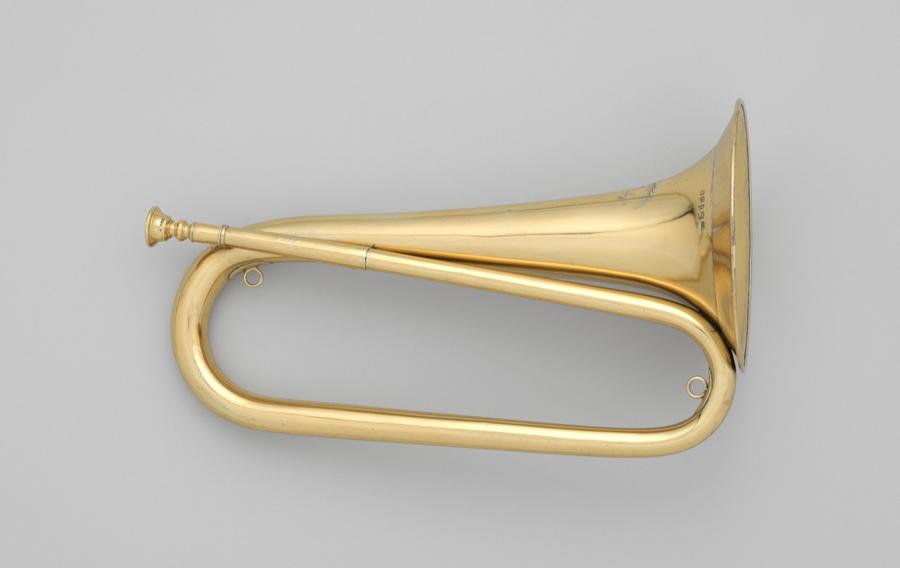
Bugle in C1811 · British (United Kingdom) -
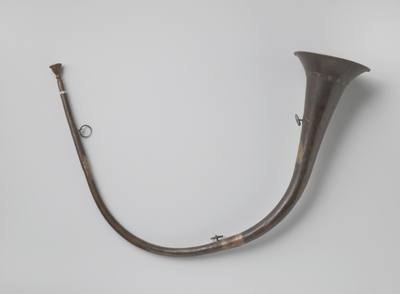
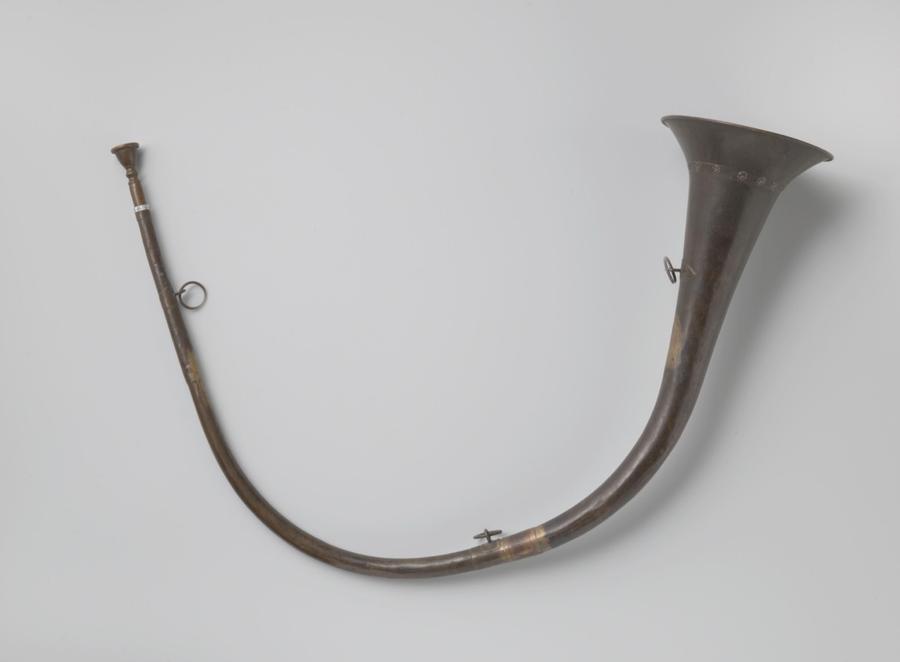
Half-moon-shaped bugle (halbmond)c. 1800 · Germany -
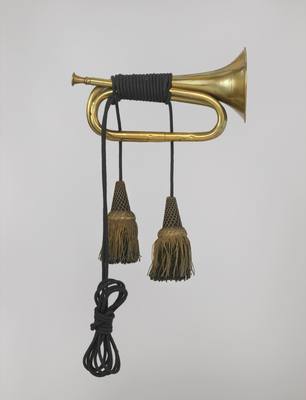
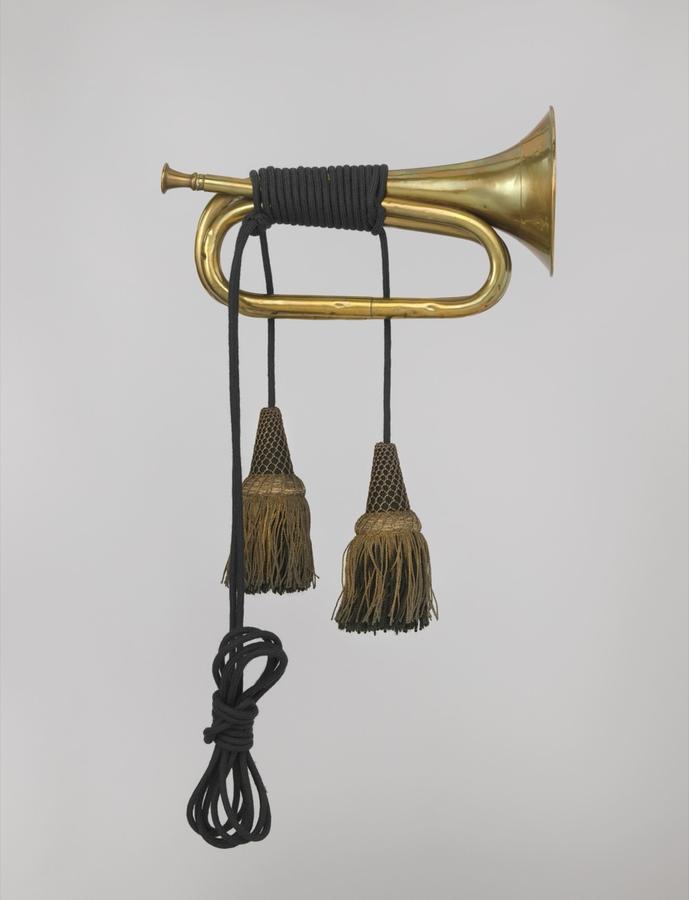
Buglec. 1820 · Amsterdam -
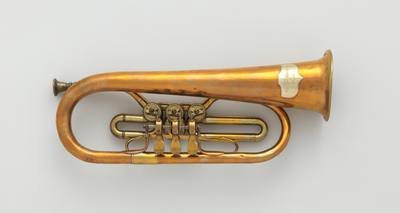
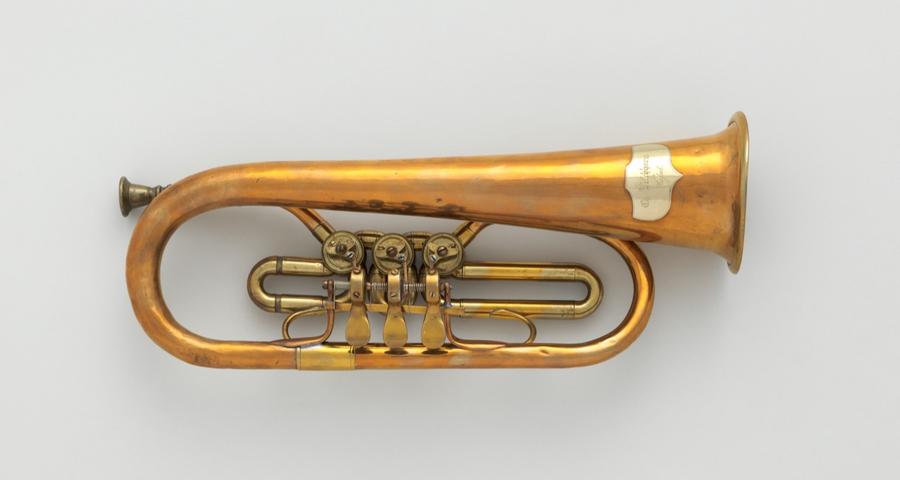
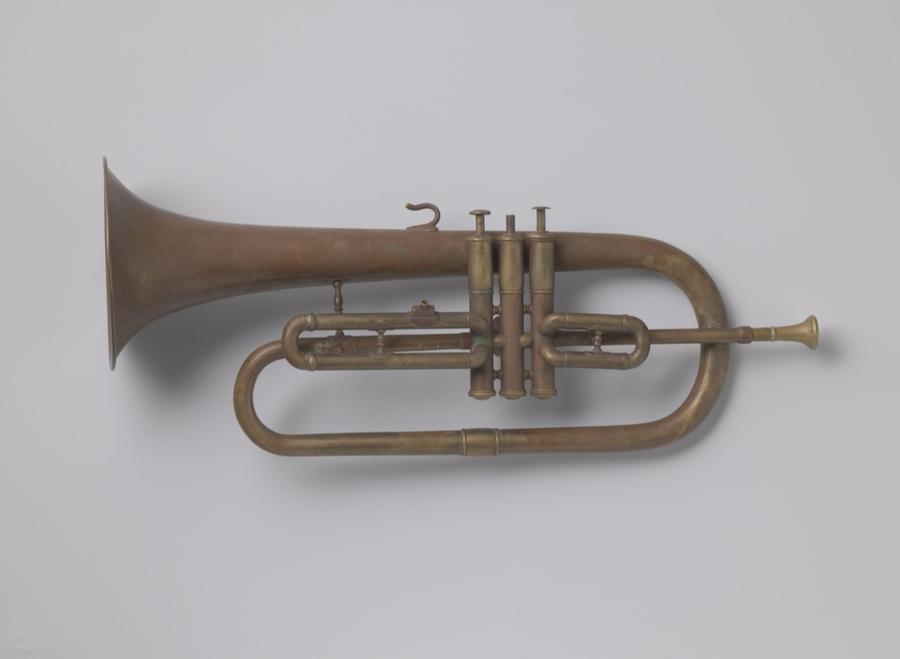
Flügelhorn (valve bugle) in B-flat1849–55 · Germany -
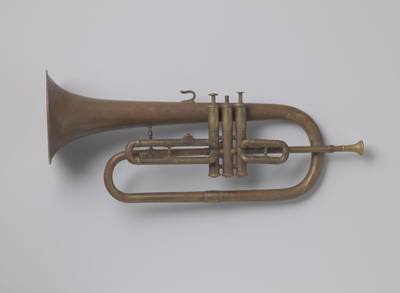
Bugleafter 1855 - before 1868 -
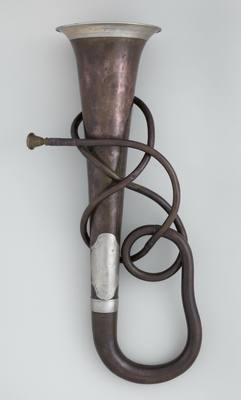
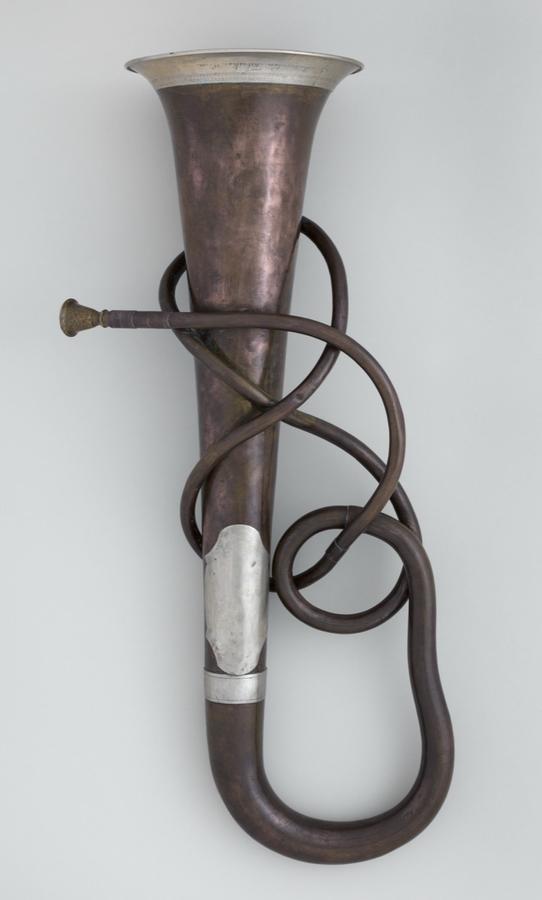
Tenor Bugle in B-flatca. 1862 · Austrian (Austria) -
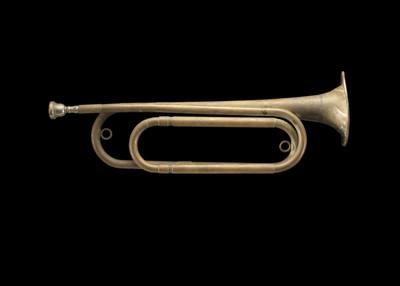
Bugle1916-1970 · African Americans (United States)
Facts at a glance
| Hornbostel–Sachs number | 423.121.22 — End-blown natural labrosone with curved or folded tube, wide conical bore and separate mouthpiece |
|---|---|
| Hornbostel–Sachs group | Aerophones › Non-free aerophones (wind instruments proper) › Trumpets |
| Also known as | field trumpet |
| Developed | Antiquity; modern forms |
| Wikidata labels | 38 languages |
| Wikipedia article | Bugle |
| Wikidata item | Q1628293 |
| Wikimedia Commons category | Bugles |
| MusicBrainz instrument | d8afa42b-9287-41a2-82b2-2a96cb6b6fca |
| Encyclopaedia Britannica | art/bugle |
| Audio sample (Wikimedia Commons) | Reveille on bugle.ogg |
Sources: Wikidata (CC0 1.0) — classification number, aliases, identifiers (dump of 2026-07-22); Wikipedia (CC BY-SA 4.0) — infobox fields (description of the classification number, development, inventors) and the names of the Hornbostel–Sachs groups (article “Hornbostel–Sachs”, revision of 2026-01-04).
The name in other languages
| Language | Name | Also written |
|---|---|---|
| English | bugle | field trumpet |
| French | clairon | |
| German | Bügelhorn | Horn |
| Spanish | corneta natural | corneta |
| Italian | bugle | |
| Dutch | klaroen | natuurbugel |
| Russian | горн | горны |
| Japanese | ビューグル | |
| Chinese | 軍號 (樂器) | |
| Arabic | نفير | بوجل (آلة موسيقية) |
Sources: Wikidata (CC0 1.0) — labels and aliases; MusicBrainz (CC0 1.0) — instrument aliases (names only).
About the bugle: history, construction and playing
The bugle is a simple signaling brass instrument with a wide conical bore. It normally has no valves or other pitch-altering devices, and is thus limited to its natural harmonic notes, and pitch is controlled entirely by varying the air and embouchure.
History
The English word bugle comes from a combination of words. From French, it reaches back to cor buglèr and bugleret, indicating a signaling horn made from a small cow's horn. Going back further, it touches on Latin, buculus, meaning bullock. Old English also influences the modern word with bugle, meaning "wild ox."
The name indicates an animal's (cow's) horn, which was the way horns were made in Europe after the fall of the Western Roman Empire. The modern bugle is made from metal tubing, and that technology has roots which date back to the Roman Empire, as well as to the Middle East during the Crusades, where Europeans re-discovered metal-tubed trumpets and brought them home.
Historically, horns were curved trumpets, conical, often made from ox or other animal horns, from shells, from hollowed ivory such as the olifant. There existed another tradition of trumpets made of straight metal tubes of brass or silver that went back in Europe as far as the Greeks (salpinx) and Romans (Roman tuba), and further back to the Etruscans, Assyrians and Egyptians (King Tut's Trumpet). After the fall of Rome, when much of Europe was separated from the remaining Eastern Roman Empire, the straight, tubular sheet-metal trumpet disappeared and curved horns were Europe's trumpet.
The sheet-metal tubular trumpet persisted in the Middle East and Central Asia as the nafir and karnay, and during the Reconquista and Crusades, Europeans began to build them again, having seen these instruments in their wars. The first made were the añafil in Spain and buisine in France and elsewhere. Then Europeans took a step that hadn't been part of trumpet making since the Roman (buccina and cornu); they figured out how to bend tubes without ruining them and by the 1400s were experimenting with new instruments.
Uses
Pitch control is done by varying the player's air and embouchure. Consequently, the bugle is limited to notes within the harmonic series. Scores for standard bugle calls use the five notes of the "bugle scale".
The bugle is used mainly in the military, where the bugle call is used to indicate the daily routines of camp. Historically, the bugle was used in the cavalry to relay instructions from officers to soldiers during battle. They were used to assemble the leaders and to give marching orders to the camps.
The bugle is also used in Boy Scout troops and in the Boys' Brigade.
The Rifles, an infantry regiment in the British Army, has retained the bugle for ceremonial and symbolic purposes, as did other rifle regiments before it. When originally formed in 1800, the Rifle Corps were the first dedicated light infantry unit in the British Army and were allowed a number of unique accoutrements that were believed to be better suited for skirmishing, such as their green jackets. Other infantry used drums when marching and had whistles to signal when skirmishing, but the Rifle Corps was a much larger body of men that would be expected to spread out over a large area under a single commander. As a result, the bugle was taken from cavalry traditions because signals could pass much further without the need for repeats. The buglers in each battalion are headed by the bugle major, a senior non-commissioned officer holding the rank of sergeant or above.
The bugle has also been used as a sign of peace in the case of a surrender.
In most military units, the bugle can be fitted with a small banner or tabard (occasionally gold fringed) with the arms of its reporting service branch or unit.
In military tradition, the Last Post or Taps is the bugle call that signifies the end of the day's activities. It is also sounded at military funerals to indicate that the soldier has gone to his final rest and at commemorative services such as Anzac Day in Australia and New Zealand and Remembrance Day in Canada.
Variations
The cornet is sometimes erroneously considered a valved bugle, but the cornet was derived from more narrow-bored instruments, the French cornet de poste (lit. post horn) and cor de chasse (lit. hunting horn).
Keyed bugles (Klappenhorn) were invented in the early 19th century. In England, a patent for one design was taken out by Joseph Halliday in 1811 and became known as the Kent bugle. This bugle established itself in military band music in Britain and America, and its popularity is indicated by the existence of many published method books and arrangements. It was in wide use until about 1850 by which time it had been largely replaced by the cornet. Richard Willis, appointed the first bandmaster of the United States Military Academy's West Point Band in 1817, wrote and performed many works for the keyed bugle.
Since the mid 19th century, bugles have generally been made with piston valves.
Source: Wikipedia, “Bugle” — CC BY-SA 4.0 — text excerpted as published (references, images and tables removed); see the article for the full text and the list of authors. Revision of 2026-05-16.
From Grove’s Dictionary (1900)
Two methods have been adopted for bridging over the gaps between the open notes of this instrument, viz. keys and valves. The key-bugle, called also the 'Kent bugle' and 'Regent's bugle,' which was extremely popular some forty years ago, has been entirely superseded by the valve system. No doubt the latter, as in the cornet and euphonium, preserves the whole length of tube for the higher notes, and thus gains power and fulness; but it is a question whether the keyed instrument does not produce more accurate intonation and a tenderer quality of tone. This however is a matter to which English bandmasters seem perfectly indifferent, although the Flügelhorn and the key-bugle are still to be heard with effect in the superb bands of Austria.
Source: Wikisource, A Dictionary of Music and Musicians (Grove, 1900) — “Bugle” (entry by William H. Stone) — Public domain (published 1879–1910; authors died before 1929) — the first paragraphs of the entry, as transcribed; see the page for the full entry.
Sources and licences
- Bugle in E, Johann Bernhard Logier, ca. 1810, German (Ireland or United Kingdom). Copper, brass, ivory. Purchase, Gift of Barnard College, by exchange, 1998 (1998.352). Museum record · CC0 1.0 (public domain dedication)
- Bugle in C, Thomas Key; William Trayls, 1811, British (United Kingdom). Silver-gilt. Rogers Fund, 1975 (1975.270a, b). Museum record · CC0 1.0 (public domain dedication)
- Half-moon-shaped bugle (halbmond), Anonymous, c. 1800, Germany. copper (metal). Purchased with the support of the State of the Netherlands and the Vereeniging van Noord-Nederlandsche Muziekgeschiedenis. Museum record · Public Domain Mark 1.0
- Bugle, c. 1820, Amsterdam. brass (alloy), lenyard, textile materials, copper (metal). Gift of the Koninklijke Militaire Academie. Museum record · Public Domain Mark 1.0
- Flügelhorn (valve bugle) in B-flat, Johann David Christian Loeschhorn, 1849–55, Germany. Brass, nickel-silver. The Crosby Brown Collection of Musical Instruments, 1889 (89.4.2203). Museum record · CC0 1.0 (public domain dedication)
- Bugle, Egidius Petrus van Osch, after 1855 - before 1868. copper (metal). Rijksmuseum, Amsterdam. Museum record · Public Domain Mark 1.0
- Tenor Bugle in B-flat, Josef Serpek, ca. 1862, Austrian (Austria). Brass, nickel-silver. The Crosby Brown Collection of Musical Instruments, 1889 (89.4.2546). Museum record · CC0 1.0 (public domain dedication)
- Bugle, 1916-1970, African Americans (United States). metal. Collection of the Smithsonian National Museum of African American History and Culture, Gift of Alan Laird. Museum record · CC0 1.0 (public domain dedication)
Photographs: open-access collections of the museums named above; each is shown here reduced in size, otherwise unchanged. Text: Wikipedia (CC BY-SA 4.0), Grove’s Dictionary (public domain), Wikidata and MusicBrainz (CC0). The full list of sources and licences is on the credits page.