
Instruments · Aerophones
Flugelhorn
A Flügelhorn is a musical instrument, a part of the brass family. It looks similar to the trumpet but the tubing is wider and more conical. It is pitched in Bb like trumpets and cornets. It can have three piston valves like a trumpet, or rotary valves like a French horn. It has been described as being a bugle with valves. The sound is more mellow, not as harsh as a trumpet.
Summary: Simple English Wikipedia, “Flugelhorn” — CC BY-SA 4.0. Revision of 2023-10-30.
Museum photographs
These 3 photographs span 865–1865, 2 places of origin and 2 museums. Every photograph is public domain or openly licensed, and links to the museum’s own record.
-
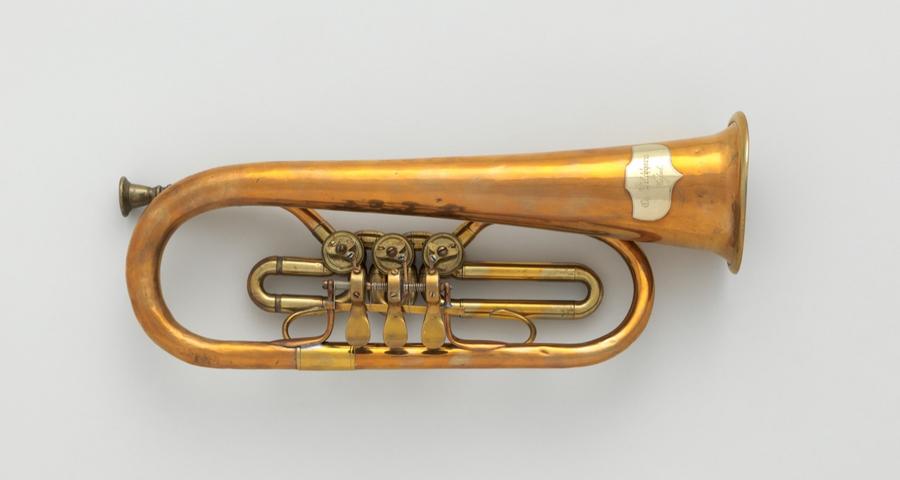
Flügelhorn (valve bugle) in B-flat1849–55 · Germany -
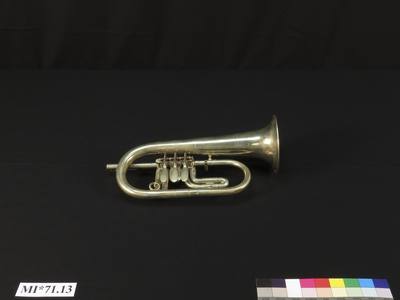
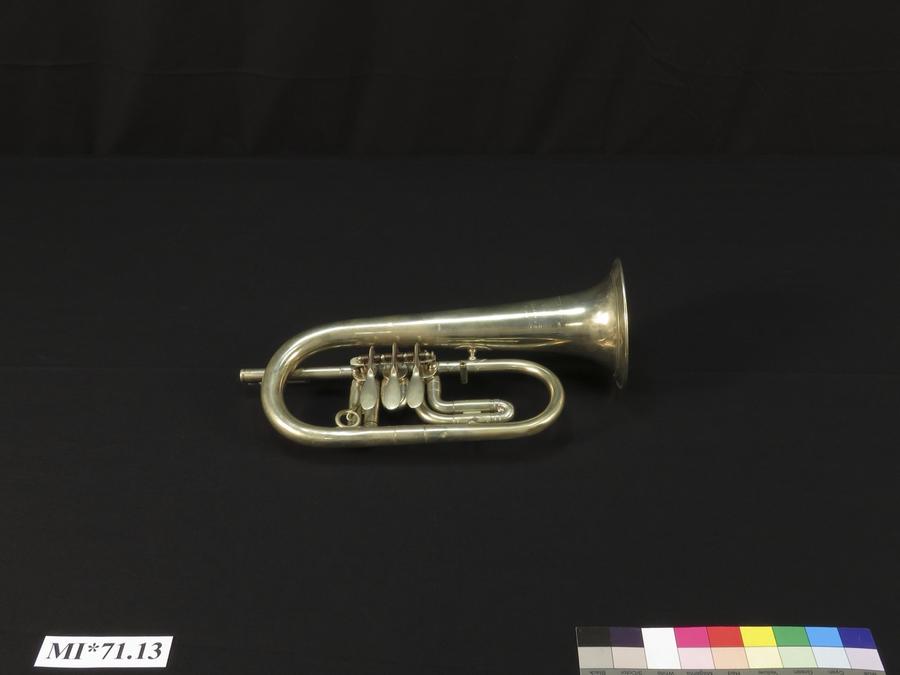
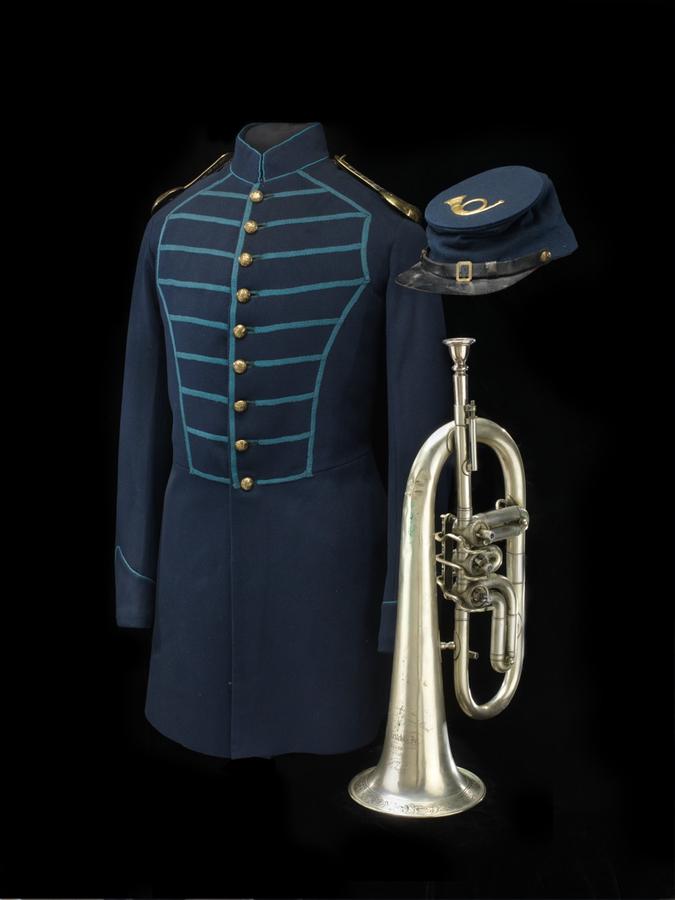
Wright & Co. Flugelhorn1864- 865 · United States -
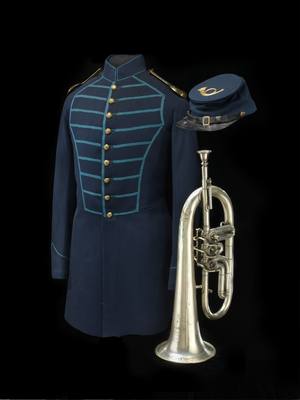
Wright Presentation Flugelhornca 1863 · United States
Facts at a glance
| Hornbostel–Sachs number | 423.232 — valved lip-reed aerophone with wide conical bore |
|---|---|
| Hornbostel–Sachs group | Aerophones › Non-free aerophones (wind instruments proper) › Trumpets |
| Also known as | B♭ soprano saxhorn |
| Developed | Early 19th century |
| Wikidata labels | 52 languages |
| Wikipedia article | Flugelhorn |
| Wikidata item | Q382616 |
| Wikimedia Commons category | Flugelhorns |
| MusicBrainz instrument | fd016966-658e-40db-8fe1-f2235fe1e9a3 |
| Encyclopaedia Britannica | art/flugelhorn |
Sources: Wikidata (CC0 1.0) — classification number, aliases, identifiers (dump of 2026-07-22); Wikipedia (CC BY-SA 4.0) — infobox fields (description of the classification number, development, inventors) and the names of the Hornbostel–Sachs groups (article “Hornbostel–Sachs”, revision of 2026-01-04).
The name in other languages
| Language | Name | Also written |
|---|---|---|
| English | flugelhorn | B♭ soprano saxhorn |
| French | bugle | saxhorn soprano en si ♭, bluggelhorn, bluegelhorn |
| German | Flügelhorn | Flugelhorn, Fluegelhorn |
| Spanish | fliscorno | Flügelhorn, Fliscornio, Fiscornio |
| Italian | flicorno soprano | |
| Portuguese | fliscorne | Flugelhorn, Fluegelhorn |
| Dutch | bugel | flügelhorn, bugelist, flügelhoorn |
| Russian | флюгельгорн | |
| Japanese | フリューゲルホルン | フリューゲル・ホーン, Flugelhorn, フリューゲル・ホルン |
| Chinese | 柔音號 | |
| Korean | 플루겔호른 | |
| Arabic | بوق جناحي | فلوجل هورن |
Sources: Wikidata (CC0 1.0) — labels and aliases; MusicBrainz (CC0 1.0) — instrument aliases (names only).
About the flugelhorn: history, construction and playing
The flugelhorn (also fluegelhorn, flugel horn; from German, Flügelhorn) is a high brass instrument similar to the trumpet and cornet, but with the wider conical bore of a bugle producing a darker, mellower sound. Like trumpets and cornets, most flugelhorns are pitched in 4½-foot (′) B♭, though some are in ′ C. It is a type of valved bugle, developed in Germany in the early 19th century from earlier traditional valveless bugles, and to replace the keyed bugle. Flugelhorns usually have piston valves in North America, France, Britain, and Commonwealth countries, and rotary valves in central and eastern Europe.
History
The German word Flügel means wing or flank in English. In early 18th century Germany, a ducal hunt leader known as a Flügelmeister used a Flügelhorn to direct his wing of the hunting party. It was originally a form of signal horn called a Halbmond (lit. half-moon), a large, semicircular brass or silver valveless horn with a conical bore. Military use dates from the Seven Years' War, during which the instrument was employed as a predecessor of the bugle.
By the end of the 18th century, attempts were made to extend the bugle's limited natural series of six to eight notes to a full chromatic scale using tone holes and keys, resulting in the first keyed bugles, appearing in Dublin and London around 1800. The keyed bugle was adopted by British and European military and brass bands, and helped to popularize the melodic and virtuosic playing of brass instruments to new and wide cross-sections of the general public.
The first bugles with valves were sold in Berlin in 1828 by Heinrich Stölzel, inventor of the first piston valves. Based on the keyed bugle, the valved bugle retained the bell construction of red brass or copper, with brass or nickel silver keys and fittings. The valved bugle was called the Flügelhorn in Bavaria, and replaced the keyed bugle as the primary soprano melody instrument in Bavarian bands and ensembles, and has remained in that role since. The valved bugles also provided the Paris-based instrument maker Adolphe Sax, creator of the saxophone, with the inspiration for his saxhorn family of instruments, including the B♭ soprano size which served as the model for the modern piston-valve flugelhorn.
A compact version of the rotary valve flugelhorn is the oval shaped kuhlohorn in B♭ developed in the late 1890s by Johannes Kuhlo. Kuhlo and his father Eduard Kuhlo founded the Posaunenchor movement, which introduced brass ensemble music to German Protestant churches. The kuhlohorn provided a softer soprano, closer to the human voice than the trumpet.
Construction
The modern flugelhorn is generally pitched in 4½-foot (′) B♭, like most trumpets and cornets. It usually has three piston valves, though instruments made in central and eastern Europe are built with rotary valves. Some flugelhorns feature a fourth valve that lowers the pitch by a perfect fourth, like the fourth valve often found on euphoniums, tubas, and piccolo trumpets. This adds a useful low range that, coupled with the flugelhorn's darker sound, extends the instrument's capabilities.
The flugelhorn is distinguished from both the cornet and trumpet by its wider conical bore, which undergoes conical expansion for a longer proportion of its tubing. The flugelhorn's (necessarily cylindrical) valves are mounted directly onto the leadpipe a short distance from the mouthpiece receiver, leaving a much longer proportion of its length after the valves to gradually expand into the bell flare. On the trumpet and cornet, the leadpipe is much longer, and the valves are mounted after the first bow, resulting in a higher proportion of cylindrical bore tubing.
The internal profile of a flugelhorn mouthpiece is more deeply funnel-shaped than trumpet and cornet mouthpieces, which are shaped more like a cup, but less conical than a horn mouthpiece.
A bass flugelhorn in ′ C, called a fiscorn, is used in pairs in the cobla bands of Catalonia, that provide music for sardana dancers.
Performance
The valves give the flugelhorn the same facility and agility as the cornet or trumpet. It employs the same fingering, so its similarity in size means it can be played by trumpet and cornet players, with some adjustment to breath and embouchure.
The flugelhorn is used frequently in jazz and popular music. It figured prominently in many of Burt Bacharach's 1960s pop song arrangements, and had a solo role in Bert Kaempfert's 1962 recording of "That Happy Feeling".
The flugelhorn is found in the Dutch and Belgian Fanfareorkesten (lit. fanfare orchestras), where it has a significant role with up to 20 players. They are pitched in B♭ and occasionally add an E♭ solo part, although it is often played on an E♭ trumpet or cornet.
Flugelhorns have occasionally been used as the alto or low soprano voice in a drum and bugle corps, and a single flugelhorn is also standard in the British brass band. The British film Brassed Off (1996) features a flugelhorn performance of the Adagio from Rodrigo's Concierto de Aranjuez as a pivotal plot device. The solo was played by Paul Hughes.
Timbre
The timbre of the flugelhorn is softer than the trumpet or cornet. Its wide conical bore dampens the higher frequency partials in the sound to produce a mellow, more rounded tone quality compared to instruments with a cylindrical bore at the same pitch. The sound of the flugelhorn has been described as halfway between a trumpet and a horn, whereas the cornet's sound is halfway between a trumpet and a flugelhorn.
Source: Wikipedia, “Flugelhorn” — CC BY-SA 4.0 — text excerpted as published (references, images and tables removed); see the article for the full text and the list of authors. Revision of 2026-06-24.
Composers who played it
6 composers on this site list the flugelhorn as an instrument they played. A selection:
- Carl Nielsen 1865–1931
- Karel Komzák II 1850–1905
- Siegfried Kurz 1930–2023
- Palle Mikkelborg 1941–
- Jun Miyake 1958–
- Jacob de Haan 1959–
Composers with a page on this site whose Wikidata record lists this instrument; featured and best-dated first. Data: Wikidata (property “instrument”, P1303), CC0 1.0.
Sources and licences
- Flügelhorn (valve bugle) in B-flat, Johann David Christian Loeschhorn, 1849–55, Germany. Brass, nickel-silver. The Crosby Brown Collection of Musical Instruments, 1889 (89.4.2203). Museum record · CC0 1.0 (public domain dedication)
- Wright & Co. Flugelhorn, 1864- 865, United States. brass (overall material); nickel silver (overall material). Gift of Frank Scimonelli. Museum record · CC0 1.0 (public domain dedication)
- Wright Presentation Flugelhorn, ca 1863, United States. nickel silver (overall material). Gift of Frances Gordon. Museum record · CC0 1.0 (public domain dedication)
Photographs: open-access collections of the museums named above; each is shown here reduced in size, otherwise unchanged. Text: Wikipedia (CC BY-SA 4.0), Wikidata and MusicBrainz (CC0). The full list of sources and licences is on the credits page.