
Instruments · Aerophones
Cornet
A cornet is a brass instrument that is similar to the trumpet. It is part of the higher-brass family, together with trumpets and French horns.
Summary: Simple English Wikipedia, “Cornet” — CC BY-SA 4.0. Revision of 2017-01-24.
Museum photographs
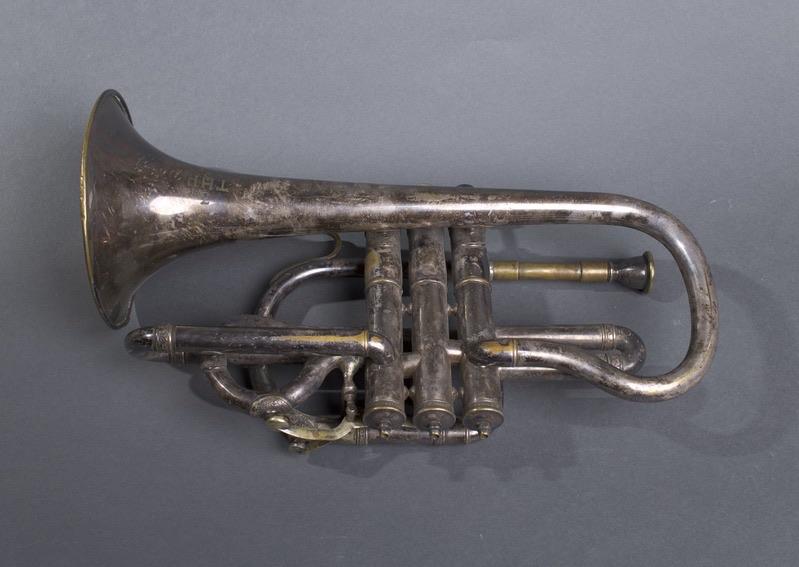
These 9 photographs span 1833–1977, 5 places of origin and 3 museums. 2 of them carry no date in the museum record. Every photograph is public domain or openly licensed, and links to the museum’s own record.
-
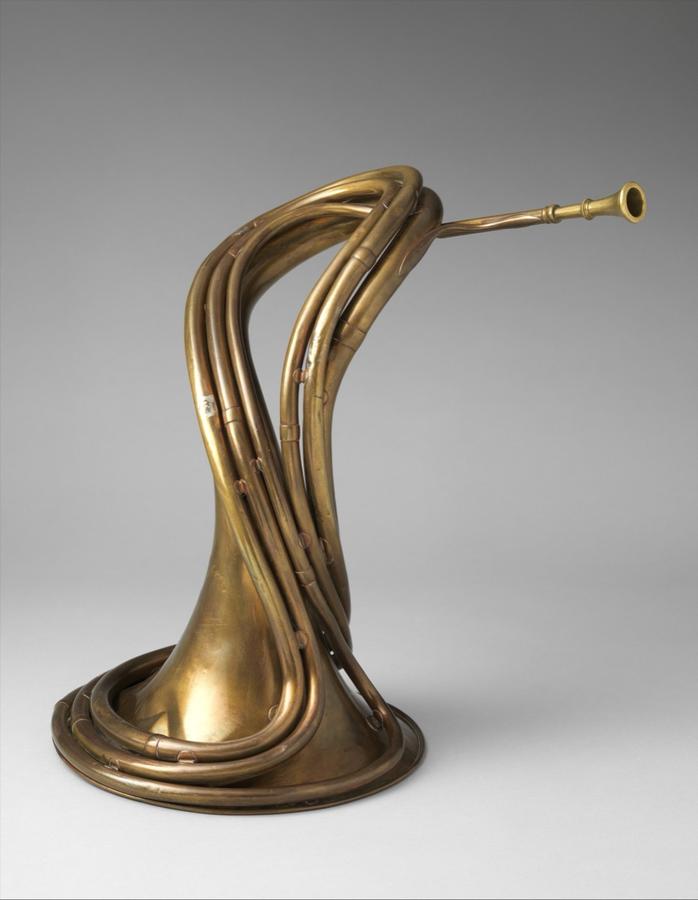
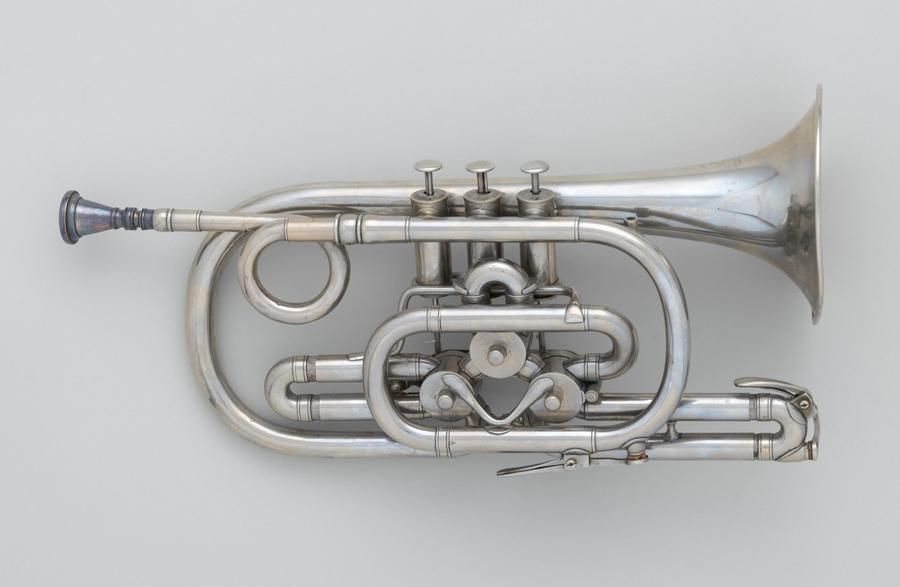
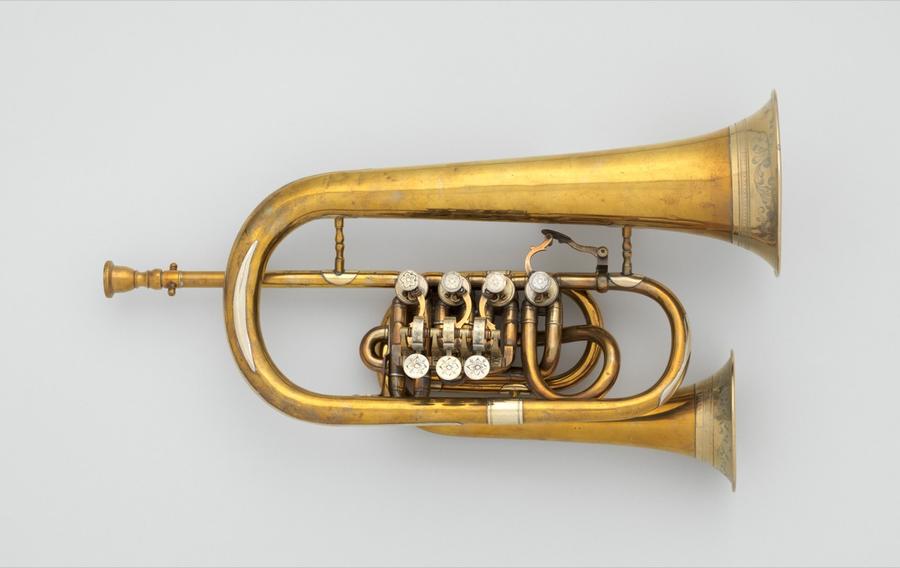
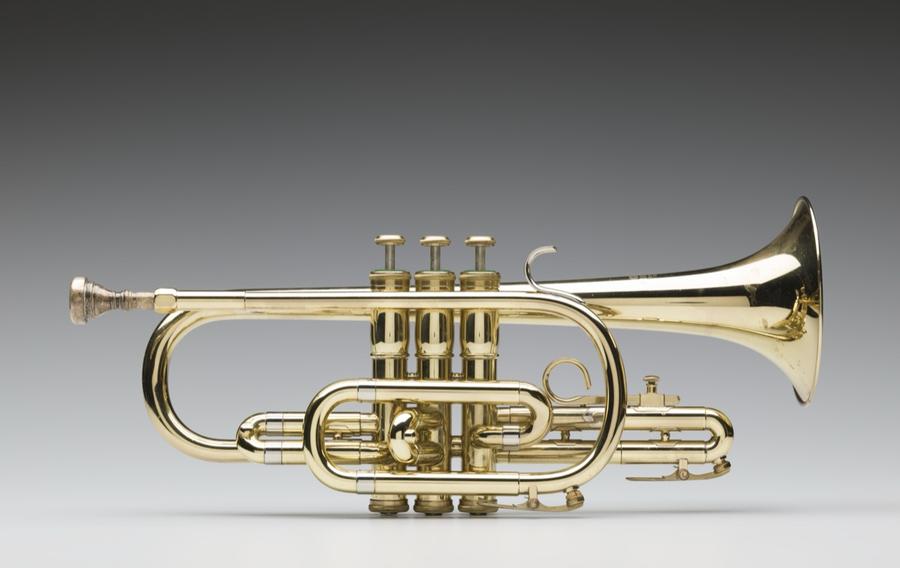
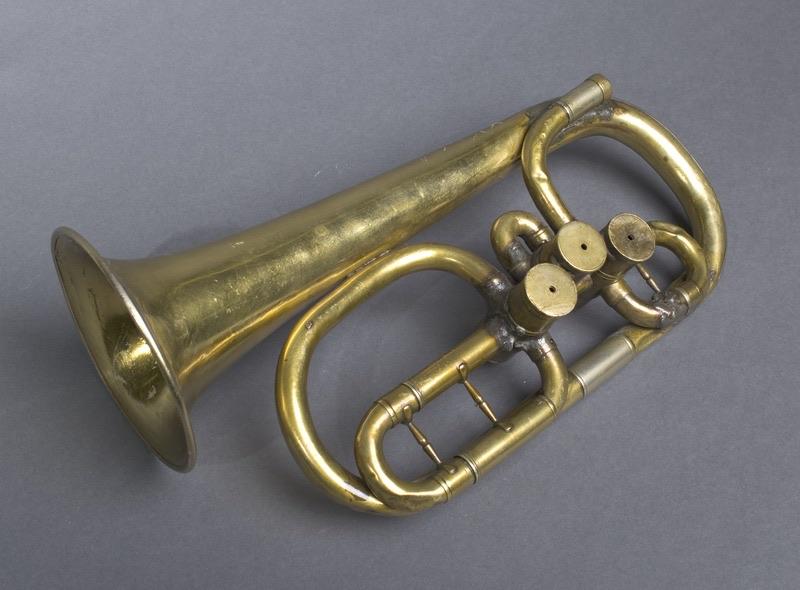
Cornet-trompe in Dca. 1862 · French (France) -
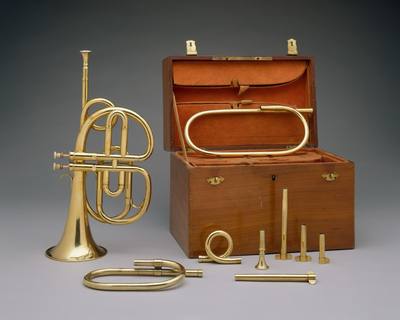
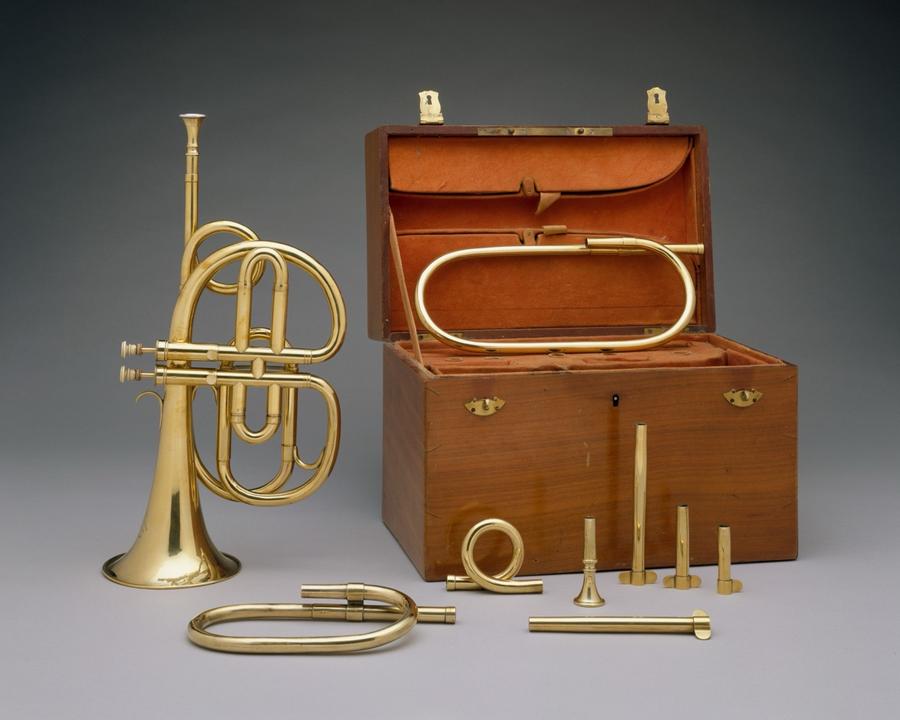
Cornet à Pistons in B-flat1833 · French (France) -
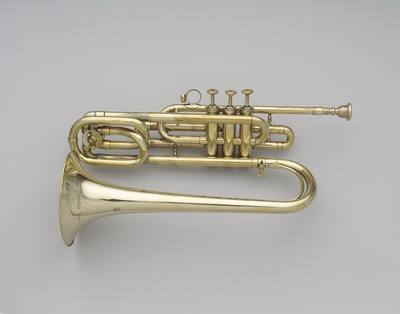
Cornet Omnitonique1847 · French (France) -
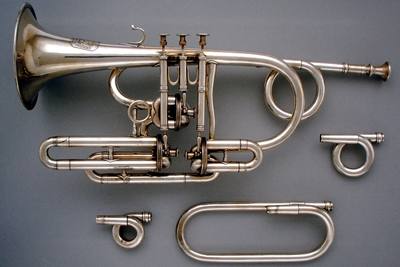
Cornet in B-flatca. 1849 · British (United Kingdom) -
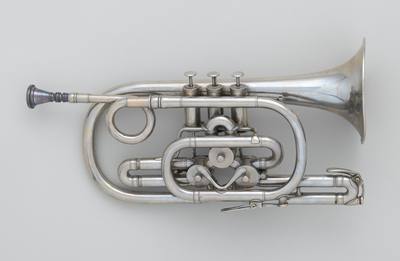
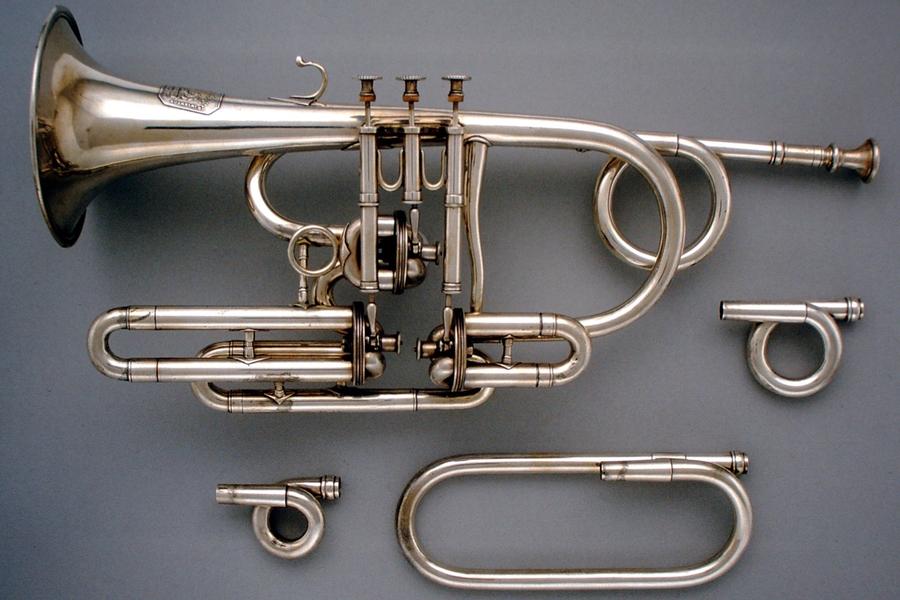
Rotary Valve Cornetca. 1875 · American (United States) -
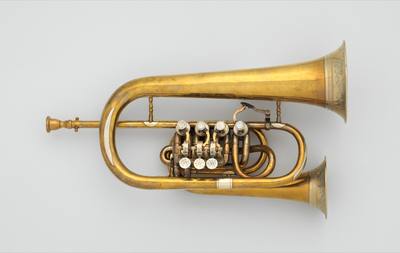
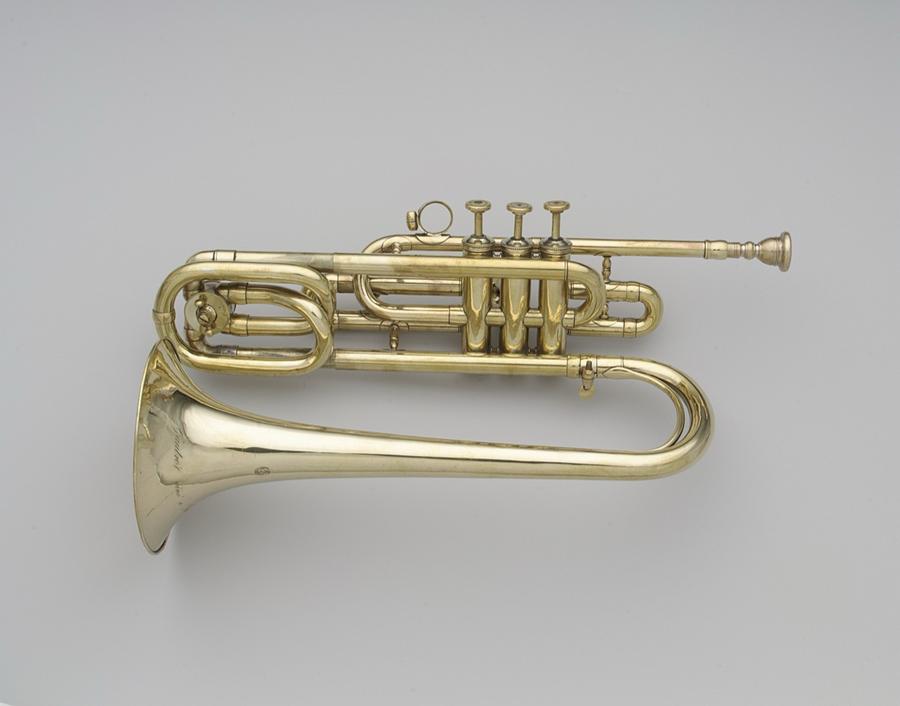
Flügel Horn with Cornet in Cca. 1890 · Italian (Italy) -
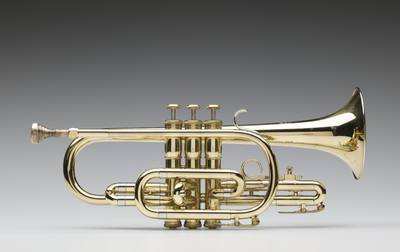
Cornet owned by Maxine Sullivan1977 · African Americans -
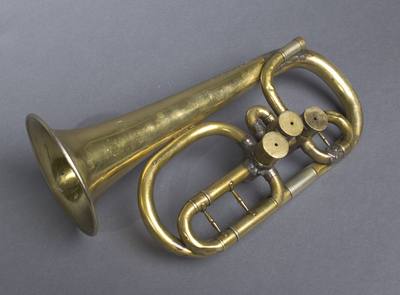
CornetUndated · Estonia -
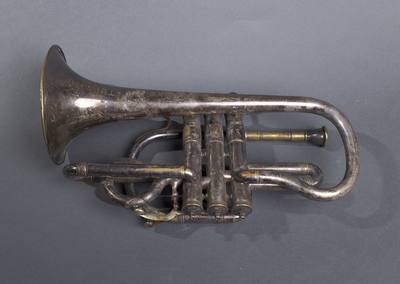
Cornet in BUndated · Estonia
Facts at a glance
| Hornbostel–Sachs number | 423.232 — Valved aerophone sounded by lip vibration |
|---|---|
| Hornbostel–Sachs group | Aerophones › Non-free aerophones (wind instruments proper) › Trumpets |
| Developed | Early 19th century from the post horn |
| Wikidata labels | 59 languages |
| Wikipedia article | Cornet |
| Wikidata item | Q202027 |
| Wikimedia Commons category | Cornets |
| MusicBrainz instrument | 257dad59-02e6-47d9-958a-659843737827 |
| Encyclopaedia Britannica | art/cornet |
| Audio sample (Wikimedia Commons) | 100,1 Tre melodier spillet på kornet.flac |
Sources: Wikidata (CC0 1.0) — classification number, aliases, identifiers (dump of 2026-07-22); Wikipedia (CC BY-SA 4.0) — infobox fields (description of the classification number, development, inventors) and the names of the Hornbostel–Sachs groups (article “Hornbostel–Sachs”, revision of 2026-01-04).
The name in other languages
| Language | Name | Also written |
|---|---|---|
| English | cornet | |
| French | cornet à pistons | cornet a pistons, cornet à piston |
| German | Kornett | Cornet a Pistons, Cornet à Pistons |
| Spanish | corneta | corneta de pistones |
| Italian | cornetta | cornetta a pistoni |
| Portuguese | corneta | cornetas, cornet |
| Dutch | kornet | cornet |
| Russian | корнет | корнет-а-пистон |
| Japanese | コルネット | ソプラノコルネット |
| Chinese | 短號 | |
| Korean | 코넷 | |
| Arabic | شياع | شِيّاع |
Sources: Wikidata (CC0 1.0) — labels and aliases; MusicBrainz (CC0 1.0) — instrument aliases (names only).
About the cornet: history, construction and playing
The cornet is a brass instrument similar to the trumpet but distinguished from it by its conical bore, more compact shape, and mellower tone quality. The most common cornet is a transposing instrument in B♭. There is also a soprano cornet in E♭ and cornets in A and C. All are unrelated to the Renaissance and early Baroque cornett.
History
The cornet was derived from the posthorn by applying valves to it in the 1820s. Initially using Stölzel valves, by the 1830s, Parisian makers were using the improved Périnet piston valves. Cornets first appeared as separate instrumental parts in 19th-century French compositions.
The instrument could not have been developed without the improvement of piston valves by Silesian horn players Friedrich Blühmel (or Blümel) and Heinrich Stölzel, in the early 19th century. These two instrument makers almost simultaneously invented valves, though it is likely that Blühmel was the inventor, while Stölzel developed a practical instrument. They were jointly granted a patent for a period of ten years. François Périnet received a patent in 1838 for an improved valve, which became the model for modern brass instrument piston valves. The first notable virtuoso player was Jean-Baptiste Arban, who studied the cornet extensively and published La grande méthode complète de cornet à piston et de saxhorn, commonly referred to as the Arban method, in 1864. Up until the early 20th century, the trumpet and cornet co-existed in musical ensembles; symphonic repertoire often involves separate parts for trumpet and cornet. As several instrument builders made improvements to both instruments, they started to look and sound more alike. The modern-day cornet is used in brass bands, concert bands, and in specific orchestral repertoire that requires a more mellow sound.
The name "cornet" derives from the French corne, meaning "horn", itself from Latin cornu. While not musically related, instruments of the Zink family (which includes serpents) are named "cornetto" or "cornett" in modern English, to distinguish them from the valved cornet described here. The 11th edition of the Encyclopædia Britannica referred to serpents as "old wooden cornets". The Roman/Etruscan cornu (or simply "horn") is the lingual ancestor of these. It is a predecessor of the post horn, from which the cornet evolved, and was used like a bugle to signal orders on the battlefield.
Relationship to trumpet
The cornet's valves allowed for melodic playing throughout the instrument's register. Trumpets were slower to adopt the new valve technology, so for 100 years or more, composers often wrote separate parts for trumpet and cornet. The trumpet would play fanfare-like passages, while the cornet played more melodic ones. The modern trumpet has valves that allow it to play the same notes and fingerings as the cornet.
Cornets and trumpets made in a given key (usually the key of B♭) play at the same pitch, and the technique for playing the instruments is nearly identical. However, cornets and trumpets are not entirely interchangeable, as they differ in timbre. Also available, but usually seen only in the brass band, is an E♭ soprano model, pitched a fourth above the standard B♭.
Unlike the trumpet, which has a cylindrical bore up to the bell section, the tubing of the cornet has a mostly conical bore, starting very narrow at the mouthpiece and gradually widening towards the bell. Cornets following the 1913 patent of E. A. Couturier can have a continuously conical bore. This shape is primarily responsible for the instrument's characteristic warm, mellow tone, which can be distinguished from the more penetrating sound of the trumpet. The conical bore of the cornet also makes it more agile than the trumpet when playing fast passages, but correct pitching is often less assured. The cornet is often preferred for young beginners as it is easier to hold, with its centre of gravity much closer to the player.
The cornet mouthpiece has a shorter and narrower shank than that of a trumpet, so it can fit the cornet's smaller mouthpiece receiver. The cup size is often deeper than that of a trumpet mouthpiece.
One variety is the short-model traditional cornet, also known as a "Shepherd's Crook" shaped model. These are most often large-bore instruments with a rich mellow sound. There is also a long-model, or "American-wrap" cornet, often with a smaller bore and a brighter sound, which is produced in a variety of different tubing wraps and is closer to a trumpet in appearance. The Shepherd's Crook model is preferred by cornet traditionalists. The long-model cornet is generally used in concert bands in the United States and has found little following in British-style brass and concert bands.
Echo cornet
The echo cornet has been called an obsolete variant. It has a mute chamber (or echo chamber) mounted to the side, acting as a second bell when the fourth valve is pressed. The second bell has a sound similar to that of a Harmon mute and is typically used to play echo phrases, whereupon the player imitates the sound from the primary bell using the echo chamber.
Playing technique
Like the trumpet and all other modern brass wind instruments, the cornet makes a sound when the player vibrates ("buzzes") the lips in the mouthpiece, creating a vibrating column of air in the tubing. The frequency of the air column's vibration can be modified by changing the lip tension and aperture, or embouchure, and by altering the tongue position to change the shape of the oral cavity, thereby increasing or decreasing the speed of the airstream. In addition, the column of air can be lengthened by engaging one or more valves, thus lowering the pitch. Double and triple tonguing are also possible.
Without valves, the player could produce only a harmonic series of notes, like those played by the bugle and other "natural" brass instruments. These notes are far apart for most of the instrument's range, making diatonic and chromatic playing impossible, except in the extreme high register. The valves change the length of the vibrating column and provide the cornet with the ability to play chromatically.
Source: Wikipedia, “Cornet” — CC BY-SA 4.0 — text excerpted as published (references, images and tables removed); see the article for the full text and the list of authors. Revision of 2026-06-07.
From Grove’s Dictionary (1900)
By the same method all notes intervening between the open notes of the natural scale can be provided for. In the absence of such a contrivance, the early composers for the trumpet were driven to make use of the superior octave, in which a consecutive scale of open notes can be obtained. This is well seen in Handel's solos for the trumpet. It materially increases the brilliancy and the difficulty of the older instrument.
The cornet was originally made with several 'crooks,' for the keys of A, B♭, A♭, G, C, and even others; but it has been customary of late to dispense with all but the A and B♭ crooks, which correspond to the clarinets of similar name.
The bore of the instrument is intermediate in size between the small cylindrical tube and restricted bell of the trumpet, and the broad conical form of the bugle. The tone stands in corresponding relation to those instruments, lacking the penetration of the former, and the smooth hornlike fulness of the latter.
Source: Wikisource, A Dictionary of Music and Musicians (Grove, 1900) — “Cornet” (entry by William H. Stone) — Public domain (published 1879–1910; authors died before 1929) — the first paragraphs of the entry, as transcribed; see the page for the full entry.
Composers who played it
9 composers on this site list the cornet as an instrument they played. A selection:
- David Wallis Reeves 1838–1900
- W. Paris Chambers 1854–1913
- Hale A. VanderCook 1864–1949
- Scott Joplin 1868–1917
- P. G. Lowery 1869–1942
- Vassily Brandt 1869–1923
- Guillaume Balay 1871–1943
- Edwin Franko Goldman 1878–1956
- Robert Nagel 1924–2016
Composers with a page on this site whose Wikidata record lists this instrument; featured and best-dated first. Data: Wikidata (property “instrument”, P1303), CC0 1.0.
Sources and licences
- Cornet-trompe in D, Alphonse (Antoine) Sax, ca. 1862, French (France). Brass. The Crosby Brown Collection of Musical Instruments, 1889 (89.4.1105). Museum record · CC0 1.0 (public domain dedication)
- Cornet à Pistons in B-flat, Courtois frères, 1833, French (France). Brass, touch pieces of ivory. Purchase, Amati Gifts, 2002 (2002.190a–n). Museum record · CC0 1.0 (public domain dedication)
- Cornet Omnitonique, Gautrot aîné, 1847, French (France). Brass. Rogers Fund, 2003 (2003.13). Museum record · CC0 1.0 (public domain dedication)
- Cornet in B-flat, John Augustus Köhler, ca. 1849, British (United Kingdom). Brass, silver-plated. Purchase, Amati Gifts, 2002 (2002.189a–f). Museum record · CC0 1.0 (public domain dedication)
- Rotary Valve Cornet, Isaac Fiske, ca. 1875, American (United States). Nickel silver. Funds from various donors, 1983 (1983.119a–e). Museum record · CC0 1.0 (public domain dedication)
- Flügel Horn with Cornet in C, Giuseppe Pelitti, ca. 1890, Italian (Italy). Brass, nickel-silver. The Crosby Brown Collection of Musical Instruments, 1889 (89.4.2587a–c). Museum record · CC0 1.0 (public domain dedication)
- Cornet owned by Maxine Sullivan, 1977, African Americans. 2013.46.29.1.1a: brass (alloy) with felt; 2013.46.29.1.1b: metal. Collection of the Smithsonian National Museum of African American History and Culture. Museum record · CC0 1.0 (public domain dedication)
- Cornet, Undated, Estonia. Estonian Theater and Music Museum / Estonian e-Repository and Conservation of Collections (via Europeana). Museum record · CC BY 4.0
- Cornet in B, Undated, Estonia. Estonian Theater and Music Museum / Estonian e-Repository and Conservation of Collections (via Europeana). Museum record · CC BY 4.0
Photographs: open-access collections of the museums named above; each is shown here reduced in size, otherwise unchanged. Text: Wikipedia (CC BY-SA 4.0), Grove’s Dictionary (public domain), Wikidata and MusicBrainz (CC0). The full list of sources and licences is on the credits page.