
Instruments · Aerophones
Tuba
The tuba is the biggest of all the brass, string, musical instruments. They are the newest part of the symphony orchestra, first showing up in the mid-19th century. Most orchestras have a tuba now. The standard tuba has about 16 feet of tubes.
Summary: Simple English Wikipedia, “Tuba” — CC BY-SA 4.0. Revision of 2025-04-26.
Hear the real instrument
These are recordings of a real bass tuba, not a synthesiser. Click or tap a key to hear that note, or press Play the range to hear every note the instrument was recorded on, from lowest to highest.
| Recorded instrument | Bass tuba |
|---|---|
| Range recorded | F♯1 to F4 |
| Notes | 36 recorded notes, one for every semitone from lowest to highest. Middle C is C4. |
Without JavaScript: play the lowest note (F♯1) or the highest note (F4) as MP3 files.
Recordings: IRCAM SOL (TinySOL), CC BY 4.0, Cella et al. Each note is cut from the original recording, levelled in loudness and converted to a short MP3; the playing technique is ordinary (ordinario), mostly at mezzo-forte.
Museum photographs
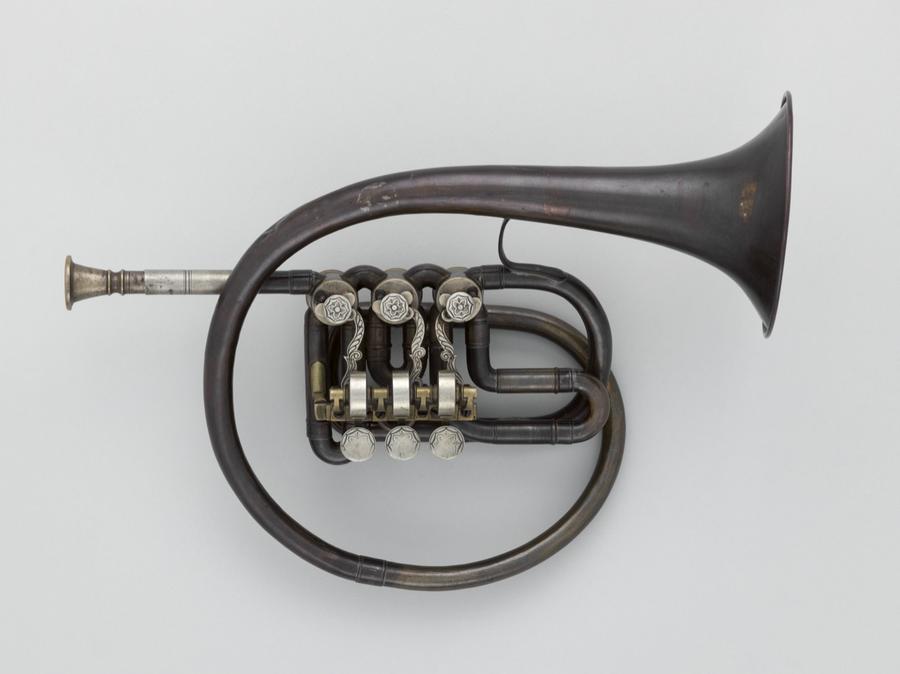
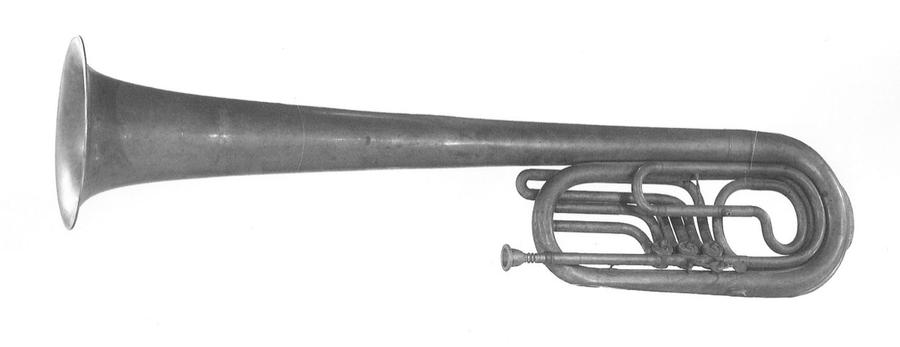
These 3 photographs span 1825–1875, 3 places of origin and 1 museum. Every photograph is public domain or openly licensed, and links to the museum’s own record.
-
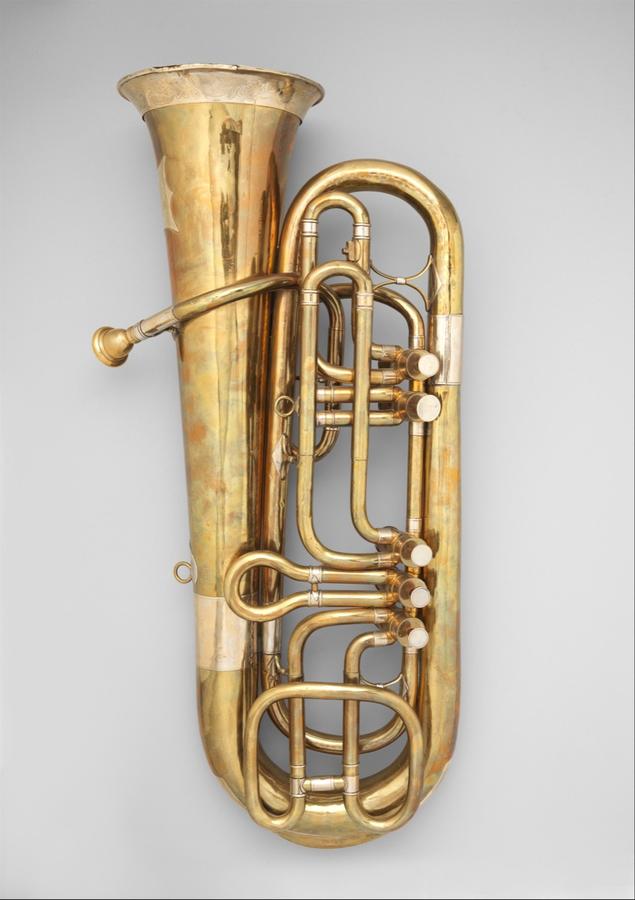
Tubaca. 1855 · Germany -
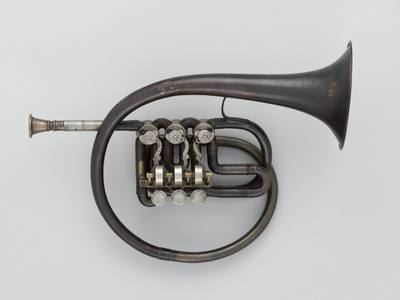
Soprano Helicon in B-flatmid-19th century · possibly Italian (Italy?) -
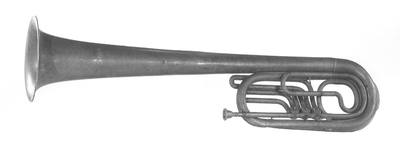
Tuba in E-flatmid-19th century · American (United States)
Facts at a glance
| Hornbostel–Sachs number | 423.232 — Valved lip-reed aerophone with wide conical bore |
|---|---|
| Hornbostel–Sachs group | Aerophones › Non-free aerophones (wind instruments proper) › Trumpets |
| Also known as | cuerno bajo, tuba baja, tuba en Si bemol♭, tuba en si♭, bombarda, tuba en do, tuba CC, tuba contrabajo, tuba en si bemol doble, tuba doble do |
| Developed | 1835 in Prussia |
| Inventors | Wilhelm Friedrich Wieprecht and Johann Gottfried Moritz |
| Wikidata labels | 98 languages |
| Wikipedia article | Tuba |
| Wikidata item | Q131168 |
| Wikimedia Commons category | Tubas (instrument) |
| MusicBrainz instrument | e297fcf6-29a7-4673-a15d-a6f54819b2d1 |
| Encyclopaedia Britannica | art/tuba |
| Audio sample (Wikimedia Commons) | Tuba-range-C-low.ogg |
Sources: Wikidata (CC0 1.0) — classification number, aliases, identifiers (dump of 2026-07-22); Wikipedia (CC BY-SA 4.0) — infobox fields (description of the classification number, development, inventors) and the names of the Hornbostel–Sachs groups (article “Hornbostel–Sachs”, revision of 2026-01-04).
The name in other languages
| Language | Name | Also written |
|---|---|---|
| English | tuba | cuerno bajo, tuba baja, tuba en Si bemol♭ |
| French | tuba | |
| German | Tuba | Basstuba, Bombardon, Kontrabasstuba |
| Spanish | tuba | |
| Italian | tuba | Flicorno basso, Basso tuba, Bassi tuba |
| Portuguese | tuba | |
| Dutch | tuba | blaas-bas |
| Russian | туба | |
| Japanese | チューバ | バス・テューバ, テノールチューバ, テノールテューバ |
| Chinese | 大号 | 低音号, 大號, 低音大喇叭 |
| Korean | 튜바 | |
| Arabic | توبا |
Sources: Wikidata (CC0 1.0) — labels and aliases; MusicBrainz (CC0 1.0) — instrument aliases (names only).
About the tuba: history, construction and playing
The tuba (Latin, "trumpet") is a large brass instrument in the bass-to-contrabass range. It is a member of the valved bugles, a large and diverse family of instruments characterized by their wide conical bore and use of valves to alter pitch. The tuba usually has four or five valves, although some models have three or six. Descending from the serpent and ophicleide, the tuba was invented in Prussia by Wilhelm Friedrich Wieprecht and Johann Gottfried Moritz and patented in 1835 as the Baß-Tuba, pitched in 12-foot (′) F. Its five valves provided a fully chromatic contrabass instrument with a deep, full contrabass timbre.
The tuba evolved through the 19th century as valves improved, and other makers contributed new designs and sizes. By the 1850s, Adolphe Sax had developed his E♭ and B♭ contrabass saxhorns which became standard in British brass bands, and Václav František Červený developed contrabass tubas in ′ C and ′ B♭ in the 1870s. A circular, wearable tuba called the helicon was designed for marching, and by the late 1890s was adopted and modified by John Philip Sousa as the sousaphone.
History
The tuba was developed to provide a low-pitched brass instrument, suitable for use in the brass sections of bands and orchestras. Before the emergence of the first valves in the 1820s, unmodified brass instruments like the natural horn or bugle were restricted to a single harmonic series. To expand the selection of notes available, either a slide (as on a trombone) or tone holes (as on a keyed bugle or serpent) were employed. Each of these options presented a problem for a low-pitched brass instrument. Natural instruments can only produce diatonic or chromatic scales in their high register, bass trombones of that era had long, unwieldy slides with handles, and the timbre of the serpent was often criticized.
Origins
To replace the serpent and its various upright derivatives, the Paris-based maker Jean Hilaire Asté invented the ophicleide in 1817, extending the keyed bugle into the bass register with a folded, bassoon-like form. It was enough of an improvement to be widely adopted in brass and military bands, and also in French orchestras, most notably by the composer Hector Berlioz.
In the 1820s, soon after the invention of valves, valved ophicleides quickly appeared (Ventilophikleide, in Vienna; ophicléide à piston, and in Italy, the bombardone or pelittone). They had the same overall layout as the ophicleide, but were built with valves instead of keys and tone holes. Some wide-bore variants were called bombardons.
Early American tubas
In the United States, saxhorns had become popular by the mid-19th century, particularly in military and brass bands. In 1838, the New York bandmaster Allen Dodworth (1816–1896) commissioned "over-the-shoulder" (OTS) instruments, with bells pointing backwards over the player's left shoulder, that included an E♭ bass model. This design allowed soldiers, usually marching behind the band, to better hear the music.
Demand for brass instruments grew, particularly in the 1860s during the American Civil War, and tens of thousands were made in the United States or imported from Europe, including contrabass saxhorns and helicons. After the war, the bands and their music remained popular, forming the basis of the American drum and bugle corps tradition, as well as the mixed-winds concert music popularized by the band leaders Patrick Gilmore and John Philip Sousa.
In 1893, Sousa had a contrabass helicon tuba built by the Philadelphia instrument maker J. W. Pepper with the bell pointing upwards, to better diffuse the sound in his concerts. This style of sousaphone, known as a "rain catcher", was later made by the American manufacturers Holton and C. G. Conn. In 1908, Conn released his "Wonderphone helicon" which turned the bell forward, to create the iconic modern sousaphone form.
An alumni of Sousa's band, the Danish-born August Helleberg (1861–1936) was the founding tubist with the Chicago Symphony Orchestra in 1891 and with the Philharmonic Society of New York in 1897. He became renowned in his day as a member of the Sousa Band, and developed a type of tuba mouthpiece which has become popular with tuba players and widely copied by many makers.
Construction
In the classification scheme of musical instruments, the tuba is considered a bass valved bugle. The valved bugles form a large family of brass instruments that includes the euphonium, flugelhorn, and the wider-bored members of the saxhorn family. They are distinguished by having a wide conical bore, and valves to alter pitch. The bore of bugles is a wider conical shape compared to other brass instruments, such as the horn or cornet, which are, in turn, wider than the cylindrical-bore trumpet and trombone. The wider conical shape causes the instrument to favor lower spectral content, producing a mellow, warm timbre. The rapidly widening bore of the tubing leading to the bell, and the bell's large diameter, combine to amplify these lower frequencies and produce a deep contrabass sound.
Quarter designation
Tubas of the same pitch will have the same length of tubing but can vary in other dimensions, such as overall width of the tubing sections, bell diameter, and conical bore profile. These measurements are categorized with a sizing scale denoted in quarters, with 4/4 designating a full-size tuba. Smaller instruments, often student or intermediate models with only three valves, may be described as 3/4 or even 1/2 size instruments. These are common in schools, where a full-size tuba may be too large, or in marching bands to reduce weight. Larger instruments are denoted as 5/4, or 6/4 for the largest tubas, sometimes known as grand orchestral tubas. These include the Conn 36J "Orchestra Grand Bass" from the 1930s, and the well-known large Chicago York tubas popularized by Arnold Jacobs and replicated by several makers. The designations have no standardized measurements of bore widths or bell diameters, but are useful for comparing models in a single manufacturer's catalog.
Valves
Modern tubas are made with either piston valves or rotary valves. Rotary valves, patented in Prussia by Joseph Riedl in 1835, were first used on Austro-Hungarian tubas made in the 1850s by Červený. Around the same time in France and Britain, the modern piston valve developed by François Périnet in 1839 had begun to replace the Berlin valves used on early saxhorn instruments.
Pistons can be top-action, oriented vertically so the buttons are operated from the top of the instrument, or front-action (sometimes called side-action), oriented horizontally so the buttons are at the front, operated from the side.
Tubas are made with three to six valves, but among professional players, tubas with four and five are the most common. Three-valve tubas are usually inexpensive student models, or smaller marching instruments made to conserve weight; the sousaphone usually has three valves. F tubas usually have five or six valves, including the six-valved Wienerkonzerttuba used in Austria.
Depressing a valve adds a length of tubing to the instrument, lowering its fundamental pitch. On modern tubas, the first three valves work the same way as other valved brass instruments: the first lowers the pitch by two semitones (whole step), the second by one semitone (half step), and the third by three semitones (minor third).
Fourth, fifth, and sixth valves
The fourth valve lowers the pitch by five semitones (a perfect fourth). The combination of valves 1 and 3 also lowers the pitch by a fourth, but this combination, and the 1-2-3 combination, tend to produce pitches that are slightly sharp. Using the fourth valve helps solve these intonation problems. Using the fourth valve with any or all of the first three extends the range down to the fundamental pitch, but some of these lower notes will be sharp.
The fifth and sixth valves, if fitted, provide alternative fingering possibilities to improve intonation, particularly in the octave between the fundamental pitch (pedal tone) and the second partial, and for smooth trills and ease of playing. Usually, the fifth valve is tuned to two and a half semitones (flattened whole step), and the sixth to one and a half semitones (flattened half step). On C tubas with five valves, the fifth valve may be tuned as a flattened whole step or as a minor third, depending on the instrument. B♭ instruments rarely have a fifth valve, but if they do, it is tuned similarly to that of a C tuba.
Compensating valves
Most high-end saxhorn-style tubas in E♭ and B♭, instead of providing a fifth or sixth valve, provide a compensating system on the fourth valve to adjust intonation when using valves in combination. This reduces the need to constantly adjust tuning slides while playing, and also simplifies fingering. The compensating piston valve was invented in the 1870s by David Blaikley (1846–1936), the factory manager at Boosey & Co, who patented it in 1878. The patent limited its application outside of Britain, and tubas with compensating valves are mainly found in Britain and British Commonwealth countries. The tubing of the fourth valve is re-routed back through the other three valves to add an extra set of small correcting tubing loops. This achieves correct intonation in the lower range of the instrument when using the fourth valve. Compensating valves can make the instrument significantly more "stuffy" or resistant to air flow when compared to a non-compensating tuba, and also make the instrument heavier.
Mouthpiece
The tuba mouthpiece is similar to that of other brass instruments. It has a cup-shaped profile with a throat at the base, and a short backbore in the shank, which fits into the leadpipe receiver on the instrument. The tuba requires a correspondingly larger mouthpiece, with a much deeper cup that usually measures 32 to 34 millimeters (1.18 to 1.34 inches) in diameter at the rim. A principal innovation in tuba mouthpiece design was introduced by August Helleberg in the early 1900s. Helleberg made his mouthpieces with a deeper, more funnel-shaped cup, which were later manufactured by C. G. Conn and have been widely copied since.
Materials and finish
The tuba is generally constructed of brass, which is either electroplated with silver or coated with a thin transparent lacquer. Unfinished brass will tarnish and must be periodically polished to maintain its appearance.
Tubas can be made of ABS plastic, or the bell and outer tubing can be made of fibreglass or carbon-fiber composite to reduce the weight of the instrument. Sousaphones have been made with fiberglass bells since the 1960s. Reduced weight is helpful for instruments used for marching, and these materials allow the instrument to be produced in many colors.
Resonance and false tones
Some tubas have a strong, useful resonance that deviates from the instrument's principal harmonic series. For example, most large B♭ tubas have a strong resonance around the low E♭1 between the B♭0 pedal and its second partial an octave above. These alternative resonances are often known as false, factitious or privileged tones, and allow the instrument to play chromatically from E1 down to the B♭ pedal of the open horn using only three valves.
Source: Wikipedia, “Tuba” — CC BY-SA 4.0 — text excerpted as published (references, images and tables removed); see the article for the full text and the list of authors. Revision of 2026-07-06.
Composers who played it
5 composers on this site list the tuba as an instrument they played. A selection:
- John Philip Sousa 1854–1932
- Walter English 1867–1916
- John White 1936–2024
- James Barnes 1949–
- Scott Irvine 1953–
Composers with a page on this site whose Wikidata record lists this instrument; featured and best-dated first. Data: Wikidata (property “instrument”, P1303), CC0 1.0.
Sources and licences
- Tuba, C.W. Moritz, ca. 1855, Germany. Brass. Purchase, Robert Alonzo Lehman Bequest, 2014 (2014.18). Museum record · CC0 1.0 (public domain dedication)
- Soprano Helicon in B-flat, mid-19th century, possibly Italian (Italy?). Brass, nickel-silver. The Crosby Brown Collection of Musical Instruments, 1889 (89.4.2189). Museum record · CC0 1.0 (public domain dedication)
- Tuba in E-flat, mid-19th century, American (United States). Brass, nickel-silver. The Crosby Brown Collection of Musical Instruments, 1889 (89.4.2299). Museum record · CC0 1.0 (public domain dedication)
Photographs: open-access collections of the museums named above; each is shown here reduced in size, otherwise unchanged. Text: Wikipedia (CC BY-SA 4.0), Wikidata and MusicBrainz (CC0). The full list of sources and licences is on the credits page.