
Instruments · Aerophones
Trombone
The trombone is a brass horn musical instrument. It is similar to a large trumpet, except the player pushes and pulls on its slide to change the length of the tube.
Summary: Simple English Wikipedia, “Trombone” — CC BY-SA 4.0. Revision of 2026-03-23.
Hear the real instrument
These are recordings of a real tenor trombone, not a synthesiser. Click or tap a key to hear that note, or press Play the range to hear every note the instrument was recorded on, from lowest to highest.
| Recorded instrument | Tenor trombone |
|---|---|
| Range recorded | B♭1 to C5 |
| Notes | 39 recorded notes, one for every semitone from lowest to highest. Middle C is C4. |
Without JavaScript: play the lowest note (B♭1) or the highest note (C5) as MP3 files.
Recordings: IRCAM SOL (TinySOL), CC BY 4.0, Cella et al. Each note is cut from the original recording, levelled in loudness and converted to a short MP3; the playing technique is ordinary (ordinario), mostly at mezzo-forte.
Museum photographs
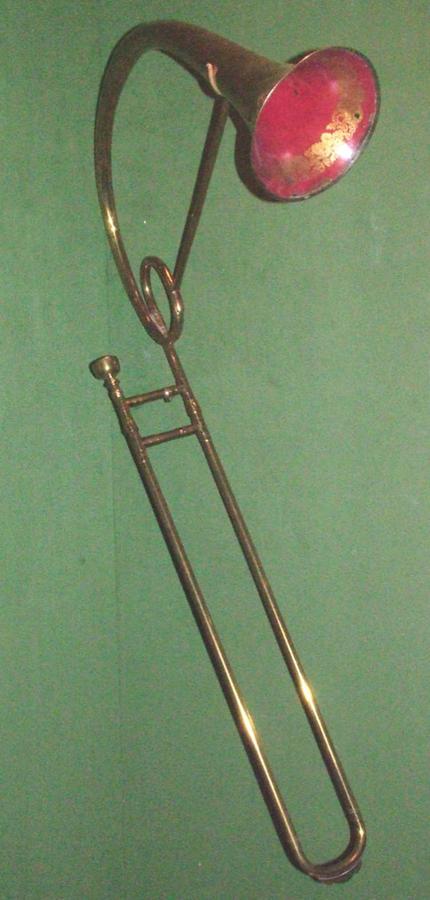
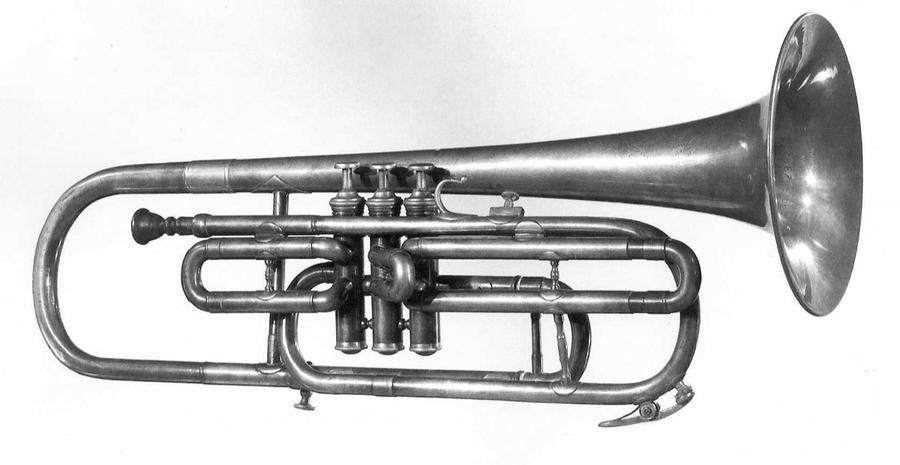
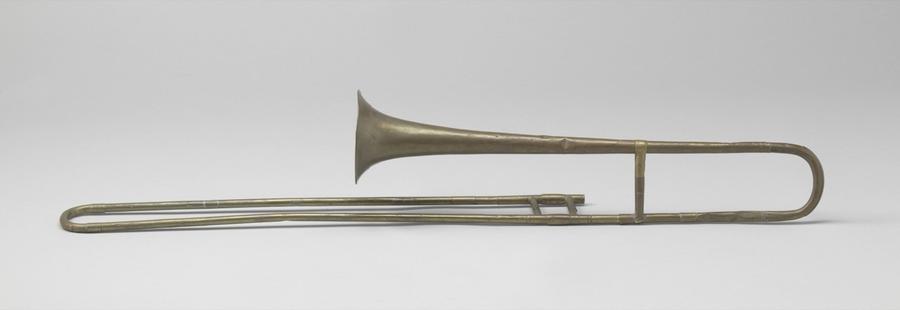
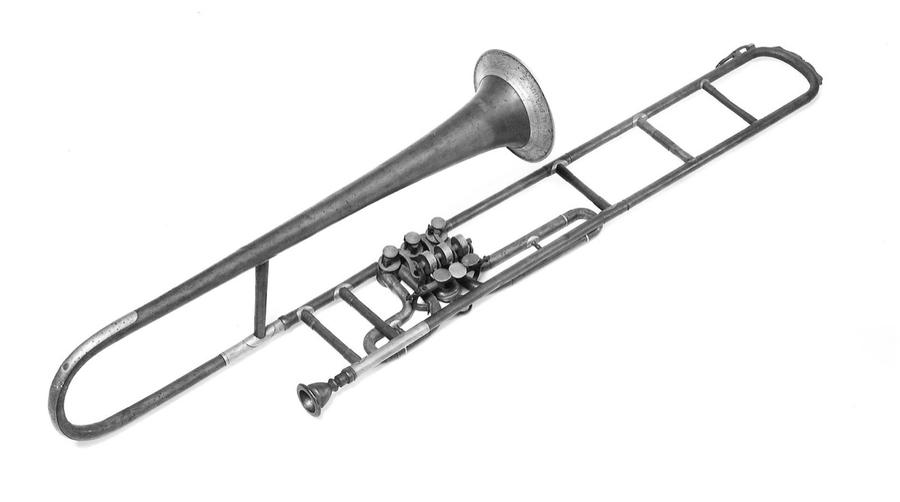
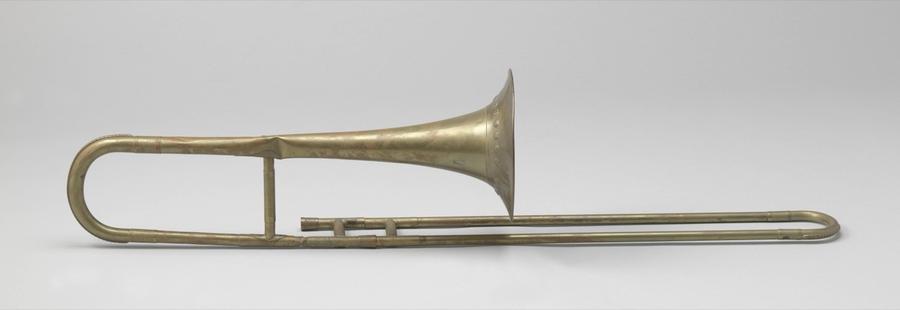
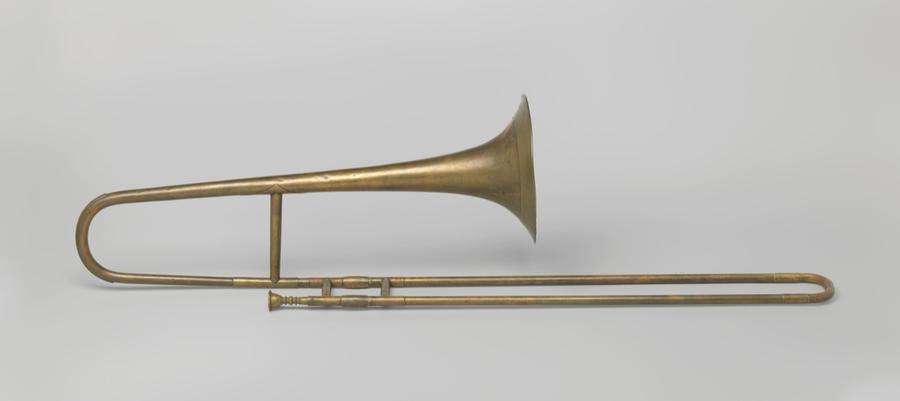
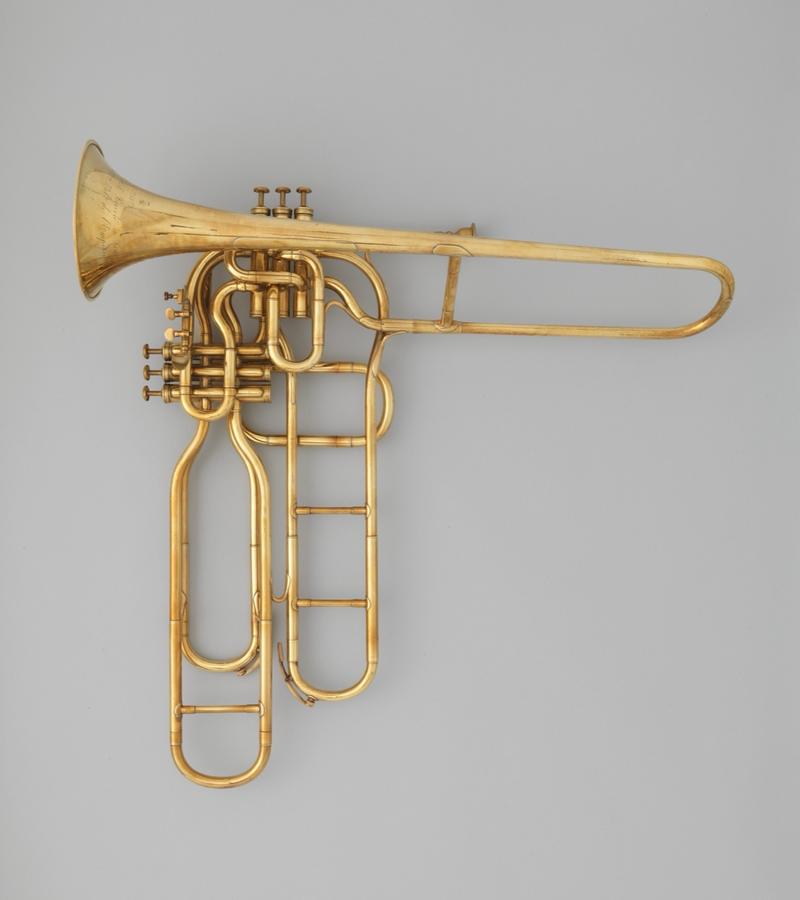
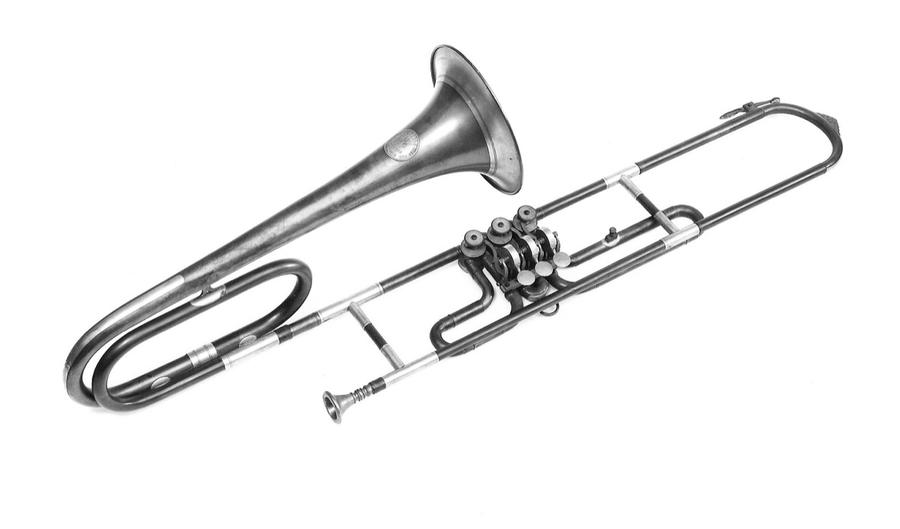
These 11 photographs span 1593–1960, 10 places of origin and 3 museums. Every photograph is public domain or openly licensed, and links to the museum’s own record.
-
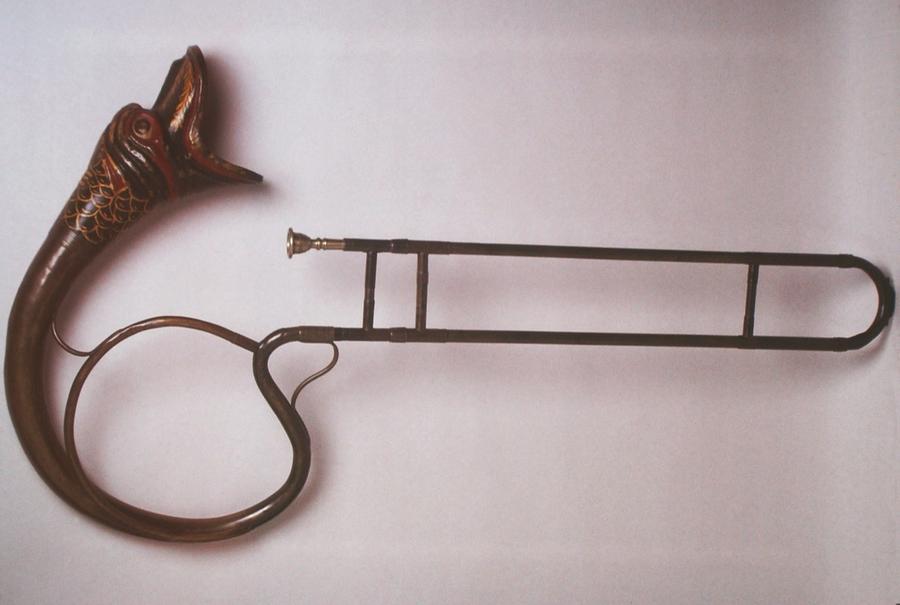
Tenor Slide Trombone in B-flatearly 19th century · Spanish (Spain) -
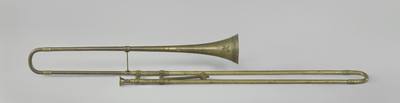
Bass trombone1593 · Reims -
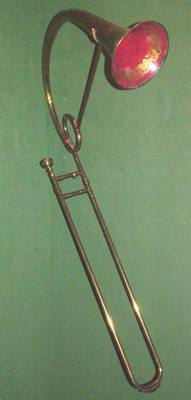
Tenor Slide Trombone in B-flat1827–49 · Belgian (Belgium) -
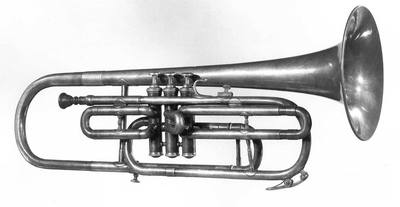
Alto valve trombone in E-flatmid-19th century · American (United States) -
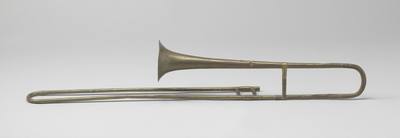
Trombonec. 1830 - c. 1850 · Hanau -
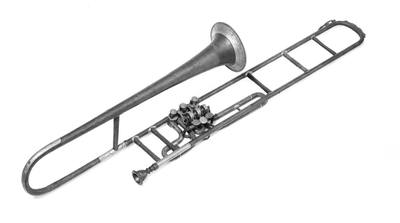
Tenor Valve Trombone in B-flatmid-19th century · Czech Republic -
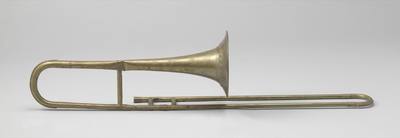
Trombonec. 1850 - c. 1880 · Germany -
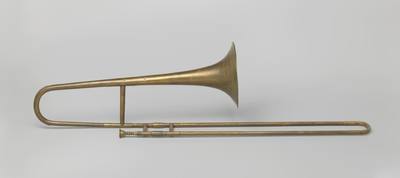
Trombonec. 1850 - c. 1900 · Amsterdam -
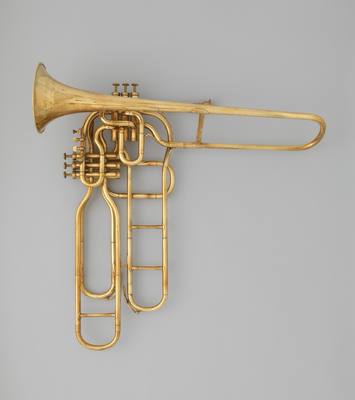
Tenor valve tromboneca. 1863 · French (France) -
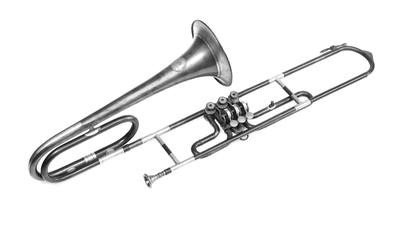
Tenor Valve Trombone in B-flatlate 19th century · Italian (Italy) -
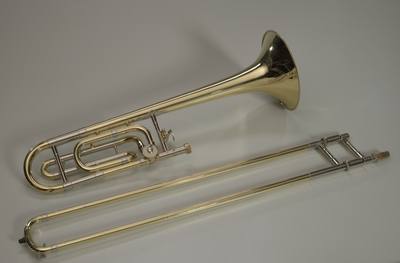
Trombone played by Fred Wesleyafter 1960 · African Americans
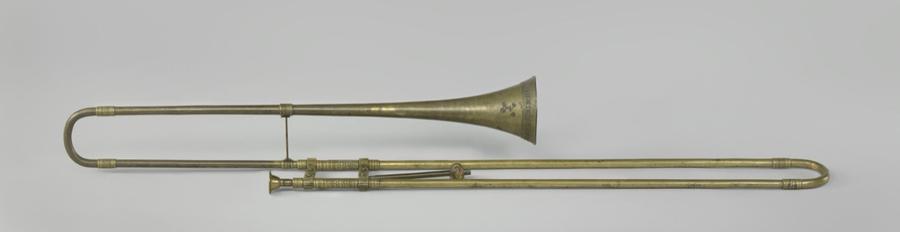
Facts at a glance
| Hornbostel–Sachs number | 423.22 — Sliding aerophone sounded by lip vibration |
|---|---|
| Hornbostel–Sachs group | Aerophones › Non-free aerophones (wind instruments proper) › Trumpets |
| Also known as | slide trombone |
| Developed | Originated mid 15th century, sackbut in English until the early 18th century. |
| Wikidata labels | 94 languages |
| Wikipedia article | Trombone |
| Wikidata item | Q8350 |
| Wikimedia Commons category | Trombones |
| MusicBrainz instrument | f6100277-c7b8-4c8d-aa26-d8cd014b6761 |
| Encyclopaedia Britannica | art/trombone |
| Audio sample (Wikimedia Commons) | 110,1 Drikkevise spillet på basun.flac |
Sources: Wikidata (CC0 1.0) — classification number, aliases, identifiers (dump of 2026-07-22); Wikipedia (CC BY-SA 4.0) — infobox fields (description of the classification number, development, inventors) and the names of the Hornbostel–Sachs groups (article “Hornbostel–Sachs”, revision of 2026-01-04).
The name in other languages
| Language | Name | Also written |
|---|---|---|
| English | trombone | slide trombone |
| French | trombone | |
| German | Posaune | |
| Spanish | trombón | trombon |
| Italian | trombone | |
| Portuguese | trombone | |
| Dutch | trombone | schuiftrompet |
| Russian | тромбон | |
| Japanese | トロンボーン | |
| Chinese | 長號 | 长号 |
| Korean | 트롬본 | |
| Arabic | مترددة |
Sources: Wikidata (CC0 1.0) — labels and aliases; MusicBrainz (CC0 1.0) — instrument aliases (names only).
About the trombone: history, construction and playing
The trombone is a musical instrument in the brass family. As with all brass instruments, sound is produced when the player's lips vibrate inside a mouthpiece, causing the air column inside the instrument to vibrate. Nearly all trombones use a telescoping slide mechanism to alter the pitch instead of the valves used by other brass instruments. The valve trombone is an exception, using three valves similar to those on a trumpet, and the superbone has valves and a slide.
The word trombone derives from Italian tromba (trumpet) and -one (a suffix meaning ‘large’), so the name means ‘large trumpet’. The trombone has a predominantly cylindrical bore like the trumpet, in contrast to the more conical brass instruments like the cornet, the flugelhorn, the baritone, and the euphonium. The two most frequently encountered variants are the tenor trombone and bass trombone; when the word trombone is mentioned alone; it is mostly taken to mean the tenor model. These are treated as non-transposing instruments, reading at concert pitch in bass clef, with higher notes sometimes being notated in tenor clef. They are pitched in B♭, an octave below the B♭ trumpet and an octave above the B♭ contrabass tuba. The once common E♭ alto trombone became less common as improvements in technique extended the upper range of the tenor, but it is regaining popularity for its lighter sonority. In British brass-band music the tenor trombone is treated as a B♭ transposing instrument, written in treble clef, and the alto trombone is written at concert pitch, usually in alto clef.
Origin
The sackbut appeared in the 15th century and was used extensively across Europe, declining in most places by the mid to late 17th century. It was used in outdoor events, in concert, and in liturgical settings. Its principal role was as the contratenor part in a dance band. It was also used, along with shawms, in bands sponsored by towns and courts. Trumpeters and trombonists were employed in German city-states to stand watch in the city towers and herald the arrival of important people to the city, an activity that signified wealth and strength in 16th-century German cities. These heralding trombonists were often viewed separately from the more skilled trombonists who played in groups such as the alta capella wind ensembles and the first orchestral ensembles, which performed in religious settings such as St Mark's Basilica in Venice in the early 17th century. The 17th-century trombone had slightly smaller dimensions than a modern trombone, with a bell that was more conical and less flared. Modern period performers use the term "sackbut" to distinguish this earlier version of the trombone from the modern instrument.
Composers who wrote for trombone during this period include Claudio Monteverdi, Heinrich Schütz, Giovanni Gabrieli and his uncle Andrea Gabrieli. The trombone doubled voice parts in sacred works, but there are also solo pieces written for trombone in the early 17th century.
When the sackbut returned to common use in England in the 18th century, Italian music was so influential that the instrument became known by its Italian name, "trombone". Its name remained constant in Italy (trombone) and in Germany (Posaune).
During the later Baroque period, Johann Sebastian Bach and George Frideric Handel used trombones on a few occasions. Bach called for a tromba di tirarsi, which may have been a form of the closely related slide trumpet, to double the cantus firmus in some liturgical cantatas. He also employed a choir of four trombones to double the chorus in three of his cantatas (BWV 2, BWV 21 and BWV 38). Because of the relative scarcity of trombones, their solo parts were generally interchangeable with other instruments.
19th-century construction
Sattler had a great influence on trombone design, introducing a significantly larger bore (the most important innovation since the Renaissance), Schlangenverzierungen (snake decorations), the bell garland, and the wide bell flare. These features were widely copied during the 19th century and are still found on German made trombones.
The trombone was improved in the 19th century with the addition of "stockings" at the end of the inner slide to reduce friction, the development of the water key to expel condensation from the horn, and the occasional addition of a valve that was designed to be set in a single position but later became the modern F-valve. The valve trombone appeared around the 1850s shortly after the invention of valves, and was in common use in Italy and Austria in the second half of the century.
20th-century construction
The trombone's construction changed in the 20th century. Different materials were used, mouthpiece, bore, and bell dimensions increased, and different mutes and valves were developed. Despite the overall trend towards larger bore instruments, many European trombone makers prefer a slightly smaller bore than their American counterparts.
One of the most significant changes was the development of the F-attachment trigger. Through the mid-20th century there was no need for orchestral trombonists to use instruments with the F attachment trigger. As contemporary composers such as Mahler began to write lower passages for the trombone, the trigger became necessary.
Construction
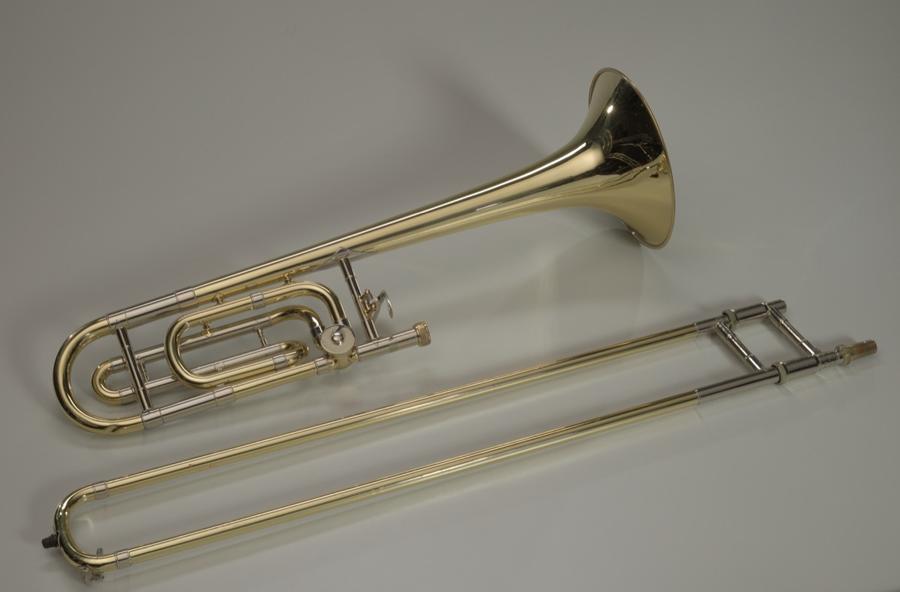
The trombone is a predominantly cylindrical tube with two U-shaped bends and a flared bell at the end. The tubing is approximately cylindrical but contains a complex series of tapers which affect the instrument's intonation. As with other brass instruments, sound is produced by blowing air through pursed lips producing a vibration that creates a standing wave in the instrument.
The detachable cup-shaped mouthpiece is similar to that of the baritone horn and closely related to that of the trumpet. It has a venturi: a small constriction of the air column that adds resistance, greatly affecting the tone of the instrument. The slide section consists of a leadpipe, inner and outer slide tubes, and bracing, or "stays". The soldered stays on modern instruments replaced the loose stays found on sackbuts (medieval precursors to trombones).
The most distinctive feature of the trombone is the slide, which is used to change the length of the tubing to alter the pitch (cf. valve trombone). During the Renaissance, sleeves (called "stockings") were developed to decrease friction that would impede the slide's motion. These were soldered onto the ends of the inner slide tubes to slightly increase their diameter. The ends of inner slides on modern instruments are manufactured with a slightly larger diameter to achieve the same end. This part of the slide must be lubricated frequently. The slide section is connected to the bell section by the neckpipe and a U-bend called the bell or back bow. The joint connecting the slide and bell sections has a threaded collar to secure the connection. Prior to the early 20th century this connection was made with friction joints alone.
Valve attachments
Modern trombones are often constructed with a valve attachment, an extra loop of tubing attached to the bell section and engaged by a valve operated by the left thumb by means of a lever or trigger. The valve attachment aids in increasing the lower range of the instrument, while also allowing alternate slide positions for difficult music passages. A valve can also make trills a lot easier.
The valve attachment was originally developed by German instrument maker Christian Friedrich Sattler in the late 1830s for the Tenorbaßposaune (lit. tenor-bass trombone), a B♭ tenor trombone built with the wider bore and larger bell of a bass trombone that Sattler had earlier invented in 1821. Sattler's valve attachment added about 3 ft of tubing to lower the fundamental pitch from B♭ to F, controlled by a rotary valve, and is essentially unchanged in modern instruments.
Valve attachments are most commonly found on the tenor and bass trombones. However, they can appear on sizes from soprano to contrabass, in different variety of keys, depending on the size of the instrument.
In the early 2010s Torbjörn Hultmark of the Royal College of Music commissioned the first soprano trombone in B♭ with an F valve, built by Thein Brass.
Although rare on the E♭ alto trombone, a valve attachment usually lowers the instrument a perfect fourth into B♭, providing the first five or six positions from the tenor trombone slide. Some alto models also have a valve called a trill valve, providing a small loop of tubing that lowers the instrument by only a minor or major second, into D or D♭ respectively.
Tenor trombones, especially the larger bore symphonic models, commonly have a valve attachment which lowers the instrument from B♭ to F.
Valve types
The most common type of valve seen for valve attachments is the rotary valve, appearing on most band instruments, as well as most student and intermediate model trombones. Many improvements of the rotary valve, as well as entirely new and radically different valve designs, have been invented since the mid 20th century to give the trombone a more open, free sound than the tight bends in conventional rotary valve designs would allow. Many of these new valve designs have been widely adopted by players, especially in symphony orchestras. The Thayer axial flow valve is offered on professional models from most trombone manufacturers, and the Hagmann valve particularly from European manufacturers.
Some trombones have three piston or rotary valves instead of a slide; see valve trombone.
Tubing
F attachment tubing usually has a larger bore through the attachment than through the rest of the instrument. A typical slide bore for an orchestral tenor trombone is 0.547 in while the bore in the attachment is 0.562 in. The attachment tubing also incorporates a tuning slide to tune the valve separately from the rest of the instrument, usually long enough to lower the pitch by a semitone when fully extended (from F to E on tenor and bass trombones, to reach the missing low B1).
Valve attachment tubing is often coiled tightly to keep within the bell section (closed wrap or traditional wrap). A less coiled configuration, called open wrap, is found on some 19th and early 20th century instruments. In the early 1980s, American instrument manufacturers began producing open wrap instruments after Californian instrument technician Larry Minick introduced open wraps around the same time that the Thayer valve began to emerge among orchestral players. Open wrap F attachment tubing is shaped in a single loop free of tight bends, resulting in a freer response and more "open" sound through the valve.
In marching bands and other situations where the trombone may be more prone to damage, the confined traditional wrap is more common, since open wrap tubing protrudes behind the bell section.
Sopranino and piccolo trombones
The sopranino and piccolo trombones appeared in the 1950s as novelty instruments, and are even smaller and higher than the soprano. They are pitched in high E♭ and B♭ respectively, one octave above the alto and soprano trombones. Owing to being essentially a slide variant of the piccolo trumpet, they are played primarily by trumpet players.
Source: Wikipedia, “Trombone” — CC BY-SA 4.0 — text excerpted as published (references, images and tables removed); see the article for the full text and the list of authors. Revision of 2026-06-23.
From Grove’s Dictionary (1900)
TROMBONE (Eng., Fr., Ital.; Germ. Posaune). The name, originally Italian, given to the graver forms of the Tromba or Trumpet, exactly corresponding with that of Violone as the bass of the Viola. Its other name, Sacbut or Sackbut, though English in sound, seems really to come from a Spanish or Moorish root Sacabuche, which is the name of a pump. In the Spanish dictionary of Velasquez de la Cadena this word has three meanings assigned to it; two as above, and the third a term of reproach for a contemptible person. The Italians also name this instrument the Tromba Spezzata or Broken Trumpet, under which title it is figured in Bonanni. The Trumpet in its many forms is one of the oldest of existing instruments; certainly the least changed, as will be shown under that heading. But the special individuality of the two instruments, and the peculiar character of the Trombone in particular, is derived from the method by which a complete chromatic scale has been evolved from the open notes of a simple tube; namely, by means of what is termed the slide. There is much reason to believe that this contrivance is also very ancient, having far greater antiquity than crooks, stoppers, or valves. In the preface to Neumann's Tutor for the Trombone its invention is claimed for Tyrtæus, 685 b.c. Others award the merit of its discovery to Osiris. In paintings and sculptures it is difficult to identify the distinguishing slide. But the writer has from several sources a circumstantial account of the finding of one or even two such instruments at Pompeii in the year 1738. Neumann states that the mouthpieces were of gold, and the other parts of bronze. 'The king of Naples,' he continues, 'gave this instrument to king George III. of England,' who was present at the digging. Mr. William Chappell, in a note made by him more than fifty years ago, confirms this statement, and adds that the instrument so found is in the collection at Windsor. The present librarian, however, denies all knowledge of it. Nor is it in the British Museum. Dr. C. T. Newton has, however, furnished the writer with an unexpected reference, which is singularly to the point. It occurs in a work on Greek Accents, by a writer named Arcadius, who, according to Dr. Scott, may be attributed to about a.d. 200, when the familiar use of spoken Greek was dying out, and prosodiacal rules, like the accents, became necessary. It is as a prosodiacal simile that the reference occurs: 'Just as those who on flutes (αὐλοῖς) feeling for the holes, to stop and open them when they may wish, have contrived subsidiary projections and bombyxes (ὑφορκίοις lege ὑφολκίοις), moving them up and down (ἄνω καὶ κάτω), as well as backwards and forwards.' It is difficult to refuse a belief that the framer of this figure, which is meant to explain the use of accents as aids to modulation, had not seen some sort of Trombone in use.
Source: Wikisource, A Dictionary of Music and Musicians (Grove, 1900) — “Trombone” (entry by William Henry Stone) — Public domain (published 1879–1910; authors died before 1929) — the first paragraphs of the entry, as transcribed; see the page for the full entry.
Composers who played it
46 composers on this site list the trombone as an instrument they played. A selection:
- Bartolomeo Tromboncino 1470–1535
- Nicolao Dorati 1513–1593
- Camillo Cortellini 1561–1630
- Johann Vierdanck 1605–1646
- John Philip Sousa 1854–1932
- Edwin Eugene Bagley 1857–1922
- Juventino Rosas 1868–1894
- John N. Klohr 1869–1956
- Frank H. Losey 1870–1931
- Gustav Holst 1874–1934
- Cyrillus Kreek 1889–1962
- Glenn Miller 1904–1944
Composers with a page on this site whose Wikidata record lists this instrument; featured and best-dated first. Data: Wikidata (property “instrument”, P1303), CC0 1.0.
Sources and licences
- Tenor Slide Trombone in B-flat, José Ramis, early 19th century, Spanish (Spain). Brass. The Crosby Brown Collection of Musical Instruments, 1889 (89.4.1301). Museum record · CC0 1.0 (public domain dedication)
- Bass trombone, Pierre Colbert, 1593, Reims. brass (alloy). On loan from the City of Amsterdam. Museum record · Public Domain Mark 1.0
- Tenor Slide Trombone in B-flat, Jeremias Franciscus Verhoeven, 1827–49, Belgian (Belgium). Brass. The Crosby Brown Collection of Musical Instruments, 1889 (89.4.2409). Museum record · CC0 1.0 (public domain dedication)
- Alto valve trombone in E-flat, August Pollmann, mid-19th century, American (United States). Brass, nickel, silver. The Crosby Brown Collection of Musical Instruments, 1889 (89.4.2337). Museum record · CC0 1.0 (public domain dedication)
- Trombone, Johann Gottfried Haltenhof, c. 1830 - c. 1850, Hanau. copper (metal). Gift of the Koninklijke Militaire Academie. Museum record · Public Domain Mark 1.0
- Tenor Valve Trombone in B-flat, Wenzelslaus Schamal, mid-19th century, Czech Republic. Brass, nickel-silver, copper. The Crosby Brown Collection of Musical Instruments, 1889 (89.4.2222). Museum record · CC0 1.0 (public domain dedication)
- Trombone, Anonymous, c. 1850 - c. 1880, Germany. copper (metal). Gift of the Koninklijke Militaire Academie. Museum record · Public Domain Mark 1.0
- Trombone, Christoffel Rep, c. 1850 - c. 1900, Amsterdam. brass (alloy). On loan from the Kunstmuseum Den Haag. Museum record · Public Domain Mark 1.0
- Tenor valve trombone, Adolphe (Antoine Joseph) Sax, ca. 1863, French (France). Brass, white metal, cork. Purchase, Amati Gifts, 2014 (2014.488a–d). Museum record · CC0 1.0 (public domain dedication)
- Tenor Valve Trombone in B-flat, Pietro Borsari, late 19th century, Italian (Italy). Brass, nickel-silver. The Crosby Brown Collection of Musical Instruments, 1889 (89.4.2144). Museum record · CC0 1.0 (public domain dedication)
- Trombone played by Fred Wesley, after 1960, African Americans. metal, synthetic fiber. Collection of the Smithsonian National Museum of African American History and Culture, Gift of Fred Wesley. Museum record · CC0 1.0 (public domain dedication)
Photographs: open-access collections of the museums named above; each is shown here reduced in size, otherwise unchanged. Text: Wikipedia (CC BY-SA 4.0), Grove’s Dictionary (public domain), Wikidata and MusicBrainz (CC0). The full list of sources and licences is on the credits page.