
Instruments · Aerophones
Serpent
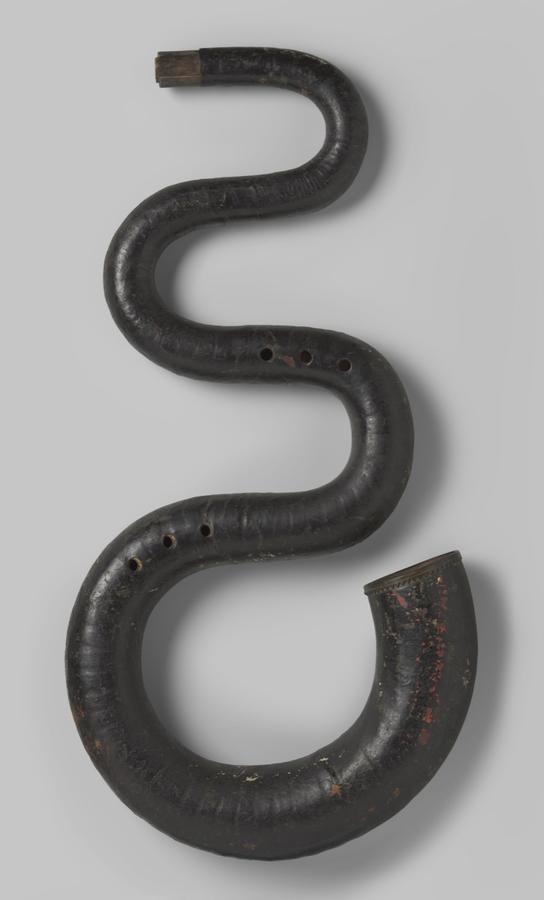
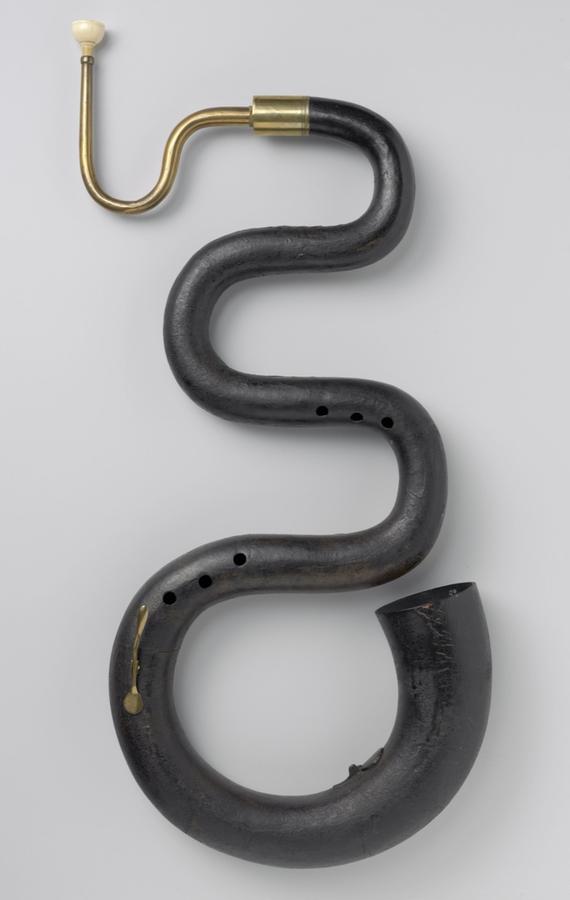
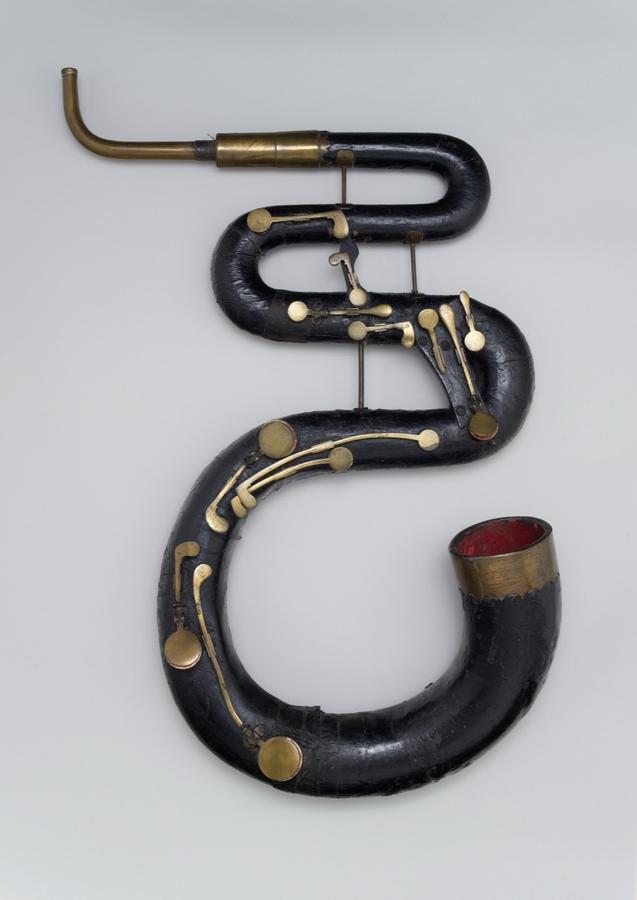
The serpent is a low-pitched early wind instrument in the lip-reed family, developed in the Renaissance era. It has a trombone-like mouthpiece, with six tone holes arranged in two groups of three fingered by each hand. It is named for its long, conical bore bent into a snakelike shape, and unlike most brass instruments is made from wood with an outer covering of leather or parchment. A distant ancestor of the tuba, the serpent is related to the cornett and was used for bass parts from the 17th to the early 19th centuries.
Summary: Wikipedia, “Serpent (instrument)” — CC BY-SA 4.0. Revision of 2026-05-29.
Museum photographs
These 9 photographs span 1600–1850, 5 places of origin and 2 museums. Every photograph is public domain or openly licensed, and links to the museum’s own record.
-
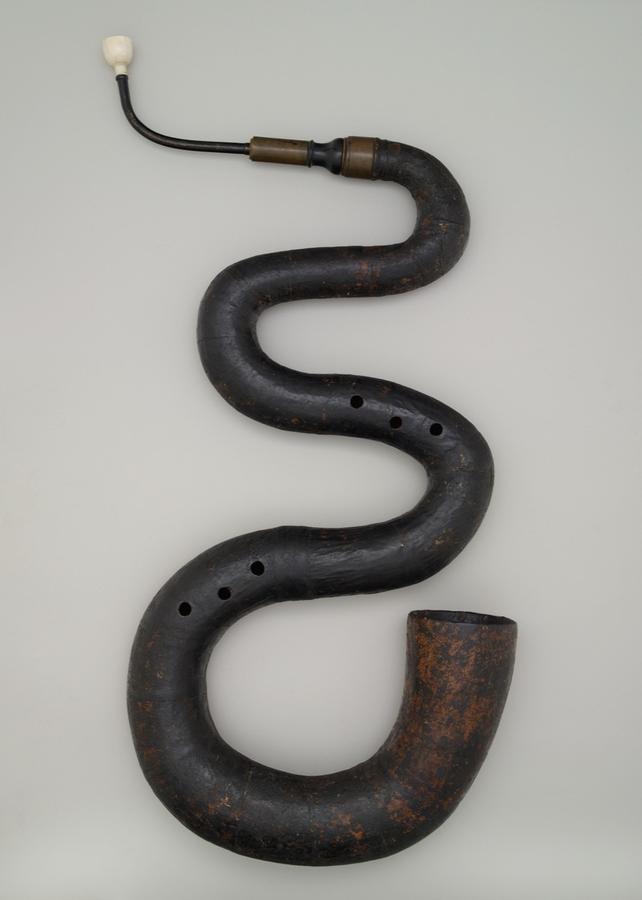
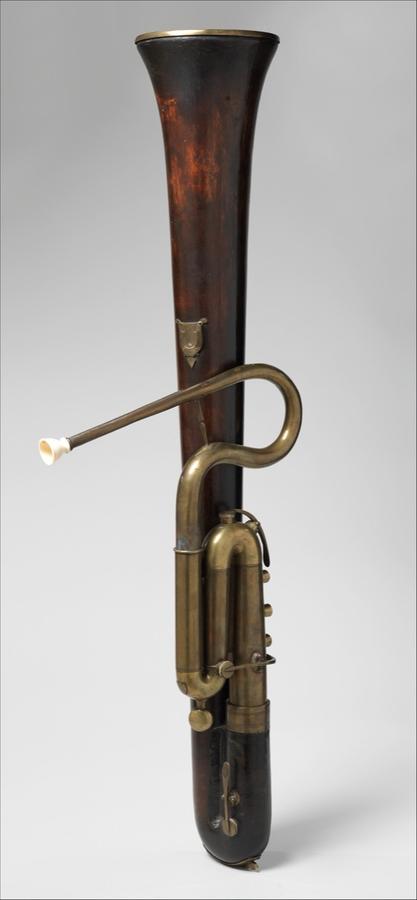
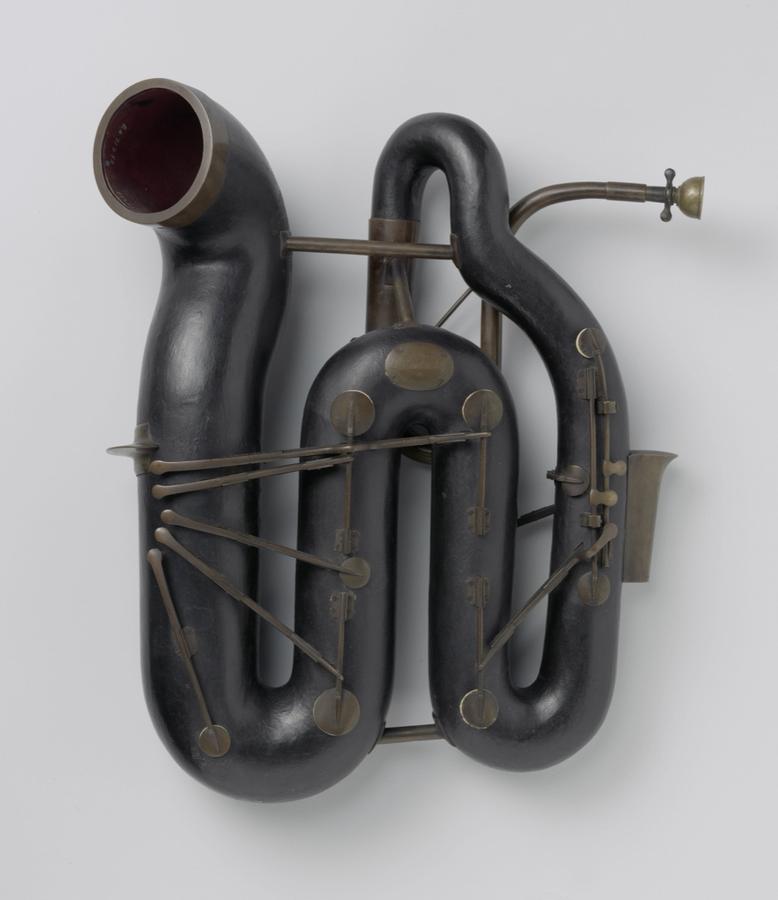
Serpent18th century (?) · Italian (Italy) -
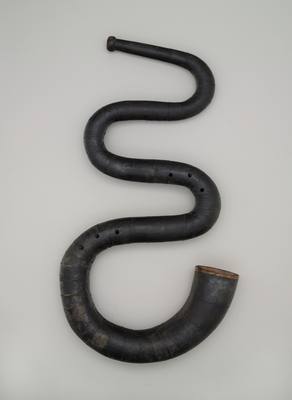
Serpent17th century (?) · possibly Italian (Italy?) -
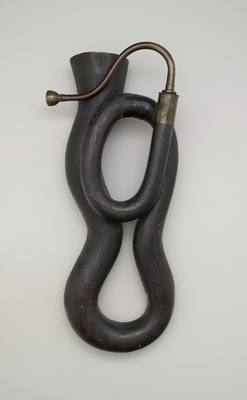
Serpent in Cca. 1805 · Germany -
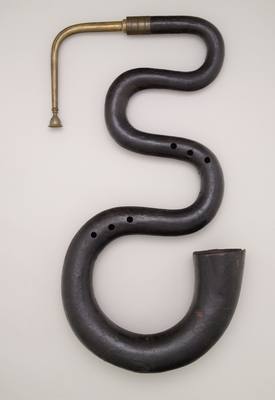
Serpentca. 1810 · French (France) -
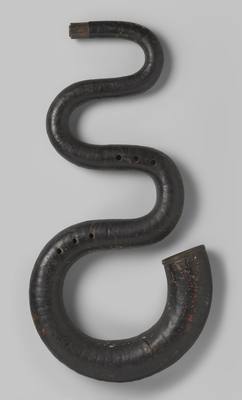
Serpent1800 - 1825 · Germany -
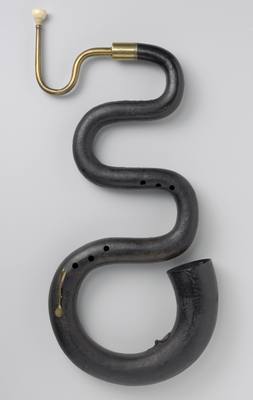
Serpentc. 1800 - c. 1825 · France -
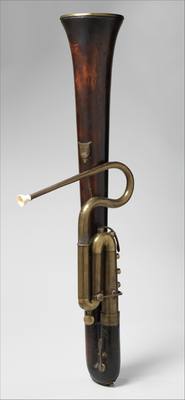
Serpent Forveille in B-flatca. 1825 · French (France) -
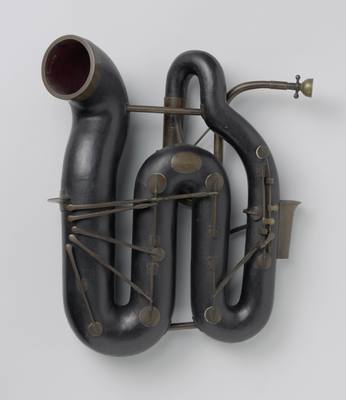
Serpentc. 1825 - c. 1835 · Amsterdam -
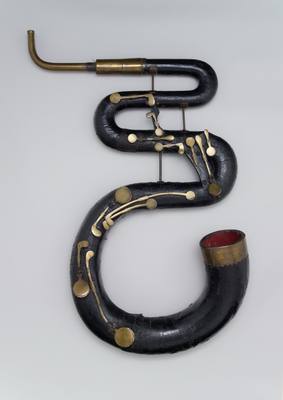
Serpent in Cca. 1840 · British (United Kingdom)
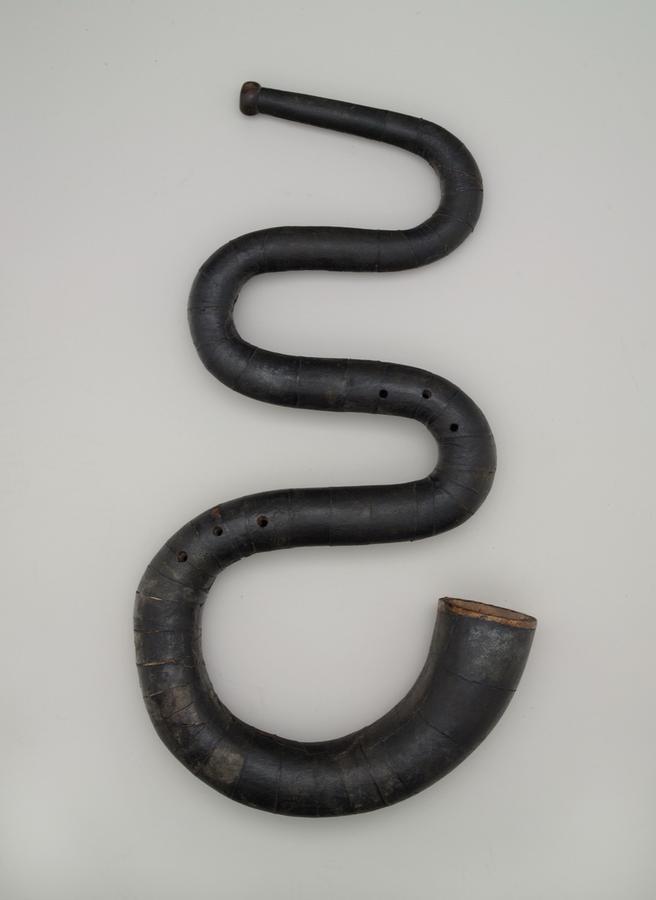
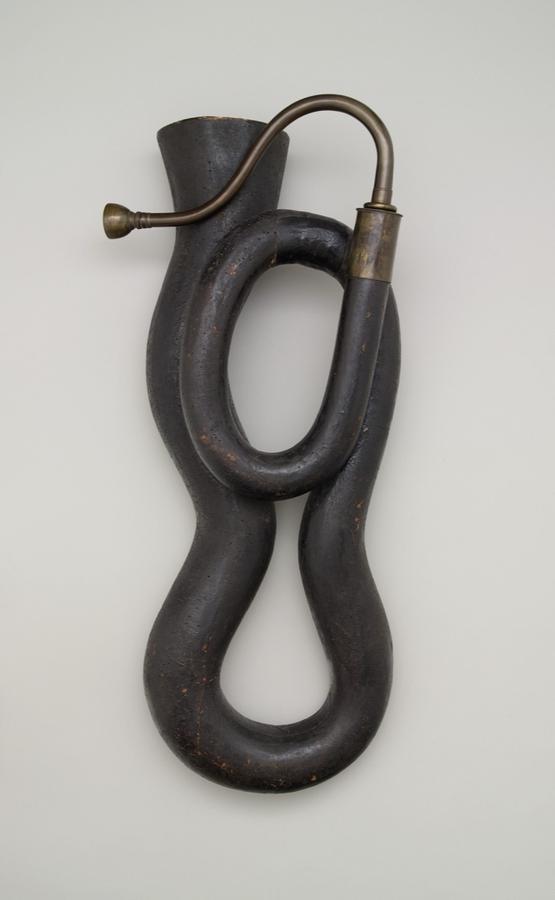
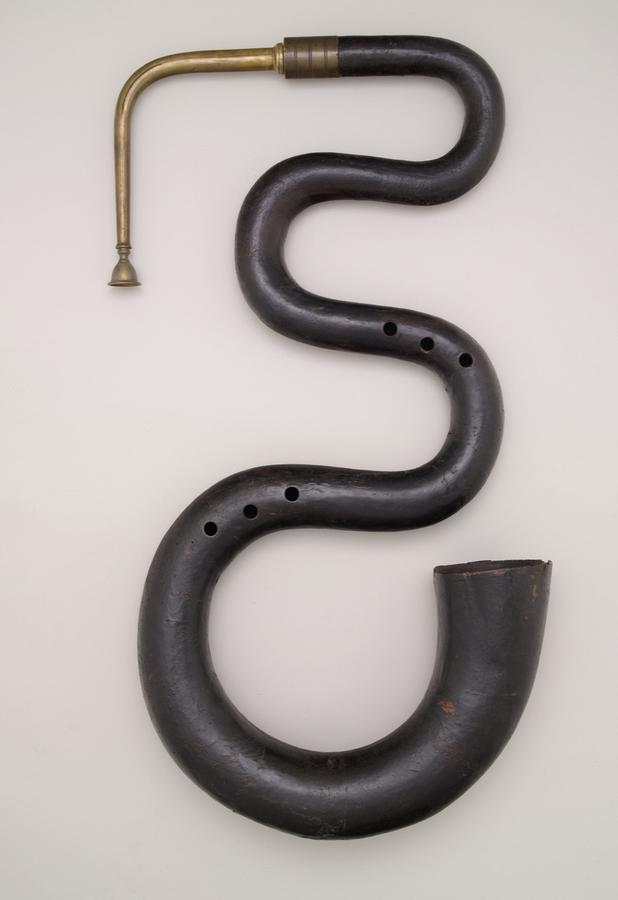
Facts at a glance
| Hornbostel–Sachs number | 423.213 — labrosones with fingerholes with wide conical bore |
|---|---|
| Hornbostel–Sachs group | Aerophones › Non-free aerophones (wind instruments proper) › Trumpets |
| Also known as | schlangenrohr, serpentone |
| Developed | Late 16th century |
| Wikidata labels | 38 languages |
| Wikipedia article | Serpent (instrument) |
| Wikidata item | Q742168 |
| Wikimedia Commons category | Serpents |
| MusicBrainz instrument | 443c51d5-44ca-4ed5-bda8-d405e9d43270 |
| Encyclopaedia Britannica | art/serpent-musical-instrument |
Sources: Wikidata (CC0 1.0) — classification number, aliases, identifiers (dump of 2026-07-22); Wikipedia (CC BY-SA 4.0) — infobox fields (description of the classification number, development, inventors) and the names of the Hornbostel–Sachs groups (article “Hornbostel–Sachs”, revision of 2026-01-04).
The name in other languages
| Language | Name | Also written |
|---|---|---|
| English | serpent | schlangenrohr, serpentone |
| French | serpent | |
| German | Serpent | Schlangenrohr |
| Spanish | Serpentón | Serpenton |
| Italian | serpentone | |
| Portuguese | serpentão | Serpent |
| Dutch | serpent | |
| Russian | серпент | |
| Japanese | セルパン | |
| Chinese | 蛇號 | |
| Korean | 세르팡 | |
| Arabic | أفعوانية |
Sources: Wikidata (CC0 1.0) — labels and aliases; MusicBrainz (CC0 1.0) — instrument aliases (names only).
About the serpent: history, construction and playing
The serpent is a low-pitched early wind instrument in the lip-reed family, developed in the Renaissance era. It has a trombone-like mouthpiece, with six tone holes arranged in two groups of three fingered by each hand. It is named for its long, conical bore bent into a snakelike shape, and unlike most brass instruments is made from wood with an outer covering of leather or parchment. A distant ancestor of the tuba, the serpent is related to the cornett and was used for bass parts from the 17th to the early 19th centuries.
In the early 19th century, keys were added to improve intonation, and several upright variants were developed and used, until they were superseded first by the ophicleide and ultimately by the valved tuba. After almost entirely disappearing from orchestras, the serpent experienced a renewed interest in historically informed performance practice in the mid-20th century. Several contemporary works have been commissioned and composed, and serpents are again made by a small number of contemporary manufacturers. The sound or timbre of a serpent is somewhere between a bassoon and a euphonium, and it is typically played in a seated position, with the instrument resting upright between the player's knees.
Construction
Although closely related to the cornett, the serpent has thinner walls, a more conical bore, and no thumb-hole. The original serpent was typically built from hardwood, usually walnut or other tonewoods like maple, cherry, or pear, or sometimes softer woods like poplar. In France, the instrument was made from bonding two double-S-shaped halves, each carved from a single large piece of wood. In England, it was usually made from several smaller curved tubular wooden segments, each made by gluing two hollowed halves together. The whole instrument was then glued and bound with an outer covering of leather. A small number were made instead from copper or brass; one brass serpent in the Museo internazionale e biblioteca della musica in Bologna was built in 1773 with an added outer layer of leather.
The instrument uses a mouthpiece about the same size as a trombone mouthpiece, originally made from ivory, horn or hardwood. The cup profiles of most historical serpent and bass horn mouthpieces were a distinctly hemispherical or ovate bowl shape, with a sharper-edged and narrower "throat" at the bottom of the cup than modern trombone mouthpieces, before expanding more-or-less conically through the shank. The mouthpiece fits into the bocal or crook, a small length of brass tubing that emerges from the top wooden segment.
The serpent has six tone holes, in two groups of three, fingered by each hand. It is initially challenging to play the instrument with good intonation, due in large part to the positions of the tone holes. They are arranged mainly to be accessible to the player's fingers, rather than in acoustically correct positions, which for some of them would be out of reach. The lower tone holes are too small to act effectively to shorten the air column, but by dampening resonances they nevertheless aid note selection and contribute to the serpent's characteristic soft timbre. While early serpents were keyless, later instruments added keys for additional holes out of reach of the fingers to improve intonation, and extend range. A mid-19th century model by London instrument maker Thomas Key has 14 keys, and survives in St Fagans National Museum of History in Cardiff, Wales.
Sizes
The majority of surviving specimens in museums and private collections are nominally Bass serpent built in eight-foot (8′) C, thus having a total tubing length of about 8 feet. A few slightly smaller specimens were built in D, and military serpents could sometimes vary in pitch between D♭ and B♭.
The Tenor serpent (or Serpet; serpenteau) arose in the 1960s when English early music specialist and instrument maker Christopher Monk began his efforts to produce modern reproduction serpents by first building a half-sized pattern, which equated to a tenor size in 4′ C. Through a pantographic milling process, he scaled up the pattern by 2× to carve a bass serpent. Since he could just as easily carve at 1×, he was also able to produce tenor serpents popular in serpent ensembles, and usable by players with smaller fingers. The Soprano serpent, or Worm, was built by scaling the tenor serpent by 0.5× to produce an instrument in 2′ C, two octaves higher than the standard serpent. It first appeared in the 1980s, made as a novelty instrument by Monk. There is no repertoire or other evidence of the historical existence of these sizes.
The Contrabass serpent, nicknamed the Anaconda and built in 16′ C one octave below the serpent, was an English invention of the mid-19th century with no historical repertoire. The prototype instrument was built c. 1840 by Joseph and Richard Wood in Huddersfield as a double-sized English military serpent, and survives in the University of Edinburgh museum collection. Its use of keys, progressively larger tone holes, and an open top tone hole make it essentially a wooden, serpent-shaped contrabass ophicleide. During the serpent's modern revival, two more contrabass serpents were built in the original serpent ordinaire form in the 1990s by Christopher Monk's workshop, by doubling the pattern for a bass serpent. They were called "George" and "George II". The first, commissioned by musicologist and serpent player Philip Palmer, was owned by American trombonist and serpent player Douglas Yeo for a time and features in some of his serpent recordings. At least four other contrabass serpents have also been built: one from PVC piping in 1986, two from box plywood based on a "squarpent" design by American serpent player and curator Paul Schmidt, and one in 2014 from spare tuba and sousaphone parts.
History
There is little direct material or documentary evidence for the exact origin of the serpent. French historian Jean Lebeuf claimed in his 1743 work Mémoires Concernant l'Histoire Ecclésiastique et Civile d’Auxerre that the serpent was invented in 1590 by Edmé Guillaume, a clergyman in Auxerre, France, which is generally accepted. Some scholars propose that the serpent may have evolved from large, curved bass cornetts that were in use in Italy in the 16th century, but the lack of knowledge of the serpent in early 17th century Italy, or surviving early serpents outside of France, counts against this idea. The serpent was certainly used in France since the early 17th century, to strengthen the cantus firmus and bass voices of choirs in plainchant. This original traditional serpent was known as the serpent ordinaire or serpent d'église (lit. ordinary serpent).
Around the middle of the 18th century, the serpent began to appear in military bands, chamber ensembles, and later in orchestras. In England, particularly in the south, the serpent was used in west gallery music played in Church of England parish churches and village bands until the mid 19th century.
Military serpents
Towards the end of the 18th century, the increased popularity of the serpent in military bands drove the subsequent development of the instrument to accommodate marching or mounted players. In England, a distinct military serpent was developed which had a more compact shape with tighter curves, added extra keys to improve its intonation, and metal braces between the bends to increase its rigidity and durability. In France around the same time several makers produced a serpent militaire initially developed by Piffault (by whose name they are also known) that arranges the tubing vertically with an upward turned bell, reminiscent of a tenor saxophone.
Upright serpents and bass horns
Several vertical configurations of the serpent, generally known as upright serpents (serpent droit) or bass horns, were developed from the late 18th century. Retaining the same six tone holes and fingering of the original serpent, these instruments resemble the bassoon, with jointed straight tubes that fit into a short U-shaped butt joint, and an upward-pointing bell.
Early cimbasso
The serpent appears as serpentone in early 19th century Italian operatic scores by composers such as Spontini, Rossini, and Bellini. In Italy it was replaced by the cimbasso, a loose term that referred to several instruments; initially an upright serpent similar to the basson russe, then the ophicleide, early forms of valved tuba (pelittone, bombardone), and finally by the time of Verdi's opera Otello (1887), a valve contrabass trombone.
Range and performance
The serpent's range typically covers the two and a half octaves from C2 two octaves below middle C to G4. The range can easily extend downwards to A1 or even F1 by fingering the low C note with all holes covered, and producing falset tones, by slackening the embouchure ("lipping down"). Proficient players can play upwards to C5.
Monk writes that due to its inherent mechanical and acoustical defects, the serpent is one of the more difficult wind instruments to play well. Although played with an embouchure similar to that used with other brass instruments such as the trombone, the instrument is easily over-blown so the player must use a more gentle air stream. The tone holes do not always serve to shorten the air column as they do in woodwind instruments. The lower tone holes in particular are too small and behave more like air leaks, working largely by dampening resonances in the air column, thus altering the note selection and influencing the timbre. Consequently, the player must rely much more on a strong, controlled embouchure to produce the correct pitch than on other brass instruments. The serpent's natural tones with all holes covered (the harmonic series on C2) are fuller and richer than those produced with fingering, so the player must also focus on consistency of timbre and a cantabile approach throughout the serpent's range.
The serpent was originally played vertically, with each hand covering one of the two sets of tone holes from above. In 1772 Abbé Lunel, serpentist at Notre-Dame de Paris, devised a way to hold the serpent horizontally, a method subsequently used in military bands. Holding the serpent this way involves supporting the lower curve with the right hand under, rather than over, the lower three tone holes, thus reversing the order of the fingering.
Production of pitch can be lowered by a semitone or more by slackening the embouchure given the same fingering. This is due to the serpent's coupling of a "strong" acoustical system of embouchure and mouthpiece, with the relatively "weak" system of the air column in the serpent body. This results in the mouthpiece having a stronger influence on selecting the instrument pitch than the air column. The mismatch of embouchure and air column length also contributes to its timbre.
Source: Wikipedia, “Serpent (instrument)” — CC BY-SA 4.0 — text excerpted as published (references, images and tables removed); see the article for the full text and the list of authors. Revision of 2026-05-29.
From Grove’s Dictionary (1900)
The serpent is considered to consist of three parts, (1) the mouthpiece, (2) the crook, or curved brass tube leading into (3) the wooden body, which is built up of several pieces held together by a leathern covering. It is usually said to have been invented by a canon of Auxerre, named Edmé Guillaume, in 1590. The story bears a somewhat suspicious resemblance to that of the discovery of the bassoon by a canon of Ferrara in the first half of the same century. But there can be no doubt that about this period clerical musicians employed bass reed and brass instruments for the accompaniment of ecclesiastical plainsong. Indeed Mersenne, who gives a remarkably good and complete account of the Serpent, notices that 'even when played by a boy it is sufficient to support the voices of twenty robust monks.' The Serpent d'Eglise is still a recognised functionary in French churches.
The scale of the Serpent is in the highest degree capricious, and indeed fortuitous. In this respect it resembles the bassoon. Mersenne gives it a compass of seventeen diatonic notes from eight-foot D upwards, and intimates that the intervening chromatics can be obtained by half-stopping. He does not name the device of cross-fingering so largely employed on the bassoon. Berlioz, who speaks slightingly of it, states that it is in B♭, and that parts for it 'must be written a whole tone above the real sound.' The old parts however from which the writer played 17 years ago at the Sacred Harmonic Society were all, without exception, in C.
Source: Wikisource, A Dictionary of Music and Musicians (Grove, 1900) — “Serpent” (entry by William H. Stone) — Public domain (published 1879–1910; authors died before 1929) — the first paragraphs of the entry, as transcribed; see the page for the full entry.
Sources and licences
- Serpent, Leopoldo Franciolini, 18th century (?), Italian (Italy). Wood, leather, brass, ivory. The Crosby Brown Collection of Musical Instruments, 1889 (89.4.1090). Museum record · CC0 1.0 (public domain dedication)
- Serpent, 17th century (?), possibly Italian (Italy?). Wood, leather. The Crosby Brown Collection of Musical Instruments, 1889 (89.4.2537). Museum record · CC0 1.0 (public domain dedication)
- Serpent in C, W. Schmidt, ca. 1805, Germany. Wood, leather, brass. The Crosby Brown Collection of Musical Instruments, 1889 (89.4.1630). Museum record · CC0 1.0 (public domain dedication)
- Serpent, Unknown, ca. 1810, French (France). Wood, leather cover. Purchase, Robert Alonzo Lehman Bequest, 2005 (2005.372). Museum record · CC0 1.0 (public domain dedication)
- Serpent, Anonymous, 1800 - 1825, Germany. leather, wood (plant material). Purchased with the support of the State of the Netherlands and the Vereeniging van Noord-Nederlandsche Muziekgeschiedenis. Museum record · Public Domain Mark 1.0
- Serpent, Anonymous, c. 1800 - c. 1825, France. wood (plant material), leather. Purchased with the support of the State of the Netherlands and the Vereeniging van Noord-Nederlandsche Muziekgeschiedenis. Museum record · Public Domain Mark 1.0
- Serpent Forveille in B-flat, Forveille, ca. 1825, French (France). Wood, leather. The Crosby Brown Collection of Musical Instruments, 1889 (89.4.1094). Museum record · CC0 1.0 (public domain dedication)
- Serpent, c. 1825 - c. 1835, Amsterdam. leather, wood (plant material), copper (metal). Purchased with the support of the State of the Netherlands and the Vereeniging van Noord-Nederlandsche Muziekgeschiedenis. Museum record · Public Domain Mark 1.0
- Serpent in C, Thomas Key, ca. 1840, British (United Kingdom). Wood, leather, fabric, brass. The Crosby Brown Collection of Musical Instruments, 1889 (89.4.1643). Museum record · CC0 1.0 (public domain dedication)
Photographs: open-access collections of the museums named above; each is shown here reduced in size, otherwise unchanged. Text: Wikipedia (CC BY-SA 4.0), Grove’s Dictionary (public domain), Wikidata and MusicBrainz (CC0). The full list of sources and licences is on the credits page.