
Instruments · Aerophones
Ophicleide
The ophicleide is a family of conical-bore keyed brass instruments invented in early 19th-century France to extend the keyed bugle into the lower range. Of these, the bass ophicleide in eight-foot (8′) C or 9′ B♭ took root over the course of the 19th century in military bands and as the bass of orchestral brass sections throughout Western Europe, replacing the serpent and its later upright derivatives. By the end of the 19th century, however, it had been largely superseded, in bands by the euphonium and in orchestras by early forms of the modern tuba, some developed from valved ophicleides. The late 20th century saw a revival of interest in the instrument for historically informed performance practice, and ophicleides are built by a small number of manufacturers.
Summary: Wikipedia, “Ophicleide” — CC BY-SA 4.0. Revision of 2026-05-27.
Museum photographs
These 8 photographs span 1820–1875, 4 places of origin and 2 museums. Every photograph is public domain or openly licensed, and links to the museum’s own record.
-
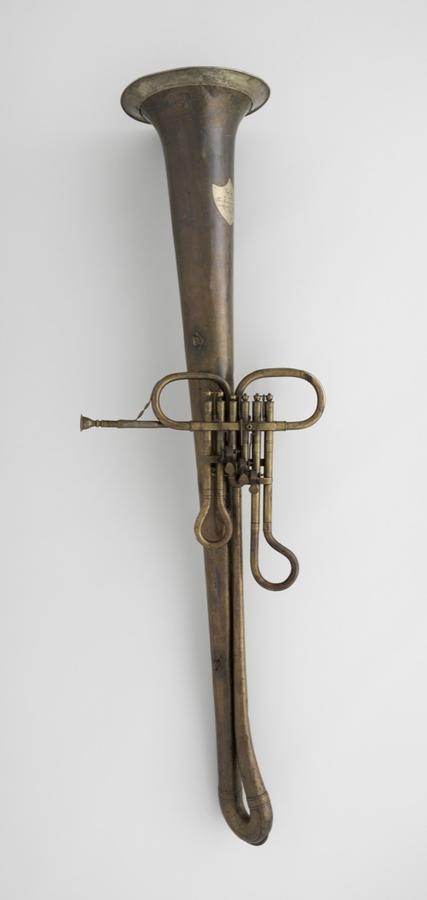
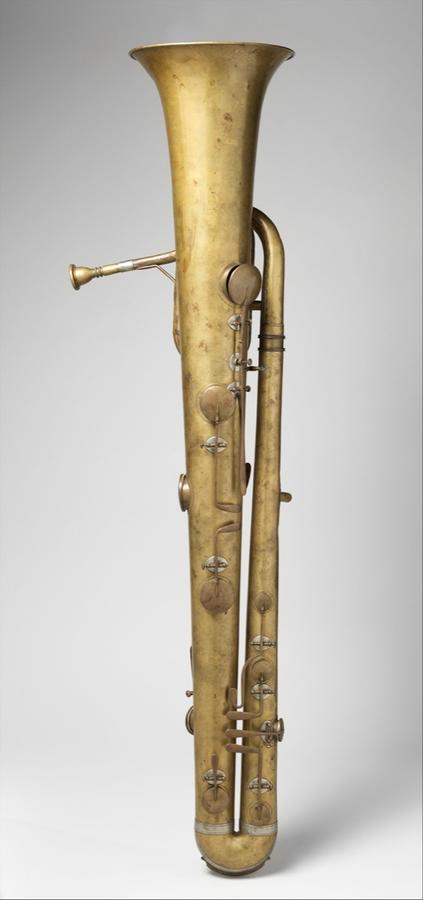
Contrabass Valve Ophicleide in Dca. 1840 · Austrian (Austria) -
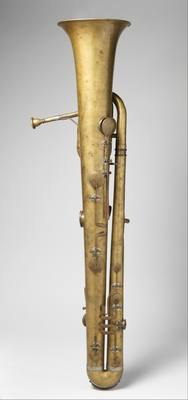
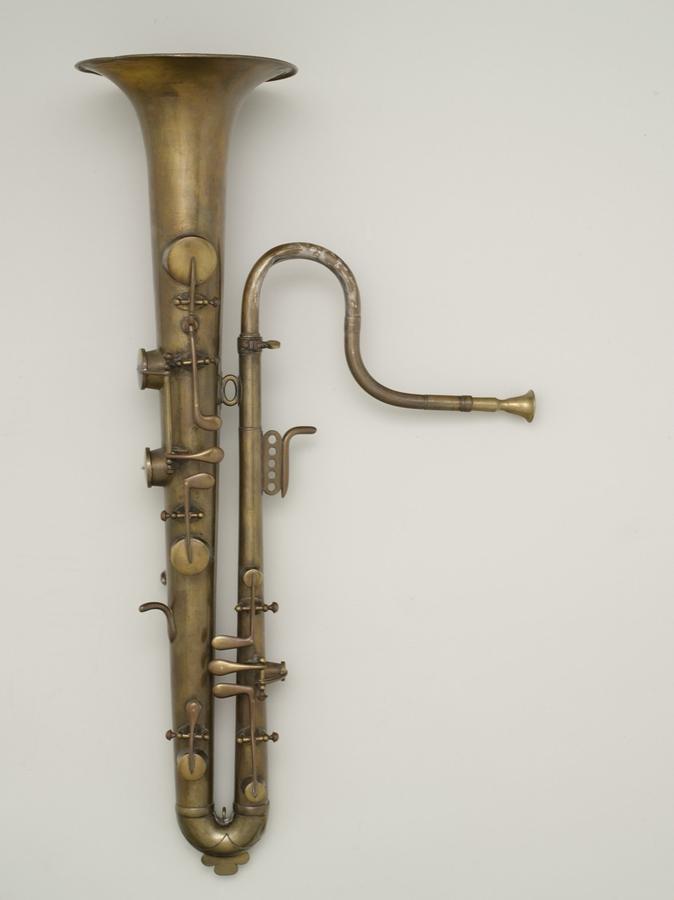
Bass Ophicleide in B-flatca. 1830 · possibly German (Germany?) -
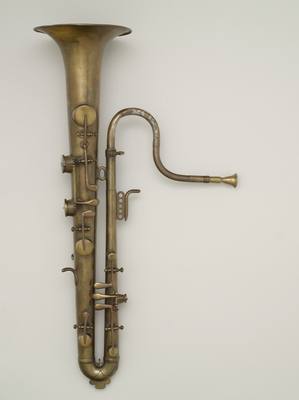
Soprano ophicleide in B-flatmid-19th century · French (France) -
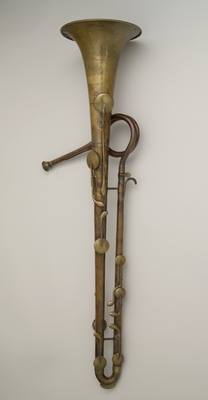
Tenor (Alto) Ophicleide in E-flatca. 1825–65 · Belgian (Belgium) -
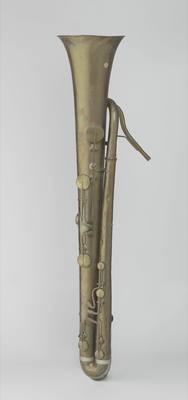
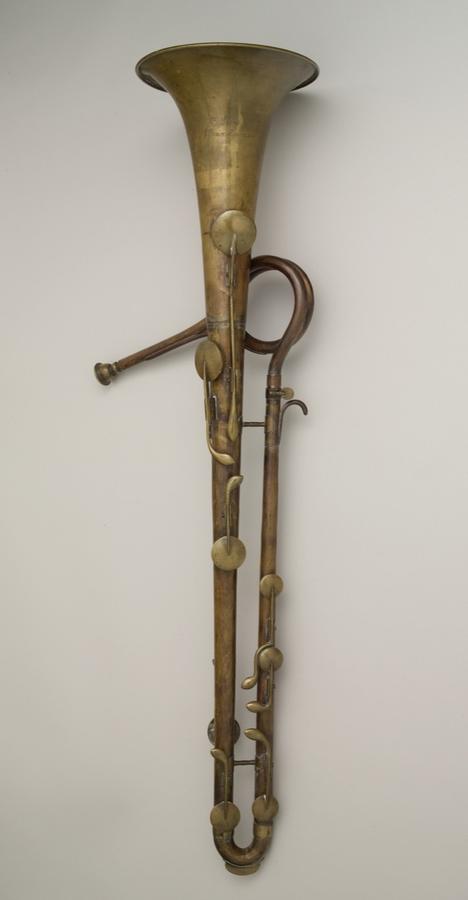
Bass ophicleide1830 - 1850 · France -
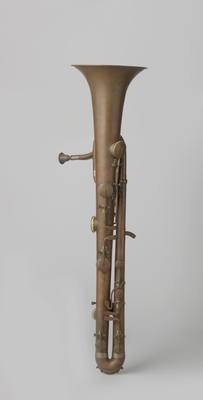
Alto ophicleidec. 1830 - c. 1850 · France -
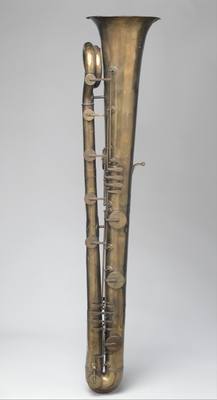
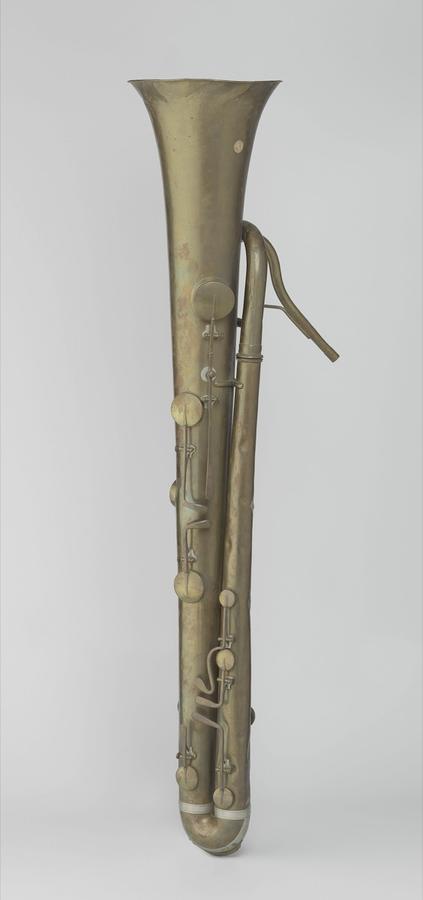
Bass Ophicleide in C (?)1837–54 · French (France) -
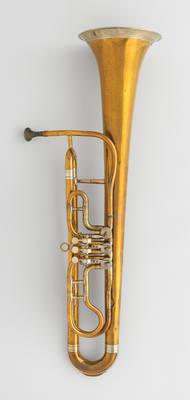
Valved Ophicleide (Bombardon) in B-flat1855–60 · Austrian (Austria)
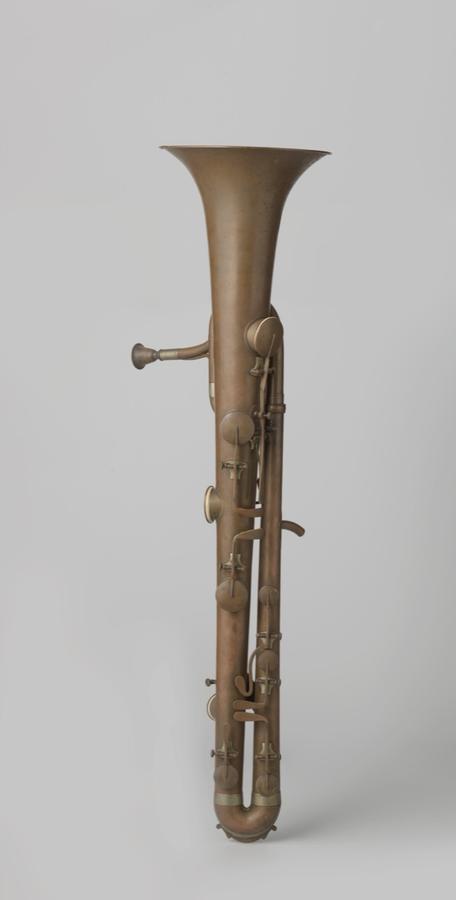
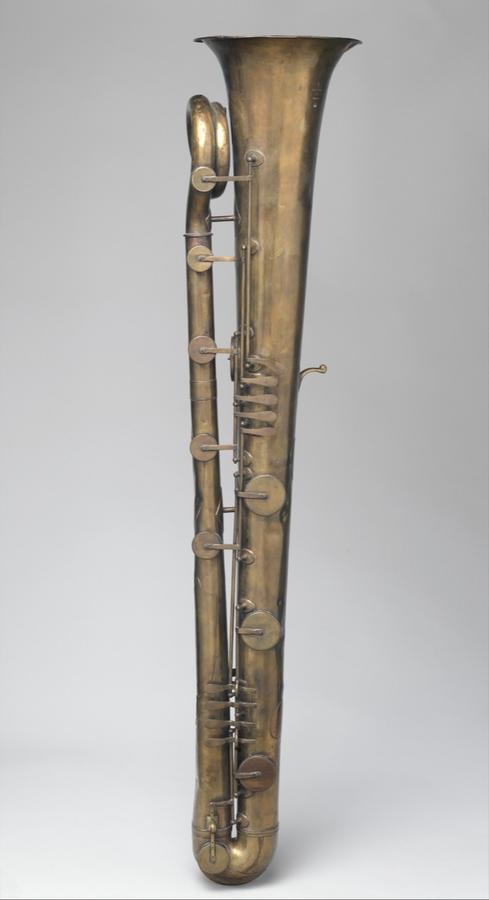
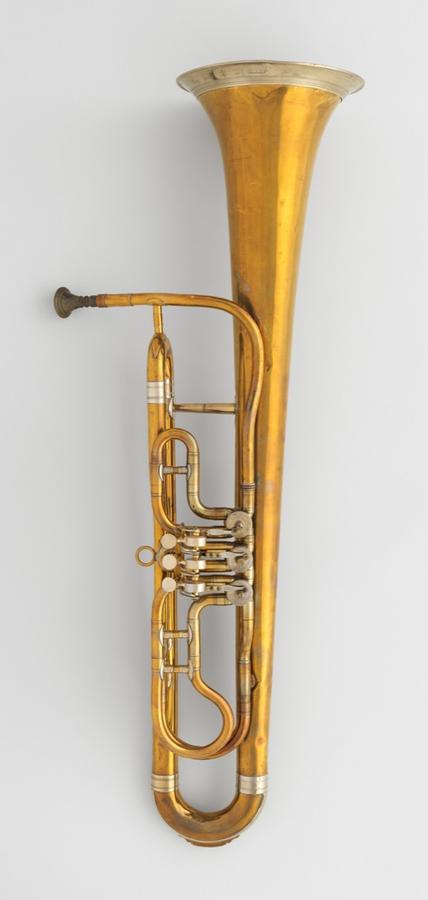
Facts at a glance
| Hornbostel–Sachs number | 423.21 — aerophone sounded by lip vibration with keys |
|---|---|
| Hornbostel–Sachs group | Aerophones › Non-free aerophones (wind instruments proper) › Trumpets |
| Developed | 19th century |
| Wikidata labels | 31 languages |
| Wikipedia article | Ophicleide |
| Wikidata item | Q200823 |
| Wikimedia Commons category | Ophicleides |
| MusicBrainz instrument | 18fb4427-58c5-4ab6-88a3-2b67a6afd718 |
| Encyclopaedia Britannica | art/ophicleide |
Sources: Wikidata (CC0 1.0) — classification number, aliases, identifiers (dump of 2026-07-22); Wikipedia (CC BY-SA 4.0) — infobox fields (description of the classification number, development, inventors) and the names of the Hornbostel–Sachs groups (article “Hornbostel–Sachs”, revision of 2026-01-04).
The name in other languages
| Language | Name | Also written |
|---|---|---|
| English | ophicleide | |
| French | ophicléide | |
| German | Ophikleide | |
| Spanish | figle | oficleido |
| Italian | oficleide | |
| Portuguese | oficleide | figle |
| Dutch | ophicleïde | |
| Russian | офиклеид | |
| Japanese | オフィクレイド | |
| Chinese | 奥菲克莱德号 | 奧菲克萊德號 |
| Korean | 오피클라이드 |
Sources: Wikidata (CC0 1.0) — labels and aliases; MusicBrainz (CC0 1.0) — instrument aliases (names only).
About the ophicleide: history, construction and playing
The ophicleide is a family of conical-bore keyed brass instruments invented in early 19th-century France to extend the keyed bugle into the lower range. Of these, the bass ophicleide in eight-foot (8′) C or 9′ B♭ took root over the course of the 19th century in military bands and as the bass of orchestral brass sections throughout Western Europe, replacing the serpent and its later upright derivatives. By the end of the 19th century, however, it had been largely superseded, in bands by the euphonium and in orchestras by early forms of the modern tuba, some developed from valved ophicleides. The late 20th century saw a revival of interest in the instrument for historically informed performance practice, and ophicleides are built by a small number of manufacturers.
History
The ophicleide was invented in 1817 by the Paris instrument maker Jean Hilaire Asté (operating as Halary) as a set of instruments to extend the keyed bugle into lower registers, with an intention to replace the serpent. His 1821 patent described the (nominally bass) ophicleide in eight-foot (8′) C or 9′ B♭, an alto Quinticlave built in 6′ F or 6½′ E♭, and a contrabass monstre in 12′ F. A rare instrument, the quinticlave enjoyed only brief use in military bands before being superseded by valved instruments; the clavicor with three Stölzel valves, followed quickly by alto and tenor saxhorns.
The contrabass in 12′ F or 13′ E♭, known in France as the Monstre, was not widely adopted. Mendelssohn commissioned one for later performances of his 1846 oratorio Elijah, played by the French musician Prospère in performances in France and England. Four known instruments, all in F, survive in non-playable condition in museums. Only two playable contrabass ophicleides exist, both built in E♭ since the late 1980s by the Californian instrument maker Robb Stewart. Adolphe Sax in the 1840s built examples of a soprano ophicleide, an octave above the bass, and playable replicas have also been built by Stewart, including a smaller instrument in E♭.
The most successful size was the bass ophicleide, which became the bass voice of the brass section of the early Romantic orchestra outside of German-speaking countries, replacing the Renaissance-era serpent and its later upright derivatives. In scores, ophicleide first appeared in the banda (stage band) of the opera Olimpie by Gaspare Spontini in 1819. By mid-century, the instrument was standard in French serious operas by Meyerbeer, Halevy, and Auber, as well as English operas by Michael Balfe, Vincent Wallace, and others. In Italian opera, Rossini, Bellini, and Verdi scored the lowest brass part for serpentone or cimbasso in their early operas; by the mid-1830s these parts were often played on the ophicleide, until the appearance of valved instruments like the bombardone and pelittone. In Germany, Richard Wagner also composed for the ophicleide in his early works, anticipating performances in Paris, before later switching to the bass and contrabass tuba or contrabass trombone.
Construction
The ophicleide's tubing has a similar length and arrangement as that of the upright serpents that preceded it, bending back on itself in a similar manner to the bassoon. The taper of the ophicleide's wide conical bore is similar to a saxophone of comparable range, with only a modest bell flare compared to other brass instruments.
It is played with a cup-shaped mouthpiece, similar to a modern trombone or euphonium mouthpiece. The patent describes the original instrument having nine keys, but it was later expanded to up to 11 and 12 keys, covering large tone holes sized proportionally to the bore diameter. Most surviving instruments have either nine or eleven keys.
Ophicleides were built in sufficient numbers, until as late as the 1920s, that instruments can still be found in playable or repairable condition. Modern replicas have been made, sometimes with modern improvements to materials, key work and acoustic design, usually to order by artisan instrument makers such as Benedikt Eppelsheim, Robb Stewart and Jérôme Wiss. In 2002 the editor of the Serpent Newsletter, Paul Schmidt, published instructions for building the Box-O-Cleide, a serviceable instrument built from plywood. The British-Chinese maker Wessex Tubas offer new ophicleides and quinticlaves, based on 19th century instruments by Halary and Gautrot, and the Leipzig instrument maker Takao Nakagawa makes a valved ophicleide in F with five rotary valves.
Performance
Keyed brass instruments have fingering unlike other keyed wind instruments, where fingers usually cover and close tone holes (or on larger instruments, operate a key mechanism to close them remotely). On the ophicleide the tone holes are normally closed, and are uncovered to an open position when pressing the associated key lever.
The largest key-covered tone hole, just below the bell, is normally open and closes when its key is pressed. When open, this tone hole acts as the acoustic bell, the bell itself having little effect on sound or pitch. When closed, the air column is extended past the tone hole and up to the bell, lowering the pitch by one half step. The sound produced with no key levers pressed is the nominal pitch of the instrument, so the lowest note, obtained by closing the open key, is a semitone lower.
The player can obtain the available partials for a given air column length by changing embouchure, as with other brass instruments. When one of the normally closed tone holes is opened by pressing its key, it effectively makes that hole the "bell" of the instrument, with a corresponding shorter air column and higher series of partials. The left hand controls three such tone holes, plus the normally open top hole below the bell. Pitches in the upper and middle range of the instrument can be obtained by using only the left hand keys, the right hand holding and stabilizing the instrument.
The lowest register of the instrument is more complex, requiring between one and three additional right-hand keys to operate smaller tone holes closer to the mouthpiece. Right hand keys can also be used in the upper register as alternate fingerings to facilitate faster passages, or to improve intonation, known as venting.
Source: Wikipedia, “Ophicleide” — CC BY-SA 4.0 — text excerpted as published (references, images and tables removed); see the article for the full text and the list of authors. Revision of 2026-05-27.
From Grove’s Dictionary (1900)
OPHICLEIDE (Eng. and Germ.; Fr. Basse d'Harmonie). A barbarous name, compounded of the Greek words for snake and door-key, which has been given to an improvement on the Serpent, Russian bassoon, or Bass-horn.
The invention of this instrument is attributed by Fétis to Frichot, a French musician settled in London about the year 1790. He states moreover that Frichot published in London in the year 1800 a description and method of playing it, under the title of 'A Complete Scale and Gammut of the Bass-horn, a new instrument, invented by M. Frichot, and manufactured by J. Astor.' It seems however that a musician of the church of St. Peter, at Lille, by name Regibo, had already, in 1780, made improvements on the serpent, by adding several keys and modifying the bore, so that Regibo may in fact be considered as the inventor even of the so-called Russian bassoon, 'which returned from the north of Europe about thirty years later.' It seems agreed on all hands that the French were made acquainted with this instrument by the bands of the allied sovereigns, when the latter occupied Paris in 1815. In this year its discovery is claimed by Halary of Paris, who patented it in 1821, and whose successor is said to possess the original model, with 7 keys and a scale of 27 notes. Labbaye added new keys to it, and the number has been since raised to 11.
Two of these instruments were employed at the Musical Festival in Westminster Abbey in June 1834. At the Birmingham Festival of the same year an ophicleide as well as a contrabass ophicleide were introduced, and are noticed in a periodical of the time as 'destined to operate a great change in the constitution of the orchestra.'
Source: Wikisource, A Dictionary of Music and Musicians (Grove, 1900) — “Ophicleide” (entry by William H. Stone) — Public domain (published 1879–1910; authors died before 1929) — the first paragraphs of the entry, as transcribed; see the page for the full entry.
Sources and licences
- Contrabass Valve Ophicleide in D, Leopold Uhlmann, ca. 1840, Austrian (Austria). Brass, nickel-silver. The Crosby Brown Collection of Musical Instruments, 1889 (89.4.2457). Museum record · CC0 1.0 (public domain dedication)
- Bass Ophicleide in B-flat, ca. 1830, possibly German (Germany?). Brass, nickel-silver. The Crosby Brown Collection of Musical Instruments, 1889 (89.4.1093). Museum record · CC0 1.0 (public domain dedication)
- Soprano ophicleide in B-flat, Adolphe (Antoine Joseph) Sax, mid-19th century, French (France). Brass. The Crosby Brown Collection of Musical Instruments, 1889 (89.4.2306). Museum record · CC0 1.0 (public domain dedication)
- Tenor (Alto) Ophicleide in E-flat, Charles Joseph Sax, ca. 1825–65, Belgian (Belgium). Brass. The Crosby Brown Collection of Musical Instruments, 1889 (89.4.2411). Museum record · CC0 1.0 (public domain dedication)
- Bass ophicleide, Anonymous, 1830 - 1850, France. felt (textile), leather, brass (alloy), copper (metal). Gift of the Koninklijke Militaire Academie. Museum record · Public Domain Mark 1.0
- Alto ophicleide, Anonymous, c. 1830 - c. 1850, France. copper (metal). Purchased with the support of the State of the Netherlands and the Vereeniging van Noord-Nederlandsche Muziekgeschiedenis. Museum record · Public Domain Mark 1.0
- Bass Ophicleide in C (?), Bartsch, 1837–54, French (France). Brass. The Crosby Brown Collection of Musical Instruments, 1889 (89.4.2369). Museum record · CC0 1.0 (public domain dedication)
- Valved Ophicleide (Bombardon) in B-flat, Franz Leibelt, 1855–60, Austrian (Austria). Brass. The Crosby Brown Collection of Musical Instruments, 1889 (89.4.2460). Museum record · CC0 1.0 (public domain dedication)
Photographs: open-access collections of the museums named above; each is shown here reduced in size, otherwise unchanged. Text: Wikipedia (CC BY-SA 4.0), Grove’s Dictionary (public domain), Wikidata and MusicBrainz (CC0). The full list of sources and licences is on the credits page.