
Instruments · Aerophones
Saxophone
A saxophone (often called the sax) is a type of single-reed woodwind instrument. The saxophone has a piece of wood, called a reed on a mouthpiece. The player blows air into the mouthpiece. This vibrates the reed and makes sound. The pitch can be changed by closing and opening holes in the saxophone. This changes the length of the tube. The holes are closed by leather pads. These leather pad connect to keys that can be pressed by the player. A person who plays the saxophone is called a saxophonist or saxist.
Summary: Simple English Wikipedia, “Saxophone” — CC BY-SA 4.0. Revision of 2026-06-30.
Hear the real instrument
These are recordings of a real alto saxophone in E♭, not a synthesiser. Click or tap a key to hear that note, or press Play the range to hear every note the instrument was recorded on, from lowest to highest.
| Recorded instrument | Alto saxophone in E♭ |
|---|---|
| Sounding range | D♭3 to A5 — the pitches you hear |
| Written range | B♭3 to F♯6 — the notes the player reads on the page |
| Transposition | The alto saxophone sounds a major sixth lower than written. |
| Notes | 33 recorded notes, one for every semitone from lowest to highest. Middle C is C4. |
The recordings are an alto saxophone; soprano, tenor and baritone saxophones have the same written fingerings but sound at other pitches.
Without JavaScript: play the lowest note (D♭3) or the highest note (A5) as MP3 files.
Recordings: IRCAM SOL (TinySOL), CC BY 4.0, Cella et al. Each note is cut from the original recording, levelled in loudness and converted to a short MP3; the playing technique is ordinary (ordinario), mostly at mezzo-forte.
Museum photographs
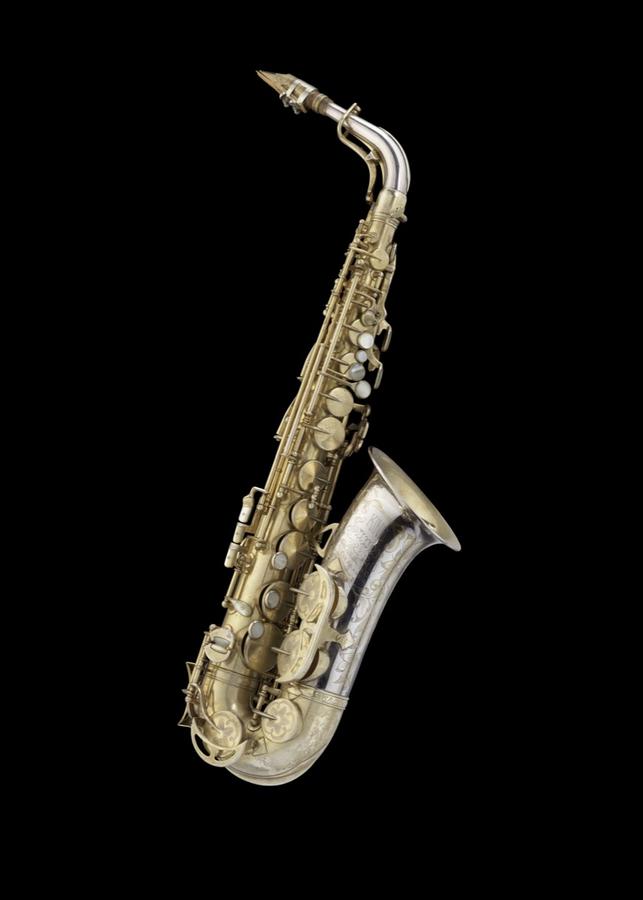
These 3 photographs span 1845–1947, 2 places of origin and 2 museums. Every photograph is public domain or openly licensed, and links to the museum’s own record.
-
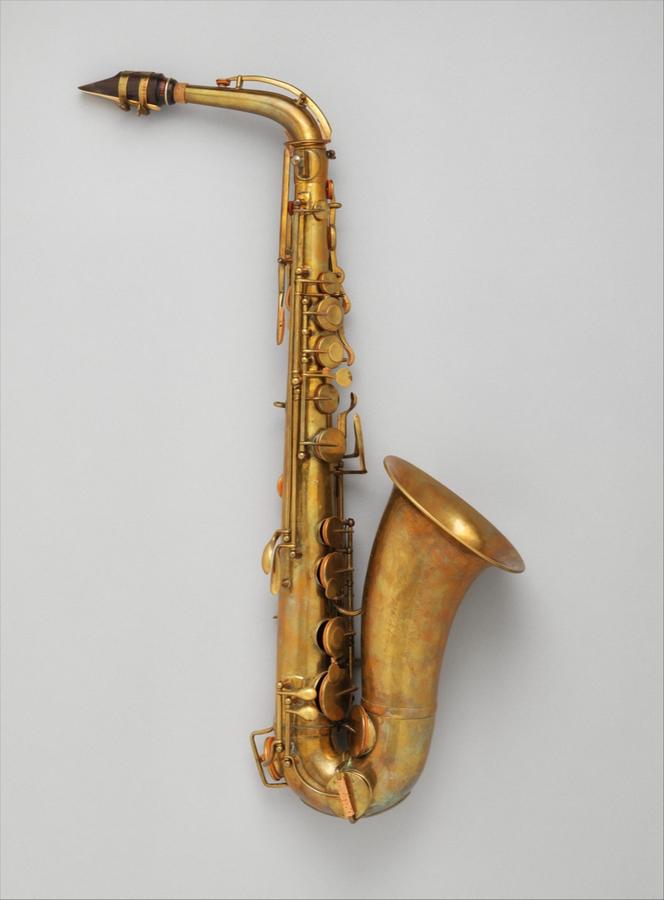
Alto saxophone in E-flatca. 1855 · French (France) -
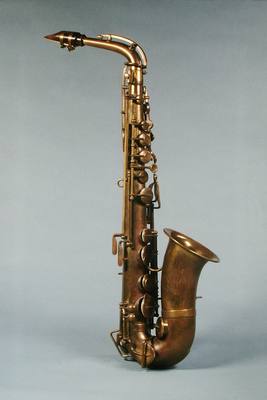
Alto Saxophoneafter 1887 · French (France) -
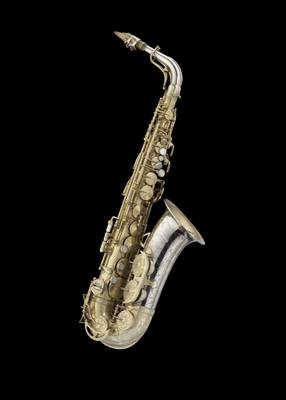
Alto saxophone owned and played by Charlie Parkerca. 1947 · African Americans (United States)
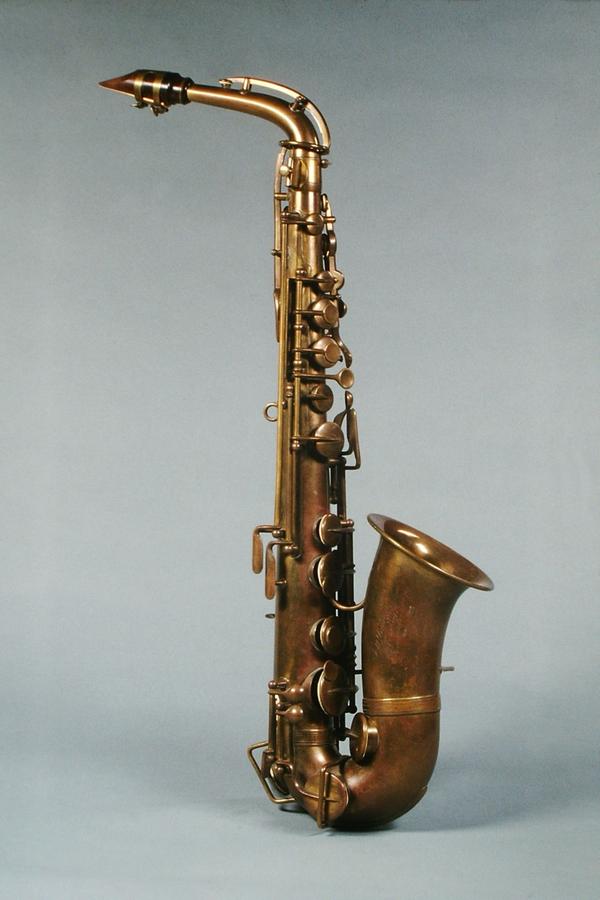
Facts at a glance
| Hornbostel–Sachs number | 422.212-71 |
|---|---|
| Hornbostel–Sachs group | Aerophones › Non-free aerophones (wind instruments proper) › Reed aerophones |
| Also known as | sax |
| Wikidata labels | 123 languages |
| Wikipedia article | Saxophone |
| Wikidata item | Q9798 |
| Wikimedia Commons category | Saxophones |
| MusicBrainz instrument | a9ed16cd-b8cb-4256-9c41-93f5f0458c49 |
| Encyclopaedia Britannica | art/saxophone |
Sources: Wikidata (CC0 1.0) — classification number, aliases, identifiers (dump of 2026-07-22); Wikipedia (CC BY-SA 4.0) — infobox fields (description of the classification number, development, inventors) and the names of the Hornbostel–Sachs groups (article “Hornbostel–Sachs”, revision of 2026-01-04).
The name in other languages
| Language | Name | Also written |
|---|---|---|
| English | saxophone | sax |
| French | saxophone | sax, saxo |
| German | Saxophon | Sax, Saxofon |
| Spanish | saxofón | saxofon |
| Italian | sassofono | |
| Portuguese | saxofone | |
| Dutch | saxofoon | |
| Russian | саксофон | |
| Japanese | サクソフォーン | サクソフォン, サキソフォン, サックス |
| Chinese | 薩克斯風 | 色士風, 薩氏管 |
| Korean | 색소폰 | |
| Arabic | ساكسفون | سَكسِيَّة |
Sources: Wikidata (CC0 1.0) — labels and aliases; MusicBrainz (CC0 1.0) — instrument aliases (names only).
About the saxophone: history, construction and playing
The saxophone (often referred to colloquially as the sax) is a type of single-reed woodwind instrument with a conical body, usually made of brass. As with all single-reed instruments, sound is produced when a reed on a mouthpiece vibrates to produce a sound wave inside the instrument's body. The pitch is controlled by opening and closing holes in the body to change the effective length of the tube. The holes are closed by leather pads attached to keys operated by the player. Saxophones are made in various sizes and are almost always treated as transposing instruments. A person who plays the saxophone is called a saxophonist or saxist.
The saxophone is used in a wide range of musical styles including classical music (such as concert bands, chamber music, solo repertoire, and occasionally orchestras), military bands, marching bands, jazz (such as big bands and jazz combos), and contemporary music. The saxophone is also used as a solo and melody instrument or as a member of a horn section in some styles of rock and roll and popular music.
Construction
The pitch of a saxophone is controlled by opening or closing the tone holes along the body of the instrument to change the length of the vibrating air column. The tone holes are closed by leather pads connected to keys—most are operated by the player's fingers, but some are operated using the palm or the side of a finger. There is an octave key, which raises the pitch of the lower notes by one octave. The lowest note on most modern saxophones is the written B♭ below middle C. Nearly all baritone saxophones are now constructed with an extra key to allow them to play low A, and a small number of altos with a low A key have been manufactured. The highest keyed note has traditionally been the F two and a half octaves above the low B♭, but many instruments now have an extra key for a high F♯, and some modern soprano saxophones even have a high G key. Notes above this are part of the altissimo register and require advanced embouchure techniques and fingering combinations.
Saxophone music is written in treble clef, appropriately transposed for each different type of instrument, and all saxophones use the same key arrangement and fingerings. Therefore, any written note corresponds to the same fingering on any saxophone, making it easier for players to switch instruments.
Alto and larger saxophones have a detachable curved neck at the top, and a U-shaped bend (the bow) that turns the tubing upward as it approaches the bell. Soprano and sopranino saxophones are usually constructed without a detachable neck or a bow but some have a small detachable neck and some are shaped like an alto saxophone with a bow section. There are rare examples of alto, tenor, and baritone saxophones with mostly straight bodies. Baritone, bass, and contrabass saxophones have extra bends to accommodate the length of tubing. The fingering system for the saxophone is similar to the systems used for the oboe, the Boehm-system clarinet, and the flute.
Materials
From the earliest days of the saxophone the body and key cups have been made from sheet brass stock, which can be worked into complex shapes. The keywork is manufactured from other types of brass stock. King made saxophones with necks and bells of sterling silver from the 1930s into the early 1960s. Yanagisawa revived this idea in the 1980s and later introduced instruments entirely made of sterling silver. Keilwerth and P. Mauriat have used nickel silver, a copper-nickel-zinc alloy more commonly used for flutes, for the bodies of some saxophone models. For visual and tonal effect, higher copper variants of brass are sometimes substituted for the more common "yellow brass" and "cartridge brass." Yanagisawa made its 902 and 992 series saxophones with the high copper alloy phosphor bronze to achieve a darker, more "vintage" tone than the brass 901 and 991 models.
Other materials are used for some mechanical parts and keywork. Buttons where the fingers contact the keys are usually made from plastic or mother of pearl. Rods, screw pins, and springs are usually made of blued or stainless steel. Mechanical buffers of felt, cork, leather, and various synthetic materials are used to minimize mechanical noise from key movement and to optimize the action of the keywork. Nickel silver is sometimes used for hinges for its advantages of mechanical durability, although the most common material for such applications has remained brass.
Manufacturers usually apply a finish to the surface of the instrument's body and keywork. The most common finish is a thin coating of clear or colored acrylic lacquer to protect the brass from oxidation and maintain a shiny appearance. Silver or gold plating are offered as options on some models. Some silver plated saxophones are also lacquered. Plating saxophones with gold is an expensive process because an underplating of silver is required for the gold to adhere to. Nickel plating has been used on the bodies of early budget model saxophones and is commonly used on keywork when a more durable finish is desired, mostly with student model saxophones. Chemical surface treatment of the base metal has come into use as an alternative to the lacquer and plating finishes in recent years.
Mouthpiece and reed
The saxophone uses a single-reed mouthpiece similar to that of the clarinet. Each size of saxophone (alto, tenor, etc.) uses a different size of reed and mouthpiece.
Most saxophonists use reeds made from Arundo donax cane, but since the middle of the twentieth century some have been made of fiberglass or other composite materials. Saxophone reeds are proportioned slightly differently from clarinet reeds, being wider for the same length. Commercial reeds vary in hardness and design, and single-reed players try different reeds to find those that suit their mouthpiece, embouchure, and playing style.
Mouthpiece design has a profound impact on tone. Different mouthpiece design characteristics and features tend to be favored for different styles. Early mouthpieces were designed to produce a "warm" and "round" sound for classical playing. Among classical mouthpieces, those with a concave ("excavated") chamber are truer to Adolphe Sax's original design; these provide a softer or less piercing tone favored by the Raschèr school of classical playing. Saxophonists who follow the French school of classical playing, influenced by Marcel Mule, generally use mouthpieces with smaller chambers for a somewhat "brighter" sound with relatively more upper harmonics. The use of the saxophone in dance orchestras and jazz ensembles from the 1920s onward placed emphasis on dynamic range and projection, leading to innovation in mouthpiece designs. At the opposite extreme from the classical mouthpieces are those with a small chamber and a low clearance above the reed between the tip and the chamber, called high baffle. These produce a bright sound with maximum projection, suitable for having a sound stand out among amplified instruments.
Mouthpieces come in a wide variety of materials including vulcanized rubber (sometimes called hard rubber or ebonite), plastic and metals like bronze or surgical steel. Less common materials that have been used include wood, glass, crystal, porcelain and bone. Recently, Delrin has been added to the stock of mouthpiece materials.
The effect of mouthpiece materials on tone of the saxophone has been the subject of much debate. According to Larry Teal, the mouthpiece material has little, if any, effect on the sound, and the physical dimensions give a mouthpiece its tone color. There are examples of "dark" sounding metal pieces and "bright" sounding hard rubber pieces. The extra bulk required near the tip with hard rubber affects mouth position and airflow characteristics.
Early development and adoption
The saxophone was designed around 1840 by Adolphe Sax, a Belgian instrument maker, flautist, and clarinetist. Born in Dinant and originally based in Brussels, he moved to Paris in 1842 to establish his musical instrument business. Before working on the saxophone, he made several improvements to the bass clarinet by improving its keywork and acoustics and extending its lower range. Sax was also a maker of the ophicleide, a large conical brass instrument in the bass register with keys similar to a woodwind instrument. His experience with these two instruments allowed him to develop the skills and technologies needed to make the first saxophones.
As an outgrowth of his work improving the bass clarinet, Sax began developing an instrument with the projection of a brass instrument and the agility of a woodwind. He wanted it to overblow at the octave, unlike the clarinet, which rises in pitch by a twelfth when overblown. An instrument that overblows at the octave has identical fingering for both registers.
Sax created an instrument with a single-reed mouthpiece and conical brass body. Having constructed saxophones in several sizes in the early 1840s, Sax applied for, and received, a 15-year patent for the instrument on 28 June 1846. The patent encompassed 14 versions of the fundamental design, split into two categories of seven instruments each, and ranging from sopranino to contrabass. A limited number of instruments in the series pitched in F and C were produced by Sax, but the series pitched in E♭ and B♭ quickly became the standard. All the instruments were given an initial written range from the B below the treble staff to the E♭ one half-step below the third ledger line above staff, giving each saxophone a range of two and a half octaves. Sax's patent expired in 1866. Thereafter, numerous other instrument manufacturers implemented their own improvements to the design and keywork.
Sax's original keywork, which was based on the Triébert-system oboe for the left hand and the Boehm-system clarinet for the right, was simplistic and made certain legato passages and wide intervals extremely difficult to finger; that system was later improved with extra keys, linkage mechanisms, and alternate fingerings.
Early twentieth-century growth and development
While the saxophone remained marginal, used mainly as a novelty instrument in the classical world, many new musical niches were established for it during the early decades of the twentieth century. Its early use in vaudeville and ragtime bands around the turn of the century laid the groundwork for its use in dance orchestras and eventually jazz. As the market for saxophones grew in the US, the manufacturing industry grew. The Martin Band Instrument Company started producing saxophones between 1905 and 1912, and the Cleveland Band Instrument Company started producing saxophones under contract to the H. N. White Company in 1916. The saxophone was promoted for the casual market with the introduction of the C soprano (slightly higher than the regular soprano) and C melody (between alto and tenor) saxophones, both pitched in C to enable them to play from piano music. Production of such instruments stopped during the Great Depression. During the 1920s, the saxophone came into use as a jazz instrument. Starting in the late 1920s and early 1930s, the modern era of classical saxophone was launched largely through the efforts of Marcel Mule and Sigurd Raschèr, and the classical repertoire for the instrument expanded rapidly.
Source: Wikipedia, “Saxophone” — CC BY-SA 4.0 — text excerpted as published (references, images and tables removed); see the article for the full text and the list of authors. Revision of 2026-06-26.
From Grove’s Dictionary (1900)
SAXOPHONE. Another instrument invented by Sax. It consists essentially of a conical brass tube furnished with twenty lateral orifices covered by keys, and with six studs or finger-plates for the first three fingers of either hand, and is played by means of a mouthpiece and single reed of the clarinet kind.
Like the Saxhorns, it is made in a number of sizes, representing in all seven different keys; namely, the sopranino in C and B♭; the soprano in F and E♭; the mezzo soprano in C and B♭; the contralto in F and E♭; the barytone in C and E♭; the bass in F and E♭, and the double bass or bourdon in C and B♭. The last of these can be played with a double-bassoon reed.
Those most used are the contralto and barytone varieties. In French military bands, however, five or more are in use; having to a great degree superseded the more difficult but more flexible clarinet, and having quite replaced the bassoon.
Source: Wikisource, A Dictionary of Music and Musicians (Grove, 1900) — “Saxophone” (entry by William H. Stone) — Public domain (published 1879–1910; authors died before 1929) — the first paragraphs of the entry, as transcribed; see the page for the full entry.
Composers who played it
86 composers on this site list the saxophone as an instrument they played. A selection:
- Hector Berlioz 1803–1869
- Hyacinthe Klosé 1808–1880
- Percy Grainger 1882–1961
- Carmen Lombardo 1903–1971
- Julia Smith 1905–1989
- Reginald Smith Brindle 1917–2003
- John Worley 1919–1999
- Charlie Parker 1920–1955
- Norman Symonds 1920–1998
- Dennis Berry 1921–1994
- Angela Morley 1924–2009
- Moacir Santos 1924–2006
Composers with a page on this site whose Wikidata record lists this instrument; featured and best-dated first. Data: Wikidata (property “instrument”, P1303), CC0 1.0.
Sources and licences
- Alto saxophone in E-flat, Adolphe (Antoine Joseph) Sax, ca. 1855, French (France). Brass. Purchase, Robert Alonzo Lehman Bequest, 2005 (2005.82.1a–e, .2a–y). Museum record · CC0 1.0 (public domain dedication)
- Alto Saxophone, Arsene-Zoe Lecomte & Cie, after 1887, French (France). Brass, ebony or cocus wood mouthpiece. The Crosby Brown Collection of Musical Instruments, 1889 (89.4.2170). Museum record · CC0 1.0 (public domain dedication)
- Alto saxophone owned and played by Charlie Parker, ca. 1947, African Americans (United States). brass (alloy), silver, mother of pearl, cork (bark). Collection of the Smithsonian National Museum of African American History and Culture. Museum record · CC0 1.0 (public domain dedication)
Photographs: open-access collections of the museums named above; each is shown here reduced in size, otherwise unchanged. Text: Wikipedia (CC BY-SA 4.0), Grove’s Dictionary (public domain), Wikidata and MusicBrainz (CC0). The full list of sources and licences is on the credits page.