
Instruments · Aerophones
Clarinet
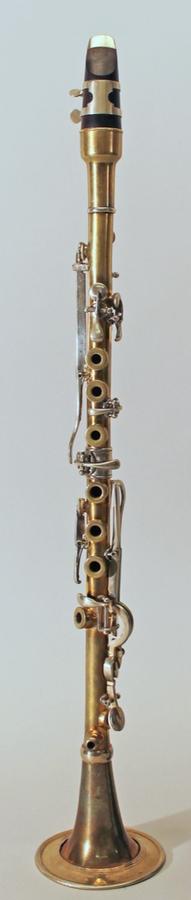
The clarinet is a single-reed musical instrument in the woodwind family, with a nearly cylindrical bore and a flared bell.
Clarinets comprise a family of instruments of differing sizes and pitches. The clarinet family is the largest woodwind family, ranging from the BB♭ contrabass to the A♭ piccolo. The B♭ soprano clarinet is the most common type, and is the instrument usually indicated by the word "clarinet".
Summary: Wikipedia, “Clarinet” — CC BY-SA 4.0. Revision of 2026-06-27.
Hear the real instrument
These are recordings of a real B♭ clarinet, not a synthesiser. Click or tap a key to hear that note, or press Play the range to hear every note the instrument was recorded on, from lowest to highest.
| Recorded instrument | B♭ clarinet |
|---|---|
| Sounding range | D3 to G6 — the pitches you hear |
| Written range | E3 to A6 — the notes the player reads on the page |
| Transposition | The B♭ clarinet sounds a major second lower than written. |
| Notes | 42 recorded notes, one for every semitone from lowest to highest. Middle C is C4. |
The recordings are a B♭ clarinet, the usual orchestral and band clarinet; the A clarinet is a minor third lower than written.
Without JavaScript: play the lowest note (D3) or the highest note (G6) as MP3 files.
Recordings: IRCAM SOL (TinySOL), CC BY 4.0, Cella et al. Each note is cut from the original recording, levelled in loudness and converted to a short MP3; the playing technique is ordinary (ordinario), mostly at mezzo-forte.
Museum photographs
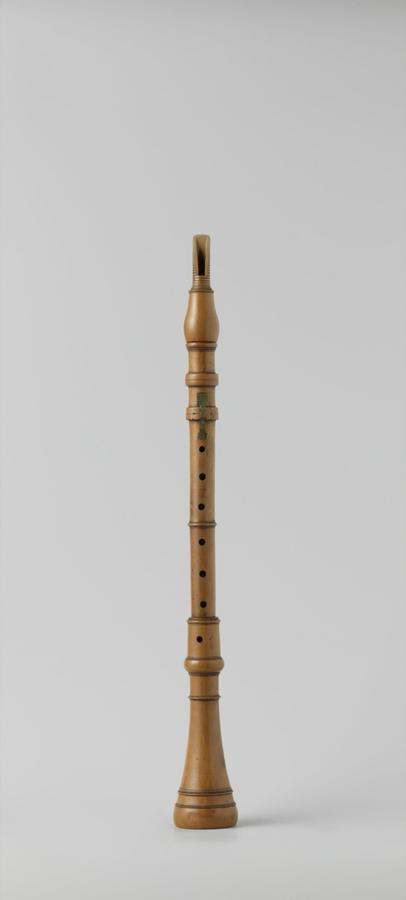
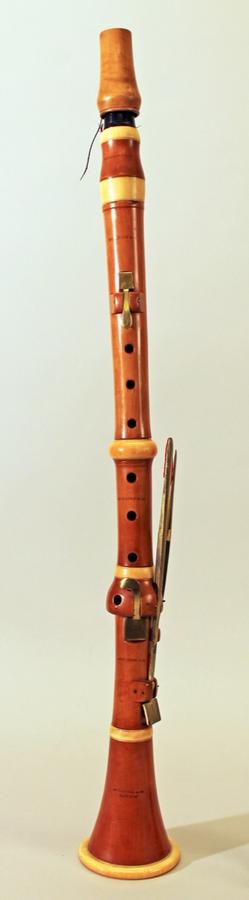
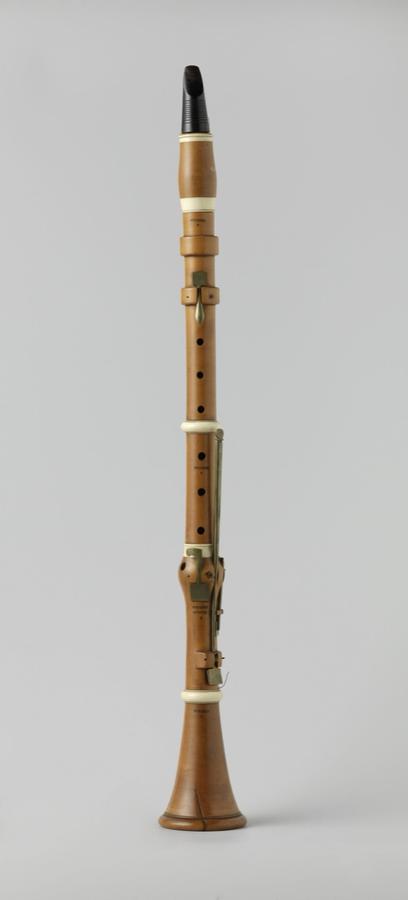
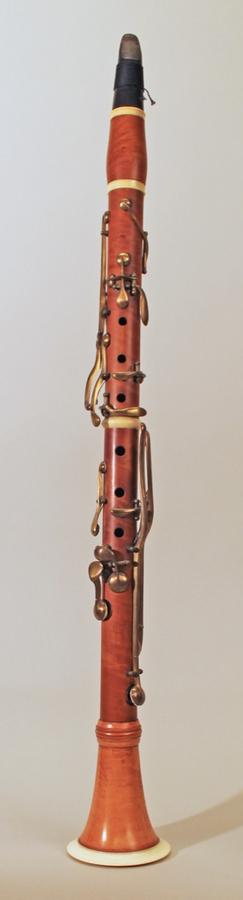
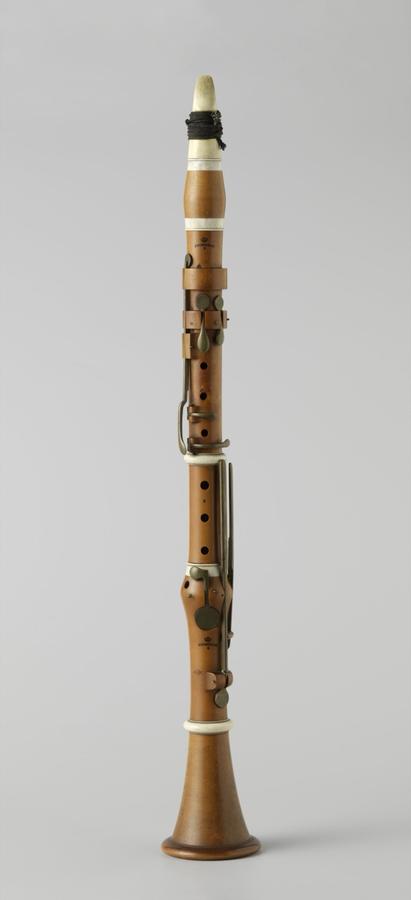
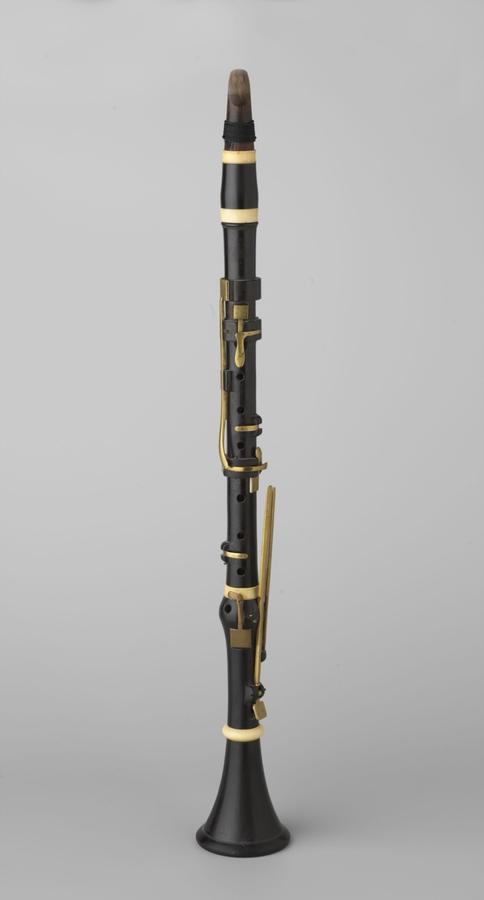
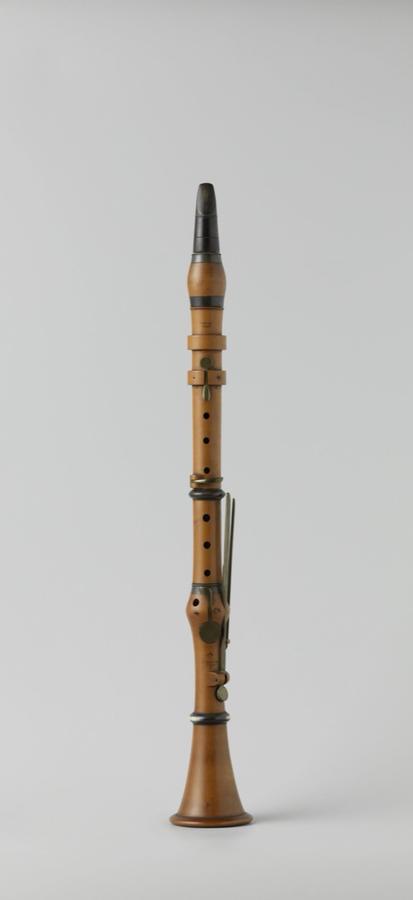
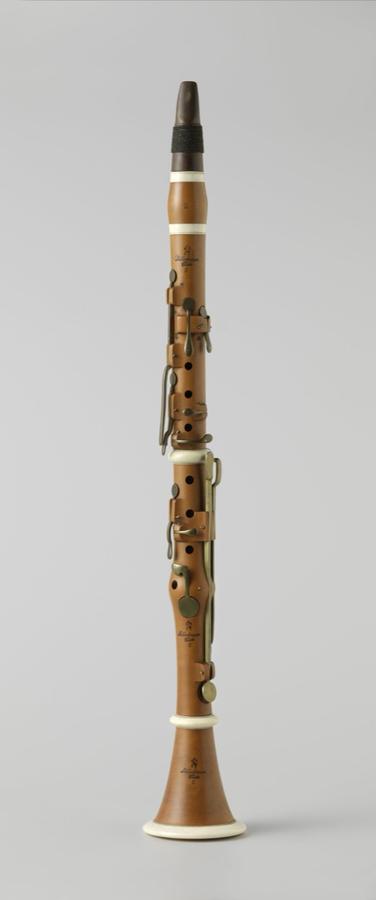
These 12 photographs span 18–1905, 12 places of origin and 2 museums. Every photograph is public domain or openly licensed, and links to the museum’s own record.
-
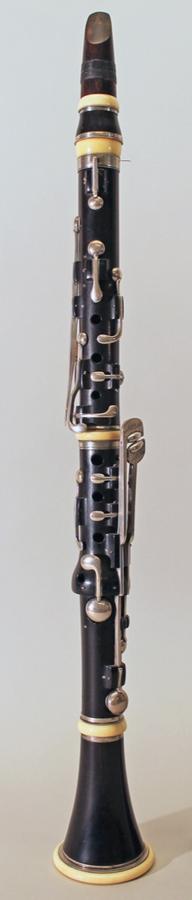
Clarinet in Cca. 1845 · American (United States) -
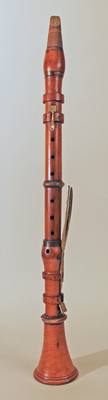
Clarinet in Csecond half of 18th century · probably German (Switzerland?) -
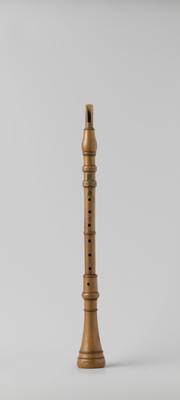
Clarinetc. 1750 · Leipzig -
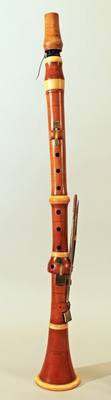
Clarinet in Cca. 1800 · British (United Kingdom) -
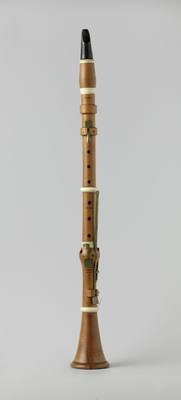
Clarinetc. 1800 · Leiden -
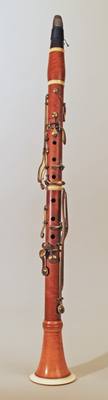
Clarinet in A19th century · Belgian (Belgium) -
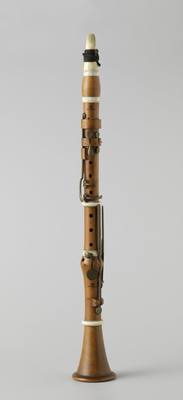
Clarinetc. 1825 · Neukirchen -
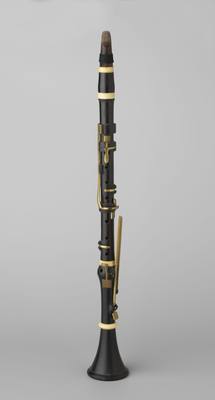
Clarinetc. 1830 · Copenhagen (city) -
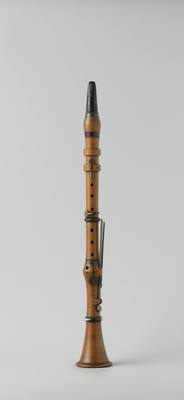
Clarinetc. 1835 · Groningen (stad) -
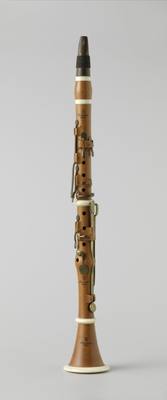
Clarinetc. 1840 · Fulda -
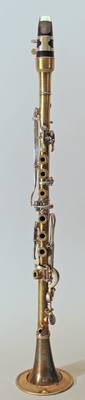
Clarinet in E-flatca. 1855 · Austrian (Austria) -

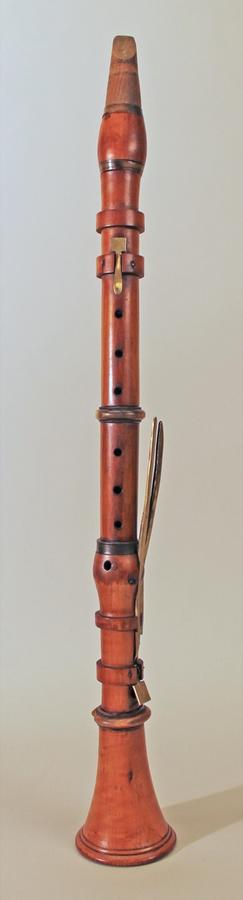
Clarinet in B-flatca. 1900–1915 · French (France)

Facts at a glance
| Hornbostel–Sachs number | 422.211.2-71 — Single-reeded aerophone with keys |
|---|---|
| Hornbostel–Sachs group | Aerophones › Non-free aerophones (wind instruments proper) › Reed aerophones |
| Classification (Wikipedia infobox) | Single-reed |
| Wikidata labels | 113 languages |
| Wikipedia article | Clarinet |
| Wikidata item | Q8343 |
| Wikimedia Commons category | Clarinets |
| MusicBrainz instrument | 08028095-6dae-4fe0-9f34-284fde19f29b |
| Encyclopaedia Britannica | art/clarinet |
| Audio sample (Wikimedia Commons) | Wolfgang Amadeus Mozart - Klarinettenkonzert A-Dur - 2. Adagio.ogg |
Sources: Wikidata (CC0 1.0) — classification number, aliases, identifiers (dump of 2026-07-22); Wikipedia (CC BY-SA 4.0) — infobox fields (description of the classification number, development, inventors) and the names of the Hornbostel–Sachs groups (article “Hornbostel–Sachs”, revision of 2026-01-04).
The name in other languages
| Language | Name | Also written |
|---|---|---|
| English | clarinet | |
| French | clarinette | |
| German | Klarinette | |
| Spanish | clarinete | |
| Italian | clarinetto | |
| Portuguese | clarinete | |
| Dutch | klarinet | |
| Russian | кларнет | |
| Japanese | クラリネット | |
| Chinese | 單簧管 | 豎笛, 竖笛 |
| Korean | 클라리넷 | |
| Arabic | يَراعة | ماصول, كلارينيت, كلارينت |
Sources: Wikidata (CC0 1.0) — labels and aliases; MusicBrainz (CC0 1.0) — instrument aliases (names only).
About the clarinet: history, construction and playing
The clarinet is a single-reed musical instrument in the woodwind family, with a nearly cylindrical bore and a flared bell.
Clarinets comprise a family of instruments of differing sizes and pitches. The clarinet family is the largest woodwind family, ranging from the BB♭ contrabass to the A♭ piccolo. The B♭ soprano clarinet is the most common type, and is the instrument usually indicated by the word "clarinet".
German instrument maker Johann Christoph Denner is generally credited with inventing the clarinet sometime around 1700 by adding a register key to the chalumeau, an earlier single-reed instrument. Over time, additional keywork and airtight pads were added to improve the tone and playability. Today the clarinet is a standard fixture of the orchestra and concert band and is used in classical music, military bands, klezmer, jazz, and other styles.
Etymology
The word "clarinet" may have entered the English language via the French clarinette (the feminine diminutive of Old French clarin), or from Provençal clarin ‘oboe’, originating from the Latin root clarus ‘clear’. The word is related to Middle English clarion, a type of trumpet, the name of which derives from the same root.
The earliest mention of the word "clarinette" being used for the instrument dates to a 1710 order placed by the Duke of Gronsfeld for two instruments made by Jacob Denner. The English form "clarinet" is found as early as 1733, and the now-archaic "clarionet" appears from 1784 until the early 20th century.
A person who plays the clarinet is called a clarinetist (in North American English), a clarinettist (in British English), or simply a clarinet player.
Development
The modern clarinet developed from a Baroque instrument called the chalumeau. This instrument was similar to a recorder, but with a single-reed mouthpiece and a cylindrical bore. Lacking a register key, it was played mainly in its fundamental register, with a limited range of about one and a half octaves. It had eight finger holes, like a recorder, and a written pitch range from F3 to G4. At this time, contrary to modern practice, the reed was placed in contact with the upper lip. Around the beginning of the 18th century the German instrument maker Johann Christoph Denner (or possibly his son Jacob Denner) equipped a chalumeau in the alto register with two keys, one of which enabled access to a higher register. This second register did not begin an octave above the first, as with other woodwind instruments, but started an octave and a perfect fifth higher than the first. A second key, at the top, extended the range of the first register to A4 and, together with the register key, to B♭4. Later, Denner lengthened the bell and provided it with a third key to extend the pitch range down to E3.
After Denner's innovations, other makers added keys to improve tuning and facilitate fingerings and the chalumeau fell into disuse. The clarinet of the Classical period, as used by Mozart, typically had five keys. Mozart suggested extending the clarinet downwards by four semitones to C3, which resulted in the basset clarinet that was about 18 cm longer, made first by Theodor Lotz. In 1791 Mozart composed the Concerto for Clarinet and Orchestra in A major for this instrument, with passages ranging down to C3. By the time of Beethoven (c. 1780–1820), the clarinet was a fixed member in the orchestra.
Acoustics
The clarinet's cylindrical bore is the main reason for its distinctive timbre, which varies between the three main registers (the chalumeau, clarion, and altissimo). The A and B♭ clarinets have nearly the same bore and nearly identical tonal quality, although the A typically has a slightly warmer sound. The tone of the E♭ clarinet is brighter and can be heard through loud orchestral textures. The bass clarinet has a characteristically deep, mellow sound, and the alto clarinet sounds similar to the bass, though not as dark.
The production of sound by a clarinet follows these steps:
Materials
Clarinet bodies have been made from a variety of materials including wood, plastic, hard rubber or Ebonite, metal, and ivory. The vast majority of wooden clarinets are made from African blackwood (grenadilla), or, more uncommonly, Honduran rosewood, cocobolo, or mopane. Historically other woods, particularly boxwood and ebony, were used. Since the mid-20th century, clarinets (particularly student or band models) are also made from plastics, such as acrylonitrile butadiene styrene (ABS). One of the first such blends of plastic was Resonite, a term originally trademarked by Selmer. The Greenline model by Buffet Crampon is made from a composite of resin and the African blackwood powder left over from the manufacture of wooden clarinets. Metal soprano clarinets were popular in the late 19th century, particularly for military use. Metal is still used for the bodies of some contra-alto and contrabass clarinets and the necks and bells of nearly all alto and larger clarinets.
Mouthpieces are generally made of hard rubber, although some inexpensive mouthpieces may be made of plastic. Other materials such as glass, wood, ivory, and metal have also been used. Ligatures are often made of metal and tightened using one or more adjustment screws; other materials include plastic, string, or fabric.
Reed
The clarinet uses a single reed made from the cane of Arundo donax. Reeds may also be manufactured from synthetic materials. The ligature fastens the reed to the mouthpiece. When air is blown through the opening between the reed and the mouthpiece facing, the reed vibrates and produces the clarinet's sound.
Most players buy manufactured reeds, although many make adjustments to these reeds, and some make their own reeds from cane "blanks". Reeds come in varying degrees of hardness, generally indicated on a scale from one (soft) through five (hard). This numbering system is not standardized—reeds with the same number often vary in hardness across manufacturers and models. Reed and mouthpiece characteristics work together to determine ease of playability and tonal characteristics.
Components
The reed is attached to the mouthpiece by the ligature, and the top half-inch or so of this assembly is held in the player's mouth. In the past, string was used to bind the reed to the mouthpiece. The formation of the mouth around the mouthpiece and reed is called the embouchure. The reed is on the underside of the mouthpiece, pressing against the player's lower lip, while the top teeth normally contact the top of the mouthpiece (some players roll the upper lip under the top teeth to form what is called a 'double-lip' embouchure). Adjustments in the strength and shape of the embouchure change the tone and intonation. Players sometimes relieve the pressure on the upper teeth and inner lower lip by attaching a pad to the top of the mouthpiece or putting temporary cushioning on the lower teeth.
The mouthpiece attaches to the barrel. Tuning can be adjusted by using barrels of varying lengths or by pulling out the barrel to increase the instrument's length. On basset horns and lower clarinets, there is a curved metal neck instead of a barrel.
The main body of most clarinets has an upper joint, whose mechanism is mostly operated by the left hand, and a lower joint, mostly operated by the right hand. Some clarinets have a one-piece body. The modern soprano clarinet has numerous tone holes—seven are covered with the fingertips and the rest are operated using a set of 17 keys. The most common system of keys was named the Boehm system by its designer Hyacinthe Klosé after flute designer Theobald Boehm, but it is not the same as the Boehm system used on flutes. The other main key system is the Oehler system, which is used mostly in Germany and Austria. The related Albert system is used by some jazz, klezmer, and eastern European folk musicians. The Albert and Oehler systems are both based on the early Mueller system.
The cluster of keys at the bottom of the upper joint (protruding slightly beyond the cork of the joint) are known as the trill keys and are operated by the right hand. The entire weight of the smaller clarinets is supported by the right thumb behind the lower joint on what is called the thumb rest. Larger clarinets are supported with a neck strap or a floor peg.
Clarinet family and ranges
Clarinets have the largest pitch range of common woodwinds. The range of a clarinet is usually divided into three registers. The low chalumeau register extends from the notated E3 (C3 if available) to the notated B♭4. The middle clarion register covers a little more than an octave (from the written B4 to C6). The high altissimo register consists of the notes above it. The three registers have characteristically different sounds: the chalumeau is full and dark, the clarion register is brighter and sweet, like a high trumpet from a distance, and the altissimo can be piercing and sometimes shrill.
Initially only C clarinets were available, but soon clarinets in B♭ and A and the basset horn in F and G were developed. From the 19th century to the middle of the 20th century, an extensive family of clarinets developed, from high A♭ to subcontrabass. Apart from the clarinets tuned in C (C soprano clarinet and basset clarinet in C), all clarinets are transposing instruments. The instruments above the C clarinet sound higher than notated, such as the aforementioned A♭ clarinet a sixth higher, the longer instruments sound lower, such as the B♭ clarinet by one tone and the B♭ contrabass clarinet by two octaves and one tone.
Performance practice
The modern orchestra frequently includes two clarinetists, each usually equipped with a B♭ and an A clarinet, and clarinet parts commonly alternate between the instruments. The standard of using soprano clarinets in B♭ and A has to do partly with the history of the instrument and partly with acoustics and aesthetics. Before about 1800, due to the lack of airtight pads, practical woodwinds could have only a few keys. The low (chalumeau) register of the clarinet spans a twelfth (an octave plus a perfect fifth) before overblowing, so the clarinet needs keys/holes to produce all nineteen notes in this range. This involves more keywork than on instruments that "overblow" at the octave—oboes, flutes, bassoons, and saxophones need only twelve notes before overblowing. Since clarinets with few keys cannot play chromatically, they are limited to playing in closely related keys. With the advent of airtight pads and improved key technology, more keys were added to woodwinds and the need for clarinets in multiple keys was reduced. The use of instruments in C, B♭, and A persisted, with each used as specified by the composer.
Source: Wikipedia, “Clarinet” — CC BY-SA 4.0 — text excerpted as published (references, images and tables removed); see the article for the full text and the list of authors. Revision of 2026-06-27.
From Grove’s Dictionary (1900)
CLARINET or CLARIONET (Fr. Clarinette, Ger. Klarinette, Ital. Clarinetto). An instrument of 4-foot tone, with a single reed and smooth quality, commonly said to have been invented about the year 1690, by Johann Christopher Denner, at Nuremberg. Mr. W. Chappell is however of opinion that he can trace the instrument back to mediæval times as the shawm, schalm, or schalmuse (Hist, of Music, i. 264).
The present name, in both forms, is evidently a diminutive of Clarino, the Italian for trumpet, and Clarion the English equivalent, to which its tone has some similarity.
Since its first invention it has been successively improved by Stadler of Vienna, Iwan Muller, Klosé, and others. The last-named musician (1843) completely reorganised the fingering of the instrument, on the system commonly called after Boehm, which is also applied to the flute, oboe, and bassoon. A general description of the older and more usual form will be given. It may however be remarked here, that Boehm or Klosé's fingering is hardly so well adapted to this as to the octave scaled instruments. It certainly removes some difficulties, but at the expense of greatly increased complication of mechanism, and liability to get out of order.
Source: Wikisource, A Dictionary of Music and Musicians (Grove, 1900) — “Clarinet” (entry by William H. Stone) — Public domain (published 1879–1910; authors died before 1929) — the first paragraphs of the entry, as transcribed; see the page for the full entry.
Composers who played it
89 composers on this site list the clarinet as an instrument they played. A selection:
- John Adams 1947–
- John Mahon 1749–1834
- Michèl Yost 1754–1786
- Frédéric Blasius 1758–1829
- Carl Andreas Göpfert 1768–1818
- Johann Georg Heinrich Backofen 1768–1830
- Bernhard Crusell 1775–1838
- Heinrich Baermann 1784–1847
- Iwan Müller 1786–1854
- Franz Wilhelm Ferling 1796–1874
- Ernesto Cavallini 1807–1874
- Hyacinthe Klosé 1808–1880
Composers with a page on this site whose Wikidata record lists this instrument; featured and best-dated first. Data: Wikidata (property “instrument”, P1303), CC0 1.0.
Sources and licences
- Clarinet in C, Graves & Company, ca. 1845, American (United States). Grenadilla, ivory, silver. Purchase, Gift of Barnard College, by exchange, 1997 (1997.55.1, .2). Museum record · CC0 1.0 (public domain dedication)
- Clarinet in C, second half of 18th century, probably German (Switzerland?). Boxwood, brass, horn. The Crosby Brown Collection of Musical Instruments, 1889 (89.4.900). Museum record · CC0 1.0 (public domain dedication)
- Clarinet, Gottlieb Crone, c. 1750, Leipzig. brass (alloy), boxwood (hardwood). Purchased with the support of the State of the Netherlands and the Vereeniging van Noord-Nederlandsche Muziekgeschiedenis. Museum record · Public Domain Mark 1.0
- Clarinet in C, George Goulding Co., ca. 1800, British (United Kingdom). Boxwood, ivory, brass. Gift of William J. Maynard, 1997 (1997.219.2). Museum record · CC0 1.0 (public domain dedication)
- Clarinet, Hijd van den Horn, c. 1800, Leiden. ebony (wood), ivory, boxwood (hardwood), brass (alloy). Rijksmuseum, Amsterdam. Museum record · Public Domain Mark 1.0
- Clarinet in A, Louis Auguste Giboreau, 19th century, Belgian (Belgium). Boxwood, brass, ivory, ebony. The Crosby Brown Collection of Musical Instruments, 1889 (89.4.897). Museum record · CC0 1.0 (public domain dedication)
- Clarinet, G. Schüster, c. 1825, Neukirchen. brass (alloy), ivory, boxwood (hardwood). Purchased with the support of the State of the Netherlands and the Vereeniging van Noord-Nederlandsche Muziekgeschiedenis. Museum record · Public Domain Mark 1.0
- Clarinet, Jacob Georg Larshof, c. 1830, Copenhagen (city). brass (alloy), ebony (wood), ivory. Gift of Elly Lammers and Gerrit van der Veer, Lelystad. Museum record · Public Domain Mark 1.0
- Clarinet, Johannes Theodorus Otté, c. 1835, Groningen (stad). granadilla wood, horn (animal material), boxwood (hardwood), brass (alloy). Purchased with the support of the State of the Netherlands and the Vereeniging van Noord-Nederlandsche Muziekgeschiedenis. Museum record · Public Domain Mark 1.0
- Clarinet, Johann Andreas Mollenhauer, c. 1840, Fulda. brass (alloy), boxwood (hardwood), ivory. Purchased with the support of the State of the Netherlands and the Vereeniging van Noord-Nederlandsche Muziekgeschiedenis. Museum record · Public Domain Mark 1.0
- Clarinet in E-flat, C. H. Sulz, ca. 1855, Austrian (Austria). Brass, nickel-silver. The Crosby Brown Collection of Musical Instruments, 1889 (89.4.1302). Museum record · CC0 1.0 (public domain dedication)
- Clarinet in B-flat, Gautrot aîné, ca. 1900–1915, French (France). various materials. The Crosby Brown Collection of Musical Instruments, 1889 (89.4.2349). Museum record · CC0 1.0 (public domain dedication)
Photographs: open-access collections of the museums named above; each is shown here reduced in size, otherwise unchanged. Text: Wikipedia (CC BY-SA 4.0), Grove’s Dictionary (public domain), Wikidata and MusicBrainz (CC0). The full list of sources and licences is on the credits page.